Hot off the presses, a brand-new episode of Jiz: the bizarre, hilarious, raunchily dubbed version of 80s cartoon Jem and the Holograms. Where the original theme song was “Exciting adventures, fashion and fame / Once you’re a Jem girl, you’re never the same,” the Jiz refrain goes something like: “Trannies and drag queens doing cocaine / Once you’re a Jiz whore you’re never the same.” And that about sums it up.
So here it is: the Jiz drug special. “I know what you’re thinking,” writes Jiz creator Sienna D’Enema. “Isn’t every episode a drug episode? Seriously though, Jiz gets cut off from her Electronic Drug Dealer. Witness her descent into madness.”
If this is your first exposure to Jiz, check out some of the older episodes, starting with the canonical Abortion Episode, in which Jiz is pro-choice. Really, really pro-choice:
In 1940, Disney released Fantasia; an epic animated film consisting of several shorts set to classical pieces. If you haven’t seen it, it’s perfect for the holidays. There are fairies and unicorns and dancing mushrooms.
And, of course, Fantasia includes the Pastoral Symphony. As a child, I was happily unaware of the heteronormative, gender essentialist overtones of this piece. I was just excited to see all the centaur boobs and watch the fashion show unfold. Multicolored centaurettes wearing hats made from lotus flowers, birch bark and even live white doves. Exotic mythical creatures lazing around all day, spending the beautiful sunset hours eating grapes, swinging on giant swings, and bathing by the waterfall. It was just lovely. Looking back, it’s clear how ridiculous the whole thing was. A post at Nectarade provides a hilarious, pitch-perfect overview (click through to the site, it’s better with pictures):
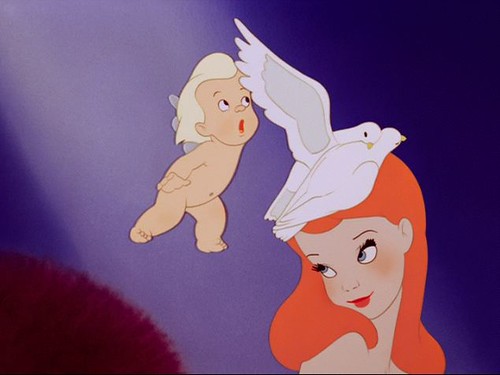
There’s a centaur meetup and the ladies are “dressing up” so it’s not so obvious they’re all clones of each other in different colors. The males are also clonic, but they don’t give a shit about looking alike because they’re there for the mare pussy (well, that sounded funny). Also, there are some weird “little cherubs” playing as sassy gay friends of the girls, matchmakers, makeover artists, and creepy voyeurs. My first reaction: “Why are there cherubs in Olympus, anyway? I suppose they’re sort of little cupids without the bow and arrows, but it’s still fucking weird.” I did my homework, and those things are called putto (plural: putti) . Oh, okay, it makes sense artistically then. It’s still weird because they’re little creepers in this movie, but I’ve learned something new today!
…meanwhile, the clonic Ken doll centaurs get their own catwalk show from which they pick the girl they want to fuck senseless take to the prom. I don’t know if it’s racism or narcissism or fashion taken to the extreme, but I can’t help but notice that all the pairings have similar color palettes. Red/pink/brown/yellow goes with red/pink/brown/yellow, blue/purple goes with blue/purple. That’s very disappointing. You can also tell how much the couples want to have sex as soon as possible, but they can’t because there are little kids watching (and depraved putti stalking them).
Seriously, they have to settle with a lot of second-base touching and inane activities such as playing in swings and eating grapes and just hang out, sitting here consumed with lust for the rest of the evening. But OH NOES!! EMERGENCY!!! DISASTER!!! ONE OF THE CENTAURS IS ALONE! Don’t worry, guys! There’s a centauride who’s also alone! And in the same color scheme! We’re saved! How convenient that there was the same amount of boys and girls! So our team of putti, like fanbrats who feel compelled to pair every character up in the bad fanfiction they write, set them to a date by playing their phallic flute-trumpets. Thankfully, our two dorks liked each other and were actually the ones with less libido. Actually, they’re quite sweet and old-fashioned, and I’m glad for them. I mean, as happy as it can be since the putti are still stalking like Edward Cullen in Bella Swan’s period days, and even when they drop the curtain (literally) they’re still peeking over the centaurs. Eww, GTFO!
The above review of Pastoral Symphony was pretty complete… except, HELLO, WHAT’S THIS:
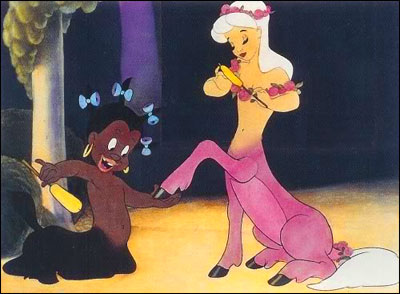
That’s right. Disney originally included a character named Sunflower – a half-donkey, half black girl servant figure who polished hoofs, brushed/decorated tails, and carried garlands for the centaurettes. It’s not surprising that Nectarade didn’t catch them; the scenes haven’t appeared on any release of Fantasia since the 1960s, and are hard to come by in high quality. Most versions on YouTube look like they were taped off a television. Here is the best-quality collection of all censored scenes. Sister Suffragette adds, “there’s also the possibility that there are more Sunflowers; the movie shows Sunflower with a couple different hair styles which could mean that they actually represent several servant/slave half-asses. It’s hard to tell, though, because the difference in hair style is the only distinguishing feature … of course she was happily shining the hoofs and fixing the tails of the non-black centaurs and there’s not even any thought or explanation given as to why she’s the only one that doesn’t meet a mate by the end of the segment. The others females are chosen by the males who picked them out of the lot after the females paraded and posed in front of the males.”
The real kicker is that, according to severalsources, Disney adamantly denied that Sunflower even existed up until somebody finally dug up the footage and put it on the internet (despite the fact that you can find her chowin’ down on watermelon, in stereotypical fashion, in the Fantasia cut-out book. Perhaps Disney was counting on the fact that it’s solidly out of print).
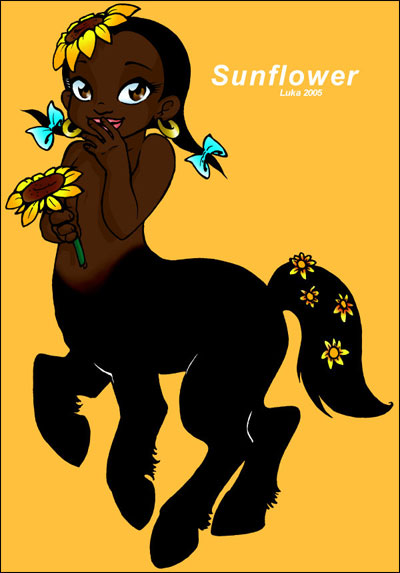
Recently, artists have been reclaiming and re-imagining Sunflower, so perhaps there’s a silver lining to all of this (as an aside, people are also reimagining some of the other Fantasia nubile centaurettes in a very – how shall I put this – non-heteronormative, non-monogamous way. Thanks, Rule 34. Thanks, Internet). People are imagining Sunflower (or Sunflowers) as a strong, confident young girl. Or a self-aware, independent woman. Or even painting her as a servant, but with much more emotion and character. If Disney won’t make this right, the people will. More remixes of Sunflower, after the jump.
Sunflower by AtomicFireball: “This is not a fanart. It’s a little wishful thinking of my own. This is my Sunflower, who never served a mistress.”
I’ve been dreading this, the moment when one of my overseers decreed a theme week. Finding items of interest on the internet is one thing, but I never do well when sent to find a specific thing. It could be some sort of blogging performance anxiety. Set with a specific task I am so preoccupied with getting a superlative result that in the end the whole experience arrives limp and unsatisfying to all involved. It’s terrible. It is with that in mind, then, that I submit to you this search result, extracted from YouTube in a fit of panicked desperation; a video clip of Harry Potter making out with a female centaur while, I believe, Hitler looks on from a hiding place behind a dresser, done in The Sims. Believe me when I say that I am just as disappointed in me as you are.
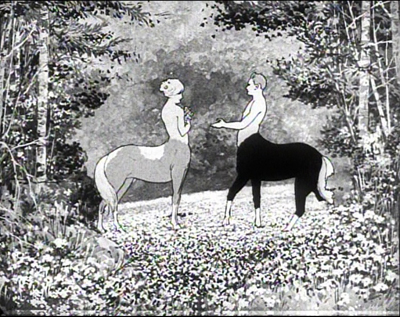
The advent of animated features and silent films remains one of the most significant accomplishments of the 20th century. Sadly, before celluloid preservation standards were set in place, much of the early studio output of the 1920s was lost or damaged beyond repair. One of those pieces is an animated film, The Centaurs, produced by Windsor McCay in 1921. Of the sole print, which disintegrated due to negligent storage, only about 90 seconds have been salvaged.
The animation style is quite beautiful, very influenced by the Art Nouveau motifs of the times, recalling Jugendstil illustrations, like this one, in particular.
There is no solid indication available anywhere about McCay’s original intentions for the feature. Was there to be a plot, or did he mean for it to be a romantic, picturesque montage of frolicking centaurs? (Nothing wrong with the latter.) At least we have this little bit to enjoy.
When I initially saw Nadya’s “Hot Human-on-Centaur Action” post in drafts, I just assumed she’d beat me to the punch with this gloriously (and mysteriously) perverted silliness:
Via Douglas, with thanks. And a vague, yet all-pervading sense of awe.
How delightful to realize, no! Apparently, there’s just some redolently centauromachian vapor riding the air currents right now.
PROTEIGON, created by Steven Briand and Luca Fiore (with some help) during a two month internship at a production company called Partizan, is one of those pieces that worms its way into your brain more because of the “how” and not so much the finished product. Which is not to say that it isn’t good, because it is. Set to a thumping, bass-heavy track, it is entertaining, but what has me watching multiple times is trying to understand what must have gone into making that piece of paper go through all those various contortions. I can only hope that they release some behind-the-scenes footage at some point.
I honestly have no idea what exactly is going on in this video for the Fleet Fox’s “The Shrine/An Argument. It seems to tell of the life and death of an ultra-violent deer who seems to have a tiny fish person living inside it. Or something. No doubt, there is dense symbolism and metaphor involved here but honestly, I’m not sure if decoding it is really a priority, especially when it’s so beautiful. Director Sean Pecknold, who also animated it along with Britta Johnson, films the characters, designed by Stacey Rozich (whose style reminds me a bit of Andy Kehoe), heavily vignetted which, combined with the paper doll quality to the animation, gives it strange, dreamlike quality. It also gives the impression of being far older than it actually is, like you’re watching something by Lotte Reiniger. The whole thing is simply mesmerizing.
Good morning! On this day in 1965, in Reykjavík, Iceland, a strange and delightful being called Björk Guðmundsdóttir was born. Or hatched out of a pod. Or was ejected from a volcano. Or something. Whatever.
Anyhoo… 46 years later, she’s still brimming with vim, vigor, and weirdness. Coilhouse has compiled a massive YouTube playlist of her music videos to honor the occasion of her whelping, and hopefully help you to wake your ass up on this glacially chilly November morn.
ROSA is, perhaps, not the most original short film ever and, in fact, it does feature a healthy dose of post-Matrix kung-fuery, but that makes it no less impressive. Made by one man, Spanish comic artist Jesús Orellana, for $100 and a year of his life, ROSA tells the story of a cyborg who, as part of a project to restart Earth’s ecosystem, awakens in a post-apocalyptic with no natural life, only other cyborgs who seem intent on destroying Rosa. Again, there’s a lot of slow motion jumping and martial arts pat-a-cake, and the characters themselves are a bit stiff at times, but the fact that one person was able to produce something of this scale is impressive. Orellana has, apparently, already been approached by some studio types so it’s quite possible that we may be seeing much more of Rosa in the future.