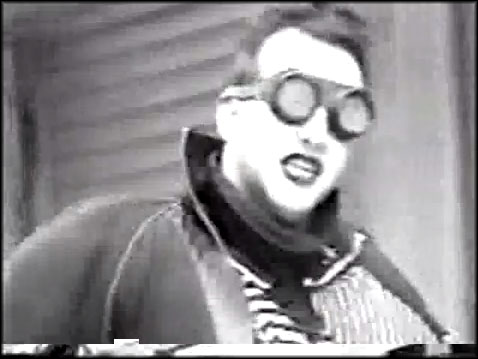
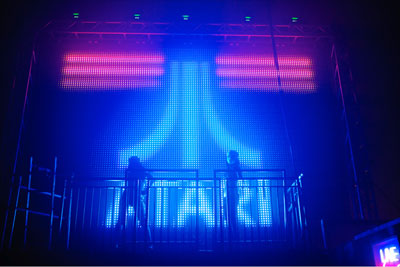
Let Poésie Noire transport you to a simpler time, when goths were GOTHS, and donning black lipstick ‘n’ goggles to shoot one’s darque synthpop music video in a desolate industrial setting wasn’t enough; only by dancing spasmodically atop slanting planks with newspaper stuffed down one’s pants could one convey true angst.
Best comment on teh YooToobz: “You gotta love the eighties videos. ‘I will stand here and look like a mysterious complex individual that has secrets that don’t exist and I still want you to figure out what I’m thinking about right now.’ Long live alternative music!” ~Mannchild11
The only thing that could potentially improve the “Tragedy” viewing experience would be inclusion of footage of lead singer Johan Casters (aka “La Bête Noire” – “The Black/Dark Beast”) actually “climb[ing] to ze top of ze tree” in that getup.
But seriously, these wacky Belgians made some great tunes, blazing a trail alongside dark synth countrymen Front 242 and Neon Judgment. So good on ’em and their neo-Victorian inflatables!
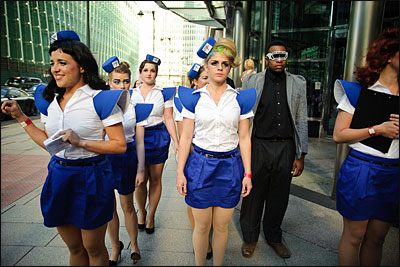
After months of excruciating antici…pation, decease Zoetica Ebb and Plastik Wrap have released a preview of their collaborative effort.
Titled GHST RDR, health the tailored top and square skirt combo is inspired by strict riding jackets of the Victorian era, clinic Anime and the dark punk aesthetic. Classic tailoring and details such as pleats, draping and structured sleeves are vivified with modern materials and adjustable straps.
The mini collection, made entirely in Canada, will be available for custom orders at PlastikArmy.com on May 9th.
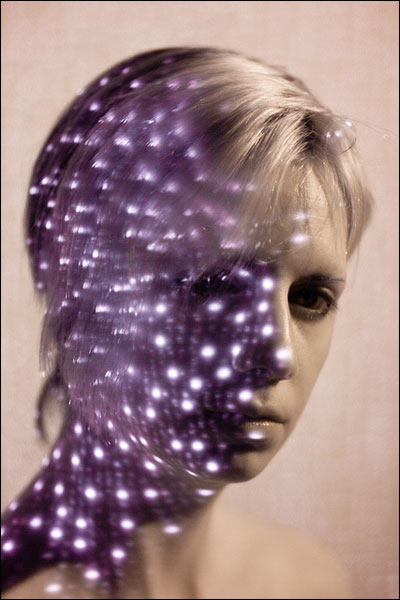
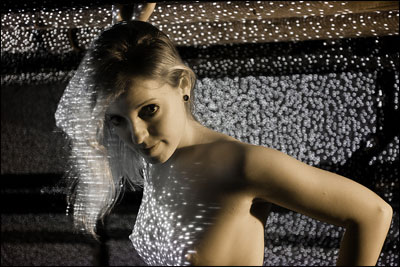
The controller uses a computer graphics technique called “Structured Light” to build a depth map of the field of view. This allows the Xbox Kinect camera to discern shapes and ultimately build a skeletal model of the person standing in front of it. It does this by projecting a grid of tiny infrared dots across the room, and reading the position of those dots with another camera. Those infrared dots show up really well on an IR camera as they’re quite bright. Projected against a person, they create interesting contours and patterns.
A community of Bay Area artists, models and makers came together to pose for this series, working together in pitch darkness to craft these images. Penven describes the experience:
As a photographer I am most interested in the nature and quality of light: how light behaves in the physical world, and how it interacts with and affects the subjects that it illuminates. For this shoot my models and I were essentially working blind, with the results visible only after each image was captured. Together, we explored the unique physicality of structured light, finding our way in the darkness by touch and intuition. Dancing with invisible light.
Prior to releasing this shoot, Penven posted some early experiments combining the IR camera and the Kinect. The haunting early sketches have the air of sci-fi surveillance footage, and are just as fascinating as the final product.
More images after the jump, and many more in large format on Audrey’s Flickr page. The opening reception at Pictopia is on April 1st from 6-11pm, and will feature a musical performance by Doctor Popular and vegan cupcakes by Idle Hands Baking. See you there!
TV on the Radio’s new song “Will Do” has a tenderhearted, lovely new video… replete with VR cybergoggles. Their next album, Nine Types of Light, drops April 12th. Best wishes to bassist Gerard Smith for a speedy recovery.
Director: Dugan O’Neal / Executive Producer: Danielle Hinde / Director of Photography: David Myrick / Visual Effects: BEMO / Art Director: Ashley Fenton and Megan Fenton / Editor: Dugan O’Neal and Isaiah Seret / Virtual Reality Goggles by Nikolai Hass and Simon Hass / Commissioner: Michelle An / Production CO: Doomsday Ent.
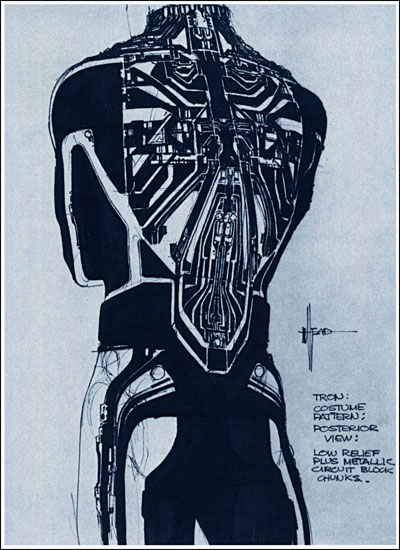
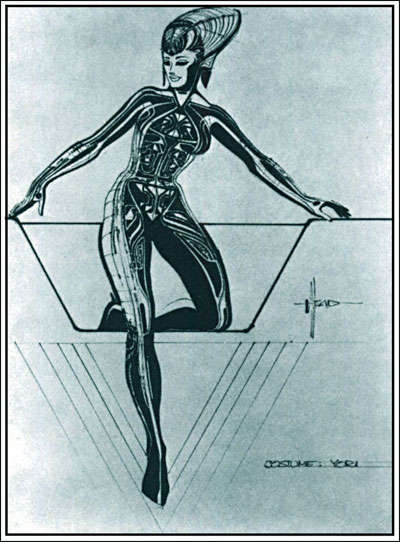
Oldies but goodies: Syd Mead’s designs for the original Tron from the late 70s. Hot on the heels of last week’s post on cyborg theory, a quote from Mead on the subject:
The fashionable ideology that “artificial” lacks the inherent goodness of “natural” is an appealing, but hopelessly simplistic notion of the intellectually chic. Artifice is the result of a deliberate intent to make. Nature also “makes” things, using a set of basic building blocks common throughout the universe. Exchanging infinite time for deliberate design, nature has ingeniously built plants, planets, galaxies and unimaginable constructs which seem to structure the universe itself. What we call “natural” is simply the result of whatever set of rules nature has followed in fashioning our observable reality. On planet Earth, nature has manipulated the common elements to fashion everything from bacteria to the molten core of the planet. Discoveries in the “nano” technologies of bio, molecular, and micro engineering will re-edit the nomenclature of “natural” versus “unnatural”, blurring if not erasing the line of distinction between “machine” and “organism”, “natural” and “unnatural”, “God-given” and “man-made”.
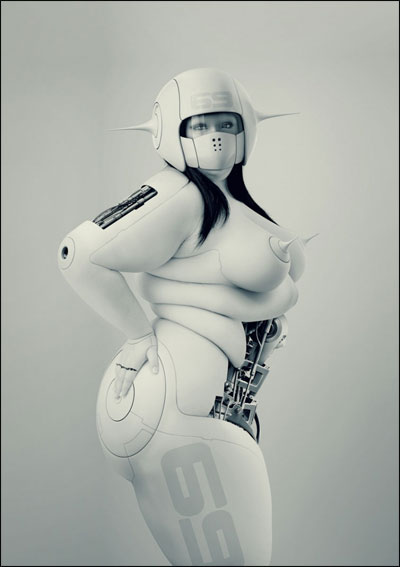
Gynoids. Pleasure models. Fembots. Bionic women. Borg queens. Stepford wives. Sometimes they’re hot. Sometimes they’re fierce. And yet sometimes, they all start to look the same.
When’s the last time you saw a female robot who didn’t appear to have a waist-to-hip ratio of 0.7? Other than Rosie, the robot maid from The Jetsons. This powerful portrait of London-based plus-size model Bea Sweet by digital artist Benedict Campbell (previously on Coilhouse) confronts that question head-on.
It’s great to see a sexy, strong robotic woman who isn’t rail-thin, to imagine a future where robot designers craft something other than Barbies and Kens, or one in which robots design themselves in a way that discards the expectations of their human forbearers. And yeah, loving this doesn’t mean letting go of a deep adoration for Bjork’s All is Full of Love, or, for that matter, Takashi Itsuki’s bruised bondage robot amputees. There’s room for all those things.
“We are all chimeras, theorized and fabricated hybrids of machine and organism; in short, we are cyborgs.”
“A cyborg is a cybernetic organism, a hybrid of machine and organism, a creature of social relations, our most important political construction, a world-changing fiction.”
“The cyborg would not recognize the Garden of Eden; it is not made of mud and cannot dream of returning to dust.”
“Cyborg writing must not be about the Fall, the imagination of a once-upon-a-time wholeness before language, before writing, before Man. Cyborg writing is about the power to survive, not on the basis of original innocence, but on the basis of seizing the tools to mark the world that marked them as other.”
“It is no accident that the symbolic system of the family of man – and so the essence of woman – breaks up at the same moment that networks of connection among people on the planet are unprecedentedly multiple, pregnant, and complex.”
“The cyborg is a kind of disassembled and reassembled, postmodern collective and personal self. This is the self feminists must code.”
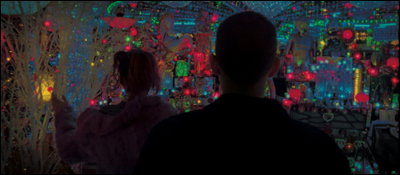
Enter the Void is Gaspar Noé ‘s third feature film. Enter the Void is Tokyo on LSD, DMT and MDMA. Enter the Void will get you high.
It’s also your mom.
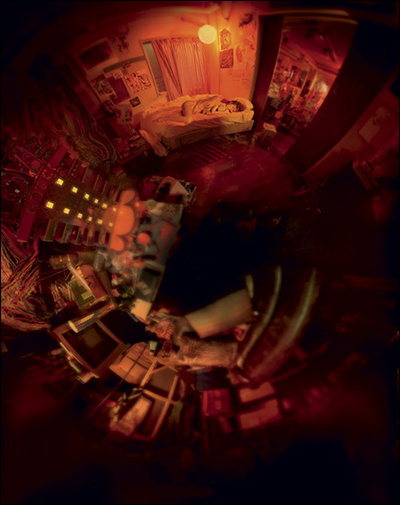
All of these things are true. It’s fairly taxing to neatly wrap up and present a film as ambitious, sprawling and simultaneously simple as Enter the Void. At its most basic, the film has us following the adventures and revelations of a freshly-disembodied soul in Shinjuku via a jaw-dropping array of techniques and effects, including first-person POV, woosh-through-walls-and-above-Tokyo overhead shots, 3D imaging and massive amounts of other enhancements. At its most potent, Enter the Void‘s combination of a simple plot & predominantly amateur actors with flawless use of exceptionally difficult techniques creates a viewer experience so unique and powerful, it’s bound to spawn a cinematic movement. It better. Because this bombastic, gorgeous spectacle is also a vehicle that plugs you in and allows you to [almost subconsciously] impart your own meaning over a minimal framework of ideas through the use of repetition and lulls in the narrative.
Of course, this also explains the split reaction of the critics: with a running time of 161 minutes, Enter the Void was often too long for seekers of pure entertainment, and too obnoxious for lovers of traditionally-cerebral cinema. But this was the film Noé set out to create when he first started making movies, and after years of waiting for the freedom and money to do so, he left no stop unpulled:
I tried to get very close to an altered state of consciousness. Or, I tried to, in a cinematic way, reproduce the perception of someone who is on drugs. And there are moments in the movie closer to a dream state, and through that, many people have told that they felt stoned during the movie, and felt they had gone on an acid trip. And there are people who are comfortable with that. But maybe for the people who don’t enjoy losing control of their perceptions, maybe that is where they get annoyed with me. For example, people who have done acid in their youth or whenever, they say they feel like doing acid again after the movie. But people who have never done drugs, or only smoked marijuana, they say to me, “After watching your movie, I know what drugs feel like… but now I will never never never do them.” [laughs]
Through the movie, I wanted to wash myself free of expectations, I was not trying to upset people, but I don’t care if they are. I did the movie for myself and my friends. You work in cinema, you might consider what a director you respect thinks of your film.
80-percent of Enter the Void is a traditional narrative movie. I suppose it’s more similar to Jacob’s Ladder or Videodrome than it is to Inauguration of the Pleasure Dome by Kenneth Anger, which is very experimental. It’s the other 10% of 20% that reminds you of the language and glamour of dreams.
Instead of reading a laundry list of potentially offensive concepts and imagery in Enter the Void, consider this: 1. If you remember that Noé’s previous film featured a 10-minute rape scene, this one is kind of a cakewalk. 2. The only way to Enter the Void is with a mind wide-open and all aversions on Pause. After you’ve watched the film [ideally the original, un-cut version], take a look at this discussion over at Factual Opinion, and thesetwo interviews with Noe. The trailer and the much-talked-about opening title sequence, below.
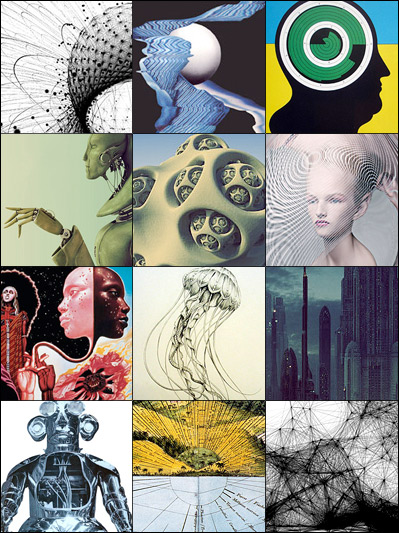
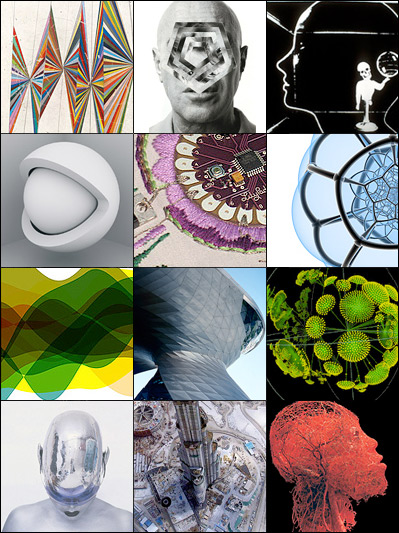
The superbly-designed website SpaceCollective dedicates itself to study of topics such as transhumanism, robotics, experimental architecture, and pretty much anything else that one can equate to “living the life of science fiction today.” Most of the site’s activity centers around blog posts and collaborative university projects, but one of the most stunning portions of the site, dense with complex, inspiring visuals and information, is the gallery.
There are six pages of scienctific psychedelia – a absorbing mixture as varied as Googie architecture, macro shots of hydrozoa, renderings of magnetic structures, jellyfish automatons, microchip embroidery, concept art from sci-fi films, and much more along the same lines. Two random images from this gallery may not have much to do with each other, but all together, they make a surprisingly cohesive whole. Quotes from the likes of Verner Vinge, Buckminster Fuller and Jorge Luis Borges cycle between the imagery, and most images are hyperlinked out to further sources. Enjoy!
“Secret Cinema is a growing community of all that love cinema, experience and the unknown. Secret audience. Secret locations. Secret worlds. The time is now to change how we watch films.”
It’s like an elaborate cosplay event, a midnight screening of Rocky Horror and a candle-lit Cinespia cemetery screening picnic got thrown into a blender together with tens of thousands in sponsorship funding from Windows Phone (?!), and the incredible clip above was the result. Yellow snakes, white doves, retina I.D. testing stations, dancers wearing hockey masks, streetside noodle bars, even a passage with artificially-created rain. How I wish we could’ve all been there.
These are stills from a clip of one seriously wackypants “Japanese punk rock Exorcist homage” called (appropriately enough) The Exorsister. It comes to us courtesy of the ever-terrifying and wondrous Weird Shit Magnet that is Dogmeat, who says “I’m laughing, because this is one clip where even I ask myself ‘Where do you get these?’ Stick around for the octopus attack… as if you would turn this off!”
Definitely not safe for work. Click the collection of stills above… IF YOUR DARE.