Lee Evil and Dougy Gyro
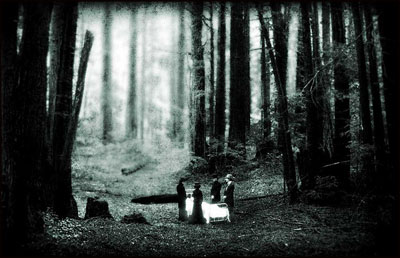
Lee Evil and Dougy Gyro in his “Nautilus” costume.

The tenth Edwardian Ball crept up upon us unawares, while we were still sleepy from holiday overeating and adjusting to our regular work schedules again. All of a sudden everyone seemed to say “This weekend? But I haven’t a costume!” And thus began the yearly scramble, with last-minute runs to the fabric store and safety pins carefully tucked away inside as-yet unfinished garments. The Edwardian Ball is one of those rare events where everyone–not just the performers and regulars–dons a costume. For some of us this means little more than our everyday wear, while others brainstorm for weeks.

Juggler
A contact juggler amongst the revelers.


Film courtesy of Syndicate of Human Image Traffickers.

All but her belly buried in the floor;
And the lewd trounce of a final muted beat!
We flee her spasm through a fleshless door…
Then you, the burlesque of our lust — and faith,
Lug us back lifeward — bone by infant bone.
– Hart Crane, “National Winter Garden,” (1930)

“Jo Boobs” Weldon is Headmistress of The New York School of Burlesque, whose home at The Slipper Room is just a few blocks from where Lydia Thompson’s “London Blondes” brought burlesque to America and a stone’s throw from where Minsky’s original National Winter Garden made burlesque part of the American vernacular. Minsky’s notoriously established Gypsy Rose Lee as an icon synonymous with striptease, and launched the careers of Abbott and Costello, Phil Silvers and Robert Alda before being closed in the name of public morality.


Houston Street Burlesque by Mabel Dwight (1928)

Is burlesque – a word which refers to turning things upside down – still able to subvert morals and mores? In a popular culture where the use of sexuality to sell consumer goods is banal, pornography of nearly every stripe is freely and instantly available, and sympathetic gay and lesbian characters are commonplace, is the self-conscious performance of gender merely campy fun or does it still have a liberating capacity? Can sex work, titillation, gender play and masturbation undermine heterosexual monogamy? Whose moralities and identities might they challenge?

Catherine MacKinnon argues that sexualized depictions of women in patriarchal societies reinforce misogyny to the point of constituting a form of violence. Do sexualized performances by women lead to their individual and collective debasement? Is stripping a phenomenon where women who appeal most to men are degraded whereas burlesque liberates women who stand outside the norms of beauty as prescribed by male desire? Considering stripping and prostitution, I ask whether everyone sells their bodies at every job? Further, when men pay a high premium to be with a woman or just to look at one, whose body is exploited? More specifically, does it make sense to import 20th century standards of judgment to a 21st century United States whose educational system produces more female post-graduates than male and whose career women earn 94.2% of the income of their male counterparts? Despite shifts in income and status, why do so few straight males study burlesque or work as strippers?

Jo Boobs and I met at the basement headquarters of her school on the coldest evening in recent years to explore questions of gender, activism, and whether she and her ilk are gender traitors or gender busters. She even stripped down to fighting gear for an intimate performance caught by our unblinking digital eyeball. (See above!) In June 2010, Jo will publish The Pocket Book of Burlesque (with a forward by Margaret Cho), a volume whose slender design can slip under the inspector’s prying gaze. The New York School of Burlesque is in sympathetic affiliation with Miss Indigo Blue’s Academy of Burlesque in Seattle and Michelle L’Amour’s Burlesque Finishing School in Chicago as well as programs in Washington, D.C and elsewhere. When will someone open a campus in Tehran?

COILHOUSE: How does burlesque differ from stripping?
JO BOOBS: To understand the difference, look at it from the audience’s point of view. If someone goes to a strip joint, they usually go in whenever they want, they pick the performer they want, they negotiate how they interact with them, they interact one-on-one, and they leave. When they go to a burlesque show, the show starts at a [predetermined] time, they pay a cover (not the performers), they watch the show, there isn’t usually any one-on-one interaction, and they leave when the performance is over.

Chances are good you’ve already heard tell of Mike from Milwaukee and his 70 minute long YouTube video review of The Phantom Menace. But have you actually taken the time to sit down and watch this vitriolic magnum opus?! I’m not gonna say “you haven’t lived” or anything, but this has got to be one of the funniest, most devastating blockbuster smackdowns in the history of cinema, let alone the internet.

Post-holiday depression can be a bitch. Let heathenish laughter cure what ails you, and pass the pizza rolls.

KVLTASFUCKTYPECASTMIX
“We remember it well now, our younger days, when we got the cassette deck for the car. The windows always rolled up, closing us off to the outside world. We moved steadily as things rolled by, always with the cassettes playing at the loudest possible volume.” [via]

Joshua Z-P (of Roadside Picnic Podcast and A Room Forever fame) and his friend Adam Helms were recently asked by Type Records (home to Svarte Greiner, Deaf Center, Grouper, and Koen Holtkamp, among other phenomenal bands) to compile a mix for their Typecast series. “So a mix we did – one of epic and biblical proportions which we now share with you. This isn’t your older brother’s black metal – there’s no Dungeons & Dragons posturing while wearing corpse paint. Just pure, brutal, lo-fi nihilism full of tape hiss and vinegar.”

LoFiBlackMetalCassettes copy
Cirrhus, Horrid Cross, Haxan.

All tracks were transferred from cassettes, save the Akitsa song. There’s Bone Awl and Ash Pool and freakin’ Ancestors and a bunch of even more obscure shit I don’t recognize at all. Holy balls, this mix is awesome. Sadly, the vast majority of our readers will find it unlistenable. So unless you enjoy making your eardrums hemorrhage with tinny, shrieking, blood-gargling KVLT AS FUCKNESS, please back away slowly from this post without making direct eye contact, and click here instead.

Tracklist after the jump.

See also:


Krautrock: The Rebirth Of Germany. Part 1 of 6. Parts 2-6 posted under the cut.

Produced for BBC Four, this excellent hour-long documentary offers an engaging and comprehensive overview of the 60s/70s experimental music scene in Germany that came to be known as Krautrock. Here’s a fascinating glimpse of what it meant to be part of a generation of radical young musicians, artists and filmmakers struggling to redefine themselves in the rubble of post-war Germany. These kids were drowning in a sea of Schlager pop and classical schmaltz– arguably the music of cultural guilt and denial. Meanwhile, they had the most horrifying historical specters imaginable hanging over their heads. They were isolated, rebellious, and deeply disinterested in “traditional” anthemic western guitar rock. The synthesizer was newly invented, and electronic music as we know it today didn’t really exist yet. They breathed life into its lungs.

Featuring the works of Popol Vuh, Amon Düül, Can, Cluster, Neu!, Tangerine Dream, Kraftwerk, Faust and others.

Sit down right now. I don’t care that mail has to be delivered. N- no, seriously, you can change that ink cartridge later. Ju- just, shhhhhhut up. Shut up and sit down, because it’s FAM Time.

Today’s very special FAM is Shinya Tsukamoto’s unmatched 1989 cyberpunk film Tetsuo: The Iron Man. To explain this movie can only be done in the very simplest of terms: The man (or The Metal Fetishist) sticks an iron bar into a wound he has made in his leg. Soon it is festering with maggots. He runs, screaming into the street and is hit by a car, driven by the Japanese Salaryman who decides to hide his crime by dumping the body in a ravine. What follows is one of cinema’s more bizarre experiences as the Japanes Salaryman, haunted by the spirit of the Metal Fetishist, begins to undergo a startling transformation wherein his entire body metamorphoses into a shambling heap of scrap metal. This is a movie in which a man’s girlfriend fucks herself to death on his penis, which by that time has changed into a giant drill bit. No, I’m not making that up and, no, telling you that it happens won’t diminish its impact in the slightest.

At first blush this all probably seems fairly pedestrian and in the context of the torture porn/special fx demo reel trash turned out these days you would be forgiven for thinking so; but Tsukamoto’s film is never about mere grotesqueries. Tetsuo is a superb audio/visual experience, its stark, moody black and white images set to Chu Ishikawa’s pounding industrial score. Many have compared it to David Lynch’s Eraserhead but it is mostly a superficial one, insomuch as, like Lynch’s seminal film they both share the same, high contrast black and white, industrial aesthetic. Tsukomoto’s presentation leaves the (purposefully) monotonous dirge of Eraserhead far behind, instead opting for a frenetic and, one might say, decidedly anime-like pacing epitomized by its multiple chase scenes, making for a frantic, fever dream of a movie.

What Tetsuo is about — the subtext, if any — is much more difficult to pin down. One interpretation is that the entire film is a metaphor for being homosexual and while it can be read that way I’m not entirely convinced that that was the intention. For certain, sex is a central component in Tsukomoto’s oeuvre, serving as a catalyst for metamorphosis, but the nature of that sexuality — homo or hetero — appears irrelevant or, at least, equal opportunity, although the final scene may convince you otherwise. Regardless of how one chooses to interpret it, however, Tetsuo: The Iron Man remains a much watch. It’s a powerful, beautiful, and confusing film, one that I find myself revisiting long after my initial viewing and it always sticks with me long after the “GAME OVER”.


Film courtesy of Syndicate of Human Image Traffickers.

Many of us across the Coilhouse nation dream of becoming full-time artists, and some of us actually become so, but few follow our vision as fearlessly as Jack Terricloth.  Jack never learned any marketable skill like speed typing or graphic design or computer programming.  He’s never had a “Plan B” of any kind whatsoever.  He just jumped out his window and – wooosh! – he started flying.  While most of us were in college, Jack was a full-time punk rocker. In fact, he never even bothered to graduate from high school. What would cause an abundantly gifted, middle class kid from a stable family to behave so recklessly? Why wasn’t he disciplined by a fear of falling through the social safety net?

While our current global economic bust forecloses conventional career options for many of us, it’s also an opportunity to change consumption patterns and general complicity with an economic order that is clearly unsustainable in the long run. Will the economic downturn lead more people to unconventional lives or will it make us ever more desperate to fit into the economic system? Will global recession be good news for the planet and for making art? Is this the best time to follow Timothy Leary’s advice: “Turn on, tune in, drop out”?  Likewise, as file sharing rings the death knell of the music industry, will we see less mass-orchestrated pop sensations? Will musicians be more inclined to self-expression and artistic exploration once they no longer have the temptation to sell out?

jack terricloth on the beach in spain
Jack on the beach in Spain. Photo courtesy of the World/Inferno.

I first met our man o’ cloth way back in 1991, while I was working at Reconstruction Records, an all-volunteer punk record store in New York’s East Village. Back then, Jack was a snot-nosed teenager living under an assumed name with more than assumed parents in suburban New Jersey and fronted the band, Sticks and Stones. With Jack at the helm, Sticks and Stones restlessly explored new musical terrain – hardcore, punk, goth, techno, pop – until 1995, when his bandmates told him that they would go no further.  Undeterred, Jack started the current cabaret revival by assembling the World/Inferno Friendship Society.  The World/Inferno has since also explored a smattering of Northern Soul, pop, klezmer, and African-American spirituals. Now, several albums and scores of tours later, the World/Inferno has embarked in a more ambitious direction. They have integrated theater into their live performance in a production titled: Addicted to Bad Ideas: Peter Lorre’s Twentieth Century. Doubtless, their tour will inspire some imitators, but there ain’t nothing like the real thing, baby.

One non-sucky aspect of being a relatively old fart: getting to see Fugazi play live several times during their fiercest years. Now, nobody’s saying these four guys aren’t still fierce as hell; they surely are. But a live Fugazi show circa early ’90s was post-hardcore baptism by fire.

fiercebloodyfugazi
Fugazi, 1988, Philly. The early days! [via sgustilo]

A bit of background on the band for the uninitiated: Fugazi formed in Washington D.C. in 1987. Ian MacKaye and Guy Picciotto on guitar and vocals. Joe Lally on bass. Brendan Canty drumming. The music, which evolved tremendously over the decades, is a singular, dynamic mix of punk rock, hardcore, anthemic guitar rock, noise, soul, and more dissonant, experimental elements. They toured extensively for many, many, MANY moons before going on indefinite hiatus in 2002. Fugazi has my vote for the most resolutely DIY, ethically upstanding band that’s ever existed. From Wiki:

Fugazi’s early tours earned them a strong word-of-mouth reputation, both for their powerful performances, and for their eagerness to play in unusual venues. They sought out alternatives to traditional rock clubs partly to relieve the boredom of touring, but also hoping to show fans that there are other options to traditional ways of doing things. As Picciotto said, “You find the Elks Lodge, you find the guy who’s got a space in the back of his pizzeria, you find the guy who has a gallery. Kids will do that stuff because they want to make stuff happen.”

Yes. Very true. Motivated kids will do just about anything to make stuff happen. And when you’re young and scrappy, you’ll also endure a lot to see live music. I loved certain bands so much, I’d go to all ages shows and cheerfully risk being crushed, clocked in the head, kicked ’til bloody or used as a footstool by crowd-surfing, slam-dancing goons twice my size. Like so many punk babies I know must be reading and remembering, I was game. At that age, you just want to get as close to the music as possible. Even so, gnawing one’s way out of Broheim Armpit/Knuckle/Knee Forest always gets old after ten minutes, tops.

It never occurred to me that shows didn’t have to be that way. I thought, “this is how these things are, it’s part of the experience.” I was just happy to be there.

But the wise, worldly fellas in Fugazi? They weren’t fucking having it.

[click below to read more]

Thanksgiving and Christmas are just around the corner. For many of us, these two holidays represent an opportunity to give thanks for the many blessings in life with creatively stuffed bird carcasses and to observe the sacred, immaculate birth of baby Jesus with hemorrhagic spending sprees, respectively. For others, they’re merely an excuse to go see schlockbuster matinees and pig out on massive quantities of Chinese buffet food.

Cookie_Misfortune_small copy
[via Whittles]

No matter how you choose to celebrate T-Day and JC’s B-Day, your experience can only be improved by Cookie Misfortune:

For too long, the world of fortune cookies has been nothing but banal platitudes and generic hopes for a brighter future. That’s all over now. Cookie Misfortune is making it possible to blow minds and ruin dinners everywhere.

[The cookies' messages] range from the quotidian (Fuck you) to the particular (You will die alone and poorly dressed) to the classical (Life is nasty, brutish, and short). You’ll never get two of the same in any given box of ten. Furthermore, our Misfortunes will be changing frequently, according to our whimsy.

I have to admit something– I’ve fantasized about doing EXACTLY what Cookie Misfortune has done for years, but could never quite muster the funds (or the vitriol) to follow through. Three cheers for Russell and Jason and their fang-ed wee upstart. I hope you guys sell a fuckload of these as white elephant gifts for the holidays.

snarkmcfbuttons

Other choice Coilhouse-sanctioned stocking stuffers:

Scrappy teensy indie vendors, have you got holiday wares you’d like to promote? Add your link in comments. (Please, just keep it short and sweet. A brief description and a URL, thanks!)

GreatBowlsofUngerFire
Various works by sculptor John T. Unger.

John T. Unger is a fabulously inventive artist, environmentalist, writer, small business owner and the creator of copyrighted sculptural Artisanal Firebowls. He crafts his wares with primarily recycled or re-used materials, designing for permanency and functionality. His work has been featured on Etsy, BoingBoing, Neatorama, and by Craft Magazine, Variety and VenusZine, to name only a few.

Right now Unger’s mired in what he has dryly referred to as “an unwanted education in copyright law” and boy, does it sound like FUN!  Unger, who obtained legal copyright a while back to protect his original sculptures from piracy, says a man by the name of Rick Wittrig, owner of FirePitArt.com, has not only begun manufacturing and selling products which are extremely similar to Unger’s, but has even gone so far as to bring a federal lawsuit against Unger to have the copyrights for Unger’s own original artwork overturned.

Repeating for emphasis: Unger is being copyright-sued by a guy who makes knockoffs of his own work. Wooo!

Ungerfirearts
Fire bowl, mask, and “fire imp” figurines by John T. Unger.

Attempts at settlement have failed. Unger, who has already spent $50,000 fighting against Wittrig, says that “seeking a judicial ruling in federal court will cost more than any artist or small business can afford on its own”, yet the lawsuit continues to move forward. Apparently, Wittrig has money to burn, so to speak. Unger isn’t taking it lying down:

A life in the arts is all I have ever really wanted. After more than 20 years of working towards that goal I have achieved success… It isn’t easy to make it as an artist and I didn’t have a lot of initial support. When I started my art business as a full time occupation I was homeless, $20,000 in debt, and had few tools but a laptop. I joke that “I did it with nothing, because nothing is free,” but there’s truth in this… I built what I have now from the ground up because I was passionate enough to keep doing the work no matter what else happened.

I don’t understand why a person would fight as hard as Mr. Wittrig has to profit from the work of another. It baffles me because I have devoted my life to making things which are unique and to marketing them as unique items crafted from a detailed personal philosophy. I don’t view original artwork as a commodity. I have no interest in imitation. If he had spent the time, energy and money that has gone into this lawsuit on designing original work, with its own story and its own unique appeal there would be plenty of room for both of us to succeed on our own merits.

Guys, I realize it’s important to pick one’s battles carefully in life. This might seem like an oddly piddling skirmish for me to throw in on, but honestly, supporting an artist like Unger is at the heart of why I got involved in an online community like Coilhouse in the first place.

If Wittrig wins by outspending, Unger could lose everything. Not just the rights to his own designs, but his house and his studio as well… basically everything he’s been working toward for roughly a decade. But at the heart of it, this is not about financial loss or gain. This is about not letting a bully with a big wallet ruin a truly creative person’s reputation and credibility. When basic protections like these are overturned, it weakens the law for all artists.

We can help: spread the word and if you can afford to, donate a buck or two to Unger’s defense fund. If you have a bit more spending money on hand, check out his incredible, lovingly made fire pits or other pieces– the integrity and beauty of Unger’s work speaks for him better than any press release ever could.