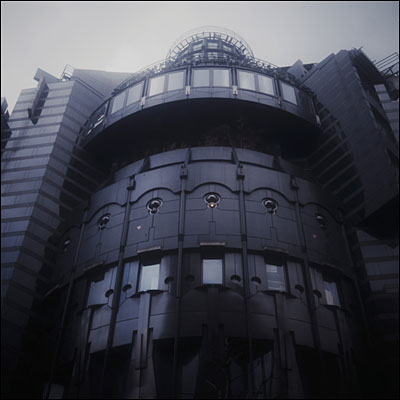
Flickr user turezure recently snapped this menacing picture of the Humax Pavilion in Shibuya. Doesn’t it look like it’s just sitting there, biding its time, waiting to bust a move, Megatron-style?
The Pavilion was designed in 1991 by Hiroyuki Wakabayashi, who also designed the Nankai 50000 train series, seen above. The design theme for the train was Outdated Future, and indeed, there is a suspicious resemblance to the 1978 Cylon Centurian model.Wakabayashi’s other works include the breathtaking Uji Station and Maruto Bldg. No.17 in Kyoto. [via Battling Pink Robots]
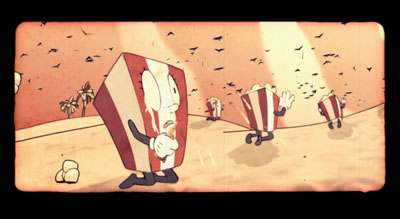
After more than a decade, ruddily engorged by countless commercial and artistic coups d’états, the Kansas City-based design and filmmaking collective known as MK12 still excels at chewing bubblegum and kicking ass and making the baby Jebus cry. PROOF:
FITC is a design and technology events company that celebrated their 10th annual flagship event in Toronto just last week. MK12 produced this brief-but-brutal animated title film to mark the occasion. Indelibly. In your shuddering brainmeats. For all eternity. Nnnngh.
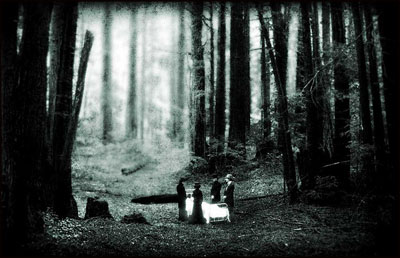
Pipe dream of the day: MK12 makes a full-length movie in cahoots with Al Columbia.
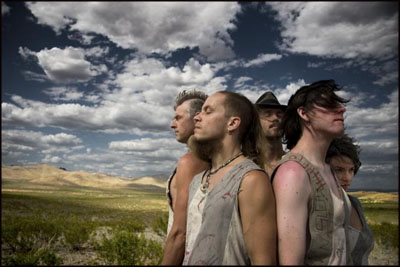
With solemnity, gratitude and a touch of sorrow, Coilhouse must acknowledge that Sleepytime Gorilla Museum, the most gloriously unclassifiable American band currently in existence, is about to call it quits. After a dozen relentless years of composing, recording, touring and performing some truly jaw-dropping music, the Oakland-based vanguards will play four final shows later this week in California: one in San Diego on April 7th, one in Los Angeles on April 8th, and two in San Francisco, both on April 10th (the evening show sold out, so they added a matinee).
Throughout the late nineties and all of the aughts, the legendary DIY road warriors of SGM crisscrossed the continental United States two, sometimes three times a year (and later on, toured Europe). Arriving at venues like a cheerful doomsday circus in their beautifully renovated vintage Green Tortoise bus, the curators entertained audiences with everything from puppet shows to Butoh dance to passionate readings of Italian Futurist manifestos. Flustered reviewers and reluctant converts, determined to pigeonhole SGM, labeled the avant-garde act as everything from neo-RIO (Rock in Opposition) to avant-prog metal, to grindcore funk theater, to, in the words of one concertgoer, “Satanic Anarchic Viking Shit”. But none of these descriptors come anywhere near encapsulating the band’s eclectic sound, style, or ethos. Not even close.
SGM on tour, 2009. Photo by Olivia Oyama.
The quintet has penned lyrics inspired by the Unabomber, James Joyce, madness, stroke-stricken baby doctors, love, death, cockroaches, and the end of the world. They have employed strange, esoteric contraptions from various folk traditions as well as several homemade instruments, such as the Viking Row-Boat, the Wiggler, the Spring-Nail Guitar, and a brutal, seven feet long piano-stringed bass behemoth called The Log. They have developed stage shows with stark lighting and elaborate costumes, sporting tooth black and spiked leather gauntlets and bonnets and bihawks and military khaki and antique lace nighties. They have sung lilting post-modern folk melodies. They have delivered face-melting blasts of pure, untrammeled metal.
They have rocked harder, more intelligently, and with more unabashed strangeness than anyone else around.
They will go down in legend.
Take comfort in knowing that these final shows won’t be the very last we’ll hear/see of them–the band has a comprehensive live DVD compilation in the works, as well as short film called The Last Human Being, and a final album. (We’ll be sure to announce all of those here when they’re released.)
Frykdahl is a fascinating artist with a lot of delight and wisdom to share. That goes for all of the curators of SGM, truly. (Nils, Dan, Carla, Matthias, Michael, Shinichi, Frank, Moe! et al: Thank you. Thank you. Thank you. Lots of love, and best of luck with all of your future endeavors.)
It is possible that you may be one of the many trapped by the newest winter storm that has much of the US in its icy grip. The new single from The Tree Ring, case “Wore It Deep”, viagra sale has a funereal melody that will perfectly compliment the next few days as you huddle with your family, burning your furniture for warmth, and drawing straws to decide who gets eaten. If you are not snowed in you may enjoy it as well. Just know that the rest of us hate you.
Yesterday, Wired published an essay by writer/comedian Patton Oswalt titled Wake Up, Geek Culture. Time to Die. It’s about the demise of geekdom, the rise of otaku culture in America, and what it means to be living in a world where Boba Fett’s helmet appears “emblazoned on sleeveless T-shirts worn by gym douches hefting dumbbells.” All this discussion is very near and dear to our hearts, and was eloquently explored by Joshua Ellis in an essay called Children by the Million Wait for Alex Chilton, which appeared in Coilhouse Issue 04.
Both essays make the point that “we’re on the brink of Etewaf: Everything That Ever Was—Available Forever.” But where Joshua Ellis suggests that we’ve won the culture war by essentially remaking the world in our image, Patton Oswalt argues that “with everyone more or less otaku and everything immediately awesome… the old inner longing for more or better that made our present pop culture so amazing is dwindling.” This, he warns, produces “weak otakus” – not a generation of artists, but one of noncommittal pop-culture consumers. “Why create anything new,” he asks, “when there’s a mountain of freshly excavated pop culture to recut, repurpose, and manipulate on your iMovie?” The proposed solution to this problem steers the essay into a weird, fantastical place. In order to rebuild geek culture, Oswalt argues, we must first bring about the “Etewaf Singularity.” He goes on to explain:
It has already started. It’s all around us. VH1 list shows. Freddy vs. Jason. Websites that list the 10 biggest sports meltdowns, the 50 weirdest plastic surgeries, the 200 harshest nut shots. Alien vs. Predator. Lists of fails, lists of boobs, lists of deleted movie scenes. Entire TV seasons on iTunes. An entire studio’s film vault, downloadable with a click. Easter egg scenes of wild sex in Grand Theft Auto. Hell, Grand Theft Auto, period. And yes, I know that a lot of what I’m listing here seems like it’s outside of the “nerd world” and part of the wider pop culture. Well, I’ve got news for you—pop culture is nerd culture. The fans of Real Housewives of Hoboken watch, discuss, and absorb their show the same way a geek watched Dark Shadows or obsessed over his eighth-level half-elf ranger character in Dungeons & Dragons. It’s the method of consumption, not what’s on the plate.
Since there’s no going back—no reverse on the out-of-control locomotive we’ve created—we’ve got to dump nitro into the engines. We need to get serious, and I’m here to outline my own personal fantasy: We start with lists of the best lists of boobs. Every Beatles song, along with every alternate take, along with every cover version of every one of their songs and every alternate take of every cover version, all on your chewing-gum-sized iPod nano. Goonies vs. Saw. Every book on your Kindle. Every book on Kindle on every Kindle. The Human Centipede done with the cast of The Hills and directed by the Coen brothers.
That’s when we’ll reach Etewaf singularity. Pop culture will become self-aware. It will happen in the A.V. Club first: A brilliant Nathan Rabin column about the worst Turkish rip-offs of American comic book characters will suddenly begin writing its own comments, each a single sentence from the sequel to A Confederacy of Dunces. Then a fourth and fifth season of Arrested Development, directed by David Milch of Deadwood, will appear suddenly in the TV Shows section of iTunes. Someone BitTorrenting a Crass bootleg will suddenly find their hard drive crammed with Elvis Presley’s “lost” grunge album from 1994. And everyone’s TiVo will record Ghostbusters III, starring Peter Sellers, Lee Marvin, and John Candy.
This will last only a moment. We’ll have one minute before pop culture swells and blackens like a rotten peach and then explodes, sending every movie, album, book, and TV show flying away into space. Maybe tendrils and fragments of them will attach to asteroids or plop down on ice planets light-years away. A billion years after our sun burns out, a race of intelligent ice crystals will build a culture based on dialog from The Princess Bride. On another planet, intelligent gas clouds will wait for the yearly passing of the “Lebowski” comet. One of the rings of Saturn will be made from blurbs for the softcover release of Infinite Jest, twirled forever into a ribbon of effusive praise.
The essay continues on to describe “year zero for pop culture,” in which we’ll be stuck with nothing but “a VHS copy of Zapped!, the soundtrack to The Road Warrior, and Steve Ditko’s eight-issue run on Shade: The Changing Man” to work with for creating new culture. Oswalt goes on to describe the society that emerges: it includes entire musical genres spawned by Road Warrior (“waste-rock” and its counterpoint, “flute-driven folk”), the creation of the Iranian Beatles, and the ubiquitousness of Shade as “the new Catcher in the Rye.”
A great read, right down to the comment thread. For the full essay, click here. [Via William Gibson, whose name, incidentally, appears in both essays, both times in the passages describing the authors’ personal golden age of otaku/alternative culture].
One possible visualization for how Patton Oswalt’s “Etewaf Singularity” may play out – with the world being destroyed by 8-bit characters from old video games. Amazing video by Patrick Jean.
Nathaniel Lindsay’s Ducked and Covered: A Survival Guide to the Post Apocalypse addresses an almost completely overlooked subject in the world of informational videos: how one should go about daily life in a world ravaged by a nuclear holocaust when the remaining population has been reduced to a shambling band of mutants and/or have all resorted to cannibalism. I will admit I was skeptical at first, after all this video hails from Australia, a land populated by the worst England had to offer making its citizens decidedly untrustworthy, not to mention that their theories of what the world will be like after a cataclysm having a strange preoccupation with vehicular combat (no doubt due to the fact that when England founded this prison continent they made it illegal for citizens to own cars. Fact. (Editor’s Note: That is not a fact. What is it with you and Australia?)) Any worries I may have had proved unjustified as Lindsay makes sure to point out the real threat of post-apocalyptic civilization: killer robots. Killer robots with lasers.
From Joseph Nanni and friends (the same twisted souls who brought us that Necronomicon infomercial) comes this important, potentially lifesaving message about Elder Sign:
Sure, this clip has been circulating on the internet for a while, but as everyone knows, flying polyp infestations are most rampant during the holiday season. If you suffer from “an overwhelming sense of dread brought on by the realization of your own insignificance in the universe” that’s possibly being compounded by Seasonal Affective Disorder, rancid egg nog or overexposure to Glenn Beck-parroting (read: polyp ridden) in-laws, you need Elder Sign now more than ever.
And possibly some *cough* stocking stuffers from the HPLHS Bazaar:
(ElderWear™: “Because you don’t want Shoggoths in your pants.”)
WHITEPRIDETV.COM has a varied lineup of video content for the modern white supremacist to educate themselves and keep up on the latest in good old American racism. From This Is The Klan to The White Woman’s Perspective Thomas Robb and his group of camera wielding bigots cover the entire gamut of life as an ignorant douchebag. They also, thankfully, have some children’s programing to help Confederate flag waving parents educate their offspring in the proper manner.
The programming in question is The Andrew Show which is, in case you had not already figured it out, “A Show for White Kids” (Finally!). Plopping the blond-haired youth in front of a green-screened bookcase, WHITEPRIDETV.COM lets the little tyke go at it, tackling the issues that face white kids today. This particular episode deals with the film Marmaduke, an unremarkable film in nearly every way except for the fact that it is a metaphor for racial tension; specifically the denial of land to white people by people of other various and sundry races. So goes Andrew’s thesis, a thesis he does not expound upon his, presumably because his point is so self-evident even a child can see it.
It is an unfortunate reality that even the worst among the human race can procreate, taking an otherwise unfettered mind and twist it with their own, poisonous worldview. It is, perhaps, worse when they give them their own television show to parrot that moronic bile.
If there is anything to be taken away from this intro for A Man Called Rage — one of 26 films distributed by US Home Video under the title of Sybil Danning’s Adventure Video — it’s that there was a time when the post-apocalypse meant that people were allowed to wear anything as clothes. Even as Danning lends the superbly written intro the sort of gravitas that an only an actor of her caliber can provide, I remain mesmerized by her xylophone and wind chime ensemble. I especially like how all her jewelry is on her right side while her teased hair is swept steadfastly in the opposite direction. The look is completed with some sort of bazooka/oversized clutch that looks like a collapsed projector screen. You can’t tell me you would take the bedraggled look of the modern wasteland wanderer over the height of fashioned favored by the Mad Max era desert divas.