EDITOR’S NOTE: Yet another wonderful post from our longtime contributor, Jeffrey Wengrofsky! This past year, he’s been keeping busy with all manner of projects, and this Sunday, April 3, his Syndicate of Human Image Traffickers will be screening “The Gospel According to Reverend Billy” as part of the Prison is an Angry Father fundraiser at Goodbye Blue Monday (1087 Broadway, Bushwick, New York). It’s a benefit for a prisoner’s rights project created by the Sanctuary of Hope. The event will include live performances of an almost musical variety, as well as the screening of several more short films in addition the Syndicate’s. Doors open at 8pm. Showtime for “The Gospel According to Reverend Billy” is 10pm. This event is free of charge.
Last year I spent my summer vacation working on a feature film in Detroit. While creeping around the city, I could not help but notice its mountainous Masonic Temple – the largest in the world – whose muscular shoulders rise above its environs as if Charlton Heston’s urban fortress in Omega Man were carved into Yosemite’s El Capitan. I was even able to arrange a private tour of the windowless monolith by its hospitable and wily Grand Master, including many meeting rooms and a majestic 4,004 seat auditorium (numerologists take note), all of it a visual feast for anyone with a taste for dramatic architecture, grotesque beauty, or even cryptography for that matter. While in the lobby, our guide offhandedly revealed three levels of meaning behind a seemingly random painting, and the stately oddities awaiting us in floors above and below nearly exploded with symbolic resonance. Unfortunately, the photographer I brought with me was so spooked by the whole experience that he ran screaming into the long night, ever since unreachable by phone or email.
And who can blame him? The uninitiated public can never comfortably claim to understand the true raison d’etre and inner machinations of secret societies because any scholar or spokesperson or self-declared defector may actually be a shill for the organization, planting seeds of misinformation and spreading misleading rumors. Even joining such a society does not entitle one to understanding the ways of its upper circles. Circles within circles, dear reader. Are you getting sleepy? The cinematic accoutrements – vaulted iron doors, masks, handshakes and cloaks – provide the perfect canvas for our fears of the unknown and desires for hidden order beneath evident chaos, conjuring a veil behind which we may never knowingly trespass. Consequently, it can never be definitely settled as to whether any or all such societies are actually: cults of mystical inquiry; wholesome gatherings of those serving laudable Enlightenment values of science and public service; the core of a dastardly “power elite”; congresses of people who enjoy rituals involving aprons (not that there’s anything wrong with that); or some combination thereof.
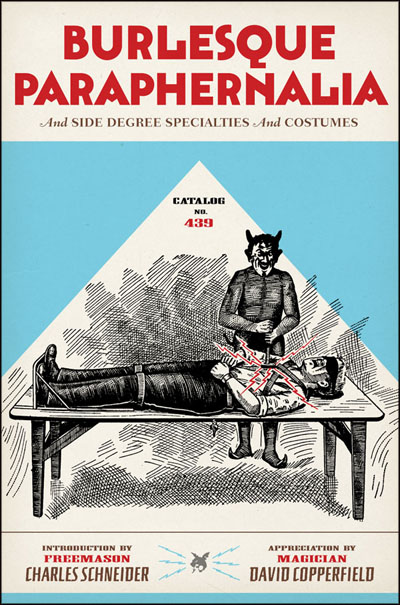
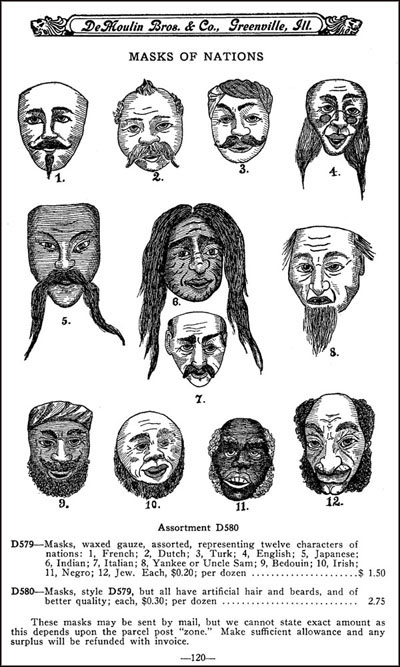
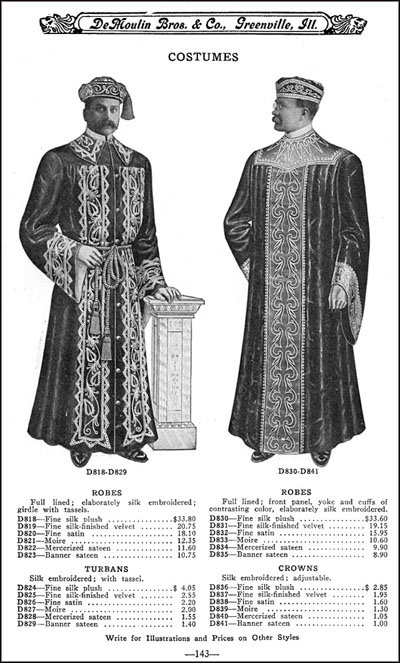
Last year, Fantagraphics reproduced Catalog No. 439 of the DeMoulin Brothers– the most extensive depiction of initiation contraptions and ritual outfits used by Freemasons and other fraternal orders, like the Odd Fellows, the Knights of Pythias, and E. Clampus Vitus. Bearing the title Burlesque Paraphernalia and Side Degree Specialties and Costumes, this wacky book may shed a shred of light into the outer sanctum of these associations – unless, of course, it is actually a hoax disseminated to lead us astray. Bracketing but never disregarding this notion, the readership of Coilhouse may discover certain Truths regarding these quasi-mystical clubs from perusing its glossy pages. Even if Enlightenment should, as always, prove ever elusive, the illustrated designs of Edmund DeMoulin and the handiwork of his brothers Ulysses and Erastus, as reproduced in Burlesque Paraphernalia, will still deliver amusing, if sadistic, anthropology.
It’s hard to imagine who the intended audience was for the “Stuffed” Girl’s Heads* from Honor House Products Corp. Certainly, there was and, no doubt, still is a well entrenched consumer base comprised of misogynists who would perhaps guffaw at the site of such an item or nod sagely, in possession of the belief that women are, indeed, nothing more than trophies. Despite this unfortunate reality, I have a hard time believing that anyone would actually buy something like this. No, this strikes me as the perfect gift for the laziest of movie serial killers; the star of some Grunge-era slasher film in which the villain is too stoned and jaded to actually get up off the couch in his parents’s basement to slay a cheerleader.
Regardless, for the low price of $3.35 you get the complete array of hair colors, those being blond, brunette, and redhead, affixed to a genuine mahogany base (notice no quotation marks there, so you know that shit is real.) The downer here, of course, is that the head is only 3/4 scale which may not completely sate your blood lust unless you have a Beetlejuice inspired fetish to go along with the murderous psychopathy. It also has the unfortunate side effect of putting a damper on the “realism” touted so often in the copy. That said, as the article suggests, it would no doubt be a conversation starter, though that conversation may take the form of a hushed exchange with authorities over the phone while the owner is in the other room.
*Also, who decided on the placement of those quotation marks. I mean, “Stuffed”? Shouldn’t they be around “Girl’s Head”? Shouldn’t the implication be that the head in question is not a real goddamn head and not that it isn’t actually stuffed? Maybe I’m over-thinking this.
Gynoids. Pleasure models. Fembots. Bionic women. Borg queens. Stepford wives. Sometimes they’re hot. Sometimes they’re fierce. And yet sometimes, they all start to look the same.
When’s the last time you saw a female robot who didn’t appear to have a waist-to-hip ratio of 0.7? Other than Rosie, the robot maid from The Jetsons. This powerful portrait of London-based plus-size model Bea Sweet by digital artist Benedict Campbell (previously on Coilhouse) confronts that question head-on.
It’s great to see a sexy, strong robotic woman who isn’t rail-thin, to imagine a future where robot designers craft something other than Barbies and Kens, or one in which robots design themselves in a way that discards the expectations of their human forbearers. And yeah, loving this doesn’t mean letting go of a deep adoration for Bjork’s All is Full of Love, or, for that matter, Takashi Itsuki’s bruised bondage robot amputees. There’s room for all those things.
“We are all chimeras, theorized and fabricated hybrids of machine and organism; in short, we are cyborgs.”
“A cyborg is a cybernetic organism, a hybrid of machine and organism, a creature of social relations, our most important political construction, a world-changing fiction.”
“The cyborg would not recognize the Garden of Eden; it is not made of mud and cannot dream of returning to dust.”
“Cyborg writing must not be about the Fall, the imagination of a once-upon-a-time wholeness before language, before writing, before Man. Cyborg writing is about the power to survive, not on the basis of original innocence, but on the basis of seizing the tools to mark the world that marked them as other.”
“It is no accident that the symbolic system of the family of man – and so the essence of woman – breaks up at the same moment that networks of connection among people on the planet are unprecedentedly multiple, pregnant, and complex.”
“The cyborg is a kind of disassembled and reassembled, postmodern collective and personal self. This is the self feminists must code.”
I’ve spent, I think I can say, an inordinate amount of time browsing through the fetishization of the most mundane activities in order to provide you, dear readers, with interesting material. Yes, it was for you that I watched dozens of Japanese YouTube clips of earwax removal, trapped in a horrific, personal grooming K-hole, desperately trying escape only to do so and realize that most, if not all of the people who would be interested in such a thing are already ensconced in a vast, virtual library of such material. Alas, such is the life of an internet spelunker.
We are not here to talk about earwax removal, however, (though, if you want to I have some videos to show you) no, we’re going to briefly discuss Konapun. Konapun is a Japanese cooking toy that allows the you to create realistic, miniature food with the use of chemicals. It’s like molecular gastronomy — a practice in which people who are bored by food and the idea of it as nourishment torture it into funny shapes and forms with needles and eyedroppers — but without the pretense of being edible.
Polish designer Katarzyna Konieczka first made an appearance on Coilhouse this past July, but these newer photos of her medical fashion are too wonderfully twisted not to share. Above is a new image of her previously-featured Elephant Man-inspired ensemble, shot by Maciej Boryna. After the jump, two dreamlike masks, photographed by Marcin Twardowski. Definitely one to watch.
Anouk Wipprecht creates garments that move, breathe, and react to the environment around them. Wipprecht started with a background of fashion, theater and dance, but a growing interest in interaction design and electrical engineering inspired her to develop clothing that appeals as much to the DIY/tech crowd as it does to fans of haute couture. “Instead of the body having to give a purpose to a design” Wipprecht said in a recent interview with Fashioning Tech, she’s interested in developing “design [that] gives a purpose to the body.”
Wipprecht has crafted projects such as Intimacy, a set of garments that become transparent when in proximity of each other, Fragilis, a dress that evokes the heart and veins through lighting and motion, and Daredroid, a cocktail-making robot dress equipped with IR sensors that administers booze through pneumatic control valves. More projects can be found on her site. Here she is discussing Pseudomorphs, her self-painting dresses:
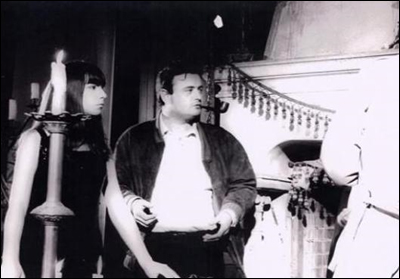
Jean Michel Rollin Le Gentil, French film director fantastique and “gentle poet of sensual horror”, passed away yesterday (December 15, 2010) at 72, after a long illness.
Much beloved by his fans and horror connoisseurs, lauded for his bizarre genius and the unique, intensely personal vision he brought to his films, Rollin leaves a legacy brimming with uncanny beauty and perverse, morbid delights.
Though his works contained elements of horror cinema, Rollin insisted he did not make horror films; instead he prefers the label fantastique, which he described as “the opposite of the supernatural”. His story telling, marked by “surreal sensibilities” and a “narcotic narrative drive”, made for mysterious (and at times maddening) viewing; but the imagery, oh, the imagery. Languid and melancholy, romantic and doom-laden, the dreamy atmospheres Rollin crafted were truly like nothing else in cinema: “…hermetically sealed worlds of desolate chateaus, solitary vampires and violent seduction”.
According to Rollin’s son Serge, who spoke with Fangoria shortly after his father’s death, “Jean was surrounded by his friends, and was looking at the photos of his two granddaughters when he died.”
Rollin was calmly uncompromising and self-assured to the very end. The filmmaker’s own words about his work and perceptions of criticism are as fitting a closing statement as any:
“Honestly, I don’t care [what people call me]. Some people say I’m a genius, others consider me the greatest moron who ever stepped behind a camera. I have heard so many things said about me and my films, but these are just opinions.
I am perfectly happy with what I do, because it has always been my choice.”
Fetishwear blog Kinky Attirewrites, “[Nichelle] Nichols sang for Duke Ellington and Lionel Hampton. But it is her inescapable destiny to be best remembered as Star Trek’s Lieutenant Uhura. At some point in her career she also helped to advertise thigh-high boots.” The Boot Fetishistadds, “I’m assuming she was commissioned for these pictures, most likely booked for a photoshoot to be used in this catalogue. I think these pictures were taken in the 1950’s, obviously prior to her Star Trek days. However she had been a singer in the famous Blue Angel Club in New York and my guess is the catalogue relates to a store in New York.” HOT. HOT. HOT. If only she were only wearing this Star Trek corset as well! Set phasers to stun, girl. RAWR.