Both films sound fascinating; here’s a bit of background from the Syndicate on the Taylor Mead feature:
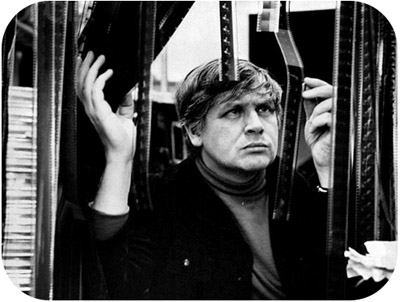
After reading Jack Kerouac’s On the Road, Taylor Mead, the scion of Michigan’s Democratic Party political boss Harry Mead, left his Grosse Point home and Merrill Lynch sinecure to hitchhike across the United States. Upon arriving in San Francisco, his ability to write and perform clever, bawdy, homoerotic poems made Taylor an instant hit with the Beatnik scene. He soon came to personify the Beatnik ethic in Ron Rice’s classic film, THE FLOWER THIEF, in 1960. Deciding to move to the Lower East Side of New York, then the Beat capital of the world, Taylor was soon a fixture of the downtown poetry scene and a Warhol Superstar, most famously appearing in “Tarzan and Jane Revisited…Sort of,” and most notoriously, as the star of ‘Taylor Mead’s Ass” in 1964. Taylor has since appeared scores of films, has acted for the stage, and has published books of poetry.
Fifty-odd years after trading in upper-crust luxury for bohemian art stardom, THE PARTY IN TAYLOR MEAD’S KITCHEN finds Taylor still living a life of poetry, painting, partying, acting, homo-eroticism, modest living, and indifference to bourgeois notions of hygiene. We visit the octogenarian in his Lower East Side grotto, finding him still brilliant, boyishly innocent, abundantly cute, and wanting to party at noon. The film depicts the romantic beauty and squalid dereliction of the bohemian life while dishing the dirt on Andy Warhol, Jack Kerouac, Ron Rice, Woody Allen, and Tallulah Bankhead.
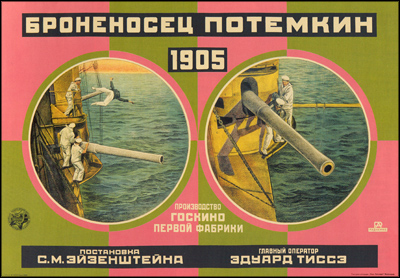
One of the most acclaimed films of all time, and certainly one of the artfully made/broadly influential propaganda pieces created to this day, Sergei Eisentstein‘s 1926 feature film The Battleship Potemkin presents an exhilarating (not to mention highly dramatized, sometimes outright fictionalized) depiction of the 1905 mutiny of a Russian battleship’s crew agains their Tsarist commanding officers. Eisenstein made cinematic history with his development of the montage concept, and his unflinching use of realistic violence.
Via Jess Nevins comes word that we can watch the entire thing, uninterrupted, on teh YooToobz. It’s the version with the Shostakovich score, too. Pretty awesome (in the traditional sense of the word, even)!
I’ll admit, I know very little about the Swiss, stop-motion cartoon Pingu other than that it is a Swiss, stop-motion cartoon about penguins. That does little to dampen my enthusiasm for this, a remake of John Carpenter’s sci-fi/horror classic The Thing by Lee Hardcastle, starring the adorable cast of the aforementioned cartoon and animated in the same style. It is just as good as it sounds.
Recently, the street dance documentarians ventured deep into the NYC underground (literally) to document the Flexing prowess of the Brooklyn-based NextLevel Squad.
Flexing (also called Bonebreaking) is a relatively new and potently individualistic fusion dance form that evolved in NYC out of Jamaican bruk-up, and incorporates popping, gliding, contortion, as well as various moves gleaned from martial arts, jazz dance, ballet, gymnastics, and whatever else looks damn good.
There are many, many things to love about this video… not least of which is watching a burgeoning subculture breathe new life (so to speak) into ye olde gas-mask chic!
Switched to a YouTube playlist because the VICE video would auto-play. You can see the full-length version at the link at the end of the article.
Perhaps not the best thing for the week of Christmas, but history cares not about holidays. Last Saturday, as I’m sure you all know, Kim Jong Il, the iron handed dictator of the Democratic People’s Republic of Korea, died from an apparent heart attack at the age of 69. The past week has seen a continuous outpouring of grief (some real, some staged) from within the Hermit Kingdom, while the rest of the world seems to look on with trepidation, waiting to see what his heir apparent, Kim Jung-un, will do.
Less than a week before Jong Il’s death, VICE News ran another of their fascinating looks into North Korea. Shane Smith, accompanied by freelance journalist Simon Ostrovosky, traveled to Siberia to investigate North Korean logging camps located deep in the forests. Here, North Korean citizens are contracted as laborers for up to 10 years, during which time they are housed, fed, and paid a pittance for their work. The North Korean government, meanwhile, was paid handsomely for what basically amounts to slave labor.
Smith’s interest seems to be twofold: to expose these camps, and to try to talk to North Korean citizens, a feat nearly impossible in his visits to the country itself. If you’ve seen Smith’s past work, then you’ll know what you’re in for. The reporting is solid, but there is a Gonzo aspect to it as well. A decent chunk of the forty minute documentary is spent on a crowded, sweltering train where the only thing to do to numb the boredom is drink. Unsurprisingly, it turns out to be rather difficult to get near these camps, but he and his crew manage to at least talk for a bit with some of the laborers.
Regardless of your feelings on the style, VICE has done a stupendous job exposing yet another facet of the horror that was Kim Jong Il’s regime. In the closing minutes of the piece Shane reveals that much of the scrutiny they found themselves under was no doubt due to the fact that the Dear Leader was visiting the same area of Russia at the time to meet with President Dmitry Medvedev and broker another labor deal, to sell more of his people. If that isn’t evil, I’m not sure what is.
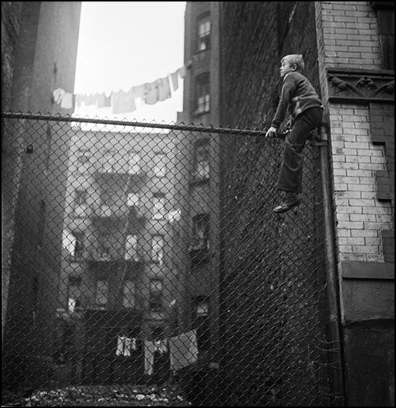
“Shoe-Shine Mickey Climbing a Fence” by Stanley Kubrick
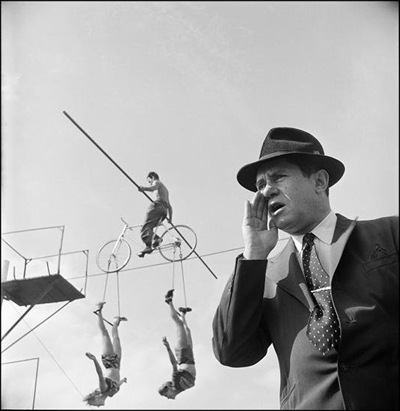
Stanley Kubrick was one of the most innovative and accomplished directors in cinema history, and, as it turns out, a bordering-on-Weegee-level badass when it came to capturing “slice of life” still imagery in NYC as a young man.
La Mer de Pianos, a charming short film by Tom Wrigglesworth and Mathieu Cuvelier, focuses on one Marc Manceaux, the current owner of Fournitures Generales Pour le Piano, the oldest piano shop in Paris. Having been there as either employee or owner for almost 30 years, Mr. Manceaux gives us a glimpse into a cluttered, chaotic world of pianos and there parts, stacked to the ceiling and harvested for their “organs”, in a manner far less delicate than one might assume. It’s a great, claustrophobic mass of keys, pedals, hammers, and wire which the agile Manceaux navigates with the kind of confidence one would expect after nigh on three decades, scampering across piles of parts that a lesser man would cause to collapse. This is the kind of shop they would use as the setting for a heartwarming animated film about a family of anthropomorphized rodents, is what I’m trying to say. It’s that charming.
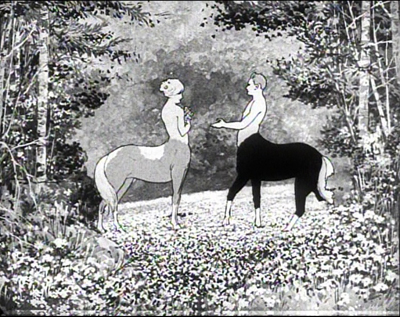
The advent of animated features and silent films remains one of the most significant accomplishments of the 20th century. Sadly, before celluloid preservation standards were set in place, much of the early studio output of the 1920s was lost or damaged beyond repair. One of those pieces is an animated film, The Centaurs, produced by Windsor McCay in 1921. Of the sole print, which disintegrated due to negligent storage, only about 90 seconds have been salvaged.
The animation style is quite beautiful, very influenced by the Art Nouveau motifs of the times, recalling Jugendstil illustrations, like this one, in particular.
There is no solid indication available anywhere about McCay’s original intentions for the feature. Was there to be a plot, or did he mean for it to be a romantic, picturesque montage of frolicking centaurs? (Nothing wrong with the latter.) At least we have this little bit to enjoy.
ATTENTION, NON-SHOPPERS. Whether you’re purposefully observing Buy Nothing Day or simply opting out of the ravenous corporation-fueled feeding frenzy of Black Friday because you find it all a bit… scary, you can still experience a gawping, consumer hoard horrorshow from the comfort and safety of your own home:
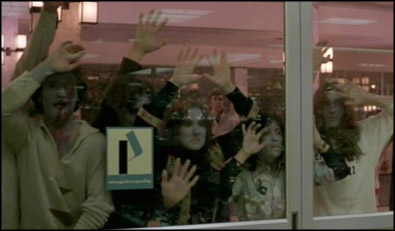
Fresh off the success of their nerdtastic exploration of the Night of the Living Dead cemetary, Cinemassacre decided to visit a certain humble indoor mall located in Monroeville, PA; the very same one featured heavily in George Romero’s original (1978) Dawn of the Dead film.
If you’re familiar with the movie, it’s adorkably entertaining. If you’re not, be sure to click on a corpse below; the photo links to a full YouTube Coilhouse Black Friday 2011 playlist comprised of choice cuts of the original Dawn of the Dead tidbits, and some other fun stuff.
Ya just can’t put a price tag on good, clean, satirical zombie fun!