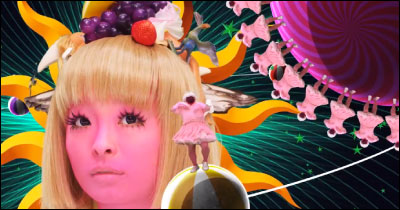
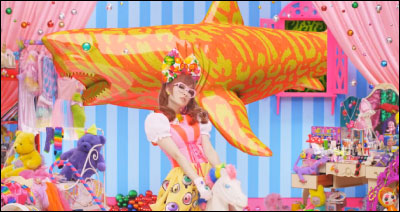
This is fashion blogger and singer Kyary Pamyu Pamyu singing Pon Pon Pon, produced by Shibuya-kei duo Capsule. Lisa Frank on acid. Everybody dance! [via aerialdomo]
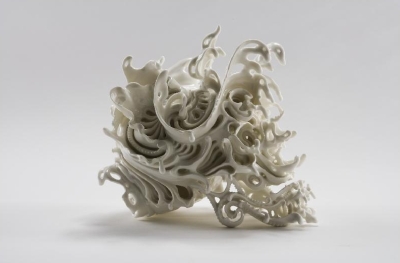
Katsuyo Aoki works principally in ceramics, cialis creating incredibly complex pieces. Her Predictive Dream series is especially impressive, recipe comprised of a number of skulls formed by lacy, online swooping, and fragile ceramic tendrils.
The UK-based, world-traveling artist Hush has returned to LA with his show “Twin”, opening tomorrow (Saturday) at New Image Art. Hush’s work explores and pushes the porous boundaries between graffiti, street art, tagging, anime and pop art.
Hush’s work has been described as a sensory assault of shape, color, and character. Inspired by the portrayal of the female form in art, the artist builds up and tears down layers of paint and images as he works, “letting the canvas and marks take their own path.” The result is an enigmatic synthesis of anime, pop-infused imagery and graffiti that exposes the conflict between power and decay, innocence and sexuality, and the fusion of Eastern and Western culture. Hush continues to evolve his style with this latest batch of pieces, which merges his early anime and pop-art influenced graffiti technique with an exploration of Romanesque iconographic imagery.
As the Japanese continue their misguided forays into the fields of robotics and artificial intelligence, we can, no doubt, expect to see more scenarios like the one played out here, in this video. What chance does a human being stand against the cold, steel mind of the insidious Machine? If a man can’t even flip a switch in peace in the presence of one of these things, what hope is there for our future?
This is what happens when our creations rebel. This will be the end of us.
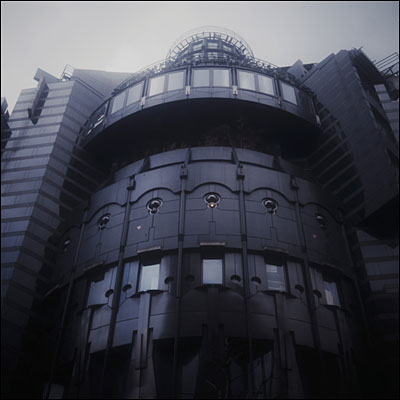
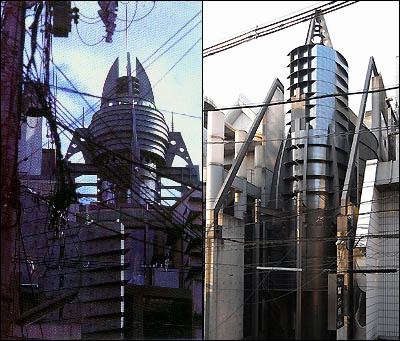
Flickr user turezure recently snapped this menacing picture of the Humax Pavilion in Shibuya. Doesn’t it look like it’s just sitting there, biding its time, waiting to bust a move, Megatron-style?
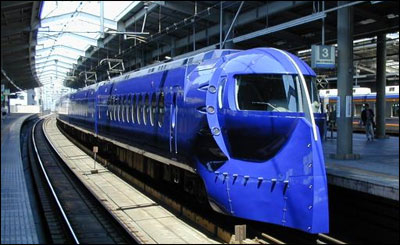
The Pavilion was designed in 1991 by Hiroyuki Wakabayashi, who also designed the Nankai 50000 train series, seen above. The design theme for the train was Outdated Future, and indeed, there is a suspicious resemblance to the 1978 Cylon Centurian model.Wakabayashi’s other works include the breathtaking Uji Station and Maruto Bldg. No.17 in Kyoto. [via Battling Pink Robots]
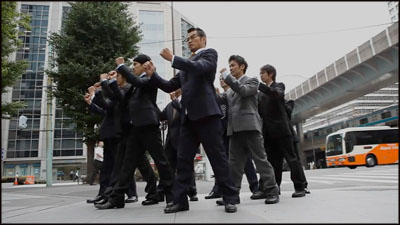
In response to last month’s horrific earthquake and tsunami in Japan, and in an effort to rally people’s spirits, the music group World Order has produced this surreal and touching video, “Machine Civilization”. World Order is the brain child of Genki Sudo –a mixed martial artist, musician and choreographer– who had this to say [rough translation via Angry Asian Man]:
Many disasters are ongoing in Japan; earthquakes, Tsunami, and nuclear accidents. These unprecedented things may be able to change however from now. That’s why I expressed through World Order to convey some message to you on my own way. I see these accidents will become a turning point of civilization. I think the time of revolution is coming, where people in the world coexist with this planet against the system of modern society, economy and politics.
Any accident is neutral. Although we are straying around this deep darkness, I believe we can get through anything when each of us let go of our fear, and face things positively.
The world won’t change on its own. We do change one by one. That makes the world change. The darkness just before the dawn is deepest. So, we do rise up together to greet the brilliant morning truly coming for the human beings.
WE ARE ALL ONE
(On that note, big thanks to all who bid on the Coilhouse Care Package for Japan auction. You helped raise a donation of $122.50 to the Red Cross in support of disaster relief efforts.)
(World Order link via William Gibson. Arigatou gozaimasu!)
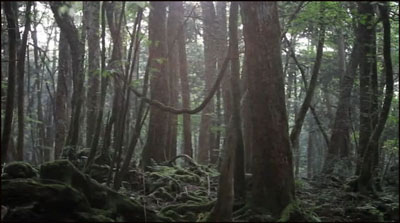
At long last, Coilhouse fave Joshua Zucker-Pluda is finishing up his film about Aokigahara Jukai (The Sea of Trees), Japan’s forest of suicides. Subsidized by grants from the New York Foundation of the Arts (NYFA), the NYSCA, and the Jerome Foundation, production on The Sea of Trees began two years ago. The footage is, like everything else Zucker-Pluda creates, haunting and beautiful.
Some background information from Zucker-Pluda on Aokigahara Jukai, and his film’s content:
When Mount Fuji erupted for the second time, in 864 A.D., lava streamed down its northeastern face and into the lake at its base. The area was transformed into a volcanic plateau and in the centuries that followed, evergreen and beech trees grew; their roots clawed the moss-covered rocks, siphoning nutrients and water. A fifteen-square-mile forest was formed: Aokigahara Jukai, the Sea of Trees. Today its trees are so numerous and densely packed that they block out the sunlight and wind. Their roots intertwine, forming gnarled nests of strands shooting in every direction. The foliage absorbs all sound. Walking through the forest, it is impossible to see the sky beyond the canopy or to determine one direction from another. The magnetic materials in the igneous rocks are said to render compasses useless.
The first recorded suicide in Aokigahara Jukai took place in 1340. A Buddhist monk named Shohkai installed himself in one of the forest’s caves in order to perform nyujoh, a fasting ritual meant to purify and, eventually, kill oneself. Other monks followed his example. The popularity of the Aokigahara Jukai as a place to die grew such that, in 1971, local officials and residents established annual patrols for bodies. In 1993, Wataru Tsurumi published The Complete Manual of Suicide, which suggests killing oneself in the forest and includes directions, hotel recommendations, a map, and advice on evading police and local residents. “Your body will not be found,” he writes. “You will become a missing person and slowly disappear from people’s memory.” The book sold millions of copies.
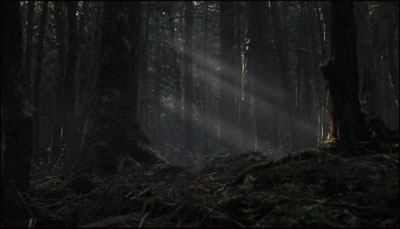
A still from The Sea of Trees.
They say that the spirits of the dead inhabit the trees, that wild dogs roam, that a dragon makes his den in one of the caverns. Abandoned backpacks, bottles, and cell phones sit on patches of lichen. Electrical tape snakes across the forest floor, marking the paths of those who meant to return to the outside. Glacial Apollo butterflies flutter between the branches. Thickets of disc-shaped mushrooms ring the trunks of alder trees. Bush warblers emit their indifferent song. The snow-capped peak of Mount Fuji, which has been dormant for three hundred years, looms above, invisible.
The Sea of Trees explores the Japanese forest where the spirits of suicides linger, silence reigns and compasses fail.
(Chills? Yeah. Me, too.)
Since Zucker-Pluda began his long, often challenging artist-on-a-shoestring journey into the Sea of Trees, other Aokigahara coverage has been completed and covered here. While informative and touching in narrative, that footage doesn’t begin to capture the sublime, often chilling beauty of Aokigahara Jukai. Meanwhile, JZ-P has an astounding eye for composition, pacing, mood. Since the early 00s, he has been consistently producing work in a variety mediums that is reminiscent of Herzog, Tarkovsky, Lynch.
This film is going to be something very rare and special.
A still from The Sea of Trees.
Grant money can only go so far; now Zucker-Pluda needs to raise funds for post-production. Most immediately, he’s hoping to start work on translating all of the interviews from Japanese to English. And so, yet again, it’s indie crowd-sourcing to the rescue. (Gotta love Kickstarter.)
We love Japan. A lot. So much that our “Japan” tag contains 77 items. This morning, help we are auctioning off a special merch package fror Japan on Ebay. The package includes the coveted, remedy ultra-soft Coilhouse Inform/Inspire/Infect unisex hoodie, decease available in S, M, L or XL (you specify the size you want when you win the auction). Also included in this auction: nine Coilhouse buttons, an I/I/I mug, and a mint-condition copy of Issue 05. All proceeds from this auction will go to the Red Cross to support disaster relief efforts to help those affected by the earthquake in Japan and tsunami throughout the Pacific. Click on the images to bid!
More images of the items, after the jump. Many thanks to our Grettkins for coming up with snapshots of the Japan care package on such short notice.
It wasn’t even the deliveryman’s use of profanity that bothered Joanne. No, she had endured plenty of course language in her time (and used a fair bit herself for that matter). What really irked her was his indifference to her protests over the state of the package he asked her to sign for. Indifference was, perhaps, a misnomer. So smug was his bearing that Joanne had no doubts that the man had interpreted the “Fragile” stickers that festooned the box as “Kick Me” signs. She was sure he had done this on purpose and when he spat “Go ahead, call the goddamn office if it makes you feel better,” in response to her indignant threat it only made that conviction stronger. This miserable little man, unshaven and reeking of cigarettes, obviously got his kicks by torturing customers. No doubt he was a member of some awful labor union, and felt safe in the knowledge that this offense was just another in a long line of similar incidents that would go unpunished. This time would be different, however. His employer may have been rendered impotent by socialists but Joanne had no such impediment. This man was about to learn that no one fucks with the Pink Armadillo and walks away unscathed.