(UN)HOLY FUCK. MOTHER OF LONDON dot COM IS LIVE.

Unf, UNF, UNF, UNF:


QAPLA

An hour ago, the darque benevolent sartorial powerhouse known as Mildred Von launched her official Mother of London website, with a webstore containing her glorious new, never-before-available, ready-to-wear line of MoL garments. Creaking black stroppy strappy happiness. Studs and grommets and buckles. Softly eldritch curve-hugging knits and witchy tees. Go take a look. Go.

You’re still here?! GO!! Drool. Spontaneously ejaculate. Cry molten rubies. Fer serious.

Having some inkling of just how many years of blood, sweat, orgone depletion, and fiery cussin’ went into making this uncompromisingly exquisite line a reality, we here at Coilhouse could not be more happy for Milly, or for everyone lucky enough to snatch up one of her amazing pieces before they sell out.

(And they WILL sell out. Soon. So if you want ‘em, go git ‘em. ASAP.)


GORKON
Quoth Mildred: “Yes, I might have named all my products after Klingon warriors.” Nope, not fucking around.

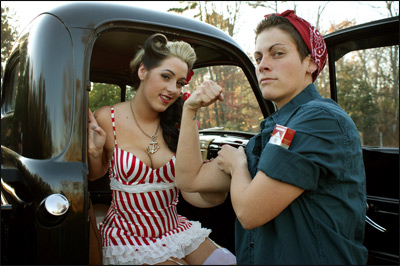
More images after the jump. All photos by the fabulous Twink. Gorgeous model is Lacy Soto. Immaculate hair and makeup by Cazzie at Gorgeous Salon on Melrose.

LONG LIVE MOTHER OF LONDON. CONGRATS, DOOD. HEGHLU’MEH QaQ JAJVAM.

Industrial Culture Handbook: The Movie!

That might as well be the title of Decoder, a German film that came out in 1984. Unreleased in the United States and forgotten until the Internet recovered it in recent years, Decoder is a fascinating relic of the early industrial ethos.

Written by Klaus Maeck, directed by Jürgen Muschalek, and based on The Electronic Revolution by William S. Burroughs, the film focuses on a lone audiophile who discovers that multinational corporations are controlling populations through muzak. By playing the mind-controlling, sedative non-music in elevators, fast food joints, lobbies and stores all over the country, corporations such as the evil H-Burger are able to produce a docile population of consumers. To combat this, our protagonist turns to industrial noise, and inspires a legion of “cassette terrorists” to covertly swap muzak tapes for sounds that are much more subliminally sinister, inciting riots all over Germany.

The film’s score was a collaboration between F.M. Einheit (Einsturzende Neubauten) and Dave Ball (Soft Cell), with contributions from Genesis P. Orridge and Alexander Hacke. In addition to scoring, F.M. Einheit, a.k.a Mufti, also plays the film’s protagonist. Other characters include cult film actor, scholar and artist Bill Rice, playing a sad-faced security official on a mission to foil the cassette terrorists’ plot, and inadvertent heroin-chic style icon/musician Christiane Felscherinow, playing an amateur herpetologist/go-go dancer who looks eerily similar to Rooney Mara’s Liz Salander. Cameo appearances include Genesis P. Orridge and William S. Burroughs. The film is sprinkled with many other references to items you might find in a 1980s-era RE/Search publication, such as the appearance of a Brion Gysin Dreamachine inside a secret nightclub belonging to an industrial cult, as well as a giant Survival Research Laboratories logo on the wall of the protagonist’s  studio.

One of the film’s most stunning features is the color palette. “Lensed by Johanna Heer,” writes Samantha Anne Scott,  ”the film’s blunted, monochromatic color schemes — primarily red, green, and CRT blue — demarcate character, mood, and motivation … while doused with art house affectation, Decoder delineates a relatively cohesive narrative of corporatism, control, and the power of noise.” The full film is posted above.

[via wobbly]

Pussy Riot Rocks Russia

Great googly moogly:

The riot grrl ethos is alive and well… in Russia! The above footage of an anonymous feminist punk band called Pussy Riot was shot earlier this month. From the Guardian‘s coverage:

Eight women stood in a line opposite the Kremlin, neon balaclavas hiding their faces, fists pounding the air in rugged defiance. Before police carted them off, the members of Pussy Riot managed to shout their way through a minute-long punk anthem: ‘Revolt in Russia – the charisma of protest / Revolt in Russia, Putin’s got scared!’ [Full lyrics here.]


(via)

Since the band formed last September, they’ve been attracting all kind of press with their colorful, expletive-laden anti-Putin protest performances. Huffpo reports:

The group’s current membership, including crew, stands at around 30 people, most of whom are college-educated, hardcore feminists, according to founding members of the band who spoke to the Guardian. They told the paper many members of the band met at small protests and monthly demonstrations aimed at voicing a range of grievances against the government, including political corruption, state monopoly on the media, and banned gay pride marches.

All members of the band are sworn to anonymity, even when giving interviews, because “it shows we can be anybody,” a member told the Guardian.

More recently, Pussy Riot crashed Moscow Cathedral to perform an impromptu rendition of their song “Holy Shit”, and a surrreal, even sublime sort of inverse Benny Hill hilarity ensued:

No doubt, they’ll be striking again soon. Revolution girl style now! (Via Cal Trumann, thanks.)

Bristol Punks, 1977

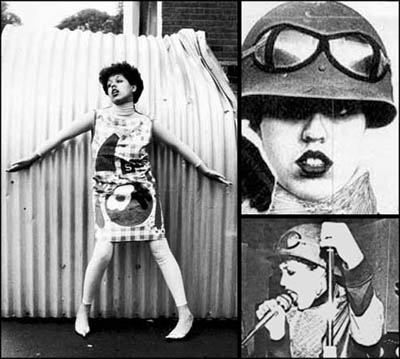
They look like a macabre traveling circus troupe out of a Neil Gaiman novel. These images are from the Bristol Archive Records’ photostream, and were taken by John Spink. More from this set here.

See also:

[via fuckyeahurbantribes]

Music Video for Light Asylum’s “Skull Fuct”

Welcome back, comrades. That was an interesting 24 hours, eh?

Here’s a verrrrrry wonderfully stark and moody Light Asylum video (directed by Emilxa Xuryłowicz and Cezary Zacharewicz) to ease us back into full-fledged internetness:

(If you haven’t heard it yet, Light Asylum’s 2011 In Tension EP is phenomenal. Tangible run is already out of print, but you can download it.)

LONG LIVE RUBULAD. (Keep the Party Going!)

“I had some kind of epiphany about not chasing something in the above-ground world. Something happened in me that I no longer wanted to be in a band that wanted to be famous and go on tour. I just wanted to do something that was ours. I guess it was firmly planting myself in the underground, not after some kind of success that my parents would like.

…In the olden days of New York they had bands and dancing. Dancing and performers of every kind — spoken word, circus, whatever — in the same venue. Places like the Mud Club or Danceteria had a lot of different spaces and a lot of different installations and all kinds of different people went.

And then this weird thing happened when it suddenly became all giant discos and little rock bars. And those people never went to the same place anymore. It seemed like when we started doing Rubulad that people really wanted to be in the same space. They wanted to watch a band and go dance. And be happy.”

~Sari Rubinstein, co-founder of Rubulad, interviewed by Nonsense NYC


Photo via the Essentialist.

Oh, loves. We cover a lot of micropatronage drives on da ‘Haus, but the Rubulad Kickstarter project is especially near and dear. They have been an indescribably huge inspiration to many, many people involved with Coilhouse.

What is Rubulad? Back in 1993, two lovely souls named Sari Rubinstein and Chris Thomas took out a lease on a 5,000 square foot basement in south Williamsburg. Maybe a dozen other people got in on that initial deal, mostly artists and musicians in need of a cheap communal space where they could spread out and work. They all started building up and decorating the space communally. Soon, it became a fun, subterranean hang-out location that drew all sorts of kindred spirits together for dinners, readings, rehearsals, etc.

After a while, Sari, Chris, and their cohorts started throwing parties to cover each month’s rent. Over the course of the next few years, Rubulad (cleverly named with touch-tone letters that corresponded to the space’s phone number)’s space began to evolve, to literally bloom (with vibrant paper flowers, glittering murals, rope vines, colored glass, paper mache sculptures), and the parties developed into these elaborately themed bohemian blow-outs. They. Are. Fucking. AMAZING. For seventeen years now…

(Hang on, let’s take a moment. Seventeen. YEARS.

Yeah.)

…Rubulad has been instrumental in planning and throwing all kinds of events. They’ve already had to move their main warehouse space twice, but their warm, inviting DIY ethic has never faltered or changed; it’s only grown stronger.

Jeff Wengrofsky Talks Punk Rock, New York, and Jewish History…and Announces a Film Premiere


Press photo courtesy of The Syndicate of Human Image Traffickers.

Longtime Coilhouse friend and contributor, Jeff Wengrofsky, was recently interviewed for a prestigious podcast series– Long Story Short, presented by Tablet magazine (a recent winner of the National Magazine Award). Two other two guests in the series are eminent writers Vivian Gornkick and Morris Dickstein.

The conversation topic: how punk rock relates to Jewish history. Jeff has been a footnote to the NYC punk scene since 1982. In the podcast, he puzzles about how Jews have made significant contributions to punk, but the same could be said for their involvement in DaDa, feminism, socialism/communism/anarchism/unionism, The New Left, ecology, and the civil rights movement.

Jeff –who has one of the most astounding original issue vinyl collections of punk on the planet– invited podcast host Liel Leibovitz into his Art Deco lair on the Lower East Side for a fascinating conversation. From Tablet’s writeup:

“…in the 1970s, a very different sort of Jewish artist emerged. Joey Ramone, Handsome Dick Manitoba, Sylvain Sylvain and the other founding fathers of punk rock were as disdainful of the culture as their predecessors were eager to help define it. Wearing leather jackets, singing about sex and drugs, and cultivating their status as rejects, they made music that was loud and fast and much more true to the traditional status of Jews as eternal outsiders. touching on how many young, disenfranchised folks of Jewish descent “the other founding fathers of punk rock were as disdainful of the culture as their predecessors were eager to help define it. Wearing leather jackets, singing about sex and drugs, and cultivating their status as rejects, they made music that was loud and fast and much more true to the traditional status of Jews as eternal outsiders.”

Listen here.

As the Director of the Syndicate of Human Image Traffickers, Jeff has been making a series of films at the intersection of art and life. Several of them have appeared on the Coilhouse website.  The sixth film in the series, “The Party in Taylor Mead’s Kitchen,” is an Official Selection of DOC NYC 2011, the documentary film festival of the Independent Film Channel. After reading Jack Kerouac’s On the Road, Taylor Mead, the scion of Michigan’s Democratic Party political boss Harry Mead, left his
Grosse Point home and Merrill Lynch sinecure for a life hitchhiking around the US. Upon arriving in San Francisco, his ability to write and perform clever, bawdy, homoerotic poems made Taylor an instant hit with the Beatnik scene. He soon came to personify the “Beatnik” ethic in Ron Rice’s classic film, The Flower Thief, in 1960. After meeting Allen Ginsberg at a poetry function, Taylor moved to the Lower East Side of New York, then the Beatnik capital of the world. Taylor was soon a Warhol superstar and came to be featured, most famously, in Tarzan and Jane Revisited…Sort of, and most notoriously, as the star of Taylor Mead’s Ass in 1964. He has since acted in over a hundred films, has acted for the stage, and has published books of poetry.

Fifty-one years after trading in upper-crust luxury for bohemian art stardom, The Party in Taylor Mead’s Kitchen finds Taylor still living the life of poetry, painting, partying, acting, homo-eroticism, gossip, modest living, and indifference to bourgeois notions of hygiene. We visit the octogenarian in his Lower East Side grotto to find him still brilliant, boyishly cute, and ready to party at noon. The film depicts the romantic beauty and squalid dereliction of the bohemian life while dishing the dirt on Andy Warhol, Jack Kerouac, Ron Rice, Woody Allen, and Tallulah Bankhead. At 85, Taylor Mead is an ambassador of bohemianism from a world without the internet, cable television, surveillance cameras, cell phones, global positioning systems, credit cards or roach spray.


As this film is short, it has been paired with a longer film that also deals with New York City artists of a bygone era: Girl with the Black Balloons.
They will be shown as a double-feature at these times and dates and locations:

  • 7:30 PM, Sun. Nov. 6, 2011 – NYU’s Kimmel Ctr. 4th Floor (Eisner Auditorium) – Buy Tickets
  • 3:45 PM, Mon. Nov. 7, 2011 – IFC Center – Buy Tickets

Coilhouse Can’t Stop Saying THANK YOU. (Epic Post-Fundraiser Gratitude Fest)


The core crew: @yerdua, @nicoles, @ashabeta, @theremina, @nadya, @raindrift, @angeliska, @sfslim

“I am covered in sweat, grit, glitter, leather dye, candle wax, hope & joy. #coilhouse” – @thekateblack, posted the day after. (Exactly how we felt, too.)

This post has been exactly one month in the making, but not because we’ve been flaking on it, trust us. Actually, even in the midst of everything else that’s going on (hoo-whee, there’s a lot going on), we haven’t been able to STOP thinking about it, or adding to it constantly. It’s taken time because we’ve wanted to try our best to give props to every single person who made that fundraising event possible, and beautiful, and memorable. There were so, so many of you. Danged if it didn’t take a friggin’ village.  Thanks for bearing with us, comrades. Thanks for helping us. Thanks for everything. We can’t stop saying thank you.

According to our tabulations, over three-hundred people came out to the Red Lotus Room on Sunday, August 21st, 2011. Most of them braved a torrential summer downpour, sweltering heat, substantial commutes, and a tough time getting out of bed on Monday morning. Approximately two-hundred-and-fifty of these folks were ticket-holding attendees. The remaining fifty-plus consisted of our enormous (mostly volunteer) crew. And let’s not forget the hundreds of others who donated or bid, watched the Livestream remotely, or hung out DJing for us in the Coilhouse Room on Turntable.fm! This was a huge and complex undertaking for all of us, and somehow, it miraculously came together with less than three weeks of planning.


Aerialist Sarah Stewart performs a death-defying drop. Photo by Audrey Penven.

Mer’s take on the whole thing: “I don’t think I’ve hugged that many people, smiled that much or said ‘THANK YOU’ so many times in an eight hour period.” A month later, it already feels like the sweetest, stickiest, sweatiest of dreams. But it wasn’t. It was real. You were real. Because of you, Issue 06 is imminent, and all kinds of new, exciting projects are in the works. Truly, we remain so deeply grateful to all of you, and we want to tell you again, officially and publicly. So here goes….

The Mark of Princess Hijab

Editor’s note: today marks the birth date of one of our most tireless and incisive contributors, Mr. David Forbes. For his birthday, David gave us a present: an interview with elusive street artist Princess Hijab. Thanks, David – happy birthday!

A spectre is haunting Paris. For five years, Metro-goers have rounded corners to find heavy, black marker strokes obscuring the idealized arcadia depicted in subway advertisements, the airbrushed bodies of the inhabitants — men and women — disappeared behind a heavy veil. Princess Hijab has struck again.

When she started her “reign” in 2006, observers initially couldn’t decide if it was the work of a modernity-hating zealot or some sort of rabble-rousing commentary. The year before Paris had destructive rioting. France has its own serious racial and ethnic issues, and culture wars are never a place for nuance. The hijab is now, controversially, banned in public.

But from her work, there is no hiding, Parisians still pour out of trains to find the mark of Princess Hijab.

She hasn’t exactly hidden from the media, either. But strangely, in an era craving constant revelation, her identity remains a closely guarded secret. She claims to be around 22 years old, poor, from an immigrant background, and not a Muslim. Those who meet her aren’t even sure if she’s female.

Via e-mail, Princess Hijab, the alias chosen to represent “a mixture of precarity and aristocracy,” has chosen to draw back the veil, just a bit, and tell us about how — and why — she chose her domain.


Official Trailer for “Autoluminescent” (Rowland S. Howard Documentary)

The lovely people at Ghost Pictures just sent us the link to their new official trailer for the upcoming Rowland S. Howard documentary Autoluminescent, which is slated for an Australian theatrical release of Oct 27, 2011.

“Autoluminescent traces the life of guitarist, songwriter and artist Rowland S. Howard. Rowland S. Howard was an influential figure in contemporary music, particularly renowned for his role in seminal post-punk bands The Birthday Party, Crime & City Solution, and These Immortal Souls. In a career spanning 30 years Howard worked with the best artists of his generation, including Nikki Sudden, Henry Rollins & Lydia Lunch. His was a singular talent, cut short by an untimely death in 2009.”

No word on further screenings yet, but if there’s any creative justice in this world, Autoluminescent will eventually be shown internationally and run the festival circuit. Fingers crossed, anyway.

Previously on Coilhouse: