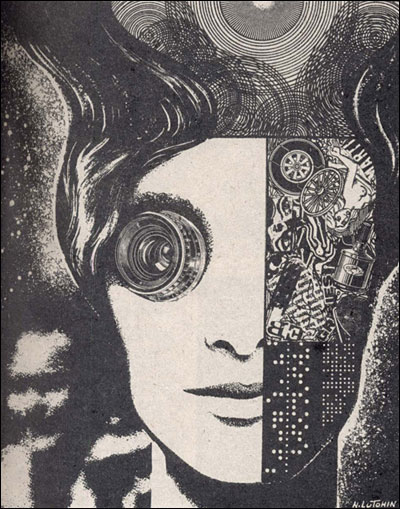
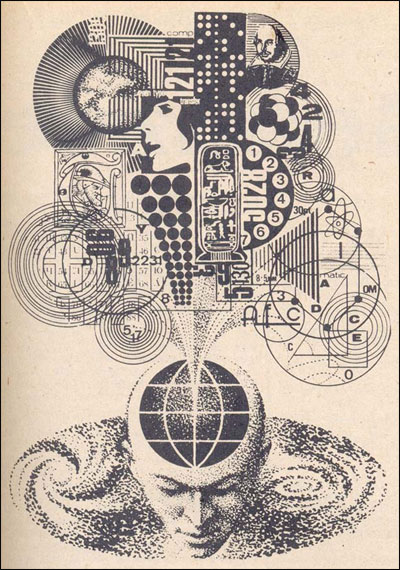
The incredible blog 50 Watts recently published a collection of illustrations by artist Nikolai Lutohin. Will at 50 Watts writes:
Milena and Vlada, the duo behind Yugodrom—a new blog focused on “graphic aesthetics from ex Yugoslavia”—have been unearthing gems from seventies and eighties issues of the science magazine Galaksija.
They wrote to me suggesting that the “surrealistic, sci-fi-sh, serigraphic and absolutely amazing” illustrations of Nikolai Lutohin would be suitable for 50 Watts, and I am inclined to agree. The Russian artist Lutohin was born in Yugoslavia and did many illustrations for Galaksija. I’ve included ten below.
I also love the magazine’s covers and for this post selected a handful from the 136 covers inYugodrom’s flickr set. See more of my favorite covers in a companion post on But Does it Float.
The YUGODROM Tumblr is a treasure trove of beautiful covers, adverts, logos, typography and fashion from the former Yugoslav republics. In addition to much of the retro sci-fi goodness, there is some sexy (sometimes in a creepy way) photography mixed in.
ROSA is, perhaps, not the most original short film ever and, in fact, it does feature a healthy dose of post-Matrix kung-fuery, but that makes it no less impressive. Made by one man, Spanish comic artist Jesús Orellana, for $100 and a year of his life, ROSA tells the story of a cyborg who, as part of a project to restart Earth’s ecosystem, awakens in a post-apocalyptic with no natural life, only other cyborgs who seem intent on destroying Rosa. Again, there’s a lot of slow motion jumping and martial arts pat-a-cake, and the characters themselves are a bit stiff at times, but the fact that one person was able to produce something of this scale is impressive. Orellana has, apparently, already been approached by some studio types so it’s quite possible that we may be seeing much more of Rosa in the future.
This week the FAM continues its Vincent Price-a-thon (Did we mention, this is a Vincent Price-a-thon? No? Well, it is.) with 1964’s The Last Man on Earth, directed by Ubaldo Ragona and Sidney Salkow. It is based on Richard Matheson’s classic novella I Am Legend which would later be bastardized into 1971’s The Omega Man with Charlton Heston, the 2007, Will Smith shit-fest I Am Legend as well as I Am Omega, the “Mockbuster” of that same year distributed by straight to video empire The Asylum.
The Last Man On Earth has two distinct advantages over these efforts. The first is that the script was partially written by Matheson himself and, as such, it most closely follows his original story. In the end, though, he was not particularly pleased with the effort and had himself credited as “Logan Swanson” (a combination of the maiden names of his mother and the mother of his wife):
I was disappointed in The Last Man on Earth, even though they more or less followed my story. I think Vincent Price, whom I love in every one of his pictures that I wrote, was miscast. I also felt the direction was kind of poor. I just didn’t care for it.
The second is, of course, Vincent Price, because everything is automatically made a bit better when he’s around. That said, I would agree with Matheson’s take that Price is a bit miscast here. He’s not the hero type, at least not in the way that the story requires Richard Neville (Morgan here) to be. His interactions with the hordes of undead outside the confines of his house, then, are usually pretty laughable, including scenes of Morgan going about his business of staking vampires while they sleep, in which Price halfheartedly waves a hammer around to pantomime the act of driving a stake into a body. I can’t help but wonder if this may have been a part of the reason why Richard was rewritten as a milquetoast scientist from the blue-collar factory worker in the story. That said, I still find his performance to have some great strengths, most obviously his ability to bring Morgan’s internal monologues to life. Price manages to instill these voice-overs with a palpable sense of sadness and desperation which is good because, much as I adore the book, it is mostly a story about a man talking to himself. This may be why Hollywood has shied away from doing a straight adaptation.
The differences here are fairly minimal, with one exception. The vampires here are shuffling, wrecks, whereas in the book they were agile and fast. This change would seem to have little impact, though it did make an impression on one George A. Romero, who would acknowledge the impact of both the film and the novella on his Night of the Living Dead. Other changes include, Richard’s last name and pre-apocalypse occupation (as previously mentioned) as well as the specifics of his interactions with the woman Ruth and the dog. The largest change, of course, is that of the title and, subsequently, its use in the final line of the story. I Am Legend very much elevates itself with that last line and, though The Last Man on Earth makes an effort, it cannot match Matheson’s twist. Regardless of any shortcomings, however, it’s worth giving The Last Man on Earth a look. It’s a solid film, starring one of the great horror masters and a worthy entry in the history of end of the world cinema.
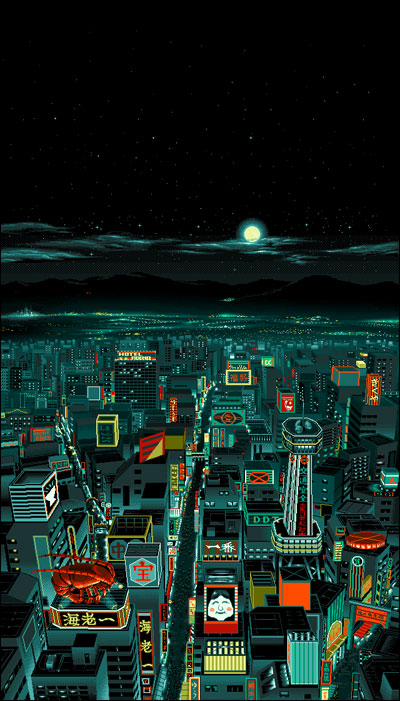
When I saw this striking image of Tokyo while riffling through my RSS feeds, my heart stopped. Supposedly, it’s a still from a forgotten video game made in 1995.
There’s something about this cityscape. I’ve been coming back to stare at the large version of it for two days now, marveling at all the details: that puffy-cheeked man and that lobster, the people on the streets, the density of the buildings, the beautiful pixel weave that makes up the clouds, and that ominous yellow moon. I want to know the story of this game world and its makers. If it’s a still from a mid-90s video game, very few people would have considered that art at the time. Now, in the world we live in, I could easily see this image selling at an art opening. If it turned out that this image was done by a contemporary pop artist, emulating/exaggerating the aesthetics of retro games, I would not be surprised. However, this image feels even more compelling to me precisely because it’s not that, but a forgotten relic, a lost gem, a genuine artifact.
Tumblr tells me (for once) that this striking image is from a video game called “Power Slave,” produced by Jellyfish Software in 1995. I’m not sure if I believe that; the only game titled Power Slave game I could find was this first-person shooter set in Egypt, released by Lobotomy Soft in 1997. Nothing in the game descriptions suggested the appearance of this scene. I checked out a couple of Power Slave playthroughs – not all 17 levels, but enough, including the intro and end, to be fairly sure that this scene was never among them. And the only Jellyfish Soft release that came up in my searches was Aerokid, an aviation game for kids, released in 1998. But then I read somewhere that on the Saturn conversion of PowerSlave included a hidden game. After some Googling, I found that name: Death Tank Zwei. With a name like that, I thought it sounded promising. But after looking through the entire game thanks to some guy’s research video for a Port-to-PC project on YouTube, I came to the conclusion that this game wasn’t the source of the image, either.
And that’s where the trail grew cold. Maybe I missed something. Maybe it’s just another beautiful Tumblr scrap I’ll never find the source of. Anyone have a clue?
Update: mystery solved, thanks to Coilhouse reader Fmtownsmarty. It’s Power Slave, a hentai first-person adventure/strategy game from Japan. “Tetsuya is a rather ordinary Japanese teenager, who prefers hanging out with his sweetheart Rika than going to school. His passion are 3D video games. The newest game machine which allows the player to completely submerge into the virtual world, modeled according to his desires, has captured his heart. But one thing is strange: lately, Tetsuya keeps seeing himself as a killer and rapist. Dreams begin to haunt him. Is this just a side-effect of the game, or does he have a dark side he knows nothing about?” Oh, Japan, don’t you ever change. <3
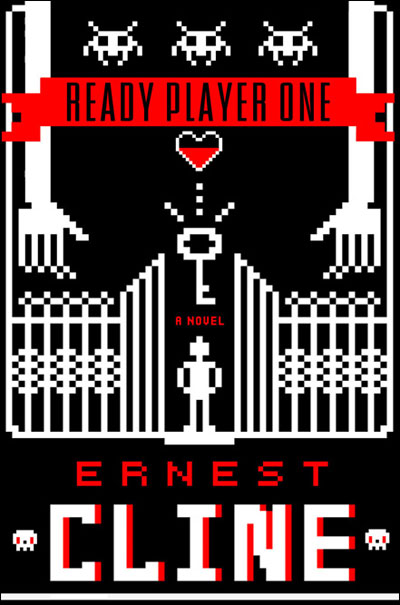
Earlier this year, Patton Oswalt wrote an essay for Wired entitled “Wake Up, Geek Culture. Time to Die.” In it, Oswalt warns that the world is on the brink of “Etewaf: Everything That Ever Was—Available Forever.” Ready Player One by Ernest Cline is a daring young-adult fiction book about what might happen in such a world.
The year is 2044, and the world is ravaged by economic collapse. The peak oil crisis has occurred, unemployment is at an all-time high (with a two-year wait for jobs in the fast food industry), global warming has destroyed the climate, and people live in abject poverty. Our protagonist, 18-year-old Wade Watts, lives with sixteen other people inside a trailer. The trailer is part of “the stacks” – a new type of ghetto on the outskirts of major cities in which trailers, RVs and shipping containers are stacked one on top of another, creating tall, precarious towers.
On the bright side, a nerd “über-deity”/computer genius named James Halliday has crafted the ultimate MMO: a haptic virtual world akin to the Stephenson’s metaverse, Gibson’s cyberspace, and World of Warcraft. The immersive environment, called OASIS, is accessed by everyone with a computer, and most people spend every waking second in it. In this world, education is free, space is nearly infinite, and every type of diversion exists to distract people away from their daily life.
One the day after James Halliday (born: 1979) dies, a recorded invitation gets sent to every player in OASIS. While Oingo Boingo’s “Dead Man’s Party” plays in the background, a recording of Halliday, digitally inserted into a scene of a John Hughes film, informs OASIS users that he has hidden an easter egg somewhere in the game. And that whoever finds it will inherit Halliday’s entire fortune of billions, his assets, his company, and rulership of OASIS.
The hunt is on. Teenagers race against an evil corporation to find the egg. In their search for clues, a new generation discovers the 80s culture that Halliday loved, the culture that inspired him to build his all-encompassing virtual world. From Blade Runner to Ultraman to the Commodore 64 to Dungeons and Dragons to Devo to Adventure and beyond, Halliday’s challenge produces an otaku culture the likes of which the world has never seen. But as the stakes get higher and people begin to die not only in OASIS but also in real life, it becomes clear that it’s not just a game, and that the future of civilization depends on the outcome.
It’s a wonderful book. Everyone should read it. Check out the excerpts on Ernest Cline’s site, where you can also purchase the book or e-book. The audiobook version is narrated by none other than “Portrait of the Artist as a Young Geek” author Wil Wheaton. A perfect match.
With the upcoming release of the prequel/re-make film, The Thing, this Friday I thought it would be good to remind everyone of John Carpenter’s 1982 musical re-make of the 1951 Howard Hawks/Christian Nyby classic The Thing From Another World. While the newest incarnation of John W. Campbell, Jr’s “Who Goes There?” looks like it could be interesting, I seriously doubt that it will be able to beat the songs from Carpenter’s effort — especially the title piece, featured here. He really nailed it.
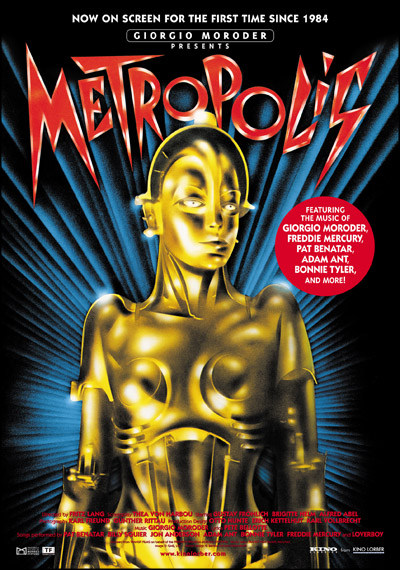
“In 1981, here three-time Academy Award-winning composer Giorgio Moroder began a three-year endeavor to restore the science fiction classic, Metropolis. During this process, Moroder made the controversial decision to give the film a new, contemporary score, and added a pop music soundtrack featuring songs from some of the biggest stars of the early MTV era, including Pat Benatar, Billy Squier, Freddie Mercury, Bonnie Tyler, Adam Ant, Jon Anderson and more. In addition to the new score, missing footage was re-edited into the film, intertitles were removed and replaced with subtitles and sound effects and color tinting were added, creating an all new experience…and an all-new film! But for more than a quarter century, this version of Metropolis has remained out of print – until now. A new HD transfer was created from one of the few remaining prints available, and Kino Lorber is presenting the film in the best possible quality – just as it was seen in its original release in August 1984.”
Seen it? Love it? Hate it?
No matter what, these current screenings are sure to be lively, campy, fun gatherings. (If any of our good readers up going, please report back!)
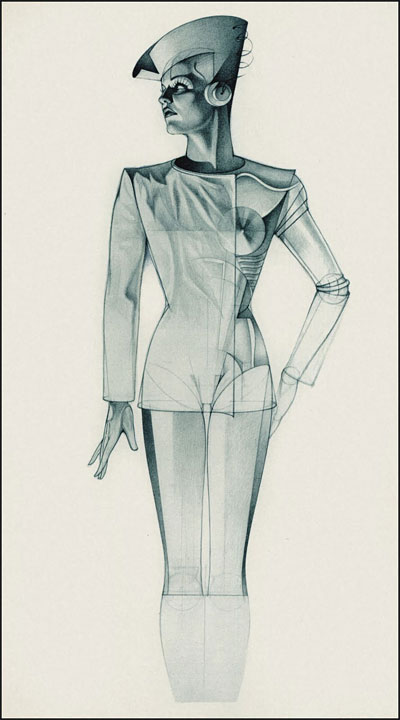
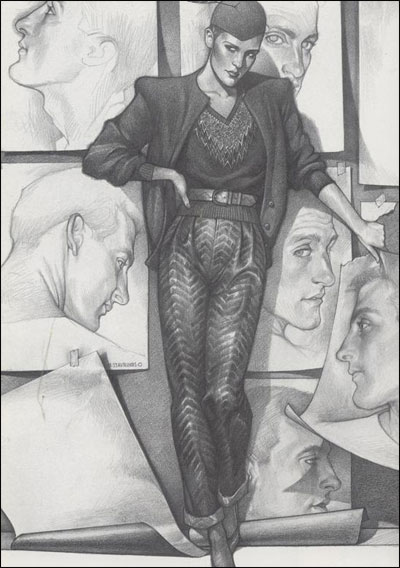
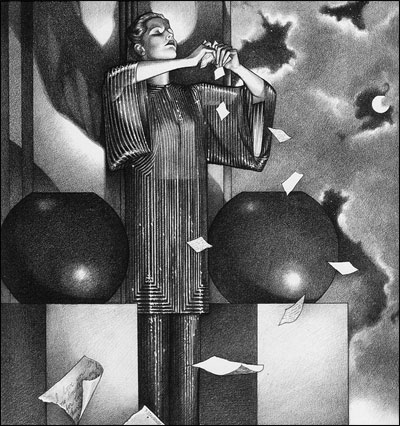
George Stavrinos was a fashion illustrator who lived from 1948-1990. Not much is written about him on Wikipedia at the moment, but according to illustrator Thomas Heller Buchanan, “his softly modeled pencil drawings were a mainstay of Bergdorf Goodman and Barney’s fashion ads, though Stavrinos did not consider himself a fashion illustrator. He was an artist, photographer, commercial illustrator, and filmmaker.”
A graduate of RISD, Stravinos was known for his representational style and strong draftsmanship that “created an arresting new look that set the pace for his contemporaries and still continues to be an influence,” according to his bio in the Society of Illustrators Hall of Fame. A huge fan of J. C. Leyendecker, Stavrinos crafted striking illustrations that mixed time periods and transcended the world of fashion. He died from pneumonia complications at the young age of 42.
Despite the bizarre scarcity of information available about Stavrinos on the web, one unlikely source turned up to give a glimse into his life: this auction website. In describing a rare book of Stavrinos illustrations printed in Japan, a person who may have known Stavrinos writes:
When my dear friend George Stavrinos arrived in New York in November 1973, he had but five hundred dollars in his pocket and a portfolio of dreams tucked under his arm. At that time Fashion was the almost exclusive province of the photographic image. Fashion Illustration, which had once flourished under the magical touch of Lepape and Benito, or much later, under Gruau, had devolved into bland, linear sketches of half hearted ads. … Into this vacuum enters Mr. Stavrinos whose illustrations for Bergdorf Goodman and Barneys New York, brought back a lushly representational style of Fine Art Illustration not seen since the days of Charles Dana Gibson, Howard Chandler Christy, J.C. Leyendecker and Antonio Lopez. The Stavrinos style was characterized by a great attention to detail, an exactness and a symmetry normally associated with classical works. His work revolutionized fashion illustration in much the same way that Bruce Weber, Herb Ritts & Scavullo revolutionized fashion photography. For while his work is highly representational, it’s imagery evokes those tender, tingling feelings of Romance & Longing. Memories of a time that never may have never existed, except in our imaginations.
In addition to his contributions to the fashion world, Stavrinos also has a place in the history of LGBT art. He created a smoldering cover for first edition of The Deformity Lover, a book of queer poems by Felice Picano, his illustrations ran in Christopher Street and Blueboy, two seminal gay magazines of the 1970s, and he may have contributed an uncredited cover for Paul Monette’s “Taking Care of Mrs. Carroll.” His most overtly homoerotic works, The Bather and Lifeguard, appear in the Leslie Lohman Museum of Gay and Lesbian Art.
Céline Desrumaux‘s fantastic animated short “Countdown” details, as one might expect from the title, the launch of a rocket. The style here is a combination of flat colors and hard, almost architectural lines, as though it had leapt straight from the pages of Popular Mechanics circa 1958, along with some character animation by Florent Remize. Desrumaux (who is one half of Céline & Yann who produced the delightful series “The Giants”) cites Chris Ware as an influence and that is, indeed, the first person that comes to mind. “Countdown” has a heart-pounding, frenetic quality to it, combining almost abstract shots of dials, meters , and light; and shots of the rocket as it prepares to launch, cropped down into the square, vignetted look associated with, at least, the older exterior NASA footage. All of this is set to the harried pace of Apprat‘s “Granulard bastard”. It all makes for a gripping three and a half minutes.