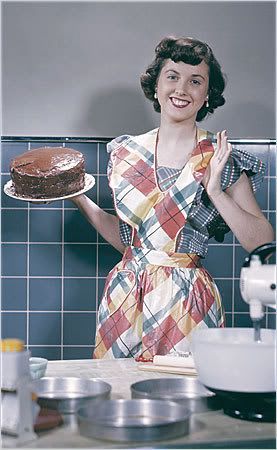
Yerim and Her Pink Things, 2005
The images above and below are just a few from JeongSee Yoon’s Pink And Blue Project, an ongoing set of images dealing with gender, consumerism, and globalization. Dozens of surreal, hyperdetailed images of mostly Asian boys and girls with their blue and pink things appear on Yoon’s page. The girls’ images are what strike me the most. “It looks like these little princesses vomited fairy-floss all over themselves,” observes Katie Olson at Lifelounge, then adds: “Fabulous.” Indeed!

It wasn’t always this way. The color pink, Yoon notes, was once considered the color of masculinity, a watered-down version of the virile color red. He quotes a 1914 American newspaper that advises parents to “use pink for the boy and blue for the girl, if you are a follower of convention.” The reversal of colors for boys and girls occurred only after World War II. Writes Yoon, “as modern society entered twentieth century political correctness, the concept of gender equality emerged and, as a result, reversed the perspective on the colors associated with each gender as well as the superficial connections that attached to them. Today, with the effects of advertising on consumer preferences, these color customs are a worldwide standard.” This is the first time I’ve ever heard the claim that the feminist movement is somehow even indirectly responsible for “pink for girls.” Some quick “say it ain’t so!” Internet research reveals that historians have been unable to pinpoint the reason for the post-WWII color reversal. Reasons for the reversal have been pinned on everything from the Nazis (who labeled the homosexuals in their camps with pink triangles) to a cultural desire on post-war America’s part to bury Rosie the Riveter and replace her with Susie Homemaker. A plausible theory – and I think I uncovered the missing link!
With stores like nANUFACTURE in Spain marketing to parents who wish to avoid the pink/blue dichotomy, it’s clear that color-coding your child’s life is increasingly being seen as unfashionable, even a bit creepy – though, as SocImages points out, this expensive store’s “Save the Babies” campaign may be “more about ‘saving’ kids from things these young, hip parents think are lame or uncool.” Even without the aid of hipster-kid clothing boutiques, parents have a myriad of choices for dressing their kids. As Yoon shows us, some skip out on the pink/blue thing altogether.
For parents of transgender children, on the other hand, the choices today are more complicated than ever. If your son insists, every day, for years, since the moment he can talk, that he’s a girl and not a boy, what kind of clothing do you buy? What kind of toys do you give them? A fascinating article in the current Atlantic examines this issue, focusing on the growing culture of parents who wish to honor their children’s wishes – and the difficulties that accompany such a decision. Delving into everything from children’s rights to Freudian therapy resembling scenes from But I’m a Cheerleader to the heartbreaking story of David Reimer (from the book As God Made Him), the article compassionately examines families on both sides of the fence, chronicling the paths of families who decide to go with their children’s wishes, and those who decide to fight against them.
Posted by Nadya Lev on November 28th, 2008
Filed under Gender, Kid Stuff, Serious Business, Surreal, Uniform, Why | Comments (12)
So… Zo, Mer and I are in Issue 02 Deadline Hell. Posting’s slowed down until Issue 02 is sorted, with many thanks to our guest bloggers for keeping the fort. Later today, a very special post from copyranter involving Mexican food and toilet paper. For now, a quickie that I’ve been wanting to post for a long time: one of our paper dolls from the magazine’s back page (a tradition that will be carried over to Issue 02), fully dressed. For those of you who didn’t want to cut out the paper dolls but are still curious about how they look in their outfits, here’s 1 of 2, the lovely Juniper Fusion by artist Paul Komoda:

Posted by Nadya Lev on October 16th, 2008
Filed under Art, Comics, Film, Goth, Grrrl, Industrial, Sci-fi, Uber, Uniform | Comments (4)

WWII image taken by Yevgeni Khaldey. Laibach was always present.
Laibach has finally returned to North America for a very short tour. If you’re in Portland or Seattle, I hope you saw them. If you’re in San Francisco, Hollywood, New York or Mexico City, you’re in luck! Click here for tour dates.
There are many reasons why this is my favorite band, and most of them actually don’t have much to do with the music. It’s the stories: weird, fantastical events that surround this band in which art, politics, history, media and human nature intersect in unexpected ways. My favorite Laibach story is this: in 1992, they group established the NSK State, a virtual “state in time.” Citizenship to the NSK State came complete with a very realistic-looking passport, and anyone could apply. Applications could be found at concerts and in the back of certain art books. In 1995, Laibach concluded their NATO tour in besieged Sarajevo. They declared Sarajevo to be NSK territory, so for a brief moment, the NSK State existed in the physical world. During this time, they issued 350 NSK diplomatic passports. What’s remarkable is this: some people were actually able to use these passports to escape occupied Sarajevo. Bosnian passports were not recognized at the borders, but a French soldier who saw the NSK ones let those people through. With their art and performance, Laibach was able to potentially save lives. Compelling – even more so when you consider that their work centers around a deadpan sense of humor.
The music is great too, of course! This entire website was designed while listening to Kapital, and partially inspired by the album’s aesthetic. So, Mildred and I will see you at the LA gig if you’re there. In the meantime, a random assortment of odd Laibach-related links:
Posted by Nadya Lev on September 25th, 2008
Filed under Art, Cryptohistory, Events, Industrial, Misinformation, Music, Politics, Serious Business, Uber, Uniform | Comments (10)

A comely consortium of Slave Leias gathered at Gentle Giant‘s booth this morning to pose with GG’s larger (and droolier)-than-life Jabba statue. Not pictured: legions of mouth-breathing Frito-eaters with cheap instant cameras and sweatpants boners.
Posted by Meredith Yayanos on July 25th, 2008
Filed under Fairy Tales, Fashion, Fetish, Film, Flora & Fauna, Geekdom, Sculpture, Stroke Material, Uniform | Comments (8)

Figure A: Russia’s bad kids [via]
Oh, modern Russia! My former homeland, with your gold-plated toilets, your polonium, your hotpants, your outdated military technology, your simple modesty… how you continue to enchant me with your many wonders! Especially when it comes to feats of social engineering. Witness, for example, the Kremlin’s ingenious new plan to ban emo and goth, as reported by The Moscow Times:
State Duma deputies, Public Chamber members and social conservatives have hammered out legislation aimed at heading off the spread of emo culture, which they describe as a “dangerous teen trend.” The Duma last month held a parliamentary hearing on a raft of proposed amendments contained in a document called “Government Strategy in the Sphere of Spiritual and Ethical Education,” a copy of which was obtained by The Moscow Times. Among other measures, the proposed legislation calls for heavy regulation of emo web sites and for banning young people dressed like emos from entering schools and government buildings. The bill also outlines what it calls a “spiritual and ethical crisis” facing Russian youth, including the high rate of alcohol abuse, teen abortions and “negative youth movements.” Emo ideology encourages and justifies drug use and sexual relations among minors, according to the bill, which also lumps emos and goths together with skinheads.
Negative youth movements? Sexual relations among minors? Of course you’d never encourage such a thing, Russia. Certainly not with government funds! And especially not if they dress like Anonymous! Oh, wait…
Update: Zo adds, “just wanted to supplement the post with this link submitted to me this morning by Apaniyam on Flickr. There is talk of curfews, a ban on body mods and more.
Under the new measures, schools would be prohibited from celebrating Western holidays like Halloween and St. Valentine’s Day, which are deemed inappropriate to “Russian culture.” Toys in the shape of monsters or skeletons would be banned as “provoking aggression.”
Bonus extended remix: compare and contrast to the Mexican government’s treatment of its young emo citizens. After violence against the subculture increased, government officials actually launched a campaign to promote understanding under the slogan “for the freedom of being young, live and let live.” Russia vs. Mexico: it’s on!
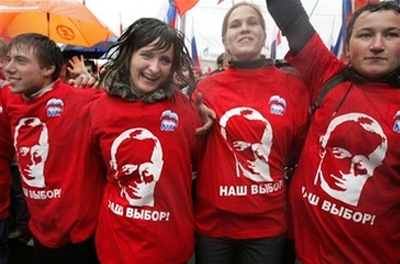
Figure B: Russia’s good kids [via]. The one with the asymmetrical bangs is about to be seized and removed from the scene.
[thanks, Milly.]
Posted by Nadya Lev on July 24th, 2008
Filed under Hair, Madness, Multiculti, Personal Style, Politics, Russia, Serious Business, Silly-looking types, Uniform, We disapprove, Why | Comments (23)
Saturday night marked the opening reception of the Fantastic Contraption exhibit I’ve been blustering about. Curated by Device Gallery owners Greg and Amy Brotherton, this show focuses on man, machine and the fusion of the two.

A very happy Greg Brotherton with his work.You may have seen Greg on Coilhouse before – read Nadya’s writeup here.
Device is nestled comfortably among dozens of galleries near the ocean. The touristy neighborhood is full of art, boutiques and eateries but there’s nothing quite like Device here! The gallery has plenty going for it besides its location, too – its spacious interior is overflowing with art I’d only dreamed of seeing in one place. Where else can you see H.R. Giger hanging alongside the huge canvases of Eduard Anikonov, wander beneath the shadow of Brotherton‘s Mercury 5000 and hover over the several enhanced insects on display before getting lost in Halleux’s menagerie of characters! I even spied work by Kazuhiko Nakamura of Mechanical Mirage – one of my earliest mentions here on Coilhouse. The exhibit has a distinct zeitgeist feel, this much I tell you with complete certainty.
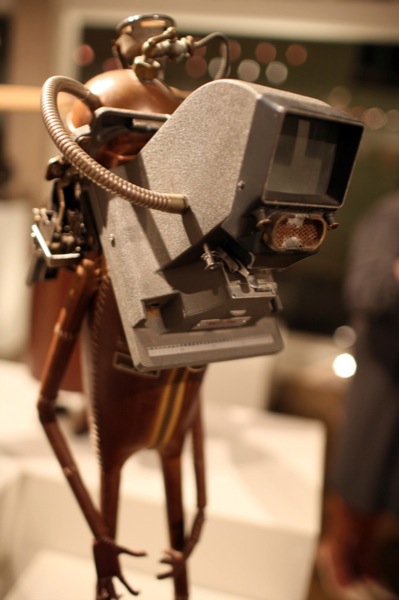
Sculpture by Stephane Halleux
After some time spent exploring I had the pleasure of chatting with Greg and Amy along with Nemo Gould and Stephane Halleux, whose work is approximately 98% more impressive in person. I also took tons of photos some of which are below the jump while the rest are being uploaded here, as time allows.
It will be interesting to see how a space like this does among galleries specializing in friendly still life, idyllic beach scenes and the like. Considering Saturday’s turnout, my prognosis is “just fine”. Fantastic Contraption is Device Gallery’s inaugural show and runs through September 2. Go now.
Posted by Zoetica Ebb on July 22nd, 2008
Filed under Art, Culture, Cyberpunk, Events, Sculpture, Uniform | Comments (10)

Open the iris.
Windom Earle: Garland, what do you fear most… in the world?
Major Garland Briggs (drugged with sodium pentothal): The possibility that love is not enough.
Q. Gauti has just informed me that Don S. Davis, the prolific character actor best known for his role as General Hammond on Stargate SG-1, passed away last weekend following a massive heart attack. Oof.
Stargate’s rad and all, but I’ll always remember Davis as the stern but gentle Major Garland Briggs on Twin Peaks, truly one of the most lovable supporting characters in television history.
Rest in peace, good sir. Safe travels to the White Lodge.
Posted by Meredith Yayanos on June 30th, 2008
Filed under Memento Mori, Television, Uniform, Why | Comments (24)
Womens’ correctional facilities are the ultimate sleep-over party with all the trappings: pajamas, bunk beds, in-fighting, sloppy joes, getting touched up under the covers, and being told when to go to bed. Some prisons even let the girls play dress-up. Miss America, meet Miss Demeanor:
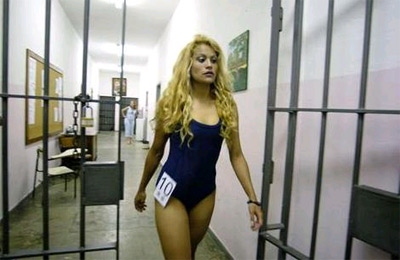
To be fair, it’s primarily inmates who organize these shows. It’s an increasingly popular phenomenon, with womens’ prisons hosting beauty pageants in Russia, Brazil, Peru, Honduras, Angola and the Philippines, amongst others, with working titles like Miss Captivity. The idea is to ‘boost’ the self-esteem of (at least the better looking portion of) the prison population.
There is arguably an obvious exploitative angle in this, one which perpetuates gender and class divisions in a place where women are their most vulnerable. The media is only too happy to join in, throwing the spotlight on the tragedy of a pretty young woman in distress, putting herself on display. A beauty contest under these conditions probably does next to nothing for the self esteem or prospects of the contestants in any meaningful way.
It’s almost a perverse caricature of a parole board hearing in a Van Halen video, an effort to charm your way into garnering favour from you captors and respite from your situation by any measure necessary. Having said that, spending years trapped like an animal in a gray, clinical dorm framed in razor wire, any warm-blooded woman would thirst for anything beautiful in her world. Participation in these productions transiently refashions the contestant from a shoplifter or drug addict into a graceful, sophisticated and beautiful person of seeming worth, if only for one evening. Who could condemn the contestants for their humble aspirations and for enjoying an event which breaks up the tedium of Gilligan’s Island re-runs on prison TV?
Trailer for Miss Gulag, a 2006 Documentary:
[kml_flashembed movie="http://www.youtube.com/v/G5uhg7oaFBw" width="400" height="330" wmode="transparent" /]
Posted by Mildred Von on March 14th, 2008
Filed under Gender, Opinion, Politics, Russia, Stroke Material, Uniform | Comments (9)
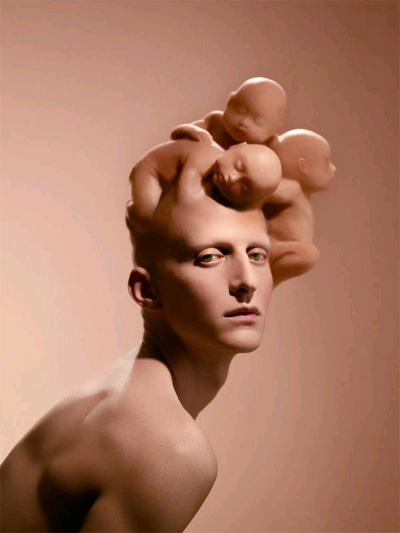
It takes a lot of guts to do a powerful self-portrait. After the jump, my 5 favorites du jour, starting with:
Ali Mahdavi
Posted by Nadya Lev on January 22nd, 2008
Filed under Art, Fetish, Japan, Personal Style, Photography, Surreal, Uniform | Comments (12)

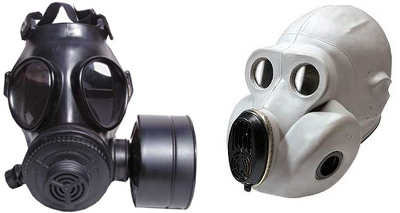
Increasingly popular mask sweatshirts were recently banned by the administrators of Orange County’s Capistrano Unified School District. The concerned officials sent out mass emails warning parents to remember, while doing their holiday shopping, that kids won’t be able to wear such sweatshirts on campus. Tom Ressler, the principal of Capistrano Valley High said “There is no way to identify who kids are. Generally, we don’t think that is a good thing. It gives kids the opportunity to do something bad”.
The goggle jacket is causing a commotion in England – it isn’t illegal, but apparently the look is perturbing anyhow. According to AFP “models with dark colors convey the image of commandos or criminals, while ones with light colors give the impression of a nuclear or biological catastrophe”.
Posted by Zoetica Ebb on December 26th, 2007
Filed under DIY, End of the World, Fashion, Uniform | Comments (28)