BTC: “Waking up to say…”

“…HEY GIRL!”

Yeah, admittedly, we’re a little late to the party re: this amazeballs Beauty and the Beast parody by Micah McCain. But it’s just too good NOT to post as a BTC, and surely, not all of you have experienced the spiffiness yet. Bonjour!

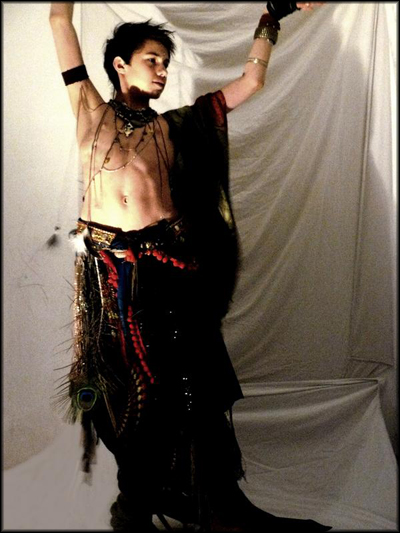
BTC: Illan Rivière

This elegant young man’s name is Illan Rivière.

Already an accomplished fusion belly dancer, Illan, who lives in France, is only eighteen years old. Definitely one to watch.

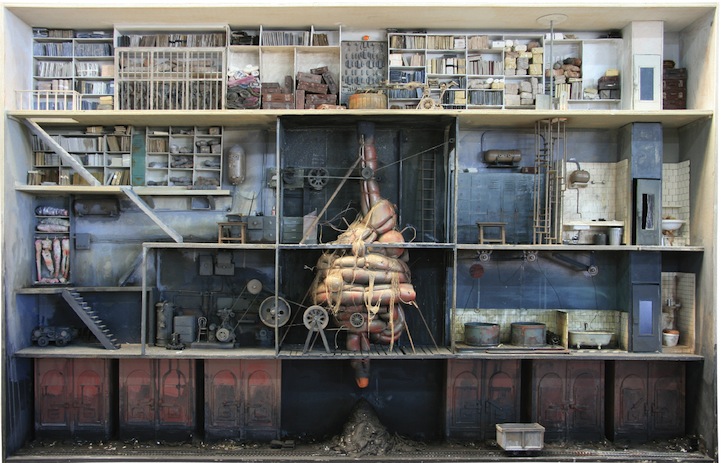
Marc Giai-Miniet’s Existential Dreamhouses


Le grand digérant (Digesting the great)  No. 4, 102 x 162 x 15

“Giai-Miniet is what’d you get if Kafka had designed Barbie dreamhouses.” (via)

Dreamhouses?  Perhaps more like maisons de cauchemars.   Marc Giai-Miniet‘s painstakingly detailed, mixed-media shadow-box installations are  reminiscent of  a vaguely ominous, fading nightmare; a slumbering visitation to a childhood home,  dilapidated and abandoned,  darkened corridors permeated with a surreal atmosphere of dusty déjà-vu.

Ominous,  fantastical, and yet on some level that barely registers  – these ‘boxes’ are familiar and comforting in a way unique to those corners in which we have previously peeked and will explore once more when we are slumbering and our subconscious holds sway.  Again and again we will wind through our own personal, chaotic and connected dreamhouses –  and M. Giai-Miniet appears to know  this full well.

Born in 1946 in Trappes, France, Marc Giai-Miniet studied at the l’Ecole Nationale Superieure des Beaux-Arts, a distinguished national school of Fine Arts in Paris, France. He is currently the Secretary of the Salon de Mai, a gallery founded in Paris with the purpose of encouraging and exhibiting younger abstract artists.


Marc Giai-Miniet, photo by Sylvie Giai-Miniet

According to Giai-Miniet (though run through Google translator) :

“The ‘boxes’ have appeared relatively late in my work as a painter, as a natural and necessary, and have become an inseparable part, a double play. Reminiscent of my teenage desire to do theater, and perhaps even the deepest yet my memories of childhood games pitched battles between miniature electric trains and installed under the table in the family dining room.  These “boxes”, from their manufacture in the years 92 – 93, repeated the themes of my paintings: the brainwashing scene, visit the mummies, stirring transfusions and various larvae.  Small characters were cardboard cut out of the ballet and existential irony of my painting.  Over work, buildings are becoming increasingly large, the characters have disappeared and books, whole libraries have taken place in conjunction with laboratories, storage rooms, waiting or interrogation cells, stairs, corridors, furnaces, sewers or outbound docks … I understand that the books burned, and figured, were painful metaphor of human life, both mind and matter and inexorably doomed to their fate. . For not only the books can be burned but sometimes transmitted through knowledge, they we “burn”, we transform, we accompany or lead us astray … in a vision became ‘existential.’ ”


Grande Boîte Blanche, 130 x 130 x 11

Super Cat World VS High Voltage Prairie Dogs Group Audio Harassment

A little light Rapture music:

Yours truly has NO idea why this video hasn’t gone insanely viral. Then again, yours truly is tripping balls on painkillers at the moment.

Double prairie-dog dare ya to watch the entire thing.

[Edited to add: holy FUCK, THIS ENTIRE CHANNEL IS NUTS.]

Diaghilev Gets His Due: The Golden Age of the Ballets Russes at the Victoria & Albert Museum

Editor’s Note: We are delighted to welcome writer and dancer Sarah Hassan into the Coilhouse family. Her premiere piece for us is a 3000 word feature about Sergei Diaghilev and the Ballet Russes. This is definitely one of the most informative, inspiring, infectious posts you’ll read here this month, so settle in, and enjoy!


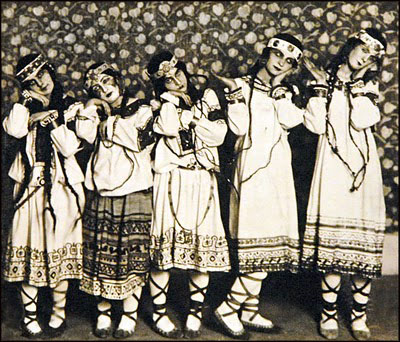
Dancers in the original Le sacre du printemps production.

The Théâtre des Champs-Élysées in Paris seems an unlikely venue for a riot. Yet almost one hundred years ago, on May 29th, 1913, fist-fights broke out in an audience made up of socialites, musicians, and artists. The institution in question was one that by today’s standards seems chaste and predictable: the ballet.

The premiere of Le sacre du printemps by Sergei Diaghilev’s Ballets Russes has become the stuff of legend. Against Nicholas Roerich’s backdrop of a primitive Russia, the radical score by Igor Stravinsky came alive to the choreography of Vaslav Nijinsky, the danseur noble darling – and object of Diaghilev’s affection – whose unsurpassed defiance of gravity on Europe’s great stages had been leaving balletomane’s breathless. Now, the dancer whose roles included a lovesick puppet, a sprightly rose, and a predatory golden slave presented a complicated tableau of sacred ritual. With balled-up fists and downward glances, his dancers jumped and stomped their pigeon-toed feet in time with the violins as if trying to conjure up the ghosts of pagan tribesmen. The heavy woolen dresses painted with folk patterns on the peasant girls were in place of the frothy tulle skirts of nighttime sylphs and bejeweled torsos of slinking odalisques expected from a program a’la Russes.


Nicholas Roerich’s Costumes for Le Sacre Du Printemps.

The production, presenting a ‘new type of savagery,’ caused a literal aesthetic outrage among the haute Parisian audience. Backstage, as the birth of modern dance unfolded, Nijinsky screamed the tempo counts in Russian to dancers who couldn’t hear over the booing, while Stravinsky held him by his coattails lest the crazed choreographer topple into the orchestra. Diaghilev attempted to placate the uproar by turning the house lights on and off. Yet despite its unsuccessful reception, Le sacre du printemps was performed six times, and Diaghilev declared the opening night scandal to be ‘exactly what he wanted.’ It was clear that the ballet was no longer safe.

Thirty-two years after Le sacre’s premiere, Nijinsky, having succumbed to insanity, leapt for a photographer’s camera in a Swiss asylum. The image captured the aging dancer smartly dressed in a suit suspended in the air, proof of his once otherworldly powers. Yet, one can only wonder if the height Nijinsky was attempting to recapture was not his own, but that of the sacrificial virgin he created, dying from her own mad dance in a flash of beastly glory.
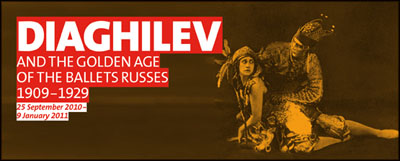

The banner at the Victoria & Albert Museum for Diaghilev and the Golden Age of the Ballets Russes.

All the hoopla generated by Darren Aronofsky’s psycho-sexual melodrama Black Swan made it easy to believe that ballet had been once again recovered from the ashes of its own antiquity. With Jennifer Homan’s attempt to condense 400 years of history with her book, Apollo’s Angels, the ballet’s ability to survive in an age where anything goes and everything changes came into question – the blood-stained tutu of Natalie Portman’s Nina Sawyer notwithstanding. Madness is, by Aronofsky’s account, the cost of greatness. This idea is artistic old-hat, retold through ballet by Moira Shearer’s exceptional Victoria Page in The Red Shoes – a movie loosely based on Diaghilev and his company – and all the gory details of Swan, from broken toes, bone-thin frames, and endless retching struck a resonant, less glamorous chord. The curtain was pulled back to reveal an art that demands perfection as you claw your way to the top while clawing yourself apart. Ballet, according to Black Swan, is more an arena for the cruel and calculated and less the foundation for beauty, innovation and fantasy.

Oh, how the days of Diaghilev would beg to differ.

La Preuve Par 4 at the 2010 Juste Debout

This has already gone ultra viral, for obvious reasons, but it’s gotta be catalogued here, too.


The women and men behind the masks: Marion Motin (Quality Street and Swagger crews), Julie Moreau (Swagger crew), Nicolas Medea (R.A.F crew), Marvin Gofin (R.A.F crew).

You’re watching La Preuve Par 4′s performance at the 2010 Juste Debout, an international street dancing competition in France. La Preuve Par 4 is comprised of two members of R.A.F crew (winners of the 2009 World Hip Hop Championships) and two members of the Swaggers crew. The music was composed and remixed for them by soFly.

EDIT: Here’s another, high res video of the same performance, shot from higher angles. This footage was taken by YAK FILMS. You might recall Coilhouse expressing a lot of love for them a while ago. Nowadays, it looks like this youth-led alternative media team is venturing a long way from Oakland, proving themselves to be invaluable curators of street dancing on an international scale. Inspiring stuff.

A Requiem for Jean Rollin


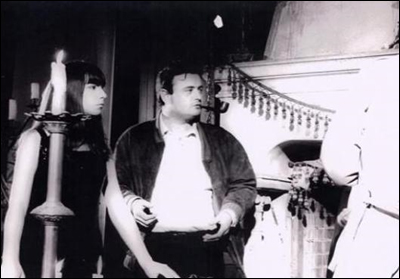
image courtesy Fascination: The Jean Rollin Experience

Jean Michel Rollin Le Gentil, French film director fantastique and “gentle poet of sensual horror”,  passed away yesterday (December 15, 2010) at 72, after a long illness.

Much beloved by his fans and horror connoisseurs, lauded for his bizarre genius and the unique, intensely personal vision he brought to his films, Rollin leaves a legacy brimming with uncanny beauty and perverse, morbid delights.

Though his works contained elements of horror cinema,  Rollin insisted he did not make horror films; instead he prefers the label fantastique, which he described as “the opposite of the supernatural”.   His story telling, marked by “surreal sensibilities” and a “narcotic narrative drive”, made for mysterious (and at times maddening) viewing; but the imagery, oh, the imagery. Languid and melancholy, romantic and doom-laden, the dreamy atmospheres Rollin crafted were truly like nothing else in cinema: “…hermetically sealed worlds of desolate chateaus, solitary vampires and violent seduction”.

According to Rollin’s son Serge, who spoke with Fangoria shortly after his father’s death, “Jean was surrounded by his friends, and was looking at the photos of his two granddaughters when he died.”


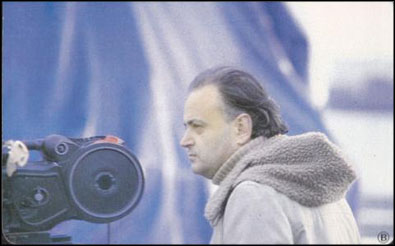
Jean Rollin (via)

Rollin was calmly uncompromising and self-assured to the very end. The filmmaker’s own words about his work and perceptions of criticism are as fitting a closing statement as any:

“Honestly, I don’t care [what people call me]. Some people say I’m a genius, others consider me the greatest moron who ever stepped behind a camera. I have heard so many things said about me and my films, but these are just opinions.

I am perfectly happy with what I do, because it has always been my choice.”

Sous La Glace


Via Foxtongue.

Just a blue-haired, underwater-smoking gayelle mermaid to brighten up your Monday morning. This illustration by Georges Leonnec appeared in risque French magazine La Vie Parisienne in 1926. The magazine was founded in 1863, relaunched just before World War I, and evolved from a mild-mannered society journal to an erotic magazine of humor, literature and scantily-clad damsels. Many more images from La Vie Parisienne can be seen here, here and here.

Badass “Les Cyclopes” Performance by E. Comparone

Elaine Comparone is the Tony Iommi of Baroque harpsichord, and you’re about to get your face rocked off, Rameau style.


Via Darla Teagarden, who says, “imagine running through a house of mirrors in Greece circa 1927 after smoking hashish while wearing tiny shoes.” (Perfect!)

Comparone claims Rameau’s shredding piece of music was inspired by Homer’s Polyphemus. Other scholars suggest that the French composer was representing the BRVTAL brothers Arges, Brontes, and Steropes –Cyclopean blacksmiths who forged lightning bolts for Zeus– and that the insanely manic percussive runs are meant represent the giants busy at work, hammering and forging thunderbolts. Either way? MMM\m/ETAL.

The FAM: The Triplets Of Belleville

Hot, steaming pantomime on order today for the FAM as we present The Triplets of Belleville (Les Triplettes de Belleville), the surreal animated adventure from 2003, written and directed by Sylvain Chomet.

Triplets tells the story of Madame Souza who is raising her son, Champion. Noticing his sadness one day, she purchases for him a dog named Bruno and though this does cheer him up, his joy is short-lived. It is only after she realizes his interest in bicycle racing and gives him a bicycle of his own that Champion finds real happiness. Fast forward and, years later, Champion has become a world-class cyclist, competing in the Tour de France. It is during this race that a mafia boss kidnaps Champion and two other cyclists, bringing them to the town of Belleville in North America and hooking them up to a virtual-reality cycling machine, allowing patrons to gamble on the races. Madame Souza and Bruno follow, of course, attempting to rescue him from the mafia’s nefarious clutches; meeting along the way the titular triplets, a trio of retired cabaret singers.

It’s a strange arc, then. Triplets starts off easily enough, slow and methodical, but upon the kidnapping of Champion things surge into overdrive, getting progressively weirder and the two don’t quite mesh as well as they perhaps should. It’s almost like they stitched together to different films. That said, this observation does little to detract from my enjoyment of the film. Chomet has created a beautifully realized world here with his characters barely uttering a single word. The version above features no English subtitles, an omission you will hardly notice. Every emotion and thought is spoken with subtle, expressive animation. In addition, the movie features an outstanding soundtrack inspired by the jazz of the 20s and 30s (the film even goes so far as to reference both Django Reinhardt and Josephine Baker in the first few minutes.)

In animation at least, I find myself drawn to pantomime. It strikes me as a testament to an animator’s talent, this ability to abandon the spoken word. In that way it’s interesting to note that Pixar, who’s Finding Nemo beat out The Triplets of Belleville for best picture has begun incorporating this aesthetic more in their recent films, most notably Wall-E (perhaps my favorite from them). Chomet’s new film, L’Illusionniste will see a release in the States in December and I find myself just as anxious as when I first saw a trailer for The Triplets of Belleville. I just can’t see his oeuvre losing its charm.