
Mondo 2000: Where Are they Now?
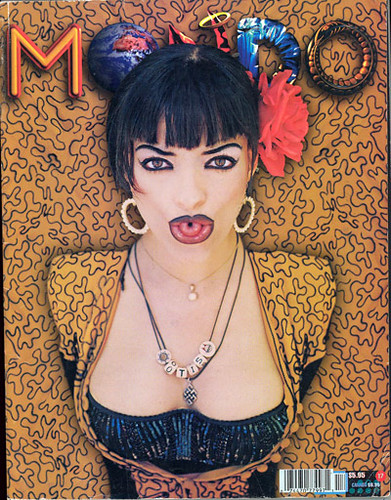
The last issue of Mondo 2000, featuring Nina Hagen on the cover.
I’m obsessed with dead magazines, especially ones that crossed over into the mainstream. The history of such magazines often sounds like a VH-1 Behind the Music special; first the group’s idealistic creation rises to fame on account of its originality, then comes the inevitable collapse due to in-fighting under the conflicting pressures of appeasing a wider audience, a set of advertisers and the project’s own artistic aims. More often then not, the problem is simply that such a magazine is way ahead of its time. This was the case with Mondo 2000, yet I’m grateful that it existed precisely when it did.
So, what made Mondo 2000 so special? It was, in my opinion, the best alternative culture magazine that America ever had. They wrote about smart drugs, brain implants, virtual reality, cyberpunk, Cthulhupunk and cryogenics. They covered Laibach and Lydia Lunch in the same issue. The pantheon of writers was a force to be reckoned with: Bruce Sterling, Robert Anton Wilson, and William Gibson all lent their talents, and there was even a Burroughs vs. Leary interview face-off. Then there was the famous U2-Negativland interview, in which Negativland, disguised as reporters, interviewed U2 into a corner to reveal the band’s hypocrisy over their lawsuit against Negativland over sampling. All in all, the magazine took risks. “The good dream for me and Mondo,” said editor R.U. Sirius in an interview with Purple Prose, “is overcoming the limits of biology without necessarily leaving sensuality or sexuality behind.” Issue after issue, Mondo 2000 threw a sexy dystopian bash and invited the decade’s best thinkers.
Mondo 2000’s most direct descendant is 10 Zen Monkeys, a blog by founding editor R. U. Sirius. Bart Nagel, the graphic designer responsible for Mondo’s trippy-technological look and feel, is now a photographer. Hacker/writer St. Jude, credited with coining the term cyberpunk, sadly passed away in 2003 [Ed. Note – actually, it was “cypherpunk!” I wish I could claim “typo,” but in this case I just ignorant].
Mond0 2000 may be gone, but bits and pieces of it survive in other publications as well. The technology and culture magazine Wired absorbed a lot of Mondo’s writers, and echoes Mondo’s ethos in the same diluted, advertiser-friendly way that Jane Magazine carried on the torch for Sassy. Boing Boing shares a lot of the Mondo 2000 vibe as well – Mark Frauenfelder even wrote for Mondo – but Boing Boing comes from its own tradition as an underground print ‘zine.
There will never be another Mondo 2000. Today, almost 10 years since Mondo stopped publishing, Coilhouse pays respects to this great magazine of alt culture. Thanks to back issues of Mondo, we enjoy the future that should’ve happened.
- A thorough and quirky History of Mondo 2000
- Mondo 2000 on Wikipedia
- Mondo 2000 Selected Articles
- Several Mondo 2000 Covers
- Interview with R.U. Sirius about Mondo 2000 by Purple Prose
October 20th, 2007 at 4:29 pm
Gah. They were so good…
October 20th, 2007 at 4:45 pm
Totally ahead of their time. I cringe from the comparison to WIRED, which to me seems like an anti-Mondo in many respects.
btw, Mondo 2000 refugee, author extraordinaire and descendant of GWF Hegel Rudy Rucker also has a blog of many interesting things.
October 21st, 2007 at 3:07 am
Magazines like that never really die if those behind them continue to do work…just sucks you can’t go to a newsstand anymore to pick up such original delights in one fine package…it was good stuff if short lived in the grand scheme of things.
October 21st, 2007 at 3:16 pm
Yea, fun ‘zine, from back when E was legal, or at least hadn’t degraded into a street drug, flash mobs were organized over someone’s BBS. Different times different minds. Wonder where I put my dreammachine, where is my Voyager tarot deck.
At least the Psychedelic Salon pushes out the occasional Terrence McKenna recording.
October 22nd, 2007 at 9:07 am
When I was in high school, living in a trailer in Montana, my dream was to write for MONDO 2000 and hang out with cyberpunks in San Francisco. I ended up doing both, thanks to Jude Milhon, whom I miss terribly. Even though I came in near the very end, those were heady days, when simply hanging out with R.U. at Anon Salon or some random art event in SoMA was enough to get my nineteen year old Lou Reed wannabe ass laid. Shit, it was the mid-90s in SF, right at the start of the boom. Everybody was doing drugs and buying warehouses with their newfound dot.com equity and getting naked and starting the revolution.
Sirius and I even started a very short-lived online ‘zine post-MONDO called Revolting.com. Good talent there — David Pescovitz from BoingBoing wrote for us, and Richard “Disinfo” Metzger, and even Paul Krassner. One of the high points of my late teens was seeing a review of Revolting on Hotwired.com by Joey Anuff from Suck.com. That was definitely cool cred in my teenage mind.
The main difference between WIRED and MONDO is that WIRED is fundamentally Apollonian, whilst MONDO was decidedly Dionysian. Also, WIRED paid better, and paid on time. :-) But WIRED was populist, and MONDO was elitist — it was all there in Rudy Rucker’s mission statement: “How fast are you? How dense?” And revolutions based on intellectual elitism always fail, because most people are fucking stupid.
Ah, well. Jude’s dead. (And how the fuck did that happen? I called her about a month before she died and she said “Listen, Pooh, I can’t talk right now, I’m dying, can I call you back?” I thought she was kidding.) Sirius is doing great stuff at 10 Zen Monkeys. But most of what’s left of that culture is championed by another 90s cyberpunk ‘zine that actually evolved and mutated with the times: Mark Fraunfelder and Carla Sinclair’s BOING BOING, which became, of course, one of the powerhouse blogs on the Net. I like Mark and Carla very much, and I read BoingBoing faithfully, but it’s not the same. How can you be subversive in a culture that markets subversion to sixteen year olds at the mall?
Me? I’m far more radical than I was at nineteen, and hopefully far less full of shit. I still want to watch the whole fucking world burn down, and start some sort of new dystopia/utopia where, to quote Grant Morrison, “everybody gets what they want…even the bad guys”. That may never happen, but a man’s reach must exceed his grasp, etc. etc. MONDO taught me how to be fast and dense, and it’s a lesson I’ve never forgotten.
(BTW — Jude’s credited with the term “cypherpunk”, not “cyberpunk”, which was coined by an early editor of such works whose name escapes me at the moment. She was the first female hacker, though, if you don’t count Ada Byron.)
October 22nd, 2007 at 12:22 pm
Oh, wow. Joshua, I’m reeling from reading this
Did you know Anon Salon is still alive and kicking? I’ve gotten to know Spoon fairly well since I arrived here. (In fact, we shared a cell in Alcatraz together. But that’s another story.)
Anyway, just… thanks so much for taking the time to write and share.
October 22nd, 2007 at 1:48 pm
Reading (and re-reading) issues of Mondo2000 are the only fond memories I have of a certain relationship. I miss access to those magazines.
October 22nd, 2007 at 7:53 pm
Joshua, a great and touching response, thank you again.
“How can you be subversive in a culture that markets subversion to sixteen year olds at the mall?
Me? I’m far more radical than I was at nineteen, and hopefully far less full of shit. I still want to watch the whole fucking world burn down, and start some sort of new dystopia/utopia where, to quote Grant Morrison, “everybody gets what they want…even the bad guys”. That may never happen, but a man’s reach must exceed his grasp, etc. etc. MONDO taught me how to be fast and dense, and it’s a lesson I’ve never forgotten.”
This directly relates to today’s “Why doesn’t alt. culture exist?” article.
As long as there are people who want to be fast and dense, who are still willing to seek out and create, and who don’t ever want to stop being inspired, this and much more is worth doing.
October 23rd, 2007 at 5:47 am
CH may well be, my new fave website. I keep checking back, to read new comments. Seeking new bits of older conversations, I hope won’t die out simply because newer posts are popping up.
October 24th, 2007 at 11:53 am
Thanks for the comments, ladies. I feel Warren’s frustration totally. I’m honestly sick of meta-everything, where everything is commentary on something else. Mash-ups and collages stop being so interesting when everybody’s mashing up and nobody’s creating anything new. Metaculture easily becomes a hall of mirrors, and just as empty.
(Every time I say that, people call me a hater. Which is absolutely true. I am a hater, because I am a lover. If that makes sense.)
Now, if I could only stop ripping off Peter Gabriel and Massive Attack when I write music… :-)
October 27th, 2007 at 3:39 am
I can’t help but think of WorldChanging as an offspring, or maybe 2nd cousin, of Mondo. I don’t know how many people involved with WC were ever involved with Mondo, but Jon Lebkowsky did at least. And Joshua contributed to the WC book and has blogged on their site. Very different in content, and especially in tone, but still some common DNA.
October 27th, 2007 at 1:24 pm
Aaah.. yesss…. the late 80’ties and early 90’ties… BAUD, BBS, Blueboxing and last but not least MONDO2000 way ahead of its time! I always read the mag as soon as I could get my fingers on a issue which was pretty hard in Denmark…
But luckily there was a small but very diehard “movement” of people in Copenhagen that was totally into everything that MONDO2000 wrote about so when there was a short supply of the mag at least we could get a shot of the future locally! ;)
Iv’e looked through the net and newsstands ever since it stopped but has yet to find a mag that is as interesting and ahead of its time like MONDO 2000 was …damn…
October 28th, 2007 at 4:07 am
The best look at the M2K era is Patrick Farley’s classic webcomic, “The Guy I Almost Was” ( http://www.e-sheep.com/almostguy/ )
M2K, while sometimes entertaining, was just another way to sell things to self-important rich people who wanted to feel like they were on the cutting edge. Meh.
October 28th, 2007 at 4:43 am
I think what keeps Mondo 2000 bright in our memories (and very distinct from such useful, but limited publications as Wired) was that it came out of a thorough and consistent point of view that encompassed culture, religion, politics, technology… and which most of the readers shared before the found their first issue. It was great to have our fondest convictions touted openly in what looked like a major media outlet – it made it easy to believe the culture was about to be re-engineered for the better. After all, with such a huge media footprint, how could “we” not be a major force in the world? In my memory, this is linked with the massive anti-corporate protests that were happening EVERYWHERE, and which dwarfed even those of the sixties. And then 9/11 happened and it all went to shit. There’s an obvious MemeWar happening on the net now, but I’m not convinced “we” are winning. Maybe it’s just that I was of a proper age for such things, but from the late eighties up to the turn of the century, it seemed as if we were advancing liberty, dispelling illusions, debunking false prophets, developing new (mostly online) tools for undermining authority… what happened?
October 28th, 2007 at 7:54 am
@ EO: I read the whole thing, and I fucking died! It was so funny. “We’re at the beginning of a cultural explosion that’s gonna make the sixties look like a fart in a hurricane!” “Aren’t you having cyberfun? Aren’t you having the cybertime of your cyberlife? HUH?” Thanks for sending it our way.
@ Jeremiadist: I agree that 9/11 has ruined things for everyone. We’ve become a much more conservative nation since then. However I still think that we’re living in a great time today, as far as the concepts mentioned in your last sentence go. Don’t take teh intrawebz for granted!
@ Joshua: I like your comparison of Mondo/Wired as Dionysian/Appolonian. That hits the nail right on the head.
November 2nd, 2007 at 1:19 pm
@EO: While there were certainly a lot of weird trustafarians and other rich weirdos involved, there was also a certain Promethean impulse within M2K, bringing the benefits of high tech out of the labs and industrial parks and into the streets. As for self-important…I dunno. I think what they (we) did *was* pretty important, even if the benefits will only be seen in the long term.
@Jeremiadist: You know, I was watching a Bill Hicks DVD yesterday morning and thinking the same thing…what happened? I think the answer is that we decided as a collective of culture that earnestness and revolution were, on some level, embarrassing. Better to set back and snipe from the cheap seats, which is so much of modern culture, rather than throwing your towel into the ring. Again, this is why everyone is so in love with metaculture: it’s all just trainspotting and talking about someone else’s better ideas.
I’m utterly bored of the sly cultural commentary that passes for discourse in most of the blogosphere. Quit talking about everybody else and make up your own culture.
November 2nd, 2007 at 10:01 pm
Joshua, I couldn’t agree more. The mainstream media has managed to attach an amazing level of stigma concepts like “activism” and “forming a movement.” It’s really sad but at least people are starting to turn around and see that this has happened – or so I hope.
February 15th, 2008 at 3:51 am
@nadyalev, Joshua: Thanks for the insights and (partial) reassurance. I do suspect that once “we” (or whoever are ready to play the proper role) get the hang ofthe various tools at our disposal, including, I suspect, marketing/rhetoric (a/k/a “memetics”) we may yet see the whole buggy start to rock…
February 23rd, 2008 at 10:57 pm
Jude Milhon started programming in 1967. Grace Hopper started working on the Harvard Mark I in 1943. Jean Sammet was teaching graduate courses in programming in 1956. Frances Allen joined IBM in 1957.
Either you’re terribly prone to hyperbole, or when you say “hacker”, you mean someone involved in hacker fandom, rather than someone involved in deep dorkery proper. (The sets are by no means non-overlapping, but the first makes me think more of Eric Raymond, and the second of Larry Wall or Donald Knuth.)
January 9th, 2009 at 5:10 pm
This looks like the perfect place to mention that Ken Goffman (aka. RU Sirius) has a new venture. A transhumanist publication called H+ that can be downloaded for free as a PDF from their website at:
http://www.hplusmagazine.com/
January 9th, 2009 at 5:17 pm
Yes! Yay! Actually, our friend Joshua Ellis conducted a fascinating interview with Sirius that’s just been published in Issue 02 of Coilhouse quarterly. Sirius talks about H+ and Mondo and other stuff. One of my fave articles in the mag!
January 21st, 2009 at 6:55 pm
it’s tres heartening to read people’s comments (hey joshua, whaddup). mondo changed my life, too, but i eventually realized why: i grew up reading Mad magazine. lots of Mad magazine. so to me, everything is real, but it’s a joke, and parody is the best, and the way to make reality is to invent some wacky-ass thing and write about it as though it were real, and and and.
Mondo seemed to have that sense of humor down, and that flair for pranksterism and messing with people’s minds and media. when i met people there and played page five girl for Bart Nagel, and wrote for mondo, and got certain completely untrue/hilarious things mentioned in the magazine, all my amusement seemed well founded.
on the other hand, m2k DID inspire some earnest post-60s let’s-fuck-shit-upness, by combining reality with made up stuff and far out stuff. fabulous.
Wired (and yes, i eventually broke down and wrote for them a bunch of times) was a slap in the face, at first. they seemed to plunder the mondo aesthetic and the various cyberdelic weirdnesses going on at the time, and use them in the service of … ugh… business. oh well. Wired lasted. mondo didn’t. that’s how these things work.
back in the proverbial day, i recall we thought we would Change the World with this magical thing called the Internet. we would overhaul democracy (in addition to doing a lot of drugs and watching robots annihilate each other). it would all be great.
interesting thought that is, now.
other zines in the mondosphere: gareth branwyn’s excellent print zine Going Gaga. paco xander nathan & jon lebkowsky & me & wiley wiggins & everybody’s Fringe Ware Review. (erika whiteway & i guest edited an issue on “chicks in cyberspace” beginning in 1993. fifteen years later, even girls have email! o the shock!) Plazm started at that same time, too — now i’m an editor there. boing boing, too, of course. and many of these folks were influenced by the Whole Earth Review, Co Evolutionary Quarterly, and its evil digital spawn, The WELL. (where, dinosaurette that i am, i still hang out. lots.)
sorry i’m kind of sick & incoherent. i should shaddup. glad the mondo conversation is rolling, though.
HOW DAFT ARE YOU?
HOW TENSE?
April 23rd, 2010 at 2:29 am
This is like finding reels of memories you didn’t realize were packed away in one of those dark corners of what’s left of your concept of “mind.” But they’re not just any memories.
These are “fire up the Super-8” memories. Well, the Betamax I suppose. Who am I kidding. VHS took my lunch money on the first day of school.
All this heroic effort to make the Web “do stuff.” I laugh. It’s all in service of the sublime Static Web (which is a synonym for The Singularity, you know). This is one small piece. I love it!
June 15th, 2010 at 8:35 am
So simple, and in it’s way, adorable. Perfectly designed, I say!
August 27th, 2010 at 6:55 am
I took that photograph of Nina Hagen. and i was the co-art director of the Magazine at that time. x Austin Young
December 18th, 2010 at 7:13 am
I had a girlfriend in 92 who’s family was tight with Bart and some of the others. She had few of her paintings published in the margins. I was a small town New England kid in CA for the first time, reading Gibson and falling in love with Berkeley. M2K farely well blew my mind, or at the least, was able to pull elements from my cyber-fantasies and lay them out in glossy full color. Brilliant. Oh, if I only knew whatever became of my original How fast, How dense T-shirt. Somebody mentioned how this thread was bringing it all back for them. I feel the same. Thanks for the memories.
January 14th, 2011 at 4:30 pm
This all takes me back to the early 90s. Mondo 2000 along with the likes of Dan Mapes and our crew were part of the rave scene in SF. I remember the SF Fashion Center, four floors of it filled with cyber-toys and heavy, heavy house music booming from speaker stacks fifteen feet high. There was all manner of people there from gang members coming in from both the city and the east bay and all of them getting high together and getting along to old folks zoned out on E or whatever they preferred dancing the night away, tripping in VR and so much more until sun-up over the city. That’s when we’d pack up our gear and head home until the next rave and it was all due to Mondo 2000 that a beautiful time was had by most.