Wayne White is an American artist, puppeteer, sculptor, set designer, cartoonist, art director, animator, and illustrator whose influence on popular culture has been quietly vast. As Mark Mothersbaugh puts it: “Kids [in the ’80s] mainlined it. He was imprinting their brains, and they don’t even know it.” Filmmaker Neil Berkeley’s new documentary about White’s roller coaster career and personal life looks like it’s packed-to-bursting with inspiration and warm-fuzzies and whimsy and pathos:
“Raised in the mountains of Tennessee, Wayne White started his career as a cartoonist in New York City. He quickly found success as one of the creators of the TV show, Pee-wee’s Playhouse, which led to more work designing some of the most arresting and iconic images in pop culture. Most recently, his word paintings, which feature pithy and often sarcastic text statements crafted onto vintage landscape paintings, have made him a darling of the fine art world.”
“Beauty Is Embarrassing chronicles the vaulted highs and the crushing lows of a commercial artist struggling to find peace and balance between his work and his art. Acting as his own narrator, Wayne guides us through his life using moments from his latest creation: a hilarious, biographical one-man show.”
The world premiere of Beauty Is Embarrassing will take place on March 10th at SXSW. Click through below to see more examples of Wayne White’s multifaceted work.
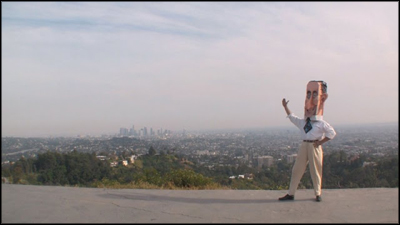
Beauty is Embarrassing film still, featuring White wearing his LBJ paper mache puppet head.
Kiss – A Love Story is a stunning short film directed by Joseph Hodgson & Franck Aubry set to a beautiful song entitled “Stille” by Bendik. It’s not a complex piece, and fairly abstract, but it’s almost a perfect combination of sound and imagery. ( As John Martz at Drawn notes, you may want to set it to full screen when you watch it, as the aspect ratio makes the video tiny when scaled down to fit our template.)
Space Stallions, a bachelor film project from the 2012 Animation Workshop, plays like every Saturday morning cartoon from my childhood boiled down into one four minute concept. Created by Thorvaldur S. Gunnarsson, Jonatan Brüsch, Ágúst Kristinsson, Arna Snæbjørnsdottir, Esben J. Jespersen, Touraj Khosravi and Polina Bokhan, it appears to have everything: spaceships, spandex-clad heroes, rainbows, unicorn-shaped hoverbikes, moustaches, and laser eggs. It’s like someone put peyote in your Lucky Charms.
This perfect, gleaming sliver of transcendent “whaaaa thaaaa faaaaaa??!” comes to us care of a tweet from Keith Jenson of Brainwomb, who claims to be sharing it to polarize the effect of the “‘spirit bomb’ of Harajuku” video that Nadya just posted. (Athough it seems just as likely that he’s trying to insidiously destroy us with subliminal mind control.)
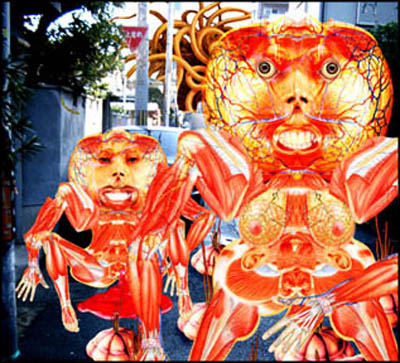
Laughing Squid says that Japanese artist Sekitani Norihiro –be sure to check out that website, but be warned, it is rife with CAN’T UNSEE imagery– made this succinctly fucked-up-beyond-all-reckoning-ness for the digital grindcore demigod Maruosa.
The best, sales silliest thing: Aardman Animations — the studio responsible for Wallace and Grommit and the series Creature Comforts, among others — teams up with DC Comics to produce a series of shorts for Cartoon Network. This one uses a setup similar to the aforementioned Creature Comforts, here taking some familiar DC villains and heroes having children voice them. So silly, but so, so good.
“Two Against One” from the album Rome, a collaboration between Danger Mouse and Daniele Luppi, which came out last year. Featuring vocals by Jack White, it’s been supplied with a spectacularly hallucinatory video directed by Chris Milk and Anthony Francisco Schepperd. Just beautiful work.
Matthew Innman, viagra twisted mastermind behind The Oatmeal webcomic, made this splendid beast. Then Ariana shared it. And lo, now it hath become the unofficial Better Than Coffee mascot. That is all. Carry on.
I’ll admit, I know very little about the Swiss, stop-motion cartoon Pingu other than that it is a Swiss, stop-motion cartoon about penguins. That does little to dampen my enthusiasm for this, a remake of John Carpenter’s sci-fi/horror classic The Thing by Lee Hardcastle, starring the adorable cast of the aforementioned cartoon and animated in the same style. It is just as good as it sounds.
Good day, comrades. This mesmerizing WTFery has been on the YouToobz for a few years now, but DJ DeadBilly only alerted Coilhouse to its existence this morning. (2012 is off to an auspicious start!)
Who among our readers remembers The Rock-afire Explosion animatronic stage show from their pepperoni ‘n’ cheese-drenched childhood? It was the brainchild of one Mr. Aaron Fechter, who, in addition to creating and heading a company called Creative Engineering Incorporated, invented the Whac-a-Mole, and co-founded a venture called Showbiz Pizza Place in 1979, which eventually merged with –and became more commonly known as– Chuck E. Cheese (apparently under bitter circumstances).
In spite of a handful of painful business disappointments over the past thirty years, Fechter and his team have stayed the course, and C.E. Inc. remains “a leader in the Family Entertainment business”, designing and manufacturing “sophisticated animatronic stage shows for many amusement parks and entertainment centers around the world”.
Fechter’s company has additionally been involved in several somewhat less HappyHappyFuntimez™ projects of various sizes and technologies, ranging from development of robotic soldiers for the U.S. Army (“a great success, I might add”, says Fechter) to water removal systems for commericial roofing (“not one of my best”).
But through it all, Fechter’s heart has remained devoted to “developing high-tech equipment to entertain and amuse the public while developing the self-esteem of the participants”.
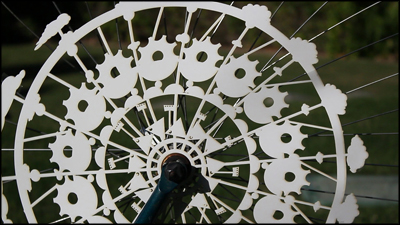
Katy Beveridge is the mastermind behind this surprising and gorgeous animation piece “that explores whether it’s possible to film animation in realtime.” Beveridge did a ton of research on “proto animation” (which basically means super early, basic, rudimentary animation) in modern design, and cross-referenced work by other contemporary designers using similar techniques.
“I have interviewed animators such as Jim le Fevre and in my research referenced other people using this technique such as David Wilson and Tim Wheatley who did this before me. I developed this project based on what is being done in animation right now as well as a lot of primary research into the history of animation techniques.”
Her friend Stefan Neidermeyer created the piece’s perfect soundtrack by remixing random bike noies recorded during filming.
For a limited time, Beveridge is offering heavy, glossy paper stock laser cuts of the bicycle wheel paper cuts for sale in her Etsy shop. She also co-runs the informative Londoncentric graphics/art/design blog, Freda & Franck.