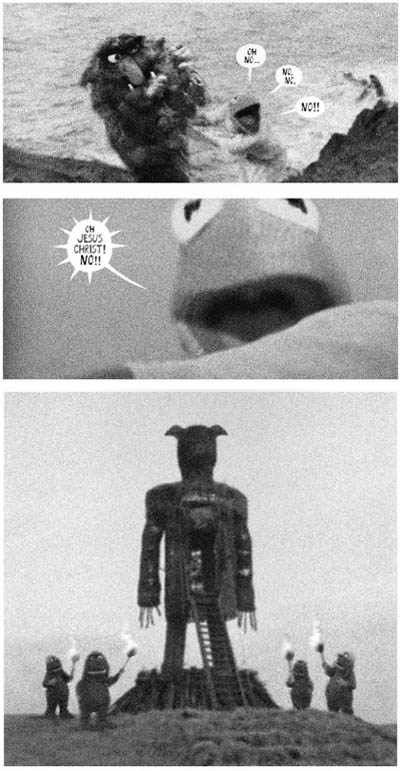
Wayne White is an American artist, puppeteer, sculptor, set designer, cartoonist, art director, animator, and illustrator whose influence on popular culture has been quietly vast. As Mark Mothersbaugh puts it: “Kids [in the ’80s] mainlined it. He was imprinting their brains, and they don’t even know it.” Filmmaker Neil Berkeley’s new documentary about White’s roller coaster career and personal life looks like it’s packed-to-bursting with inspiration and warm-fuzzies and whimsy and pathos:
“Raised in the mountains of Tennessee, Wayne White started his career as a cartoonist in New York City. He quickly found success as one of the creators of the TV show, Pee-wee’s Playhouse, which led to more work designing some of the most arresting and iconic images in pop culture. Most recently, his word paintings, which feature pithy and often sarcastic text statements crafted onto vintage landscape paintings, have made him a darling of the fine art world.”
“Beauty Is Embarrassing chronicles the vaulted highs and the crushing lows of a commercial artist struggling to find peace and balance between his work and his art. Acting as his own narrator, Wayne guides us through his life using moments from his latest creation: a hilarious, biographical one-man show.”
The world premiere of Beauty Is Embarrassing will take place on March 10th at SXSW. Click through below to see more examples of Wayne White’s multifaceted work.
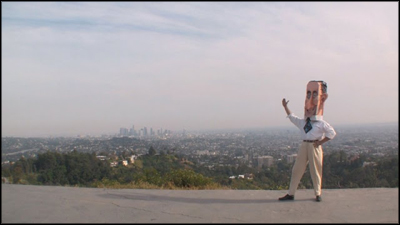
Beauty is Embarrassing film still, featuring White wearing his LBJ paper mache puppet head.
Space Stallions, a bachelor film project from the 2012 Animation Workshop, plays like every Saturday morning cartoon from my childhood boiled down into one four minute concept. Created by Thorvaldur S. Gunnarsson, Jonatan Brüsch, Ágúst Kristinsson, Arna Snæbjørnsdottir, Esben J. Jespersen, Touraj Khosravi and Polina Bokhan, it appears to have everything: spaceships, spandex-clad heroes, rainbows, unicorn-shaped hoverbikes, moustaches, and laser eggs. It’s like someone put peyote in your Lucky Charms.
(Rabbit Rabbit Radio illustration by Mariko Ando.)
Next Wednesday, February 1st, professional musicians/married couple/doting parents Carla Kihlstedt and Matthias Bossi –whose various other projects have been mentioned on Coilhouse manytimes— are launching a very interesting new multimedia musical subscription service called Rabbit Rabbit Radio.
“Saying ‘rabbit, rabbit’ on the first of the month is a tradition here in New England,” Kihlstedt explains. “It is said to bring good luck and a sense of renewed purpose. We’ve taken it to heart and are releasing a new song on the first [day] of each month along with photos, videos, and other implicating evidences of our creative process, all on rabbitrabbitradio.com“
The Kihlstedt/Bossi family: Matthias, Tallulah, and Carla. Photo by Eurydice Galka.
Last year, not long before the Sleepytime Gorilla Museum (a legendary band they were members of) closed its doors, Kihlstedt and Bossi moved from Oakland to Cape Cod with their baby girl Tallulah. “Our lives have changed a lot since [she] was born and since we moved back East.” Kihlstedt and Bossi predict that their Rabbit Rabbit Radio project will help them to accomplish many things, warmly and comfortably, in ways that more traditionally grueling channels (constant low-budget touring is exhausting enough without kids!) could not:
“It keeps us in touch with you [our audience]. It conveys each song with much more depth and dimension than a simple iTunes download would. It holds us to an ongoing commitment to our own creativity. It allows us to be creatively independent from home, which in turn allows us to be good parents. In short, everyone wins. We have finally created our very own dream job.”
Fans who subscribe to Rabbit Rabbit Radio can choose to pay $1, $2, or $3 per month (but there’s no difference in content access; it’s just a chance to pay them a bit more for their efforts, if you can afford to). You can learn more –and get a taste of the quirky, sweet whimsy this lovely duo creates together– from the following YouTube pitch video:
RRR has its own Twitter account and a Facebook page as well.
Rabbit Rabbit Radio is a fascinating-yet-simple premise that feels very new, and fresh, and… cozy! Kihlstedt and Bossi both hope this kind of project takes off: “there are lots of artists whom we would gladly subscribe to ourselves!” While there may very well be other musicians out there attempting similar transmedia subscription services (and please feel free to give them a shout-out in comments, because we’d love to know more about them, too) it’s certainly not status quo quite yet. Fingers crossed that it soon will be.
The modern quest for reasonable and sustainable alternatives to a more staid career path in the arts is always worth discussing on Coilhouse. We live in interesting- no, scratch that, fascinating times. It might feel daunting to watch the old regimes fall down around our ears, but there’s no doubt about it: we are lucky to be alive during a time period where there’s so much opportunity to build newer, better, kinder infrastructures. Let’s stay tuned in!
Two very different videos of teenage girls airing our their grievances on YouTube have gone viral in the past two days. Here they are. Compare and contrast:
On the uplifting side, we have a 13-year-old vlogger named astrorice articulating the concepts of slut shaming and rape culture. “While I am fully aware that this is a bit of an unorthodox topic for a thirteen year old virgin to be talking about, it’s an important issue to discuss, and a great topic for girls my age to know about,” writes astrorice.
As Aaron Muszalski noted on Facebook, “This is the most inspiring thing I’ve seen this year. Seriously a must-watch. An amazing young person speaking out — eloquently and forcefully — about a topic that many people much older than her still have a hard time wrapping their heads around. Or indeed, even acknowledging its existence. Major props. As unfortunate as the issue of slut shaming is, this video and its maker give me great hope for the future.”
And on the dark side, there’s this: a 14-year-old girl calling for the boycott of Girl Scouts due towards their inclusive policy towards transgendered kids: in particular, a 7-year-old transgender child who was allowed to join Girl Scouts in Colorado. Richard Metzger writes, “From what I can make of her argument, young Taylor here seems to think that high school age boys are suddenly going to want to wear drag and join the Girl Scouts so they can rape her or something? Taylor, there are far, far easier ways for teenage boys to get laid! … Do you really want to be the Rebecca Black of intolerance? For the rest of your life?”Audrey Penven adds, “Shame on her parents for sucking so hard. Shame on her community for nurturing this kind of close-mindedness.”
This is Cinamon. I remember seeing her on the very same day, though I didn’t take this photograph of her. I was probably 12 at the time, and as I passed by her on The Drag down by Sound Exchange, the trajectory of my life changed forever. I was completely mesmerized by this vision in black tatters, a gorgeous alien-wraith who seemed like an apparition drifting down a banal sidewalk in the bright Texas sun. She was the most beautiful woman I had ever seen. I stopped and told her how amazing I thought she was, and she was so sweet to me. I’ve held this photo dear for years, a treasured gift from a mutual friend. She was such a huge influence on not only my style, but also for scores of others, (maybe even yours!) – Cinamon was the original inspiration for Neil Gaiman’s Death character from the Sandman series. Her friend Mike Dringenberg drew her years before, and by an odd twist of chance (or fate), this woman unwittingly helped shape the style of scads of wee gothlings. Cheers to you, Cinamon – you continue to inspire and astound!
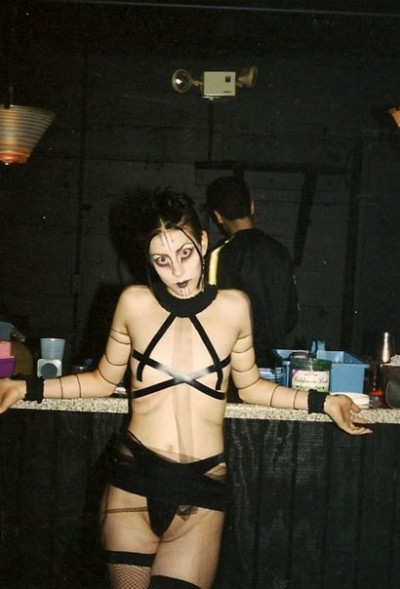
This was me at maybe 15 or 16? It was for a fashion show at the old Club 404, a legendary big gay bar from back in the day here in Austin. I was total monster-child jail bait, who spent most of my time scampering around in the woods on drugs wishing I wasn’t human, poring over Elfquest and Sandman comics and Storm Constantine’s Wraeththu trilogy. I made my outfit in five minutes out of electrical tape, eyeliner, wire and black tulle. Oh, and a thong. Heaven forbid that should I ever spawn a girl-child as naughty as I was! With any luck, I’ll end up with a Saffy.
(photo by Monte McCarter)
At the tender age of barely 17, I became the armed spokesmodel for FringeWare Review’s book catalogue. This involved posing in my underpants and various getups made of rubber and dollparts with books and guns. Real guns. That’s totally an actual Uzi or Tech-9 or whatever the hell, too. I was super blessed to be part of FringeWare when it was around – it was a strange and magical era.
In light of the charming Goodnight Dune children’s book that’s making the rounds online right now, today seems like a great time to share some treasures from my personal stash of weird, random, off-color, No-Seriously-WTF-Were-They-Thinking movie franchise ephemera.
These, for your delectation, are scans and photos of various pages from the astoundingly age-inappropriate Dune activity book series, published in 1984 to promote David Lynch’s movie adaptation of the classic Frank Herbert novel, produced by Universal Studios.
You know, FOR KIDS:
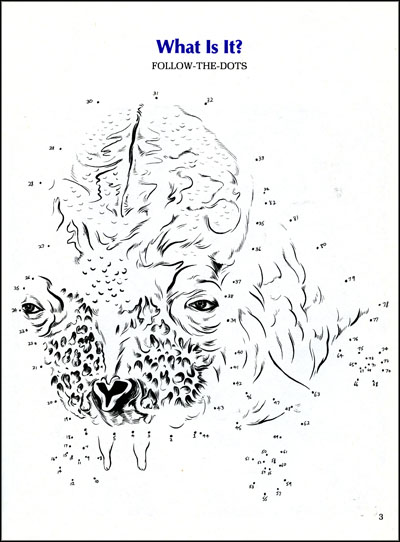
Yes, that’s a coloring page of Dr. Yueh preparing to assassinate Duke Leto with a dartgun. And up at the top there, that’s a floppy, diseased sex organ-reminiscent Guild Navigator, presented a-la la la “Connect the Dots”.
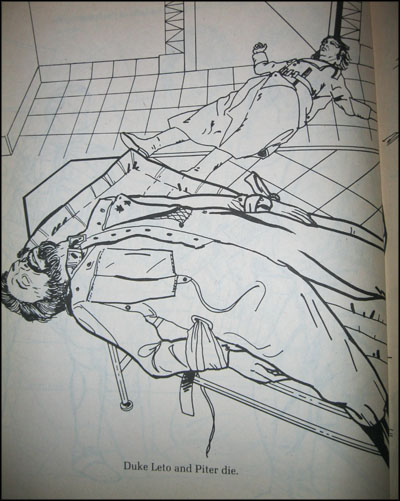
And here’s another cheerful coloring page of the fresh corpses of Duke Leto and Piter:
Heeeeee! Who the frak was in charge of marketing? More to the point, what kind of Melange were they smokin’ during the merch meeting, when it was decided that producing this series of vengeful activity books for a K-through-8 demographic made good business sense?
Well, whoever they were, Coilhouse salutes them.
Explore the childlike wonderment murder, intrigue, suppurating boils, phallic symbolism and knifeplay after the jump.
I’m not sure how Hulu works in countries outside the US at this point. My apologies if you cannot watch this, it’s one of the reasons I try to avoid sites like Hulu.
It’s Friday, people, which means that there’s only a few more hours until you can stick a fork in another soul-crushing work week. Allow the FAM to help that time pass a little more quickly with this week’s presentation of Don Bluth’s 1982 classic The Secret of NIMH, starring, among others, Mary Elizabeth Hartman (in her last role before her suspected suicide), John Carradine, Dom DeLuise, Aldo Ray, and Wil Wheaton.
An adaptation of Robert C. O’Brien’s 1971 children’s novel Mrs. Frisby and the Rats of NIMH, the movie tells the story of Mrs. Brisby, a widowed field mouse, whose son falls ill with pneumonia and cannot leave the house for three weeks. At this time, Spring plowing is set to begin on the farm the Brisbys live on and Mrs. Brisby, knowing she cannot stay where she is, visits the Great Owl who directs her to a group of mysterious rats who live in a rose bush and are led by a wizened old rat named Nicodemus. Brisby learns that the rats, along with her late husband Jonathan, were part of an experiment performed at the National Institute of Mental Health which boosted their intelligence to human levels at which point they made their escape.
The Secret of NIMH was a favorite of mine as a child and recent viewings have done little to dampen my enthusiasm for it. Bluth and his partners, most of who had defected from Disney with him, were fixated on what they perceived to be the decline of animation as an art form. The Secret of NIMH, then, was a collection of expensive and, even at the time, outdated animation techniques. The glowing eyes of Nicodemus, for example, were created by back-lighting colored gels. Characters had different color palettes for individual lighting situations (Mrs. Brisby alone had 46). It’s a veritable showcase of animation and it all makes for a beautiful film. Still, it came at a price, and the film came in so over the original budget that Bluth and his co-producers had to collectively mortgage their homes to finance some of it. There was even a problem with their diminutive protagonist’s name:
During the film’s production, Aurora contacted Wham-O, the manufacturers of Frisbee flying discs, with concerns about possible trademark infringements if the “Mrs. Frisby” name in O’Brien’s original book was used in the movie. Wham-O rejected Aurora’s request for waiver to use the same-sounding name to their “Frisbee”, in the movie. Aurora informed Bluth & company that Mrs. Frisby’s name would have to be altered. By then, the voice work had already been recorded for the film, so the name change to “Mrs. Brisby” necessitated a combination of re-recording some lines and, because John Carradine was unavailable for further recordings, careful sound editing had to be performed, taking the “B” sound of another word from Carradine’s recorded lines, and replace the “F” sound with the “B” sound, altering the name from “Frisby” to “Brisby”.
In the end, there are really two things that make NIMH stick out: its tone and its protagonist. The mood of the film is exceedingly foreboding, especially for a G-rated feature intended for children, without crossing into the historical seriousness of, say, Grave of the Fireflies or the political allegory of Watership Down. When I think of it, the images that come to my mind are bleak, eerie, and filled with fire. Likewise, its heroine is unlike anything one would have seen from Disney. Mrs. Brisby is no princess. She is a middle-aged mother and widow. Her quest is not an epic struggle between good and evil, it is to save her family. She doesn’t fall in love with a dashing male lead, she is not even looking for it, the love she had for another is in her past, before we are even introduced to her. Is she one of the great feminist characters in film? No. But she is a refreshing change from the typical Barbie doll pap most peddle.
Watching The Secret of NIMH it is perhaps most evident that it is a labor of love, both for its story and for the medium it is presented in. It is not a stretch to say that they don’t make them like this anymore. After all, who would be crazy enough to try?
My apologies but I’m unable to embed today’s film. Above is the trailer. The playlist with the film is here.
The FAM is ever ephemeral, dear readers. It is the nature of finding films posted on the internet. Sooner or later they shall be found and, no doubt, taken down. That said this movie’s time may be shorter than some, so get it while it’s hot. Today the FAM presents 2008’s Let the Right One In (Låt den rätte komma in) the Swedish vampire masterpiece directed by Tomas Alfredson, based on the book by John Ajvide Lindqvist who also wrote the screenplay.
I’m posting this today mostly because I finally got around to reading the original novel so the details are still fresh in my mind and, thus, this will be more of an examination of some differences between the film and its source material (though by no means a thorough one.) For those who haven’t seen it, Let the Right One In takes place in 1982 and tells the story of 12 year old Oskar who lives with his mother Yvonne in Blackeberg, a suburb of Stockholm. He is a shy, meek boy who is tormented at school by bullies. One night he meets a young girl on the playground by his building. Her name is Eli and she has moved into the apartment next to his with an older man, Håkan, who Oskar assumes is her father. Oskar will soon learn, as you no doubt guessed, that Eli is not who she seems.
Spoiler Warning: I usually don’t do these as I assume that most people realize that these posts are bite-sized analyses and expect spoilers. However, I will also being discussing the book in some detail, and the thought of ruining two forms of media for the unsuspecting reader makes me feel that a warning is necessary.
Yesterday, Wired published an essay by writer/comedian Patton Oswalt titled Wake Up, Geek Culture. Time to Die. It’s about the demise of geekdom, the rise of otaku culture in America, and what it means to be living in a world where Boba Fett’s helmet appears “emblazoned on sleeveless T-shirts worn by gym douches hefting dumbbells.” All this discussion is very near and dear to our hearts, and was eloquently explored by Joshua Ellis in an essay called Children by the Million Wait for Alex Chilton, which appeared in Coilhouse Issue 04.
Both essays make the point that “we’re on the brink of Etewaf: Everything That Ever Was—Available Forever.” But where Joshua Ellis suggests that we’ve won the culture war by essentially remaking the world in our image, Patton Oswalt argues that “with everyone more or less otaku and everything immediately awesome… the old inner longing for more or better that made our present pop culture so amazing is dwindling.” This, he warns, produces “weak otakus” – not a generation of artists, but one of noncommittal pop-culture consumers. “Why create anything new,” he asks, “when there’s a mountain of freshly excavated pop culture to recut, repurpose, and manipulate on your iMovie?” The proposed solution to this problem steers the essay into a weird, fantastical place. In order to rebuild geek culture, Oswalt argues, we must first bring about the “Etewaf Singularity.” He goes on to explain:
It has already started. It’s all around us. VH1 list shows. Freddy vs. Jason. Websites that list the 10 biggest sports meltdowns, the 50 weirdest plastic surgeries, the 200 harshest nut shots. Alien vs. Predator. Lists of fails, lists of boobs, lists of deleted movie scenes. Entire TV seasons on iTunes. An entire studio’s film vault, downloadable with a click. Easter egg scenes of wild sex in Grand Theft Auto. Hell, Grand Theft Auto, period. And yes, I know that a lot of what I’m listing here seems like it’s outside of the “nerd world” and part of the wider pop culture. Well, I’ve got news for you—pop culture is nerd culture. The fans of Real Housewives of Hoboken watch, discuss, and absorb their show the same way a geek watched Dark Shadows or obsessed over his eighth-level half-elf ranger character in Dungeons & Dragons. It’s the method of consumption, not what’s on the plate.
Since there’s no going back—no reverse on the out-of-control locomotive we’ve created—we’ve got to dump nitro into the engines. We need to get serious, and I’m here to outline my own personal fantasy: We start with lists of the best lists of boobs. Every Beatles song, along with every alternate take, along with every cover version of every one of their songs and every alternate take of every cover version, all on your chewing-gum-sized iPod nano. Goonies vs. Saw. Every book on your Kindle. Every book on Kindle on every Kindle. The Human Centipede done with the cast of The Hills and directed by the Coen brothers.
That’s when we’ll reach Etewaf singularity. Pop culture will become self-aware. It will happen in the A.V. Club first: A brilliant Nathan Rabin column about the worst Turkish rip-offs of American comic book characters will suddenly begin writing its own comments, each a single sentence from the sequel to A Confederacy of Dunces. Then a fourth and fifth season of Arrested Development, directed by David Milch of Deadwood, will appear suddenly in the TV Shows section of iTunes. Someone BitTorrenting a Crass bootleg will suddenly find their hard drive crammed with Elvis Presley’s “lost” grunge album from 1994. And everyone’s TiVo will record Ghostbusters III, starring Peter Sellers, Lee Marvin, and John Candy.
This will last only a moment. We’ll have one minute before pop culture swells and blackens like a rotten peach and then explodes, sending every movie, album, book, and TV show flying away into space. Maybe tendrils and fragments of them will attach to asteroids or plop down on ice planets light-years away. A billion years after our sun burns out, a race of intelligent ice crystals will build a culture based on dialog from The Princess Bride. On another planet, intelligent gas clouds will wait for the yearly passing of the “Lebowski” comet. One of the rings of Saturn will be made from blurbs for the softcover release of Infinite Jest, twirled forever into a ribbon of effusive praise.
The essay continues on to describe “year zero for pop culture,” in which we’ll be stuck with nothing but “a VHS copy of Zapped!, the soundtrack to The Road Warrior, and Steve Ditko’s eight-issue run on Shade: The Changing Man” to work with for creating new culture. Oswalt goes on to describe the society that emerges: it includes entire musical genres spawned by Road Warrior (“waste-rock” and its counterpoint, “flute-driven folk”), the creation of the Iranian Beatles, and the ubiquitousness of Shade as “the new Catcher in the Rye.”
A great read, right down to the comment thread. For the full essay, click here. [Via William Gibson, whose name, incidentally, appears in both essays, both times in the passages describing the authors’ personal golden age of otaku/alternative culture].
One possible visualization for how Patton Oswalt’s “Etewaf Singularity” may play out – with the world being destroyed by 8-bit characters from old video games. Amazing video by Patrick Jean.