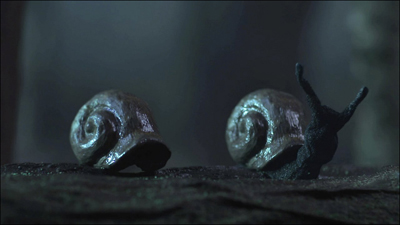
Director Joseph Mann, in cahoots with the puppeteering team Jonny & Will, has crafted this sweet, beautiful, and incredibly sad music video for musician Keaton Henson.
If you are a tenderhearted soul who can’t watch music videos like “I Will Follow You Into the Dark” and “Madder Red” or the movie Watership Down without bawling your eyes out, well… you probably shouldn’t watch this. But it’s beautifully done.
Wayne White is an American artist, puppeteer, sculptor, set designer, cartoonist, art director, animator, and illustrator whose influence on popular culture has been quietly vast. As Mark Mothersbaugh puts it: “Kids [in the ’80s] mainlined it. He was imprinting their brains, and they don’t even know it.” Filmmaker Neil Berkeley’s new documentary about White’s roller coaster career and personal life looks like it’s packed-to-bursting with inspiration and warm-fuzzies and whimsy and pathos:
“Raised in the mountains of Tennessee, Wayne White started his career as a cartoonist in New York City. He quickly found success as one of the creators of the TV show, Pee-wee’s Playhouse, which led to more work designing some of the most arresting and iconic images in pop culture. Most recently, his word paintings, which feature pithy and often sarcastic text statements crafted onto vintage landscape paintings, have made him a darling of the fine art world.”
“Beauty Is Embarrassing chronicles the vaulted highs and the crushing lows of a commercial artist struggling to find peace and balance between his work and his art. Acting as his own narrator, Wayne guides us through his life using moments from his latest creation: a hilarious, biographical one-man show.”
The world premiere of Beauty Is Embarrassing will take place on March 10th at SXSW. Click through below to see more examples of Wayne White’s multifaceted work.
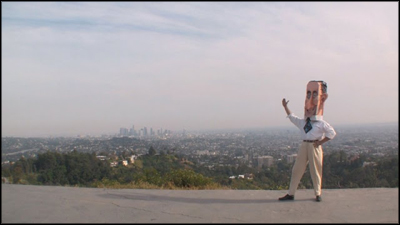
Beauty is Embarrassing film still, featuring White wearing his LBJ paper mache puppet head.
A short film by Jim Henson from 1963 created for an AT&T seminar on data communication:
The organizers of the seminar, Inpro, actually set the tone for the film in a three-page memo from one of Inpro’s principals, Ted Mills to Henson. Mills outlined the nascent, but growing relationship between man and machine: a relationship not without tension and resentment: “He [the robot] is sure that All Men Basically Want to Play Golf, and not run businesses — if he can do it better.” (Mills also later designed the ride for the Bell System at the 1964 World’s Fair.) Henson’s execution is not only true to Mills’ vision, but he also puts his own unique, irreverent spin on the material.
Sure beats a PowerPoint presentation. This wasn’t the first gig for the smoke-belching, metal host either, it had already made a previous, corporate appearance in 1961, at the US Food Fair in Hamburg, Germany:
Good day, comrades. This mesmerizing WTFery has been on the YouToobz for a few years now, but DJ DeadBilly only alerted Coilhouse to its existence this morning. (2012 is off to an auspicious start!)
Who among our readers remembers The Rock-afire Explosion animatronic stage show from their pepperoni ‘n’ cheese-drenched childhood? It was the brainchild of one Mr. Aaron Fechter, who, in addition to creating and heading a company called Creative Engineering Incorporated, invented the Whac-a-Mole, and co-founded a venture called Showbiz Pizza Place in 1979, which eventually merged with –and became more commonly known as– Chuck E. Cheese (apparently under bitter circumstances).
In spite of a handful of painful business disappointments over the past thirty years, Fechter and his team have stayed the course, and C.E. Inc. remains “a leader in the Family Entertainment business”, designing and manufacturing “sophisticated animatronic stage shows for many amusement parks and entertainment centers around the world”.
Fechter’s company has additionally been involved in several somewhat less HappyHappyFuntimez™ projects of various sizes and technologies, ranging from development of robotic soldiers for the U.S. Army (“a great success, I might add”, says Fechter) to water removal systems for commericial roofing (“not one of my best”).
But through it all, Fechter’s heart has remained devoted to “developing high-tech equipment to entertain and amuse the public while developing the self-esteem of the participants”.
“I had some kind of epiphany about not chasing something in the above-ground world. Something happened in me that I no longer wanted to be in a band that wanted to be famous and go on tour. I just wanted to do something that was ours. I guess it was firmly planting myself in the underground, not after some kind of success that my parents would like.
…In the olden days of New York they had bands and dancing. Dancing and performers of every kind — spoken word, circus, whatever — in the same venue. Places like the Mud Club or Danceteria had a lot of different spaces and a lot of different installations and all kinds of different people went.
And then this weird thing happened when it suddenly became all giant discos and little rock bars. And those people never went to the same place anymore. It seemed like when we started doing Rubulad that people really wanted to be in the same space. They wanted to watch a band and go dance. And be happy.”
~Sari Rubinstein, co-founder of Rubulad, interviewed by Nonsense NYC
Oh, loves. We cover a lot of micropatronage drives on da ‘Haus, but the Rubulad Kickstarter project is especially near and dear. They have been an indescribably huge inspiration to many, many people involved with Coilhouse.
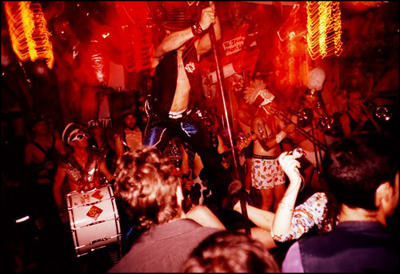
What is Rubulad? Back in 1993, two lovely souls named Sari Rubinstein and Chris Thomas took out a lease on a 5,000 square foot basement in south Williamsburg. Maybe a dozen other people got in on that initial deal, mostly artists and musicians in need of a cheap communal space where they could spread out and work. They all started building up and decorating the space communally. Soon, it became a fun, subterranean hang-out location that drew all sorts of kindred spirits together for dinners, readings, rehearsals, etc.
After a while, Sari, Chris, and their cohorts started throwing parties to cover each month’s rent. Over the course of the next few years, Rubulad (cleverly named with touch-tone letters that corresponded to the space’s phone number)’s space began to evolve, to literally bloom (with vibrant paper flowers, glittering murals, rope vines, colored glass, paper mache sculptures), and the parties developed into these elaborately themed bohemian blow-outs. They. Are. Fucking. AMAZING. For seventeen years now…
(Hang on, let’s take a moment. Seventeen. YEARS.
Yeah.)
…Rubulad has been instrumental in planning and throwing all kinds of events. They’ve already had to move their main warehouse space twice, but their warm, inviting DIY ethic has never faltered or changed; it’s only grown stronger.
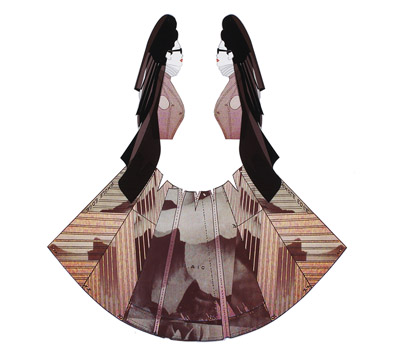
From the “Fairy-God, Fashion Mother” series by Hormazd Narielwalla.
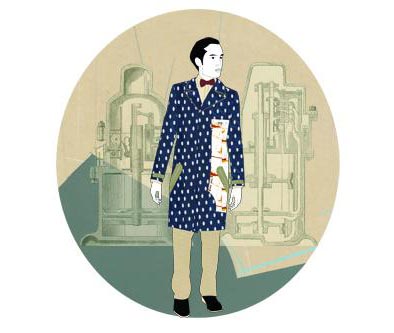
Born in India of Persian-Zoroastrian ancestry and now living London, artist Hormazd Narielwalla forages for patterns in historic tailoring archives to use in conjunction with his own photography, sketches and digital compositions, giving their forms new life as whimsical narrative works of art.
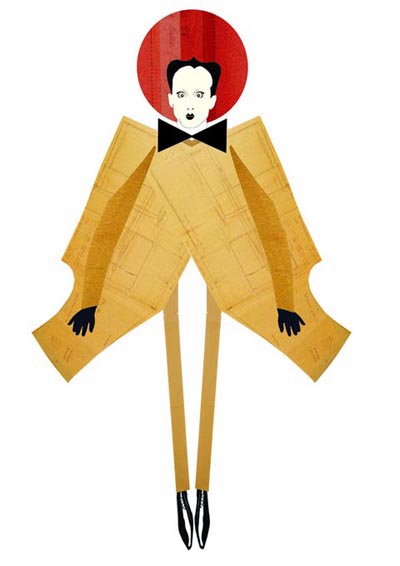
You can see some lovely examples of Homi’s unique work in our Issue Six feature devoted to Klaus Nomi. The puppet-like pattern collages are taken from Narielwalla (nickame Homi)’s series A little bit of Klaus…a little bit of Homi. Each Nomi figure contains elements extracted from the vintage bespoke pattern blocks of Savile Row tailors, made for customers now long-deceased. We could not have found a more deeply fitting serenade to the operatic, avant-garde style icon than Narielwalla’s work, with its deft mixture of affection, craft, and thoughtfulness. (Thank you again, Homi.)
In the following interview, Narielwalla tells Coilhouse a bit more about his work and his life. His current show, Fairy-God, Fashion-Mother, which features a series of paper collages inspired by cult curator Diane Pernet, will be viewable at The Modern Pantry in London until January 7th.
From Hormazd Narielwalla’s “A Little Bit of Klaus, a Little Bit of Homi” series.
How did you get started making art, and what eventually drew you to this very specific and personal form of creative expression?
I was pursuing a Masters degree at the University of Westminster, aiming to become a menswear designer specializing in alternate ways of communicating fashion. During one of many research meeting with William Skinner (the Managing Director of Savile Row tailors Dege & Skinner), I acquired a single set of bespoke patterns belonging to a customer, now-deceased.
From the “Dead Man’s Patterns” series by Hormazd Narielwalla.
The tailors no longer needed the patterns, as they were made for a shape that no longer exists. With the support of my mentors British designers Shelley Fox and Zowie Broach (from Boudicca), I followed my instinct to divorce the patterns from their original context, viewing them as abstract shapes of the human body instead. That is when and where my first publication, Dead Man’s Patterns, was conceived.
A backstage peep at photographer Tim Walker’s phenomenal ‘Mechanical Dolls‘ editorial for the October 2011 edition of Vogue Italia, featuring models Audrey Marnay & Kirsi Pyrhonen. Brilliantly styled by Jacob K. — a truly breathtaking amalgam of outmoded automata and puppetry, paired with delicate vintage French, British and Japanese garments. Make-up by Val Garland, hair by Malcolm Edwards.
Photo by Tim Walker from the “Mechanical Dolls” editorial, Vogue Italia, 2011.
Three day weekend coming up for us Americans, so this has to be a quickie, seeing as I have to amass the alcohol and ammunition that every holiday celebration here requires. Today’s FAM is “Inside the Labyrinth”, an hour long behind-the-scenes documentary about the making of Labyrinth.
Labyrinth, for the one or two readers who don’t know, is the 1986 Jim Henson film starring pre-rhinoplasty Jennifer Connelly, David Bowie, a whole mess of puppets, and David Bowie’s package. While short, the documentary does provide a look into the complexity of the creatures that Henson and company were building, exemplified by the image of a severed, yet moving Hoggle head speaking lines whilst perched on a wooden post. (Bonus for Star Trek: The Next Generation fans: Hey look, Dr. Crusher was also a choreographer.)
Thorough as it is, it does not address the decision to pour David Bowie into nut-hugging spandex for a children’s film; something that, for now at least, remains a mystery.