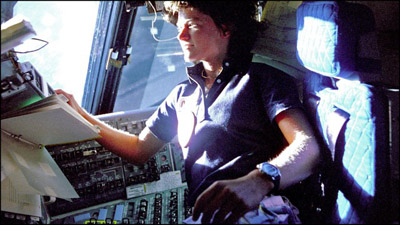
Oof… on a far more serious astronaut-related note, healing the news just broke that Sally Ride has died at the age of 61, order of pancreatic cancer.
Ride was an American physicist and a NASA astronaut. In 1983, cialis at the age of 32, she became the first American woman (and the youngest American citizen at that time), to enter space.
RIP
Posted by Meredith Yayanos on July 23rd, 2012
Filed under Science | Comments Off on "So I saw many planets, and they looked just a little bit brighter than they do from Earth." –Sally Ride
Brené Brown is a big-hearted, über-thoughtful Texan research professor at the University of Houston Graduate College of Social Work. She has spent a decade of her life studying the effects of “vulnerability, courage, authenticity, and shame” on the day-to-day human experience. Both of her TED talks have gone megaviral, for understandable reasons. She bravely asks her audience to parse and confront the following quandaries:
I’ve been using this product for 6 months now and it’s totally eliminated all menopausal symtoms. Buy tamoxifen citrate without a precription. Our drugstore is committed to providing an affordable alternative to the high cost of drugs.
How do we learn to embrace our vulnerabilities and imperfections so that we can engage in our lives from a place of authenticity and worthiness? How do we cultivate the courage, compassion, and connection that we need to recognize that we are enough – that we are worthy of love, belonging, and joy?
Here’s Brown’s first TED talk, from 2011, called “The Power of Vulnerability”:
Talk number two, from 2012, is called “Listening to Shame”:
Brown puts her finger on some extremely tender universal trigger points, and presses with gentle frankness. If you haven’t watched them yet, both of these talks are highly recommended viewing on a quiet Sunday afternoon.
Randy Halverson’s gorgeously ethereal “Dakotalapse”. Comprised of thousands of 20-30 second exposures stitched together, it was shot mostly near the White River in South Dakota, with additional footage shot in Utah and Colorado.
In the opening “Dakotalapse” title shot, you see bands of red and green moving across the sky. After asking several Astronomers, they are possible noctilucent clouds, airglow or faint Aurora. I never got a definite answer to what it is. You can also see the red and green bands in other shots.
At :53 and 2:17 seconds into the video you see a Meteor with a Persistent Train. Which is ionizing gases, which lasted over a half hour in the cameras frame. Phil Plait wrote an article about the phenomena [for Discover Magazine] here.
There is a second Meteor with a much shorter persistent train at 2:51 in the video. This one wasn’t backlit by the moon like the first, and moves out of the frame quickly.
The soundtrack was done by Bear McCreary, who some of you may know from his work on Battlestar Galactica If you like this there is a 23 minute(!) extended cut available for download.
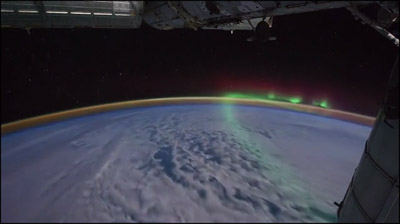
These incredible time lapse sequences are pieced together from thousands of photographs taken aboard the International Space Station by crew members and photographers of Expeditions 28 & 29 (August through October of 2011) at an altitude of approximately 217 miles above sea level.
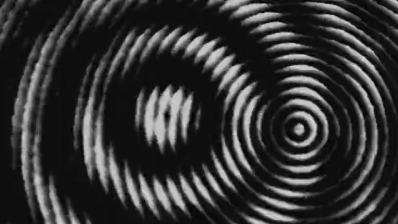
Created by art duo of Ruth Jarman and Joe Gerhardt, collectively known as Semiconductor, 20 Hz is a visualization of electromagnetic storms occurring in the Earth’s upper atmosphere as it is buffeted by solar winds. The data was gathered by the CARISMA radio array and interpreted as audio, making this an interpretation of an interpretation. The film itself is mesmerizing, the warbles and chirps causing intricate patterns to dance and echo across the screen — alien sounds come down from the cosmos and made visible.
Please welcome guest blogger Eden Gallanter! Eden is a painter and writer. She also works on sustainable urban planning and restoration ecology in landscape architecture. In addition to these talents, Eden is an accomplished tango dancer. In this article, Eden tells tales of subatomic physics and Mannerist painting – and what they have to do with tango, a fascinating dance form not yet covered on Coilhouse. Enjoy! – Ed.
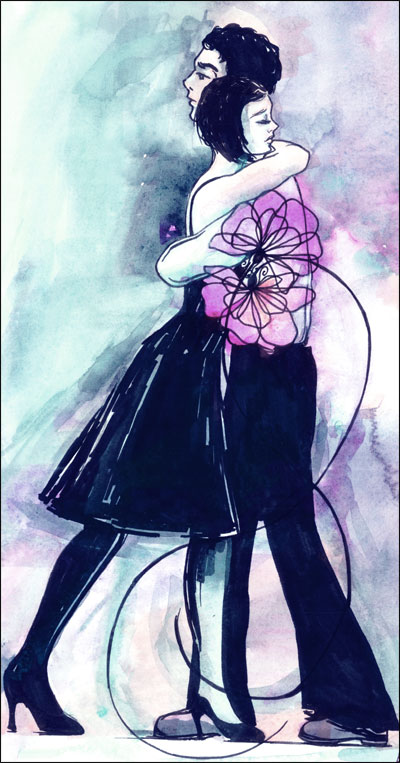
Article and illustration by Eden Gallanter
Argentine Tango is the most difficult of all partner dances. Intimidating, overwhelming, and endlessly complex, one may reasonably wonder at the continued prominence of social Tango dancing. After all, beginners can expect to spend many months in practice before venturing out to a Tango dance (called a Milonga), and even then, most dancers must endure a few years, at least, of rampant unpopularity. Even those who are skilled in other partner dances, such as Swing, Salsa, or Waltz, usually find themselves disconcertingly back at beginner level when learning the Argentine Tango. Everything you hated about your middle school dance instruction (whether this involved a finishing school-style class in ballroom dancing or just a traumatic experience at a school dance) is amplified, all of your insecurities lining up to greet you if you decide to learn Tango, the most demanding of all social dances.
Then what are people coming back for? The truth is, it’s the very qualities that make Tango so difficult that also make it so rewarding. Tango isn’t hard because of all the moves you must learn, it is hard because it relies on the partner connection more than any other dance. If you’re dancing a Viennese Waltz and your partner doesn’t know what he or she is doing, you can at least dance the correct steps anyway and hope that your partner catches on– but if you’re dancing a Tango, this is next to impossible. You can’t move a single step if your partner can’t feel where you are, or where you’re going. Leaders have somewhat more control over this connection than followers do, but the lesson is the same: without a physical understanding of the position and direction of your partner, there is no dance. In Tango’s closed position, the two of you are leaned against one another, the centers of your chests aligned. You are sharing a single gravitational axis, and, for better or for worse, you move as one. This is precisely what makes this dance both terrifyingly difficult and, at the same time, perilously, wonderfully, heart-stoppingly intimate.
Bautiful tango video to post from a festival in Montreal set to Cat Power’s weird, moody cover of “(I Can’t Get No) Satisfaction.”
This heavy emphasis on partner connection doesn’t mean there aren’t plenty of moves to learn in Tango. There is an amazing array of styles, steps, and decorations to learn, though all depend strongly on the partner connection in order to work. The boleo contra (“throw against,” in Spanish) is made with a bent knee while the whole body rotates, drawing a graceful circle in the air with the toe. The boleo contra results from an abrupt change of direction between you and your partner, releasing the energy of opposite motion; done quickly, it feels like the beating of wings, each partner using the other’s momentum to execute a series of brief kicks.
The partner connection is not the only relationship that matters on the dance floor, though it is of the most vital importance. The best instructors in Buenos Aires teach that there are in fact no less than five “partners” in a single dance: the partner, the floor, the other couples, the music, and yourself. Tango dancers (called tangueros) must constantly pay attention to all of these. For instance, if a follower does not move to the tempo of the music, the leader will not be able to stay on beat either, and a vital framework for the communication of one another’s movements is lost. Negotiating relationships with all five “partners” is essential to the dance, even though all do not require equal attention (and, in fact, for the follower there are only four partners, as it is the leader’s job alone to manage their spatial relationship to the other dancing couples). If tangueros look overly serious when dancing, it is only because their attention is engaged fully in the demands of the dance.
Over in a SomethingAwful forums titled 3D Emoticons Redux – Now With NEWTONIAN Physics!, SchmuckFeatures writes, “I’m sure everyone’s familiar with this image:”
“My version of it turned into… this.”
Music: “Vessels” by Philip Glass, from Koyaanisqatsi. Via Kyle McElroy.
Everything’s majestic +1 when you throw some Philip Glass at it, eh?
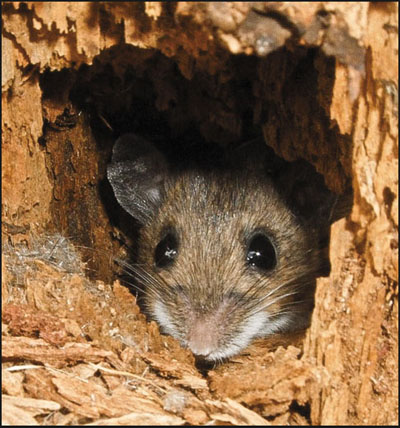
Many of us have heard about the apparent laughter of rats. Now, Smithsonian Magazine is reporting that a biologist at the University of North Carolina, Matina Kalcounis-Rueppell, has ascertained that certain high-pitched sounds made by mice could actually be melodious songs. Some excerpts from author Rob Dunn’s coverage:
In late 1925, one J. L. Clark discovered an unusual mouse in a house in Detroit. It could sing. And so he did what anyone might have done: he captured the mouse and put it in a cage. There it produced a lyrical tune as if it were a bird. A musician named Martha Grim visited the mouse, commented on the impurity of its tones and left, musical standards being high in Detroit. Clark gave the mouse to scientists at the University of Michigan. The scientists confirmed that the mouse could sing and then bred it with laboratory house mice. Some offspring produced a faint “chitter,” but none inherited the father’s melodic chops. These observations were all noted in a scientific article in 1932 and mostly forgotten.
Recently, though, Matina Kalcounis-Rueppell, a biologist at the University of North Carolina, Greensboro, revisited the mystery of the singing mouse. And after figuring out how to listen to mice on their own terms, she heard something entirely new. […]
The world of rodents, long thought mostly quiet, may be full of songs, broadcast short distances, from one animal to another, songs that we still know very little about. […]
Her discovery reminds us that each species perceives the world in a unique way, with a finely tuned set of senses, and so finds itself in a slightly different world. Bacteria call to each other with chemicals. Mosquitoes detect the carbon dioxide we exhale. Ants see polarized light. Turtles navigate using the earth’s magnetic field. Birds see ultraviolet markings on flowers, signs invisible to us. Snakes home in on the heat in a cougar’s footprint or a rabbit’s breath. Most of these different worlds are little understood because of the narrow reach of our own perceptions. Kalcounis-Rueppell hears music in the dark, but as a species we still fumble around.
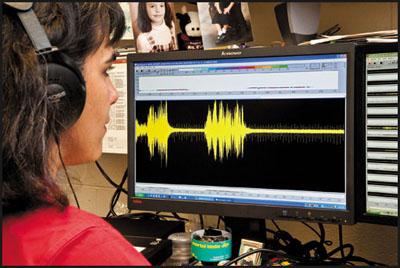
Photo by Lynda Richardson for Smithsonian Mag. Kalcounis-Rueppell examines a wav file.
It’s remarkable, how new perceptions of something so tiny could make our world suddenly seem so much larger. The entire Smithsonian article is astonishing. Check it out, and make sure to listen to Kalcounis-Rueppell’s audio file of mice vocalizing. It sounds, for all the world, like the wooing songs of tiny whales.
Good morning, heathens! Here’s a nice hot cup of atheist-approved parody to start your day off with a big bang. It comes to us courtesy of Ben Hillman (apparently the same man responsible for animating Anthony Mackie’s sperm for Spike Lee’s infamous 2004 dramedy, She Hate Me):
Via our own dear S. Elizabeth, who is still giggling over the lamprey.
An oldy but a goody, posted both for those who have never heard it, and those who have heard it a hundred times already. The serene and mysterious ambient music of Jupiter as captured by NASA Voyager:
These sounds are the result of “the complex interactions of charged electromagnetic particles from the solar wind, planetary magnetosphere, etc.” (Via Andy Ristaino, thank you.)
There’s something deeply comforting and astonishing about this, isn’t there? Our universe is so far from silent. A wide range of heavenly bodies are constantly emitting unique electromagnetic signals that we can pick up and process, provided we have the right instruments. The stars do sing.