Owning the Cardinal Directions of the Heart: An Interview with Author Nick Harkaway
O frabjous day! (Callooh! Callay!) It is March 20th, 2012– the official US release date of UK-based author Nick Harkaway‘s second novel, Angelmaker.
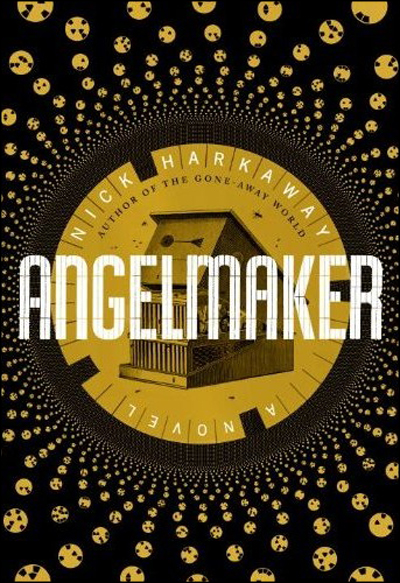
Comrades, if you appreciate joyful and highly original storytelling, you need to pick up this book. Immediately. Trust me when I tell you that Angelmaker is easily one of the most endearing works of fiction that will be published this year… or next, for that matter.
Better yet, trust William Gibson: “You are in for a treat, sort of like Dickens meets Mervyn Peake in a modern Mother London. The very best sort of odd.” Or Tim Martin: “this is as far as it could be from the wearied tropes that dominate so much of fantasy and SF.” Or Glen Weldon: “A big, gleefully absurd, huggable bear of a novel.” Or Charles Yu: “Nick Harkaway’s novel is like a fractal: when examined at any scale, it reveals itself to be complex, fine-structured and ornately beautiful. And just like a fractal, all of this complexity and beauty derives from a powerful and elegant underlying idea.”
(Yes. YES! THIS. What they said. All of it, plus tax, and with great interest.)
Who among you has read Harkaway’s debut novel, The Gone-Away World? Those who have know what a big-hearted and ferociously intelligent storyteller he is– how he crafts narratives that defy categorization (and sometimes gravity), shunting his intricate, multi-pronged prose along at breakneck speeds. TGAW is a sprawling, surprisingly poignant hero’s epic that unfurls like a Lichtenberg figure against an unlikely backdrop of pirates, mimes, ninjas, horrific super-weapons and devastating post-apocalypse. It’s equal parts meticulous, silly, sincere, impassioned, hilarious.
The yarn of Angelmaker is made of similarly electric stuff, only spun even more finely, and woven so intricately that many passages play out like a kind of multi-layered literary sleight-of-hand: How did he do that? Within his wordplay, Harkaway ensconces acts of commensurately deft swordplay, espionage, gangbuster hijinks, and even higher fantasy. Intricate family bonds are explored and philosophical quagmires grappled with. There are trains, planes, automobiles, and submersibles. Sex! Monks! Murder! Mechanical bees! We are introduced to tragic elephants and a heroic pug. Harkaway dares us not to fall in hopelessly in love with each and every character and object and exotic locale he braids into the microcirculatory tapestry. (Bear in mind, there are thousands of distinct and lavishly described elements.)
At the golden hammering heart of the story we find Joe Spork, a lonely/adorable identity-crisis-having horologist, and Edie Banister, a ninety-year-old former superspy whose badassery transcends time and easy pigeonholing. Together –with the help of their magnificent friends/lovers/family, and thwarted by an assortment of deliciously loathsome villains– Joe and Edie must rescue the world from an antiquated doomsday device unlike anything anyone ever imagined… save for the tormented genius Frenchwoman who haplessly invented it.
It all sounds utterly absurd, doesn’t it? Well, it is. Ravishingly so.
Now. That being said, I’m delighted to present the following Coilhouse interview with Nick Harkaway, author of Angelmaker and The Gone-Away World. Huge thanks to Qais Fulton for supplying several of these questions, and downright humongous thanks to Mister Harkaway for taking the time to answer them all so thoughtfully.
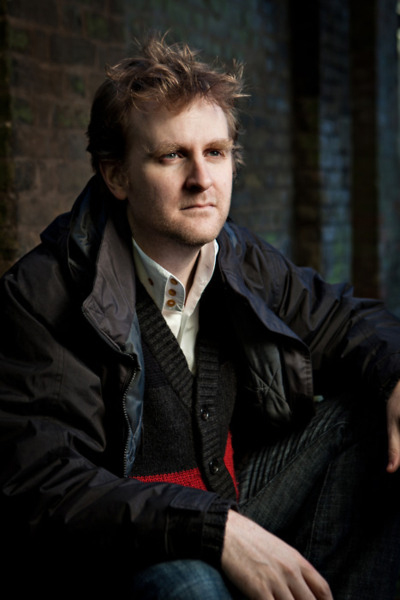
Nick Harkaway. Photo by Rory Lindsay.
COILHOUSE: You were a professional screenwriter before becoming a novelist. Both The Gone Away World and Angelmaker –while infinitely more complex, dense, and multi-layered than the medium of film could ever allow for– have decidedly cinematic qualities: panoramic descriptions of places and scenes, well-paced bursts of action, crackling dialogue. Do you often find yourself pushing or pulling against that previous construct, or have you compartmentalized the two mediums? What (if any) are some of the most important tools you’ve brought with you from your screenwriting career?
NICK HARKAWAY: Mostly for me the sense of the story leads the writing, so I know where I’m going and I come up with how to say it as I go. (I don’t mean that character doesn’t drive, rather than I have an overarching sense of what character and plot will do in combination, and I then have to write a line through that using the right scenes and the right language to express it. There’s a constant battle to find words and events which properly capture the concept in my head. And sometimes it turns out that the concept has conveniently ignored some logical realities and I have to bridge a gap…)
But screenwriting is a terrific base to work from. There are two gifts it gives which are obvious: if you’ve written a movie script, you know that you can finish a story. (I swear, more people get hung up on sheer terror of the long form than anything else.) And you know about concision. Every good writer I know has at one time or another worked in a field which required them to be able to express a lot in a short space, with minimal linguistic flourish. Whether that’s journalism, the civil service, the law, or something else, it’s a great discipline. I, obviously, have sort of abandoned that kind of sparse writing, at least for the moment, but that doesn’t mean I don’t benefit from it.
What pushed you to write your first novel? Was there a specific catalyst?
Yes. I was heartily sick of pitch meetings. I couldn’t stand taking another great story to someone who was fried on Starbucks’ coffee and not really paying attention and have them object to everything which was interesting about it and then complain that what was left wasn’t original enough. Or some variation on that theme. The final straw was a musketeer-ish story I wanted to write which was about a women who had, in her youth, dressed as a kind of D’Artagnan figure. She’s in middle age, her kid gets kidnapped, and she has to go back to being an adventurer – but she’s no longer a waif. She’s a farmer. She’s strong, heavy, and very obviously female. So she puts on a fake beard and decides essentially to be Porthos instead. There was all kinds of fun stuff in that story – just talking about it I want to get it out of the drawer again. Anyway, my panel of (female) execs sit through this, and at the end they say “well, it’s kinda hard to place stories with a middle-aged female lead”. And that is their entire critique apart from a nice extra kiss-off about transvestitism being hard to sell, too. And I just thought “screw this”.