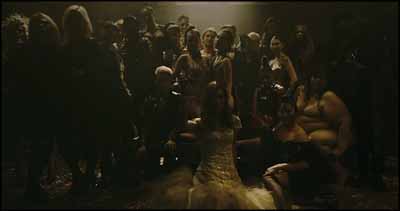
Wren Britton of PUREVILE just posted this (and several more scorching hot, queer-as-fuck music videos) on his website, saying: “Just some pretty amazing gay positive hip hop…FINALLY…I mean with so many in this genre still on the DL its really amazing to see some new kids standing up and saying ‘YES HUNTY’…..Keep that shit up !!!!!”
Oh, hells yass.
The video for Mykki Blanco‘s “Wavvy” is particularly off the hook. Really, what’s not to love about a juicy, no-holds-barred, 19th Century salon style orgy? Some of our east coast readers may recognize some familiar faces and names from the downtown NYC bohemian gallery scene: Susan Surface, No Bra, Christelle de Castro, Jeanette Hayes, Ruth Gruca…
“What the fuck I gotta prove to a room full of dudes who ain’t listenin to my words cause prednisone 100 mg they starin at my shoes?”
Today’s “I’ll be in my bunk” moment brought to you by… fashion designer Katarzyna Konieczka! Previously featured on Coilhouse here and here, the Kraków-based fashion designer has outdone herself in this incredible collaboration with photographer Sylwia Markis, model Kwiesatz, and hair/makeup designer Katharina Armleder.
Earlier this month, in the middle of a rather typical Coilhouse work day, a certain Hot Plumber walked into Mer’s life. Time seemed to stop and the world watched in awe as Mer live-tweeted her encounter with the dashing, dignified, big-handed plumber.
Alas, instead of advancing boldly, my adorably shy co-editor hid under a blanket in the other room while the hot plumber worked his magic. He left without ever suspecting the powerful connection that existed between them, wondering perhaps why nothing he did – not the loud banging in the kitchen, nor his deft handling of the plumbing snake – seemed to catch her eye.
Coilhouse readers, we can’t let this missed connection fade into history. We have to help Mer gain the confidence needed to grab the Hot Plumber’s attention the next time that he walks through that door, making the image at the top of this post a reality! How about arming her with an unforgettable ice-breaker: “did you know that I’m Klout’s Top Influencer on Diarrhea?” What self-respecting Hot Plumber could resist a person of such power, such prestige?
Mer is currently #5 on the list of Klout influencers about Diarrhea (she’s also influential about Unicorns and Adolph Hitler). Ever since Mer found out about Klout, it’s been her ambition to be at the top of this elite list. Let’s make it happen! On this special day and during all of next week, please join me in giving Mer a +K on Diarrhea on Klout, and helping make her dream come true. HAPPY BIRTHDAY, MER! We love you.
This video is spreading like wildfire, and it’s too good not to repost here. It’s Gilbert Gottfried reading steamy passages from Fifty Shades of Gray, an extremely popular erotic fiction novel about a BDSM love affair.
Have had more success compared to the much more expensive products that my doctor wanted me to take. I am very happy with the results. . Our Online Canadian Pharmacy is also accredited by the Canadian International Pharmacy Association (CIPA).
Written by E. L. Leonard, the book started out as a Twilight fanfic titled Master of the Universe, published under the pen name Snowqueen’s Icedragon. Once the book was reworked for publication, high schooler Bella and vampire Edward replaced with college grad Anastasia Steele and powerful business magnate Christian Grey, the novel became an overnight success, recently landing on the New York Times #1 bestseller list with major movie studios vying for the film rights.
If I were a member of the Christian right, sitting on my front porch decrying the decadent morals of working American women, what would be most alarming about the Fifty Shades of Grey phenomena, what gives it its true edge of desperation, and end-of-the-world ambience, is that millions of otherwise intelligent women are willing to tolerate prose on this level. If you are willing to slog through sentences like “In spite of my poignant sadness, I laugh,” or “My world is crumbling around me into a sterile pile of ashes, all my hopes and dreams cruelly dashed,” you must really, really, want to get to the submissive sex scene.
Roiphe’s piece is clever, but flawed in its premise that feminism is at odds with the type of sex described in Fifty Shades. “It is perhaps inconvenient for feminism that the erotic imagination does not submit to politics,” Roiphe writes in one passage. “Nope!” counters Maya in a well-written rebuttal on Feministing. “Really don’t care! I don’t want the erotic imagination to submit to politics. That sounds horrible. I’d like to create a politics that affirms the full range of the erotic imagination, though.” Well-put.
take this every day. Helps with keeping things moving and feeling good. . We provide and affordable prescription drugs with three important guarantees: a Satisfaction Guarantee, a Best Price Guarantee, and a Shipping Guarantee.
Pardon the clipped, crass commentary but that’s what leapt from my mouth upon watching The Eagleman Stag, the 2011 BAFTA award-winning short film from Mikey Please. The stop-motion animation used here is incredible, with everything from the characters to the sets having been constructed using pure white foam, requiring a meticulous use of lighting to create shadows and, thereby, definition. The site for the film features a teaser of a behind the scenes look at how it was made. Even if the process underpinning the film isn’t something that usually gets you hot and bothered the film itself is still an utterly captivating, Existential study. Well worth eight minutes of your day, though Dr. Eagleman may disagree.
It’s hard to believe Dick Clark is gone. Is it safe to surmise that secretly, many of us kids who grew up watching him on the boob tube decided long ago that Clark (or, at the very least, legions of indiscernible vat-grown clones of Clark kept in a top-secret underground facility located a few miles beyond the city limits of Fresno) would be Rockin’ our Eves for centuries to come? Alas.
In (somewhat oblique) honor of the departed (and because NO halfway decent excuse to feature the Mael Brothers on Coilhouse should ever be passed up) here’s a fabulous performance of “Pulling Rabbits out of Hats” by Sparks on Dick Clark’s American Bandstand in 1984, followed by a unexpectedly sweet and silly “interview” between three very disparately distinguished gentlemen. SO GOOD.
Previously on Coilhouse:
“This Town Ain’t Big Enough For the Both of Us” Top of the Pops, 1974. (A very old post, wherein I get grumpy about Bedford Ave. hipsters and the SPARKS energy drink. Ignore that bit. S’all about the MAEL LURVE.)
Last week’s BTC starred a gorgeous, mega-talented yogini in an elegant-yet-questionable ad that blurred the lines between art, athleticism, sexuality and voyeurism. This week’s BTC features, uh… these guys:
As of yet, no confirmation –though certainly a lot of speculation– as to whether this was a Playgirl or Chippendales production. Either way, what bliss!
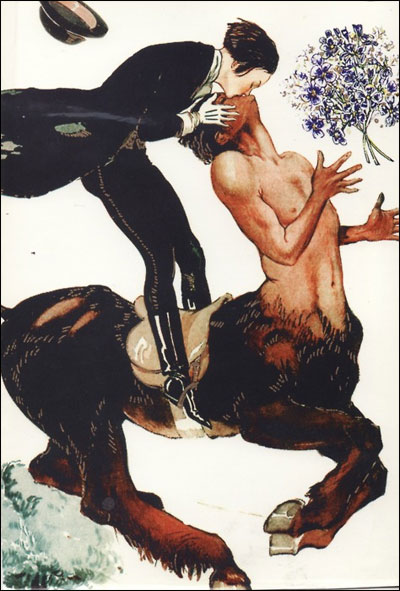
When I initially saw Nadya’s “Hot Human-on-Centaur Action” post in drafts, I just assumed she’d beat me to the punch with this gloriously (and mysteriously) perverted silliness:
Via Douglas, with thanks. And a vague, yet all-pervading sense of awe.
How delightful to realize, no! Apparently, there’s just some redolently centauromachian vapor riding the air currents right now.
Editor’s Note: Coilhouse reader Dicyfer just commented that this is “Centaur Kiss” by George Leonnec. It ran as cover artwork for the magazine La Vie Parisienne back in 1924. Thanks, Dicyfer!