Another thoughtful article by guest contributor Jeffrey Wengrofsky, “The Praise of Motherfuckers” looks at intergenerational warfare and the use of the word “motherfucker” in counterculture. NYC readers, take note: Jeff’s latest film (with the Syndicate of Human Image Traffickers), “The Party in Taylor Mead’s Kitchen,” is an Official Selection of DOC NYC 2011, the documentary film festival of the Independent Film Channel. It is scheduled to make its premiere on November 6 at New York University’s Kimmel Center at 7:30 and on November 7th at the Independent Film Center at 3:45. The film depicts the romantic beauty and squalid dereliction of the bohemian life as embodied by Beat poet and Warhol Superstar Taylor Mead. It’s being shown with “Girl with the Black Balloons.” Grab your tickets here. Congrats, Jeff! – Ed
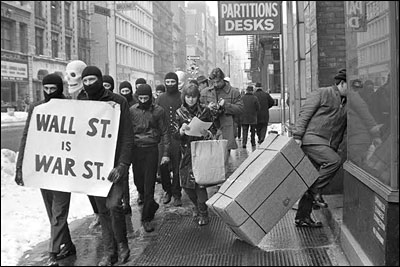
“WALL ST. is WAR ST.” Photo by Larry Fink. More photos here.
There is a … sort of madness… which the furies bring from hell; those that are herewith possessed are hurried on to wars and contentions… inflamed to some infamous and unlawful lust, enraged to act the parricide, seduced to become guilty of incest, sacrilege, or some other of those crimson-dyed crimes… ~ Erasmus
Not long ago I attended a lecture on youth rebellion in the 1960s. The presenter noted with disdain that the word “motherfucker” was used by some of the speakers at the notorious demonstration against the 1968 Democratic National Convention. Use of this term, so the argument went, was emblematic of a movement that was politically inept if not inherently self-destructive. And the most immediate casualty of the unholy coupling of “mother” and “fucker,” it was alleged, was the candidacy of Hubert Humphrey, who lost to Richard Nixon. For those outside the Convention, however, Humphrey’s nomination – pre-ordained by party insiders – offered a continuation of the Vietnam War and seemed to make a farce of our democracy.

The Motor City Five get it on (and duck stray bullets)
Well, it got me to thinking, and I soon made the personal discovery that Motherfuckery was all over America in the late 1960s and early 1970s. No, not literally, of course. The phrase was, however, in conspicuous currency among New Leftists in a way it had not been before or has been since.
On that fated afternoon in 1968, Rob Tyner of the MC5 had, indeed, shouted his shibboleth – “It’s time to kick out the jams, motherfuckers!” – to ignite his band’s performance, as he did for nearly every show. After hours of peaceable, if raucous, assembly and rock’n’roll (the MC5 were the only band with the gumption to perform), Chicago mayor Richard Daley dispatched 23,000 police and National Guardsmen to beat and gas the protestors. And when Connecticut Senator Abraham Ribicoff noted, on the floor of the Convention, that Daley was using “Gestapo tactics,” Daley himself fired the epithet of the era right back at the rostrum: “Fuck you, you Jew son of a bitch! You lousy motherfucker!”
Just a year earlier, Everett LeRoi Jones decorated a poem celebrating the race riots that would permanently cripple Newark: “All the stores will open if you say the magic words. The magic words are: Up against the wall mother fucker this is a stick up!” Magic words indeed, but the “joosh stores” did not “open,” they closed and remain shuttered to this day or marked only by empty spaces in their footprint.
The phrase “motherfucker” had already been in circulation in hip, African-American lingo long before Jones tapped it, referring to someone who may be evil, a passionate musician, or simply a force to be reckoned with. It is important to note here that mainstream African-American society, ever-struggling for respect, was possibly even more hostile to the use of the term in polite company than America as a whole.
In New York City, Ben Morea, a ballsy street urchin whose totalizing, uncompromising politics was wedded to a phrase befitting his society of self-proclaimed “suicidal sidewalk psychopaths” known as “Up Against the Wall, Motherfucker,” “The Motherfuckers,” or, most simply, as UAW/MF – though they referred to themselves collectively as “The Family.” Perhaps significantly, Morea “did not know his father [and] did not want to tell his mother he was a Motherfucker because he did not want to disappoint her.” Osha Neumann, another Motherfucker, also had a twist in his family romance: his father’s best friend, a man who had lived in his house like an uncle (Herbert Marcuse), married his widowed mother.
The Motherfuckers declared war on “the totality of reality as shaped by” the financial, military, and cultural elites by disrupting the suburban commute at Grand Central Station and high mass at St. Patrick’s Cathedral. In the middle of the garbage strike of 1968, Motherfuckers dumped bags of rotting garbage from the scummy streets of the Lower East Side onto the pristine promenade of the newly-minted Lincoln Center. They “ran free stores and crash pads…organized community feasts…[and] propagandized against the merchandizing of hip culture…” And, in the middle of the attempted “exorcism of the Pentagon,” only the Motherfuckers actually got inside the five-sided hole of power. Puritanical Roundheads on the frontline of America’s “cultural revolution,” they fought the police and sometimes against other radicals, criticized both the war and the naive embrace of the Vietcong by the left, shot blanks at poet Kenneth Koch (who may have fainted or told them to “grow up”), printed and distributed fliers in solidarity with fellow traveler Valerie Solanas after she shot Andy Warhol, and forced Bill Graham into letting them use the Fillmore East for free once a week.
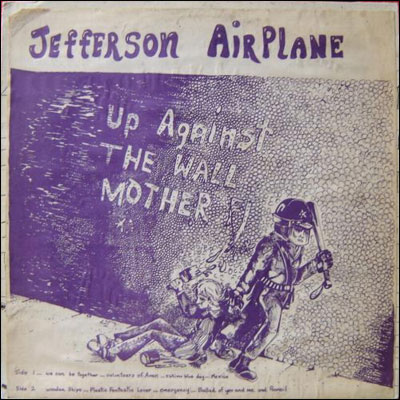
When Detroit’s MC5 came to play New York’s Fillmore on one such night, free tickets had not been distributed to the Motherfuckers and their ilk, unbeknownst to the band. The sight of the MC5 pulling up in a limo provided by Electra Records the Motherfuckers then took to be a sign of bourgeois bedfellowship, so they trashed the Fillmore and sent that otherwise courageous band into rapid retreat under threat of grievous body harm. The Motherfuckers were so feared that they once closed the mighty Museum of Modern Art by simply revealing their plans for it. Their slogan was put to music by David Peel and Harold C. Black, lo-fi renegades calling themselves “The Lower East Side,” in a feisty ditty on an album whose cover demurred from disclosing the word “motherfucker” although it was otherwise brash enough to be titled Have a Marijuana. More than a regional phenomenon, the Motherfuckers were the only non-student branch of Students for a Democratic Society (SDS), were admitted to and then purged from the largely French Situationist International, and had their slogans scooped up by San Francisco’s Jefferson Airplane for their song, “We Can be Together.” (Jefferson Airplane would actually voice a parricidal fantasy in a different song: “Hey Frederick.”)