Charles Bronson For MANDOM

If one were to suggest a spokesman for a rugged, tough men’s cosmetic, Charles Bronson is a good choice. Despite the man’s questionable choice in hirsute facial adornment, he exudes manliness. His eyes have an ever purposeful gaze, his face is craggy and weather worn, and his walk is the walk of a man who rides a horse on a regular basis, forsaking it only in very extreme circumstances, in which case he takes his car, which he also rides like a horse.

Yes, Charles Bronson is a man’s man, and the makers of MANDOM knew this when they crafted a series of commercials — mostly in Japanese — with him as their focus. Here they show Bronson at his very manly best, doing manly things like tossing his cowboy hat onto a set of mounted steer horns, spinning around in his desk chair, and giggling on the phone like a manly schoolgirl. MANDOM knows exactly what the users of MANDOM want; and they deliver with possibly more Bronson than is safely recommended.

For more manly MANDOM action hit the jump.

Adrien Merigeau’s Old Fangs

Part of the 2010 Sundance Film Festival’s Animation Showcase, Adrien Merigeau presents the tale of a young wolf’s sojourn to a dark and foreboding forest. Accompanied by two friends, his mission is to find his estranged father. Whether or not he will find closure as well remains to be seen.

Nightmares By Kate Clark

I’ve been walking through this forest for some time now. I came here after I left work. I shut my oyster off, placed my paperwork in my squid and got on the elevator. It brought me down to the forest, and now I’m walking home. It seems like it’s taking a lot longer than usual. I begin to worry that it may be taking too long. If I’m not home in time for dinner, the terrorists will kill my girlfriend. This cannot happen. I begin to run, but it’s no use. I must have taken a wrong turn somewhere. I frantically look around, trying to regain my bearings. To my left, I hear a noise. Whipping around, I notice that the brush is rustling. Suddenly, a nyala with a man’s face emerges from the brush. We stand there for a moment, staring at each other. Or maybe we stare at each other for a long time, I’m not sure. I am sure, though, that we stare at each other. Then the man-nyala slowly opens its mouth and in a deep, lugubrious voice says, “The mother’s milk is poisoned by the quiche.” Then it begins to scream. And then I wake up.

Lamija Suljevic’s Old-World Vamps

Silent-era glam, cure Balkan patterns and futuristic, sovaldi fortified silhouettes: this is the work of Lamija Suljevic, buy a 22-year-old designer based in Stockholm. In her new collection, shot by Emma Johnsson Dysell and unveiled last week, the Bosnian-born designer reflects on childhood memories of the home her family had to flee when she was five years old. “When I think of my hometown, I think of old techniques and handmade garments,” the designer told styleskilling blog. “Having that with me during my design process has become one of my strengths. If I’m working on my collections, I work wholeheartedly. Nothing else is good enough. If my grandmother were alive she would be proud, and things like that are very important to me.” Some of the old techniques incorporated into these garments include braiding, embroidery, pleating and crochet. Prior to this collection, Suljevicreleased some vintage-romantic looks on Lookbook under the label name Lamilla.


Designer –  Lamija Suljevic’. Stylist – Tekla Knaust @ new blood agency. Hair & make up – Nina Belkhir @ link details. Model – Olivia @ stockholmsgruppen. Photo – Emma Jonsson Dysell @ new blood agency

BTC: Tommy and the Atom

Who else from the US is long-toothed enough to remember those bunged up old Sterling Educational Film reels that lazy or under-prepped public school teachers often showed in place of real lessons? They were short, vaguely informative features on anything from personal hygiene, to parameciums, to overviews of friggin’ dairy production in Wisconsin. And of course, there was plenty of morbidly fascinating “duck and cover” fare:

I’d all but forgotten watching Tommy and the Atom one morning in my 1st grade homeroom class (this would have been early in Reagan’s first term) until now. But the minute that electrified fox showed up, it all came flooding back: the Rasputinian magician with his beard of lightning, the impassive narrator’s description of good versus bad atoms, the malignant black atom thrashing inside of a bomb, intimation of worldwide destruction at the hands of evildoers… This is one beautifully creepy, potent little slice of cold war propaganda.

Zoetica’s Vinyl Stickers – Going Fast!

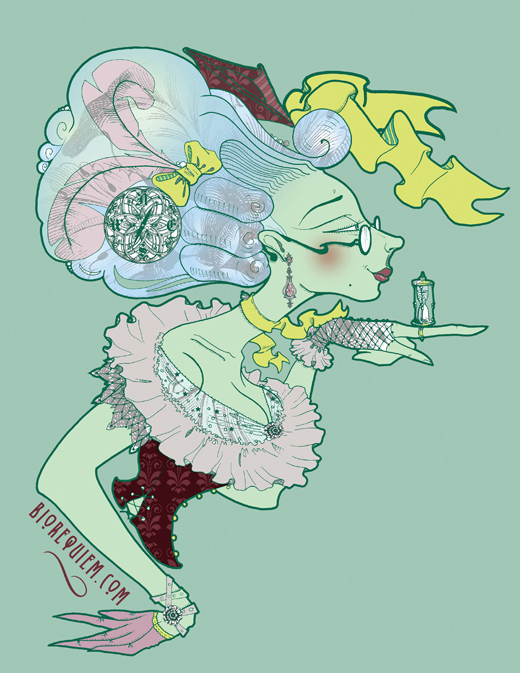
Just in case you missed this announcement elsewhere, Zo is selling these gorgeous contoured vinyl stickers of her original artwork over at her site, Biorequiem! There are two designs: Cumulus Confection, which appeared as one of the Coilhouse section headers in Issue 02, and Poke, an artwork that Zo released as fine-art print some time ago. The stickers are coated with a UV finish, making them resistant to discoloration over time. Get ’em before they’re gone!

Jane Quiet, Occult Detective

Much as her name would suggest, Jane Quiet is a woman of few words.

…none at all, to be exact.

But in all truthfulness, and surely most would agree, words completely fail to do justice to scenes such as the one depicted above!

I stumbled across Jane Quiet, Occult Investigator quite by accident, whilst conducting a bit of research on the internet; to further elaborate, it was a serendipitous miss-spelling of Dennis Wheatley which led me directly into her path. Heralded as a “Denise Wheatley,” Jane Quiet is the co-creation/collaboration which crept from the minds of author K.A. Laity (Unikirja) and artist Elena Steier (Revenge of the Vampire Bed and Breakfast, Goth Scouts). The comic “presents the adventures of occult investigator Dr. Jane Quiet who uses her practical knowledge and esoteric studies to uncover the sources of paranormal disturbances.” If that is not compelling enough, this author whose writing has been praised by Clive Barker as “full of fluent style and poetic dialogue” has added the twist of an entirely silent comic.

From the author’s website :

“I think it was Elena’s idea to riff on John Silence, the psychic investigator created by Algernon Blackwood, master of the weird tale, about a hundred years ago. John Silence was rich doctor, skilled in weird science and keen to explore occult phenomena. It was an idea ripe for reinvigoration.”

If you are curious as to how one goes about writing a story with no dialogue, inquiries and subsequent replies can be found in a snippet below.

Coilhouse And how did you find the find the process of “writing” a silent comic?

K.A. Laity: Thank you — it was hard as HELL to write! You can see the script online: http://www.kalaity.com/jq1.pdf. I think it was just an off-hand remark, “hey, we could make it a silent comic, wouldn’t that be appropriate!” then when I started writing it, I cursed myself endlessly for having the idea. There was a lot of back and forth while Elena was drawing – partly because she always has lots of projects going on, but also because she would say “you can’t do all this in one panel” and either draw what she thought would work or ask me to work it out more carefully. It’s great discipline. I’m glad Elena is so patient and flexible. The anxiety of collaborating with friends is fearing that it will affect your relationship if things go badly. I really had to let go of control and find joy in the unexpected frisson that would occur. A lot of it is about leaving a looseness for the other person to do what they do best. The first drafts weren’t quite Moore-like, but they were far too specific. I learned to focus on what had to happen and the tone, and let Elena produce her magic.

Farewell to Howard Zinn, the People’s Historian

“If history is to be creative, to anticipate a possible future without denying the past, it should, I believe, emphasize new possibilities by disclosing those hidden episodes of the past when, even if in brief flashes, people showed their ability to resist, to join together, occasionally to win. I am supposing, or perhaps only hoping, that our future may be found in the past’s fugitive movements of compassion rather than in its solid centuries of warfare.”

—Howard Zinn, A People’s History of the United States

The news came yesterday that Howard Zinn — historian, veteran, playwright and activist — had died of a heart attack at the age of 87.

Zinn was best known for his magnum opus, A People’s History of the United States, and for relentless activism against war and oppression in every form he saw. He kept up the fight until the end; giving his last interview just days before his death.

Born to poor immigrants in Brooklyn, Zinn’s family constantly moved during his childhood, staying “one step ahead of the landlord.” He later recalled the experience of “living in poor neighborhoods, seeing people evicted from their homes, their furniture put out onto the street—it seemed to have nothing to do with race or ethnicity, just poverty and helplessness.”

His childhood left him experienced in desperation, and he soon found out about war as well. Enthusiastically joining the Army Air Force in World War II, Zinn flew bombing runs over Berlin, Czechoslovakia and Hungary before participating in the first military use of napalm in 1945. The horrors he witnessed drove him to become a life-long opponent of militarism, convinced that “war in our time is always indiscriminate, a war against innocents, a war against children.”

Upon his return, Zinn took up the career of an educator, but found his own experiences missing from the official histories of his country. He strove to change that, and, instead of standing back, leapt into the civil rights and anti-war movements, inspiring his pupils (including a young Alice Walker), securing the release of POWs from Hanoi and testifying about America’s role in Vietnam at the Pentagon Papers trial.

Through it all, he laid the groundwork for his masterpiece, a book that revealed an alternate universe of dissident uprisings and almost forgotten struggles, simmering just under the surface of the American Dream.

Portrait by Robert Shetterly


J.D. Salinger — 1919-2010

They’re dropping like flies this week, dear readers. Yesterday it was reported that both actress Zelda Rubinstein and author/historian Howard Zinn had died and today word comes that J.D. Salinger, famed author of Catcher in the Rye is also gone, at the ripe old age of 91. A recluse for most of his life, besides the occasional lawsuit to stop seemingly anyone from publishing any details about his life, one could be forgiven for thinking him already dead which, I suppose, might have pleased him immensely.

What we are left with is a blurry portrait, taken from accounts by a former lover and his daughter. The man who emerges is a narcissist with a penchant for Eastern philosophy, homeopathy, and drinking his own urine. It is, perhaps, not the most flattering of biographies.

Still, in the end, none of this really matters. Those who will mourn the loss of Salinger do not mourn him, so much as they mourn the man who gave us Holden Caulfield. In that sense, the frustration with Salinger’s reticence has less to do with the words from his mouth than those from his typewriter. All we are left with is a set of four, slim volumes and a handful of short stories, taking up precious little in the way of shelf space. And yet his most famous creation, the young Mr. Caulfield, endures in just about every aspect of adolescence in this country. One may dispute Salinger’s ability with the written word and it would be a far easier proposition than disputing his influence. In many ways, J.D. Salinger created the teenager we know today. The sullen, disenchanted, angry and, ultimately, sensitive young person was set in stone in Catcher in the Rye, the model for countless (if not all) counterculture icons since.

It may be that such effusive words are unwarranted when describing a book or its protagonist, but a book so widely read, so deeply entrenched in our culture, deserves nothing less. Ultimately it is a case of the work having far outgrown its creator; a creator who quickly came to despise both it and the fame it brought him. In that regard the loss of Salinger is already decades old.

When Lace Becomes Skin: The Serge Lutens Mystique

Please welcome two new guest bloggers to Coilhouse this week! Tomorrow, we have S. Elizabeth (who you may know as ghoulnexdoor on Tumblr) joining us for a fascinating look at Jane Quiet, Occult Detective. And today, we’re premiering a post from decadent fashion designer and long-time friend of Coilhouse, Kambriel. In addition to our two new guests, you will soon be treated to an account of San Francisco’s Edwardian Ball by Neil Girling, last seen on Coilhouse covering the Great Handcar Regatta of ’09. Without further ado, I give you Kambriel! – Nadya

“Beauty is the moment when you raise your head” – Serge Lutens

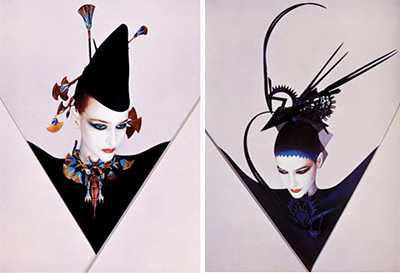
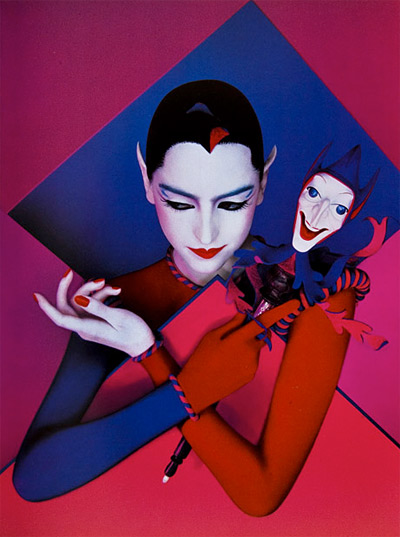
If there was one person who almost mystically inhabited the stylistic world of my own dream-mind starting in the mid-late ’80s, it would be the seemingly not-of-this-world French visionary, Serge Lutens. If you remember the eye-catchingly surreal and over-the-top, yet starkly minimalist graphics he created for Shiseido cosmetics in that era, they embodied a fantastical mystery taken to the extreme ideal. Sometime around 1989, Serge partnered with Shiseido to develop an eyeshadow trio entitled “Black Variations”. Packaged in a Zen-like, sleek black case, it was comprised of three shades. The colours in question? Black, black, and… black! The set was said to be inspired by lava – something that’s often inspired me in my own design work as well, with its ever-changing play of light, contrasting the depth of ultra-matte and sultry shimmering highlights – all translated into a language of divine and utter blackness.

Wizard of variations in black, Serge Lutens also is a master of conjuring extremes in vivid hues of whimsy, creating a world inhabited by willowy court jesters descended to visit us awhile from another universe:

For those with a spare $400-$600 burning a hole in your velvet-lined pocket, an oversized coffee table book of Serge’s photographic, surrealistic splendor is available here.

More images by Lutens, after the cut.