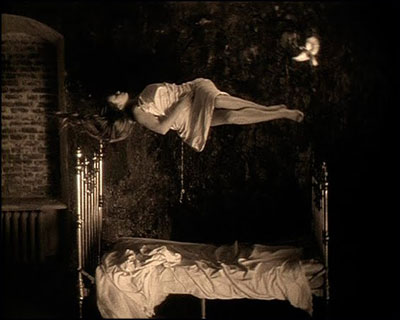
Jay-Z’s hypnotic music video for the song On to the Next Onewas released as “the first music video of the decade” on the morning of 01/01/10. Of course, Vigilant Citizen – who you’ll remember for his incisive analysis of Lady Gaga’s true Masonic origins – was immediately on the case. Jay-Z has been on the Citizen shitlist ever since the rapper wore a “Do What Thou Wilt” shirt last August, so with the release of this video came righteous vindication and the kind of breathless analysis that causes sharp spikes in the purchasing of duct tape and canned beans amongst the site’s core readership. God-fearing truthseekers weren’t the only ones dissecting the macabre clip. In an article on Jay-Z’s ties to the art world, Slatecommented on the clip’s symbols of wealth and status:
Jay-Z and the director Sam Brown jumble bluntly evocative status symbols—a bulging stack of hundreds, Armand de Brignac champagne—with more mysterious symbolism—a bell jar containing taxidermy birds, a swirling ink blot, those whipping cords (which, it bears mentioning, are lifted from the 2002 video for Interpol’s “Obstacle 1”). Some of the most memorable shots in the video are of black paint pouring down a diamond-covered skull. The skull is a replica of “For the Love of God,” a Damien Hirst sculpture that the British artist fabricated for about $30 million in 2007 and sold for a purported $100 million (to a group of investors that includes the Ukrainian billionaire Viktor Pinchuk and, oddly, Hirst himself). Like the Jaguar XJ, Hirst’s skull telegraphs extreme wealth, but that’s not all: Screaming its value while begging to be mulled over, it’s a status symbol and a puzzle in one.’
But Slate’s art-fag analysis is just part of the big cover-up, because this video’s occult powers are clearly beyond anything that even Vigilant Citizen could conceive of, as explained by Derek Jones from the Light of the Lamb Church (Mr. Jones’ breakdown is, perhaps, the true masterpiece here).
Satanic mind control issues aside, the video itself is well-played. Watching this clip is like stumbling across yet another mind-blowingly amazing, anonymous Tumblr blog where nothing is contextualized, nothing is credited, and nothing stays on top for long (hello, NOWITSDARK). Incredible images flash past your eyes as you continue to scroll down… sometimes you’ll recognize a film still or some fashion editorial from 10 months ago, but most times you have no idea, though you feverishly wish you did. You look at the image properties for a clue, and of course it’s only named something like “tumblr_kwqnmlcOoe1qa2t6ho1_500.jpg”. You will probably never know. This video captures the awed anxiety of seeing too many disembodied things in rapid succession.
Her first album was titled Metropolis, its follow-up – The Arch Android. She has killer rock n’ roll androgyne style and addictive musical-theater-trained pipes. Oh, she also does live painting and has her own label, too. Yet somehow, I hadn’t heard of Janelle Monae before this video for her single Many Moonspopped up on my screen last week.
As you can see, Metropolis is a concept album. Its fictional protagonist Cindi Mayweather finds herself in the year 2719 and on the run from android law, because she’s in love with a human. Monae’s next three albums will follow Mayweather’s adventures, some of them in space.
Yep, I’m in full swoon. Monae’s influences might be more than a little transparent, but I just don’t care – the combination is fresh and it’s pop. Great pop, at that. There’s space and robots and art and she’s adorable, but above all that, she gives answers like this in interviews:
I am driven by the need for change. I have had many nightmares about our future and if we do keep living the way we do, killing the way we do, hating ourselves the way we do, I do believe we are headed to the great road of nowhere. I know that I was put on this earth to lead, not to be perfect, but to lead and display a positive example and that is what I will die trying to do.
And I actually believe these aren’t just producer-polished words – Janelle is already working on starting a non-profit organization to help disadvantaged girls develop their artistic side. When, in light of a Grammy nomination, she was asked if she enjoyed being photographed and interviewed, she said, “Only when I have something to say. I’m not a red carpet gal. I wear a uniform for god’s sake! I have a hair machine I stick my head into. I have other duties to worry about.”
You hear that, pop culture? More of it, please. Also, I need a hair machine.
“Call me eccentric I haven’t a doubt
I’ll labeled a whole lot worse and far out
When I roll down a springtime grassy green hill
You think I won’t but I betcha I will
Cause I’m over 21 considerably
and I’ve earned the right to be no one but me.”
“Rad Anthem” by Rad Omen. Directed by Nicholaus Goossen.
Gack! What a disgustingly perfect, perfectly disgusting piece of work. Very “Dick in a (Happy Meal) Box”. One of those indelible wee slices of cultural tongue in stripper cheek that makes ya want to spit, laugh, cry, vomit, and masturbate all at the same time.
The four reigning icons of American fast food (Ronald, Jack, The Colonel and The King) get together for a boy’s night out and proceed to rampage up and down Sunset Strip like the douchiest of all popped collar, Entourage-aping broheims, gorging on drugs/booze/casual sex before retiring to Carney’s for late night refueling and condiment abuse. (The only thing missing is a cameo from the “yo quiero Taco Bell” chihuahua. Thankfully, comedian Nick Swardson‘s appearance as Wendy the stripper more than makes up for that omission.)
As Steven Gottlieb at Video Static puts it, “why wouldn’t fast food mascots live fast? After all, if they actually subsist on the shit they’re selling, it only stands to reason that they’d be just as tasteless with other aspects of their lives.” He goes on to state that the video “dry humps the line between parody and defamation” and I’d have to agree. It’s not as full-on chaotic neutral as “Smack My Bitch Up” or as viciously intelligent as “Windowlicker“. I’m giggling, but also left feeling the same vaguely irked “YOU’RE DOING IT WRONG” sentiment that I get watching a mindless sausage-baster like “Country Girl“. Displays of entitled douchebaggery + vapid disco shitbeats + the unbidden, deeply personal olfactory memory of being accosted with the stench of other people’s McDonald’s = INSTINCTIVE WRATH.
So. Is this conscious social commentary, or just another music video that –more cleverly than most– panders to the lowest common denominator? Either way, it got a strong response from me (I sure didn’t intend to ramble on this long about it)! Kudos. Now I’m off to alleviate this emotional hangover by fixing myself a huge, healthy salad.
Juxtaposing a person with an environment that is boundless, collating him with a countless number of people passing by close to him and far away, relating a person to the whole world, that is the meaning of cinema.
–Andrei Tarkovsky
Stalker (1979)
This is a heads up for the Andrei-lovin’ Zobotron as much as anyone else in SoCal: starting today (Jan 23), the Los Angeles County Museum of Art begins a complete retrospective of Tarkovsky’s films, with supplementary material. They will be screening Solaris, Ivan’s Childhood, Stalker, The Mirror, Nostalghia, Andrei Rublev, The Sacrifice, and two documentaries about Tarkovsky and his apocalyptic, mesmerizing work. Not to be missed.
Hey you, over there. Yeah you, with the Garfield plushy and the pictures of your cat, Garfield, dotting your cubicle walls. That’s right, you. You know what your problem is? You’re too damn cheerful. You say you hate Mondays in a way that tells me you really don’t and you’re always the first one to suggest ideas for weekend long team building exercises. You should stop that. What you need is a good, harsh dose of reality, delivered with an animated veneer. Here, sit yourself down and let me show you something.
Today, the Friday Afternoon Movie presents Grave of the Fireflies directed by Isao Takahata and adapted from the book of the same name by Akiyuki Nosaka. Released in 1988 by Shinchosha, who wisely hired the renowned Studio Ghibli to animate it, Grave of the Fireflies tells the story of Seita and his sister Setsuko. Orphaned near the end of World War II — losing their mother in the firebombing of Kobe and their father in the line of duty in the Japanese Imperial Navy — we follow the two through a desolate and famine ravished Japan as they attempt to survive, enduring the cruel indifference of both their relatives and fellow countrymen.
The antithesis of what many people expect from an animated feature it must have been even more puzzling upon its release in Japan, paired as a double feature with Hayao Miyazaki’s My Neighbor Totoro. Grave of the Fireflies is a look at the aftermath of an event that Japan continues to come to grips with and it is nearly unflinching in its gaze refusing to gloss over the cruelty and desperation it falls upon without ever becoming gratuitous. Roger Ebert, in his review, said that he felt the choice to animate the story was the correct one as “live action would have been burdened by the weight of special effects, violence and action” and I could not agree more (thought it should be noted that there have been two live action versions released in Japan since, in 2005 and 2008). The impressionistic nature of animation only helps to let this tragic tale emerge on its own terms. Scenes like Setsuko, dying of starvation and hallucinating, offering her brother a “dinner” she cooked for him, in reality clumps of mud and stones, are some of the most heart-wrenching things I have seen a movie.
It’s proof of the power of animation that something like Grave of the Fireflies work’s so well; and a shame then that, in this country at least, the majority of animated feature films decline to deal with this kind of subject matter, opting instead to tackle stories deemed too strange (or costly) for traditional live action films or the saccharine, princess fantasies of Walt Disney. In fact, it seems disingenuous to limit that statement to the U.S. There are few animated features that dare to approach this kind of subject matter and perhaps none that have plumbed the same emotional depth, period. It’s a testament to Takahata and Studio Ghibli’s skill and courage — and the power of Nosaka’s story — that even movies from some of my favorite directors, writers, and producers don’t affect me the way Grave of the Fireflies does. If you haven’t seen it you owe it to yourself to experience this profound study of war and its effects on the human condition.
Remember those mind-blowing Heather Parisi clips we were all gaping at a few months ago? Well, it’s time for Heather to scooch her bedazzled Mickey Mouse-clad tush over on that giant Rubik’s Cube pedestal we built for her.
Make room on the throne, and in your hearts, for another star of numerous 80s Italian television variety shows, the inexplicable Miss Sara Carlson:
I’m just gonna give your guys a minute to process that clip. Deep cleansing breaths, people. Zalright? Zalright.
The commentary on Carlson over at Nobody Puts Baby in a Horner is sharper and better than anything I can come up with at this late hour, with the fabric of my reality in tatters:
I recognize that, in the era of YouTube clips, what probably made sense in a particular time to a particular group of people is reintroduced to the world in a contextual vacuum. Without meaning, these videos become a veritable playground for camp, a place where the indecipherable message is the first language of ironic detachment and surface aesthetics the currency of visual pleasure. As such, perhaps I’m inherently biased towards this Fellini meets Lady Gaga pinnacle of unadulterated, uninhibited batshit insanity.
Several more clips and further spot-on commentary from Benjamin after the jump.
Quickly! A sneak peek of some (very happy, glowy) people we’ll be featuring in Issue #05:
photo credit: Allan Amato/Coilhouse
(And everybody goes “AWWWWWWW.”)
So far, 2010 has indeed been a happy nude year for musician Amanda Palmer and her beau, author Neil Gaiman. On New Year’s Eve, Amanda joined the Boston Pops Orchestra for the second year running to perform both Dresden Dolls and solo material (as well as passionately ravish Tchaikovsky’s Piano Concerto No. 1), and at some point during the course of the night, Neil proposed. They publicly announced their engagement on January 15th. A day later, the lovebirds met up with our wondrous Mister Allan Amato in NYC, who took these photos for an upcoming Coilhouse Magazine feature on their creative life together. They like that top portrait so much, they’re using it as their official engagement press photo. Yay!
photo credit: Allan Amato/Coilhouse
At 4am the next morning, they boarded a plane to LA and went directly to the Golden Globes, where, as the Huffington Post put it, Amanda “immediately became the most interesting thing at the awards.” (Heeee hee hee hee hee. Some things never change.) Congratulations, you two.
So, hey… things are kind of chaotic around here for the next few days, owing to the Whitechapel residency and all of us juggling multiple balls. Please forgive me for consolidating the following announcement with the Gaimanda Impending Nuptials Declaration, but my co-editors and I would also like to mention that Coilhouse Issue #04 has OFFICIALLY SOLD OUT in the online store.
Wow. It’s been what, a month?! We’re floored. Thank you for your overwhelming support and patronage! For those of you (in the States, at least) who missed the cutoff, fret not. There are still copies available in select Barnes & Noble stores across the country. Full list of stores here. Just be sure to call ahead to reserve your copy. There’s also Meltdown Comics in LA, Wildilocks in Australia, and… well… me in New Zealand. (Kiwis, just pipe up in comments and I’ll arrange to get your info.)
Onward and upward, comrades! Please do drop by the Whitechapel thread if you get the chance. There’s some really lively discussion happening over there, and we’d love to see more of our beloved blog readers chime in.
A French carving, pharm dating from the 1700s, designed to look like a human molar. At 10.5 centimeters in height it depicts inside its two halves, “The tooth worm as Hell’s demon” an explanation of the toothache as a battle occurring with the mythical tooth worm. The legend of the tooth worm apparently dates back to 1800 BC Mesopotamia and even has its own creation myth:
“When Anu created the Sky,
the Sky created the Rivers,
The Rivers created the Valleys,
the Valleys created the Swamps,
the Swamps created the Worm,
the Worm went to Samas and wept.
His tears flowed before Ea.
“What will you give me to eat, what will you give me to such?”
“I’ll give you a ripe fig, apricots and apple juice.”
“What use are a ripe fig,
an apricot and apple juice to me?
Lift me up! Let me dwell ‘twixt teeth and gum!
I’ll suck the blood from the teeth
and gnaw the roots in their gums.”
“Because you have said this, O Worm, may
Ea sink you with his mighty hand!”
The idea of a tooth worm was finally put to scientific scrutiny in the late 18th century by both Pierre Fauchard — “the father of modern dentistry” — and Philip Pfaff — who was dentist to Frederick the Great of Prussia. Pfaff seemed loathe to totally commit to such a position however (or was, in fact, a wonderfully sarcastic man), writing that, while he himself had never personally come across a tooth worm, he did not wish “to dispute the observations of learned doctors.”
All but her belly buried in the floor;
And the lewd trounce of a final muted beat!
We flee her spasm through a fleshless door…
Then you, the burlesque of our lust — and faith,
Lug us back lifeward — bone by infant bone.
— Hart Crane, “National Winter Garden,” (1930)
“Jo Boobs” Weldon is Headmistress of The New York School of Burlesque, whose home at The Slipper Room is just a few blocks from where Lydia Thompson’s “London Blondes” brought burlesque to America and a stone’s throw from where Minsky’s original National Winter Garden made burlesque part of the American vernacular. Minsky’s notoriously established Gypsy Rose Lee as an icon synonymous with striptease, and launched the careers of Abbott and Costello, Phil Silvers and Robert Alda before being closed in the name of public morality.
Houston Street Burlesque by Mabel Dwight (1928)
Is burlesque – a word which refers to turning things upside down – still able to subvert morals and mores? In a popular culture where the use of sexuality to sell consumer goods is banal, pornography of nearly every stripe is freely and instantly available, and sympathetic gay and lesbian characters are commonplace, is the self-conscious performance of gender merely campy fun or does it still have a liberating capacity? Can sex work, titillation, gender play and masturbation undermine heterosexual monogamy? Whose moralities and identities might they challenge?
Catherine MacKinnon argues that sexualized depictions of women in patriarchal societies reinforce misogyny to the point of constituting a form of violence. Do sexualized performances by women lead to their individual and collective debasement? Is stripping a phenomenon where women who appeal most to men are degraded whereas burlesque liberates women who stand outside the norms of beauty as prescribed by male desire? Considering stripping and prostitution, I ask whether everyone sells their bodies at every job? Further, when men pay a high premium to be with a woman or just to look at one, whose body is exploited? More specifically, does it make sense to import 20th century standards of judgment to a 21st century United States whose educational system produces more female post-graduates than male and whose career women earn 94.2% of the income of their male counterparts? Despite shifts in income and status, why do so few straight males study burlesque or work as strippers?
Jo Boobs and I met at the basement headquarters of her school on the coldest evening in recent years to explore questions of gender, activism, and whether she and her ilk are gender traitors or gender busters. She even stripped down to fighting gear for an intimate performance caught by our unblinking digital eyeball. (See above!) In June 2010, Jo will publish The Pocket Book of Burlesque (with a forward by Margaret Cho), a volume whose slender design can slip under the inspector’s prying gaze. The New York School of Burlesque is in sympathetic affiliation with Miss Indigo Blue’s Academy of Burlesque in Seattle and Michelle L’Amour’s Burlesque Finishing School in Chicago as well as programs in Washington, D.C and elsewhere. When will someone open a campus in Tehran?
COILHOUSE: How does burlesque differ from stripping? JO BOOBS: To understand the difference, look at it from the audience’s point of view. If someone goes to a strip joint, they usually go in whenever they want, they pick the performer they want, they negotiate how they interact with them, they interact one-on-one, and they leave. When they go to a burlesque show, the show starts at a [predetermined] time, they pay a cover (not the performers), they watch the show, there isn’t usually any one-on-one interaction, and they leave when the performance is over.