Very sad news out of Japan yesterday as it was confirmed that visionary director Satoshi Kon had indeed passed away, after a long battle with pancreatic cancer. He was 46.
Kon began his career as a manga artist, working with Akira creator Katsuhiro Otomo. He wrote a section of Otomo’s anthology film Memories entitled “Magnetic Rose” and in 1997 he made his directorial debut with Perfect Blue. This was followed by Millennium Actress in 2001, Tokyo Godfathers in 2003, the television show Paranoia Agent in 2004 (featured previously on Coilhouse), and finally Paprika in 2006. At the time of his death he was working on the film The Dream Machine which may be released posthumously.
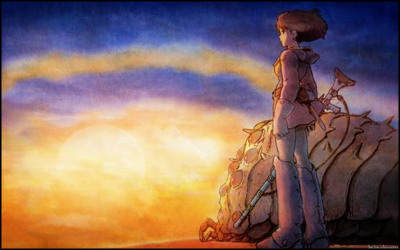
Close on the heels of the announcement that filmmaker Hayao Miyazaki may be preparing a sequel to his 1992 animated film Porco Rosso, Roger Ebert posts some well-deserved, effusive praise of Miyazaki and his first masterpiece, Nausicaa of the Valley of the Wind:
Much of anime in the past 20 years has concentrated on a utopian future, filled with technological wizardry and innovation, which is abundant in Japanese culture. But Miyazaki tends to look back instead of looking forward, inward instead of outward, looking at treasures of futures past that might have been. Like most of his films, his timeline here isn’t technological, but pastoral, with people relying more on each other and the Earth. He favors gorgeous green panoramas usually near blue bodies of water. He is in love with flight with his heroes soaring through the sky, representing our dreams of breaking through our limitations. We sense his hope in women more than men, believing them to be the key to humanity’s progress as opposed to man’s history of violence. These creeds and themes are held dearly and instinctively by the young and hopeful, and its Miyazaki’s ability to convey these naturalistic ideas through his visual imagination, which makes him unique.
Only Pixar has been able to rival Miyazaki’s creative energies in forming entirely new sights, sounds, and stories with each subsequent film. But Pixar is a collection of talent (all of whom pretty much worship him), while Miyazaki is a singular force. While even the greatest of directors have to rely on cast and crew to carry out their visions, Miyazaki pretty much IS the film. He might be the closest thing to the idea of an “auteur” which filmdom has.
Ebert has pointed his readership in the direction of Google Video to watch Nausicaa for free –and apparently guilt free– online. Hooray!
A ride through the dusty landscape of Australia’s Outback as the FAM presents 2005’s brutal Western The Proposition; directed by John Hillcoat, written by Coil Beat heartthrob Nick Cave, and starring Guy Pierce, Ray Winstone, Emily Watson, Danny Huston, and John Hurt to name a few.
The world of Hillcoat’s Australia, circa 1880, is a harsh, desolate, and unforgiving wasteland; an Abadon devoid of compassion or solace. It is this land that Ray Winstone’s Captain Stanley, having moved there with his proper, English wife Martha, attempts to tame. His immediate aim is to hunt down the Burns gang, who are wanted for the rape and murder of the Hopkins family. Having captured two of the brothers, Mikey and Charlie (Guy Pierce), he makes Charlie an offer: he and his brother will be released and excused of all crimes if Charlie kills his brother Arthur (Danny Huston), an eloquent psychopath so vicious that he is known to the Aboriginal inhabitants as “The Dog Man”.
Cave is an accomplished writer and The Proposition calls to mind many of the same themes as his first novel And the Ass Saw the Angel, a book I’ve read twice and still not decided whether I actually enjoyed. As with his novel, The Proposition comes close to merely becoming gruesome pornography of the soul. Cave constructs stories devoid of the concept of innocence — in the end all are guilty and shall be punished.
Still, the images of sun-baked emptiness and blood red skies evoke enough strange beauty to transcend, if only momentarily, the unyielding parade of violence. Winstone plays Stanley as a land-locked Ahab whose intentions, while principled, are not exactly pure in contrast to Arthur, a man with no illusions as to his place in world. The penultimate scene, taking place during an absurd staging of a traditional English Christmas dinner, is superb in its tension making for a dénouement in which no one wins.
It would, perhaps, be easy to dismiss The Proposition as a simple tale of violence begetting violence and indeed that might be a true assessment; but it is so raw in its telling, so unapologetic in its delivery that in the end such an observation is moot. It’s a film that refuses the viewer any consolation and expects no quarter in return. You may either watch or, like the Stanley’s Aboriginal servant Tobey — removing his shoes and abandoning them in the meticulously cultivated garden — you may quietly take your leave.
Witness the nerdy buffoonery of the trailer for Frank Miller’s commercial for the new scent from Gucci, Gucci Guilty. Certainly, this is not the first director-driven television spot we have featured on Coilhouse, Nadya having previously spotlighted David Lynch’s sixteen minute ad (Film? Vignette?) for Christian Dior. Gucci, however, is playing this one up as an event. The actual commercial hits a little under a month from now at the MTV Music Awards, no doubt preceding the long awaited Lady Gaga/M.I.A. Fish Slapping Dance Battle to the Death.
Entitled “Friendly Fires” “Frank Miller’s Gucci Guilty”, it stars Evan Rachel Wood and Chris Evans in a wire-frame world of imposing, CG skyscrapers and a distinct lack of color. Wood plays a femme fatale in a slinky outfit piloting a futuristic Jaguar XK120on fire while Evans plays a gentleman involved with the aforementioned seductress. It is all very tried and true ground for Miller, a man whose greatest crime has been to take his credit as a director on Sin City seriously enough to convince people with money that he actually is a director. No doubt I will be accused of various degrees of hipster posturing due to this bit of nerd rage but Miller’s green screen chicanery is truly a film-making nadir — managing to take a style that produced some excellent comic books and turning it into a tired, vapid cliche. On the other hand, those same qualities might work well for pimping an over-priced, designer fragrance and indeed “Guilty” seems to share many of the same qualities that made Calvin KleinObsession ads from the 1980s so absurd (and, some would argue, effective). It may be that Miller has finally found his niche.
Update: As BaggerMcGuirk notes in the comments, the ad’s title is not “Friendly Fires” as originally written in this post. Friendly Fires is responsible for the music in the ad.
Chiranjeevi’s Tollywood is a marvelous, magical, moustachioed realm that we’ve explored briefly on Coilhouse before. This morning, let us reopen the Telugian floodgates! We’ll start off with a particularly choice Chiru clip (via Dogmeat, thanks) and continue on with several more rip-roaring performances spanning the Megastar‘s illustrious career, featuring Chiranjeevi in cahoots with various gorgeous female co-stars… and a horse.*
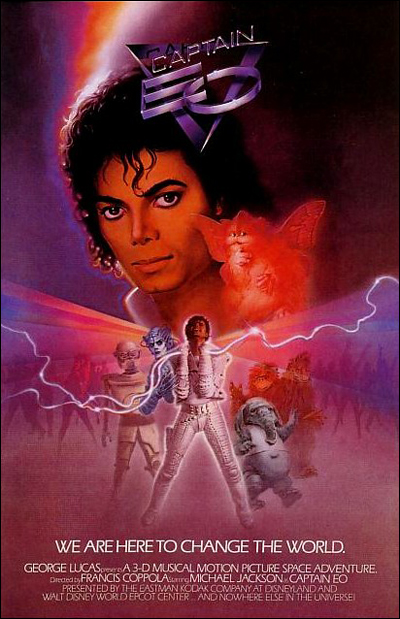
I went to Disneyland on Monday for the first time since my high school graduation night, which was a very, verrry long time ago. The biggest lure to re-enter the happiest place on Earth? Captain Eo‘s triumphant return, of course. The 17-minute, 3-D [or 4-D, if you count the synchronized in-theater effects] film stars Michael Jackson as the captain of a spaceship on a mission to deliver a gift to the Supreme Leader of a dark planet deep in the throes of a cyber-catastrophe.
Coppola-directed and Lucas-produced, Captain Eo began screening in 1986 and was shut down at the height of the alleged child abuse drama in the early 90s. Re-opened, predictably, after Michael Jackson’s death, this film is quintessential Jackson. As Eo, in addition to feeding his notorious Disney obsession, Michael gets to shoot lasers from his fingertips and to hang with adorable fantasy creatures and robots. He also wears a tight, studded white leather space suit while saving the world through the power of music and dance. This is who he wanted to be. Captain Eo should have been a mini-series.
One of my favorite aspects of watching this film again was finding all the influences from from sci-fi and fantasy films of the time. There’s the Geiger’s Alien-inspired Supreme Leader, the Gilliam’s Brazil-inspired pipes and steam of the dark planet, the Jim Henson-inspired puppets alongside nods to Star Wars and Terminator. You can probably find even more influences if you watch Captain Eo beyond the jump, but I don’t recommend it if it’s your first time and there’s a chance you might make it to an in-theater screening. It’s just so much better in 3-D!
Come with us as the FAM takes you on an extraordinary journey. Today’s offering is no doubt familiar to many, and yet bears repeated viewings. Released in Japan in 2001, Hayao Miyazaki’s Spirited Away (Sen to Chihiro no Kamikakushi which translates literally to Sen and Chihiro’s Spiriting Away) remains his most popular film. By the time of its release in the US in 2002 nearly a sixth of Japan’s population had seen the film, making it the highest-grossing film in the nation’s history. It would eventually win the Academy Award for Best Animated Feature becoming the first anime film and, thus far, only foreign language film to win the award.
Spirited Away, then, is the ambassador for Miyazaki’s work in the States. While his other films had seen release here, none did so much for his reputation among the general public than this film; and it’s not hard to see why. Spirited Away is a stunning piece of animation, the culmination of decades of Studio Ghibli’s work. It’s a film that upon each successive viewing reveals new details. The bathhouse scenes in particular are wonders, packed to the brim with background points of interest. For their part, when Disney localized the movie for North America they resisted the urge to fill the cast with big-name actors (something they did previously with Princess Mononoke and since with other Studio Ghibli releases). It makes the English dub much less intrusive to me.
It is easily my favorite of Miyazaki’s films, a man whose oeuvre is rife with amazing offerings. Spirited Away strikes me as the film that he let his imagination run wild while still managing to retain a cohesive narrative. It’s also a film that allows the viewer to enjoy it as merely a story and not necessarily a parable like, say, Princess Mononoke a film that, while beautiful, was bogged down by its environmentalist message. Spirited Away is a surrealist journey in the tradition of Lewis Carroll’s Alice’s Adventures in Wonderland, its messages and meanings subtly woven into the fabric of the story; there for those who wish to find it, invisible for those who don’t. It’s a truly timeless piece of movie making.
The Unarius Academy of Science is a non-profit organization founded in in the mid 50s in California, with various cells still located throughout the United States as well as Canada, Japan, and Nigeria. Unarius is an acronym which stands for UNiversal ARticulate Interdimensional Understanding of Science. Founded by Ernest and Ruth Norman, Unarius espouses “a new interdimensional science of life based upon fourth dimensional physics principles.” Ernest Norman also believed that the Chinese “evolved from ancient interstellar migrants who began colonizing Mars a million years ago.” After being attacked by native humans, these interstellar migrants reportedly returned to Mars, where they now live in subterranean dwellings. In 2001, the Unarians were all supposed to fly away in a fleet of spaceships, but that doesn’t appear to have worked out so great for ’em. From Wiki:
From the period of 1954-1971, when Ernest Norman still controlled the organization, the organization defined “the mission” as the bringing in of the interdimensional science of life in the books channeled by Ernest Norman. In the period of 1972-1993, while Ruth Norman guided the organization, the organization experienced renewed growth and public awareness. “The mission” became bringing Unarius to the masses. Ruth Norman granted interviews, appeared on The Late Show […] and kept very up-to-date technologically with video productions and a studio built in the late 1970s when such equipment was still in its infancy. Unarius video productions began appearing on public access stations all over the United States…
…much to the delight of stoned and tripping teenagers nationwide. Watch their entire “educational” film, The Arrival, below.
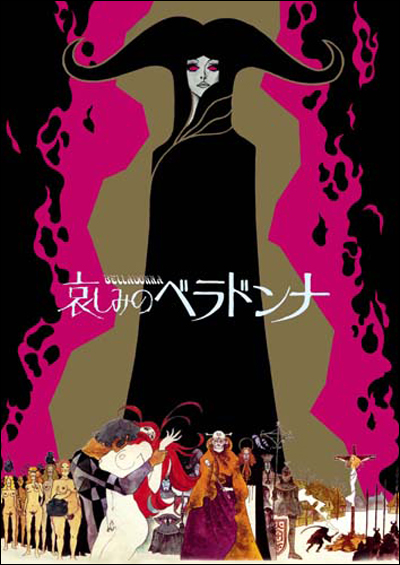
Belladonna of Sadness (?????????, Kanashimi no Belladonna) (1973) –an animated Japanese art house film by director Eiichi Yamamoto– is a rare and beautiful, though polarizing piece of avant-garde cinema.
A sexploitative, psychedelic rock opera set in the Middle Ages, the synopsis for Belladonna of Sadness from various internet sites describes it thusly: “The beautiful peasant woman Jeanne is raped by a demonic overlord on her wedding night. Spurned by her husband, she has no outlet for her awakened libido, which develops to give her powers of witchcraft.”and“…in her powerlessness she is gradually driven to ancient superstitions and satanic practices, and then accused, tortured and executed for witchcraft. ”
With striking visuals not unlike a Beardsley illustration or Klimt painting, it is more a fluid tableaux of watercolor elegance than actual moving animation. Despite the bewitching, breathtaking art, one never loses sight that it is a tragic story of unrelenting cruelty and despair. At certain points, it is an almost excruciating watch.
“Belladonna is an adaptation of La Sorcière, the 1862 novelized history of satanism and witchcraft in the late middle ages. The book was written by feminist, freethinker, and Frenchman Jules Michelet, who, like many other post-revolution French intellectuals, was eager to condemn the barbaric European forces of the prior few centuries. In Michelet’s story, the practice of witchcraft is not simply the leftover trace of ancient pagan traditions, but an active rebellion against an oppressive church and system of government. …According to Michelet, the spirit of rebellion and experimentation found in 14th century witchcraft was a progenitor of the enlightenment values yet to come. Furthermore, this was a movement led by women, those who likely suffered the most at the hands of the church and the feudal system.”
“The film adaptation of La Sorcière is often very faithful to the book…It tells the story of an archetypal witch (unnamed in the book, named Jeanne in the movie) who suffers a series of misfortunes that lead her down the path from being a chaste, obedient peasant’s wife, to giving in to her awakened earthly desires, to finally blossoming into the bride of Satan himself. The process of selling one’s soul to the Devil can be interpreted literally or metaphorically, but keep in mind that at least according to Michelet, those who would enter into such a pact in the middle ages presumably believed they were literally sacrificing eternity for just a glimmer of relief from a cruel and bleak life… Her relationship with the Devil may be nothing but a psychological coping mechanism for the brutality she suffers.”
Is Belladonna of Sadness a misogynistic sleaze-fest, a surreal feminist empowerment message, or a stylistic gem of exquisite curiosity? Perhaps a baffling hybrid of all of these things? Repeated viewings do not make the question any easier to answer. Those fortunate enough to find a (subtitled) copy may judge for themselves; in the meantime, several film stills can be found below.