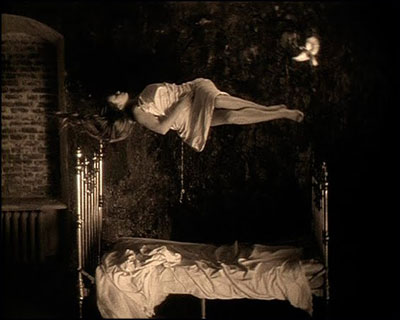
Jay-Z’s hypnotic music video for the song On to the Next Onewas released as “the first music video of the decade” on the morning of 01/01/10. Of course, Vigilant Citizen – who you’ll remember for his incisive analysis of Lady Gaga’s true Masonic origins – was immediately on the case. Jay-Z has been on the Citizen shitlist ever since the rapper wore a “Do What Thou Wilt” shirt last August, so with the release of this video came righteous vindication and the kind of breathless analysis that causes sharp spikes in the purchasing of duct tape and canned beans amongst the site’s core readership. God-fearing truthseekers weren’t the only ones dissecting the macabre clip. In an article on Jay-Z’s ties to the art world, Slatecommented on the clip’s symbols of wealth and status:
Jay-Z and the director Sam Brown jumble bluntly evocative status symbols—a bulging stack of hundreds, Armand de Brignac champagne—with more mysterious symbolism—a bell jar containing taxidermy birds, a swirling ink blot, those whipping cords (which, it bears mentioning, are lifted from the 2002 video for Interpol’s “Obstacle 1”). Some of the most memorable shots in the video are of black paint pouring down a diamond-covered skull. The skull is a replica of “For the Love of God,” a Damien Hirst sculpture that the British artist fabricated for about $30 million in 2007 and sold for a purported $100 million (to a group of investors that includes the Ukrainian billionaire Viktor Pinchuk and, oddly, Hirst himself). Like the Jaguar XJ, Hirst’s skull telegraphs extreme wealth, but that’s not all: Screaming its value while begging to be mulled over, it’s a status symbol and a puzzle in one.’
But Slate’s art-fag analysis is just part of the big cover-up, because this video’s occult powers are clearly beyond anything that even Vigilant Citizen could conceive of, as explained by Derek Jones from the Light of the Lamb Church (Mr. Jones’ breakdown is, perhaps, the true masterpiece here).
Satanic mind control issues aside, the video itself is well-played. Watching this clip is like stumbling across yet another mind-blowingly amazing, anonymous Tumblr blog where nothing is contextualized, nothing is credited, and nothing stays on top for long (hello, NOWITSDARK). Incredible images flash past your eyes as you continue to scroll down… sometimes you’ll recognize a film still or some fashion editorial from 10 months ago, but most times you have no idea, though you feverishly wish you did. You look at the image properties for a clue, and of course it’s only named something like “tumblr_kwqnmlcOoe1qa2t6ho1_500.jpg”. You will probably never know. This video captures the awed anxiety of seeing too many disembodied things in rapid succession.
Juxtaposing a person with an environment that is boundless, collating him with a countless number of people passing by close to him and far away, relating a person to the whole world, that is the meaning of cinema.
–Andrei Tarkovsky
Stalker (1979)
This is a heads up for the Andrei-lovin’ Zobotron as much as anyone else in SoCal: starting today (Jan 23), the Los Angeles County Museum of Art begins a complete retrospective of Tarkovsky’s films, with supplementary material. They will be screening Solaris, Ivan’s Childhood, Stalker, The Mirror, Nostalghia, Andrei Rublev, The Sacrifice, and two documentaries about Tarkovsky and his apocalyptic, mesmerizing work. Not to be missed.
Hey you, over there. Yeah you, with the Garfield plushy and the pictures of your cat, Garfield, dotting your cubicle walls. That’s right, you. You know what your problem is? You’re too damn cheerful. You say you hate Mondays in a way that tells me you really don’t and you’re always the first one to suggest ideas for weekend long team building exercises. You should stop that. What you need is a good, harsh dose of reality, delivered with an animated veneer. Here, sit yourself down and let me show you something.
Today, the Friday Afternoon Movie presents Grave of the Fireflies directed by Isao Takahata and adapted from the book of the same name by Akiyuki Nosaka. Released in 1988 by Shinchosha, who wisely hired the renowned Studio Ghibli to animate it, Grave of the Fireflies tells the story of Seita and his sister Setsuko. Orphaned near the end of World War II — losing their mother in the firebombing of Kobe and their father in the line of duty in the Japanese Imperial Navy — we follow the two through a desolate and famine ravished Japan as they attempt to survive, enduring the cruel indifference of both their relatives and fellow countrymen.
The antithesis of what many people expect from an animated feature it must have been even more puzzling upon its release in Japan, paired as a double feature with Hayao Miyazaki’s My Neighbor Totoro. Grave of the Fireflies is a look at the aftermath of an event that Japan continues to come to grips with and it is nearly unflinching in its gaze refusing to gloss over the cruelty and desperation it falls upon without ever becoming gratuitous. Roger Ebert, in his review, said that he felt the choice to animate the story was the correct one as “live action would have been burdened by the weight of special effects, violence and action” and I could not agree more (thought it should be noted that there have been two live action versions released in Japan since, in 2005 and 2008). The impressionistic nature of animation only helps to let this tragic tale emerge on its own terms. Scenes like Setsuko, dying of starvation and hallucinating, offering her brother a “dinner” she cooked for him, in reality clumps of mud and stones, are some of the most heart-wrenching things I have seen a movie.
It’s proof of the power of animation that something like Grave of the Fireflies work’s so well; and a shame then that, in this country at least, the majority of animated feature films decline to deal with this kind of subject matter, opting instead to tackle stories deemed too strange (or costly) for traditional live action films or the saccharine, princess fantasies of Walt Disney. In fact, it seems disingenuous to limit that statement to the U.S. There are few animated features that dare to approach this kind of subject matter and perhaps none that have plumbed the same emotional depth, period. It’s a testament to Takahata and Studio Ghibli’s skill and courage — and the power of Nosaka’s story — that even movies from some of my favorite directors, writers, and producers don’t affect me the way Grave of the Fireflies does. If you haven’t seen it you owe it to yourself to experience this profound study of war and its effects on the human condition.
New Yorkers with a taste for the deeply weird and gorgeous and ridiculous, you owe it to yourself to go see Hausuplaying at the IFC Center this week. Actually, y’know what? Correction– you owe it to ME to go, since I live thousands of miles away and won’t be able to.
Comrades, we’re talking about something unprecedented: a high-end screening of an actual print of what was long considered one of the most legendary horror bootlegs in existence. As far as I know, this fantastical film has been nigh-impossible for Westerners to view any other way. Until now.
Kudos to comics/film guru Ben Catmull for turning me onto this raging brilliant nutterfest.
Shot in 1977 by experimental Japanese director Nobuhiko Obayashi (and based on a story written by his 7 year old daughter), Hausu is one of the most riotously demented movies ever committed to celluloid. There’s plenty I could tell you about it (and there are tons of rabid, frothing film geek reviews online if you want to go exploring) but my instinct tells me it’s best to go unprepared, and just give yourself over to being repeatedly tit-slapped by the technicolor Japanese KRAY ZAY. My own virgin viewing experience was similar to seeing The Forbidden Zone or Eraserhead or The Billy Nayer Show for the first time– mindblowing, seminal, beautiful, and fucked up as all hell. Seifuku Koo Koo!
Come to think of it, there are a lot of wonderful things happening in New York imminently: Throne of Blood (a completley different flavor of Japanese cinematic genius) is showing at Film Forum, BAM is celebrating Dr. Martin Luther King on Tuesday, and tomorrow there’s the Knickerbocker Orchestra’s WFC performance of Prokofiev’s Peter and the Wolf, with Neil Gaiman narrating. Plus, two ultra high-concept Coilhouse Issue 05 photo shoots that have been in the planning stages months are finally happening. We’ll divulge more about those shortly.
Meanwhile, seriously, DO NOT miss seeing Hausu in the theater. GO, GO, GO. If my fervent urging hasn’t yet convinced you jaded bastards that this screening is not to be missed, click below for several more clips and stills.
It’s a little sad, how the advent of CGI rendered much of the animatronics industry obsolete just when cinematic robotics were starting to get so intricate, so lifelike. But the technology retains its place, and under certain circumstances, there’s still a definite advantage to using animatronics instead of CGI or stop motion. Some truly badass robotic FX artists have continued to find plenty of work. Take British wunderkind John Nolan, for instance:
Squeee! Although a relative newcomer, Nolan’s already worked on everything from Hellboy to Where the Wild Things to Doctor Who to Harry Potter. You have to check out his entire show reel. Incredible stuff.
Today is as good as any for a mind-fuck so the FAM is proud to present 2006’s A Scanner Darkly directed by Richard Linklater and featuring a rotoscoped cast headed up by Keanu Reeves who stars as Bob Arctor, a member of a household of drug users. Arctor is also known as Fred. This is the name he goes by at work, where he is an undercover police agent assigned to the household in order to discover the source of a new drug called Substance D. Fred has, in the course of his investigation, become addicted to Substance D as well and soon his surveillance focuses on one person: Bob Arctor.
And so it goes in A Scanner Darkly. Adapted from the 1977 novel of the same name by the late, great Philip K. Dick, one of his most personal work, in many ways a record of his drug experiences in the 70s. Twisting and turning, it is also one of his most complex, a labyrinth of alter egos where people are hidden from even themselves. Linklater handles all of this with aplomb, putting together a movie that deftly trumps its source in plot presentation. As much as I have always liked A Scanner Darkly it oftentimes trips over itself in explaining events, making for more than a few passages that require multiple readings in order to suss out.
Despite any problems with plotting, it remains one of Dick’s saddest works, and one of the few novels in which he goes out of his way to create real characters with a modicum of depth. The man, for all his brilliance, never put much importance on the people that inhabit his worlds; they function merely as tour guides, escorting the reader through the fantastic universes he has created. But the story of Arctor/Fred, perhaps by dint of it being a roman à clef, manages to overcome this proclivity and in doing so presents a powerful tale of paranoia and profound loneliness.
The fate of Arctor, used, abandoned, and broken, was one that Dick witnessed far too often and he channeled that hurt and anger into a story that sets its sights on both sides of the drug debate. It is most telling, then, that in his afterward, in which he lists people he has known who have suffered serious permanent physical, mental damage, or death from drug use he lists himself as well. It is just as sad that this list, included in the ending credits of Linklater’s film, had a name added to it. The story of A Scanner Darkly never really ends.
It seems that, no matter how many times we are warned about them, human beings cannot resist a creepy, dark, and empty storefront. We appear hardwired to look into the dusty and grimy abyss of a shop devoid of another person (or, at best, one so wizened that they may as well not be human at all) and immediately ascertain that, yes, indeed this is a place we must enter. Ladies and gentlemen, please, stop doing this. Should you be presented with such a choice, let me assure you that you will only bring upon yourself a swift, painful, and perhaps ironic end. Really, just walk away.
Alma, the titular main character in the short film by Rodrigo Blaas, received no such lecture, I’m afraid. Her parents were negligent in educating their child about the dangers of unmanned counters and stores with a distinct lack of helpful salesmen. Alas, Alma is naive and tragically ignorant of such places, a combination that, as previously mentioned, can only get one into trouble. All the more so when dolls are involved. No, dear reader, no good can come this. No good at all.
I’m not sure if it’s telling that Takashi Miike’s best film is also, by all accounts, his most conventional. It may be more telling that, considering the content of today’s FAM, Audition, it is one of the director’s less bizarre offerings.
Based on the novel by Ryu Murakami, Audition is the story of a single father looking for a wife. Shigeharu Aoyama’s wife has been dead for seven years and, urged by his son Shigehiko, he begins the now alien process of dating. To help in this matter, Aoyama’s film-producer friend Yoshikawa concocts a grand plan, in which they will hold mock auditions, telling applicants that they are vying for the role of Aoyama’s wife in an upcoming film. In the course of the auditions Aoyama becomes entranced by Asami Yamazaki, a seemingly soft-spoken and reserved 24 year old. He will learn, in due course, that she is anything but.
Audition really shines in its pacing, and thereby, its atmosphere. Something is not right with Asami. When we first see her on her own she is sitting in her apartment. It is an empty apartment, furnished only with a sack and a telephone. Asami sits in the empty apartment, staring at the phone and when it suddenly rings she does not move. Not even a twitch. The sack, however, is a different story.
This scene sets the tone for the rest of the film. We know that something is going to happen. We are waiting for it, mulling it over, guessing at it, and yet we could not have imagined what would finally happen and that terrible occurrence happens in one explosively brief moment of release, so brief that we are barely given time to understand its entirety before it is over and done and, in the end, we are left just as clueless and hurt and bewildered as Shigeharu Aoyama. This, then, is the genius of Audition and Miike, a director whose oeuvre, so rife with a frenetic insanity, belies the talent required to maintain such a perfect cadence. I look forward to the day when he tops it.
In 2007, David Lynch published a short book on Transcendental Meditation, titled Catching the Big Fish. Roughly half the book is devoted to extolling the virtues of meditation in decidedly Lynchian terms: “I call [depression and anger] the Suffocating Rubber Clown Suit of Negativity. It’s suffocating, and that rubber stinks. But once you start meditating and diving within, the clown suit starts to dissolve.” The other half reads like a scrapbook of anecdotes (“There’s a scene [in Eraserhead] in which [Henry] is on one side of the door; and it wasn’t until a year and a half later that we filmed him coming through the other side of that door”), musings (“there’ a safety to thinking in a diner”) and filmmaking advice (DV, DV, DV). One of the most touching sections describes Lynch’s first and last meeting with the great Italian director Federico Fellini:
I was shooting a commercial in Rome, and I was working with two people who had worked with Fellini. So I said, “Do you think it’d be possible to go over and say hello to him?” And they said, “Yeah, we’ll try to arrange that.” There was an attempt on a Thursday night that fell through, but Friday night, we went over. It was about six o’clock in the evening in summer – a beautiful, warm evening. Two of us went in and were taken to Fellini’s room. There was another man in the room and my friend knew him, so he went over and talked to him. Fellini had me sit down. He was in a little wheelchair between the two beds, and he took my hand, and we sat and talked for half an hour. I don’t think I asked him much. I just listened a lot. He talked about the old days – how things were. He told stories. I really liked sitting near him. And then we left. That was Friday night, and on Sunday he went into a coma and never came out.
The book’s rapturous tone can feel surreal when keeping the author in mind. Just imagine Lynch saying out loud, to you, “when you dive within, the Self is there and true happiness is there… it’s bliss physical, emotional, mental and spiritual happiness that starts growing from within.” But in another section, Lynch addresses the obvious question: is he’s such a blissful guy, why are his films so dark? “I fall in love with certain ideas. And I am where I am. Now, if I told you that I was enlightened, and this is enlightened filmmaking, that would be another story. But I’m just a guy from Missoula, Montana, doing my thing, going down the road like everybody else.”
Lynch states that meditation changed his life. Coilhouse readers, who here meditates? Is it as healing as David Lynch says? Who’s never meditated properly, and doesn’t really get how it works (me!)? Lynch’s passion and clown suit metaphors make me want to try again.
Sparrow Songs is a project in which filmmaker Alex Jablonski and cinematographer Michael Totten make and exhibit one short documentary per month, every month for one year.
Episode 3 – Porn Star Karaoke
Every week porn performers, fans and others from the adult industry get together at a bar in the San Fernando Valley to sing karaoke.
Jablonski and Totten’s third short documentary functions as an almost perfect microcosm of pornography, encompassing nearly all sides of an industry whose existence remains more, shall we say, problematic than most. It is a subject so rife with moral, emotional, and intellectual landmines that I fear even treading near it, especially when there are people so much more qualified to wrestle with it (a prime example being the always smart and stunning Susannah Breslin, from whom this clip was pilfered and who has written extensively on the matter). It’s a powerful piece of film and I present it to you here, then, with limited comment. Feel free to draw your own conclusions.