Bon matin! May flowers are blooming, kites are flying, a dirigible is idling on the wind above my good city by the bay, and for some reason I can’t stop thinking about this film:
Written and directed by Albert Lamorisse, The Red Balloon has got to be one of the most gorgeous and enduring depictions of childhood ever committed to celluloid. 34 minutes depicting youth’s resilience, playfulness, longing, loneliness, passion, violence, innocence, fearfulness, and most of all, JOY! It’s all here, presented in glistening primary colors and awash in natural Parisian light.
This was a student film made by Sundance filmmaker Madeleine Olnek about Leni Riefenstahl’s 100th birthday. If you take it literally, it could be a little mean-spirited towards the old lady. I mean, Leni wasn’t that obviously smug in the interviews that served as reference. There’s a little more depth to her. I mean, she never said that shit about Helen Keller in real life. Poor little Leni. What an unfair portrayal.
But if you take this short film as satirical commentary on artists who contribute to certain regimes and then try to pull that “I didn’t know there were politics going on!” shit later, which is how I think this film is meant to be taken, it’s fucking hilarious. My favorite real-life moment on par with the absurdity in this clip comes from a famous 1979 interview with (utterly homoerotic) Nazi sculptor Arno Breker, whose work was hailed by Hitler as the antithesis to all so-called degenerate art. Journalist Andre Müller, considered one of the hardest interviewers of his generation, described the scene thus:
When he mentioned the tragic consequences of his professional activities under Hitler, his isolation and desperation, his wife trembled with laughter. When I asked her what she found so amusing, she replied that normally her husband spoke in a completely different way. During a stroll around the garden, where several sculptures dating from the National Socialist period were on display, she told me: “I don’t listen when he tries to discuss politics, it bores me.”
A macabre incident occurred when I asked the sculptor about his attitude toward the gassing of the Jews. Precisely at that moment, [Breker’s art dealer] inserted a new tape into his recorder and mistakenly pressed the play button, so that my words were accompanied by a few bars of dance music.
And no. I can’t read the words “Nazi” and “dance music” in such close proximity to each other without bopping my head to this song. It’s funny. It’s not funny.
Charley Bowers ain’t even half as widely known as Ray Harryhausen, Georges Méliès, Winsor McCay, Buster Keaton, Jan Švankmajer, Ladislaw Starewicz or Willis O’Brien, but damn it, he should be! WACK-A-DOODLE-DOOOO:
It’s a Bird, featuring Charley Bowers and a scrapyard metal-eating, proto-Seussian “Metal Bird.” Directed by Harold L. Muller. (Thanks to longtime Coilhouse friend Mark P. for the heads up on this one!)
Once championed by the likes of Andre Breton, quite possibly an early inspiration to the likes of Theodor Seuss Geisel and Chuck Jones, this gonzo animator and comedian had fallen into obscurity by the time of his death in the mid 40s. Bowers’ work didn’t resurface until decades later, when a French film archivist sleuthed him out. Via mediascreen.com:
Raymond Borde of the Toulouse Cinemateque began the search after discovering a collection of rusty canisters simply labeled “Bricolo.” After discovering that Bricolo was the name given to an American comic named Charley Bowers, Borde began to scour the world archives for Bowers films. As usually the case in film preservation, Bowers films were located throughout the world in the archives of France, the Netherlands, and Czechoslovakia and only one film found in Bowers’ own native country of the United States. Eleven of Bowers’s twenty shorts are still considered lost films.
Bowers’s original claim to fame was as the animator and producer of hundreds of “Mutt and Jeff” animated films from 1915 until the early twenties. In the mid-20s, Bowers switched from pure animation to a hybrid mixture of live action and animation… comedy shorts starring himself as an obsessive inventor of gadgets, gizmos, contraptions, and crazy machines. Bowers continued with these shorts until after his first talkie short — “It’s a Bird” from 1930 (much admired by surrealists like Andre Breton). After “It’s a Bird,” Bowers dropped off the map, heading to New Jersey, working in advertising and industrial shorts, and drawing cartoons for local New Jersey newspapers. He reemerged in the late thirties as the animator for a short subject about oil for the New York World’s Fair (the film was also the first film produced by Joseph Losey). But after a few other animations in the early forties, Bowers contracted a debilitating illness and died in obscurity in 1946.
Fairly recently, Image Entertainment produced a lavish two-disc collection The Complete Charley Bowers: The Rediscovery of An American Comic Genius, which includes nearly all of his surviving films. They’re a frisky mixture of live-action slapstick, stop motion, uncanny SFX, talking cockroaches, Rube Goldberg shenanigans, and more.
In Now You Tell One, possibly Bower’s most over-the-top and mind-boggling film, a “gentlemen’s Liar’s Club” known as The Citizens United Against Ambiguity gathers for a storytelling contest. Wonky stop-motion animated cats and mice battle for dominance; bizarre botanical grafts yield impossible fruits; elephants and donkeys appear to stampede the Capitol building.
In Bowers’ world, a maternal Model T Ford hatches dozens of baby cars; a rapacious ostrich gobbles up inorganic matter and dances to a phonograph; a mad inventor labors to invent the world’s first “no-slip banana peel”; a sentient, white-gloved robotic creature runs amuck in what one reviewer refers to as an extraordinary “comical-bizarro poetic representation of the industrial age.”
The man’s talents as an actor/comedian may not have been on par with his idols Keaton and Chaplin, but his imagination certainly was. This is gloriously demented stuff deserving of far more cinematic acclaim.
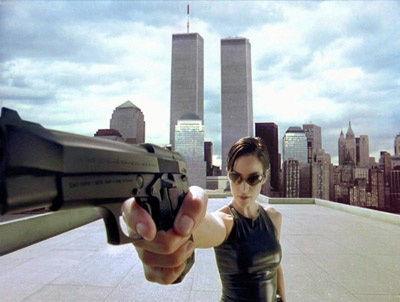
The Matrix turned 10 last week. It debuted March 31, 1999, though us plebs had to wait til April 2 to see it.
It’s easy to forget, in the wake of two disastrous sequels and equally lackluster (except for the Animatrix) tie-ins, exactly how radical and groundbreaking a pop culture artifact the first movie was.
Try, for a second, to look at the original trailer. Imagine you know absolutely nothing about the movie inside:
Pretty f’in cool, no?
To date myself, I was 16 at the time and came out of the theater utterly energized. I wasn’t the only one. William Gibson dubbed it “an innocent delight I hadn’t felt in a long time.” Darren Aronofsky raved that it heralded a new age in sci-fi. Neil Gaiman and Poppy Z. Brite wrote stories to fill out the movie’s universe.
It became a phenomenon, immensely successful and influential beyond anyone’s expectation. Hell, conservative scolds even blamed the movie’s anarchistic heroes for the Columbine massacre.
The Matrix worked because it managed to blend philosophy, allegory, action and fashion into one glorious, fun package.
Left: Durova as a noble lady. Right: Durova as a soldier in uniform.
When she was an infant, her father placed her under the care of a soldier after her abusive mother threw her out of a moving carriage. Growing up, she memorized all the standard marching commands, and her favorite toy was an unloaded gun. A noblewoman by birth, Nadezhda Durova wanted nothing more than to don a uniform and defend Russia against Napoleon. At age 24, she did just that. “With firmness so alien to my young age,” she wrote in her memoirs, “I was wrecking my brain about how to break free from the vicious circle of natural and customary duties assigned to us, women.” In 1807, disguised as a boy, she left home on the back of her favorite mount, Alchides, and enlisted in a Polish uhlan regiment. “At last I am free and independent. I had taken my freedom, this precious, heavenly gift, inherently belonging to every human being!”
Durova’s service in the military earned her distinguished honors, and throughout her career she was, by all accounts, revered by everyone in her chain of command. A few officers knew her secret, but most did not. Tsar Alexander I, aware of her true identity, awarded her a cross for saving a soldier’s life and gave her permission to join the regiment of her choice. He gave her a new male surname, Alexandrov (after his own name). Durova continued crossdressing after retirment from the military. She died at age 83 and was buried dressed as a man, with full military honors.
In 1962, the Soviet Studio MosFilm released a musical called Gusarskaya Balada(“Hussar Ballad”) based on Durova’s life. In what’s certainly a complete misrepresentation of Durova’s complicated existence, the musical paints Durova as a young patriotic woman in love with a male soldier, eager to win him over on her terms, as a fellow fighter. The film is without subtitles, but has enough colorful characters, costumes and music that I think a non-Russian-speaking audience would appreciate the clip above, which showcases Durova’s character first dressed as a woman, then dressed as a man. I love actress Larisa Golubkin’s confident, homoerotic swagger in the second half of the clip.
It’s difficult not to revel in the fabulousness of Gusarskaya Balada, but I wish that someone would make a textured, compassionate film that dug deeper into Durova’s life. There are many different ways for this play out, for many facets of Durova’s identity are still debated to this day. On the topic of her gender identity, Wikipedia states that “some readers interpret her as a cisgendered woman who adopted celibacy and male clothing to achieve professional freedom,” while others believe that Durova was transgender. Similarly, Durova’s sexual orientation remains a mystery. She eloped with a man when she was young, against her father’s wishes. However, she omitted her marriage (and any description of attraction to men or women) from her memoirs. When it comes to her relationship with women, one biography notes, “Durova felt uncomfortable around other women. On at least two occasions women recognized her true identity and addressed her as ‘Miss.’ Her fellow officers often joked that Aleksandrov was too shy and afraid of women.”
The deeper I dig, the more fascinating scenes I find. Beyond the obvious allure of wartime crossdressing, there are many odd tidbits, like Durova’s powerful connection with animals. As a child, she “frightened her family by secretly taming a stallion that they considered unbreakable.” Later in life she provided shelter to stray cats and dogs that she rescued, and she passed on her animal-taming abilities to her descendants, circus legends and founders of the Durov Animal Theatre in Russia. Then, there’s her horrible mother, who only wanted a boy, and seemed to punish Durova for being born a girl by making her spend countless hours doing monotonous “women’s work” like sewing and crocheting. That’s a whole other story itself, right there.
Hopefully, one day soon, someone will make a serious film about Durova. Until then, enjoy the song and dance.
Tilt-shift miniature faking is a technique for making images of real-life lanscapes look like tiny scale models by manipulating the focus and shooting from a specific angle. Keith Loutit a master of this craft; he’s shown us beaches, harbors and a monster truck rally from the point of view of a giant child. His latest video of the Sydney Gay and Lesbian Mardi Gras is the most fascinating of all. The disco candyland we see here is the straight out of the religious right’s worst nightmares about where the world is heading. Watching this felt like someone crammed Dziga Vertov and Zombie Zombie into one sparkling mini-masterpiece. Enjoy! [Thanks, Kelly]
The Sheffield, UK-based band began as a trio (Richard H. Kirk, Stephen Mallinder and Chris Watson), mucking about with recorded sounds manipulated by reel-to-reel recorders in 1973. It started out as a very gritty, buzzy, bewildering wall-of-noise project. Later songs, while more conventional, were no less confrontational, helping to define both the sound and the anti-authoritarian attitude of the industrial music genre.
Difficult to imagine, perhaps, but the scratch and break elements of hip hop and rap are partly rooted in the noise terrorism of Cabaret Voltaire… Even as they’ve moved far away from their original all out assaults, their tempestuous beginnings still inform everything they do. The importance of those early years should not be denied, for their great blasts of noise were instrumental in freeing popular music from its narrow, restrictive definitions.
Control, and how to confound or defeat it, was a recurring theme in their work…. They were among the first popular musicians to seriously use “found” soundbytes, lacerating recorded speeches of politicians, pornographers and slot TV preachers, juxtaposing them in odd configurations, not only for comic effect but also to reveal their true nature.
Cabaret Voltaire, 1982.
Watson left in 1983*, right before CV’s decidedly more danceable albumThe Crackdowncame out. The above video –innovative in its own right– was created in support of one of the most addictive songs in their catalog: “Sensoria” from the albumMicro-Phonies.
They really were something special. As excited as I am to see Throbbing Gristle reforming, I’d be even more psyched to see these three reunite. Laptop music it ain’t, never was, and hopefully never will be.
Do you hear that weird, wet fluttering noise? No, it’s not an intergalactic death squid. That is the sound of the buttholes of approximately 6 million nerds palpitating in dewy anticipation. Watchmen must be opening today.
Anyone else need a drink? Yes, I realize it’s only 8am here. Hey, we all cope differently. Dave Gibbons, Zack Snyder et al are very likely bathing in solid gold jacuzzis filled with dom perignon. Meanwhile, somewhere in Northampton, Alan Moore, having chugged a quart of psilocybin tea out of the gilded skull of a medieval pope who secretly worshiped Glycon the snake god, is now levitating three feet above the ground, muttering a curse of warts and incontinence upon anyone who dares to attend opening weekend.
I figure I can have a morning cocktail if I like.
Left: a “Full Frontal Manhattan” (hurr hurr!) Right: the “Black Freighter” (let’s drink ourselves direct to DVD!)
The End is Nigh! Ladies and Gentlemen, the day has finally arrived! After over a decade of waiting, speculating about the cast, and debating whether it should even be attempted, Alan Moore and Dave Gibbons’ classic graphic novel, WATCHMEN, is finally a major motion picture. And whether you feel that this is cause for no end of celebration or you believe you will need to drink yourself into oblivion to make it through this bastardization of a pure artistic vision, the Isotope is here for you! Serving up a bevy of Watchmen-inspired cocktail recipes to suit all your boozing needs!
Bless you, Isotope. I’m going to fix myself a “Silk Spectre” right now… with added Rohypnol.
Folks, feel free to use this thread to rant, rave and runteldat about Watchmen Babies or whateverthefuck to your heart’s content. Please, just try to keep the spoilers to a minimum, and remember, I have to mop up the booth when you’re done. Cheers.
A while back, Coilhouse covered the bleak, beautiful art of the late Polish painter, Zdiszlaw Beksiński. Beksiński’s star has been steadily rising over the past decade, thanks largely in part to increased exposure on the internet, and a phenomenal volume in the Masters of Fantastic Art series published by Morpheus Press.
This coming Thursday at 7:30pm, Beksiński’s long time friend and agent, Valdemar Plusa, will be joined at the Egyptian Theater in LA by several heavy-hitting horror directors: Wes Craven, Tobe Hooper, Stuart Gordon, Mick Garris, and William Malone. They’re gathering together to chat about Beksiński’s life, art and influence on film. After the talk there will be a screening of William Malone’s latest project, Parasomnia, which prominently features Beksiński’s art as CG dreamscapes (honestly, I’m not completely sold on that concept, but who knows…it could be amazing).
All proceeds from the event will go to the American Cinematheque and MOCA’s Art Education Programs for children in Los Angeles. More info here.
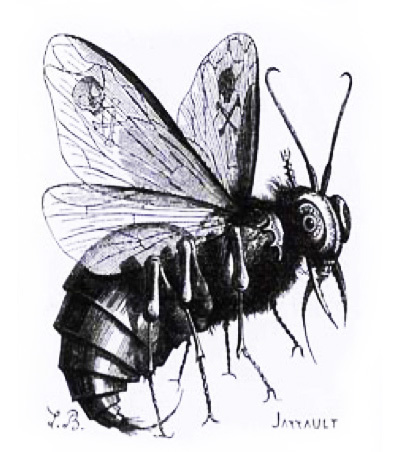
Belzebuth (aka Belzebub, Beelzebuth), whose name means “lord of the flies” is prince of demons according to the Scriptures. Milton calls him foremost in power and crime after Satan, and most demonographers call him supreme chief of hell. Belzebuth is also known to rid harvests of flies. His favorite color is chartreuse.
Even if you’re not remotely interested in the occult, chances are you’ve been exposed to at least a few of the critters compiled in that hugely influential Dover collection, Treasury of Fantastic and Mythological Creatures; it’s been kicking around for decades. Several of the most fascinating and grotesque beasts contained therein are from a series of 19th century illustrations produced for Jacques Auguste Simon Collin de Plancy‘s Dictionnaire Infernal, aka, Demonographia. Louis Breton drew the set of 69 illustrations of various demons as described by Collin de Plancy, which were then engraved by one M. Jarrault.
Did you know that in addition to vomiting flames and commanding forty legions (most of these dudes seem to command an awful lot of legions… or, alternately, inflict lesions), the Egyptian deity Amon has the power to reconcile differences between friends? Or that Ukobach the Inferior, a lesser minion who maintains the oil in the infernal boilers of hell, also probably invented deep-frying? Is that wild? That is wild! Did you know that? I did not know that. Weird, wild stuff.
For a while, proper reprints of the grimoire were very difficult to obtain. In fact, they’re still pretty pricey, but you can download the entire book in PDF form (in fairly good quality).
Furfur: a count of hell who rules 26 legions. He appears as an angel or a stag with a flaming tail and speaks only lies unless enclosed in a triangle. He speaks in a raucous voice. Furfur sustains marriage, can cause thunderstorms, and speaks on abstract things. He has also been known, on occasion, to “get Yiffy wid’ it.”
Several more frisky demons and (paraphrased) descriptions from Demonographia after the jump.