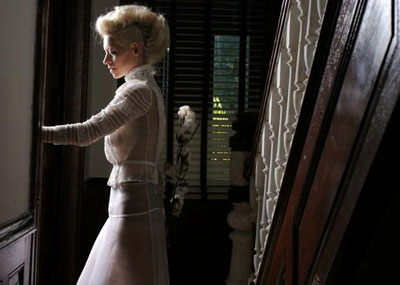
There is only one Paul Komoda in this world. Our first mention of this artist came back in October of 2007 when we first launched – we featured the piece “Blind Love.” This time, I’d like to share with you Paul’s creepy, emotional take on Joseph Merrick, the Elephant Man. In addition to being a fantastic artist, Paul also happens to be my best friend in the world. He was there the night that Zoe, Mer and I were all together in the same place, at the same time, for the very first time. ComicCon 2007, Dr. Sketchy’s. Nobody knew each other well at all then, yet. They had us drawing an imaginary George Takei for some reason, in addition to the posing Sketchy’s model. We recognized Mer (whom I’d met only once before) on the street due to her green dreads. Zo was the model, and had a terrible cold. Her usual, high-pitched voice sounded so low that weekend that it was as if she’d been smoking 10 packs a day since she was 2. She was talking to Mer for the first time and I kept saying “this isn’t really what she sounds like!” It was a magical night. Warren Ellis (drink!) was at that ComicCon too, and Molly Crabapple was at Dr. Sketchy’s. That one night had 2 magazine contributors and all 3 editors… before anyone even knew there’d be a magazine.
Anyway, so here’s Paul. Many years ago, we watched David Lynch’s The Elephant Man(see full movie here) together. Now we quote that movie at each other all of the time. Paul just moved to California – 5 minutes away from me! – after living on the East Coast his whole life. The first thing he said when he entered his new room: “this… is my home. I have a home.” Expect great things from this fellow East Coast expatriate, who has finally become one of us, one of us, gooble gobble.
Every holiday has its series of rituals and Christmas is no exception. Whether you’re with family, friends or drinking alone, these two informative videos from Rare Exports will reveal a new facet of Father Christmas that’s sure to make you reconsider everything you know about him.
You’ve probably been told to think about the hard work that went into putting that dinner on the table, but have you ever considered Santa’s origins? After watching the videos below you’ll never take another “Ho!” for granted. You’ll walk away with a deep sense of appreciation for the secret workings behind that jolly visage. A grim, NSFW Christmas tale for the ages awaits beyond the jump!
The image (Sci-Fi Christmas, via AdsOfTheWorld) above came after I utterly failed to find pictures of Samuel Delany, Tanith Lee, Joanna Russ or the late, great Octavia Butler in a festive and appropriately seasonal hat. If anyone can remedy this gaping, unforgivable hole in the historical record, please let me know. Until then, bah humbug.
All Tomorrows will be taking a special holiday intermission as I’ll be traveling for the holidays this week and I imagine many of you wonderful people will be similarly occupied. It will return, full force, on Dec. 30. We have many stunningly written worlds – weird, beautiful and hellish – in store for you lucky souls.
In the meantime, have the Star Wars Holiday Special. You’ll never want to do anything but read (far, far away from the moving images) ever again.
Julia Frodahl is a dreamy dove, a love, a healer, and dare I say, the most precious of precious snowflakes. When I use the word precious, I don’t mean it in a cloying or derisive manner. Julia is truly precious in the incalculably valuable, rare and astonishing sense of that word, like the Baroda Diamond, like a unicorn found wandering the streets of Greenpoint, Brooklyn.
Music video for Edison Wood’s “Last Night I Dreamt I Would Last Forever” directed by Alicia Reginato, 2008
As an accomplished yoga instructor (according to some, she’s one of the best inversion teachers in New England), her serene approach to the yoga asana practice is paired with a deep working knowledge of human anatomy and alignment. As lead songwriter, singer and keyboardist for the chamber orchestra Edison Woods, she infuses her music with a pensive, wintry grace that makes me think of pure white things: falling snow and eiderdown, powdered sugar, frost, pearls.
Listen for yourself. Here’s Edison Woods’ “Shirts for Pennies”:
Photo by Sebastian Mlynarski.
Click through for more photos of the exquisite Mme Julia, and a rave review of Edison Wood’s album Seven Principles of Leave No Trace from All Music Guide.
Forrest J Ackerman: literary agent, magazine editor, writer, actor, producer, archivist, curator, and so much more, too much to pack into a brief obituary. He was a crackpot visionary to the max, to be sure, and deeply loved by millions of fellow freakazoids the world over. Tip o’ the iceberg: he discovered Ray Bradbury, represented Isaac Asimov, Ed Wood and L. Ron Hubbard, founded Famous Monsters of Filmland and is widely acknowledged as the man who coined the term “sci-fi.”
Ackerman cultivated one of the most enormous private collections of science-fiction movie and literary memorabilia in the world, cramming his hillside “Ackermansion” with 50,000 books, thousands more science-fiction magazines, and such priceless collectibles as Bela Lugosi’s cape, actual Star Trek tribbles, and original props from War of the Worlds.
He sold off quite a bit of his collection back in 2002 and moved to a smaller place, but schedule permitting, continued to open his home to strangers every Satuday afternoon to view his remaining treasures. He greatly enjoyed sharing his many colorful stories and anecdotes with fellow Hollyweird aficionados. Speaking to the AP during a lively tour of the Ackermansion on his 85th birthday, Ackerman said “My wife used to [ask] ‘How can you let strangers into our home?’ But what’s the point of having a collection like this if you can’t let people enjoy it?”
When I first heard about Sita Sings the Blues, my initial reaction was one of near-disbelief. “No, wait, you’re telling me that someone made a feature-length animated version of the Ramayana focused on much-put-upon Sita and if that wasn’t enough, it’s filled with musical numbers set to Annette Hanshaw’s inimitable jazz vocals? With sarcastic shadow puppets?! You’re kidding, right?”
No, Nina Paley‘s Sita Sings the Blues is very, blessedly, real. My next reaction was that something this eclectic and experimental in concept was going to either crash and burn or succeed brilliantly.
The result? Well here’s a glimpse:
After attending a sold-out showing at the Asheville Film Festival a two weeks ago, I was blown away. It is, without a doubt, like nothing I have seen on screen. There are very few movies anymore where one can gleefully proclaim, mid-way through “Wow, I’ve got no fucking clue what’s going to happen next!”
Sita‘s magnificence is a testament to the tireless hard work and innovative vision of Paley, a longtime alternative cartoonist, who made the whole film on her home computer over five years. The ideas for the movie stem from a particularly harsh break-up (that story’s also told in the movie). Her struggle still isn’t over either: her creation still faces numerous hurdles, both from Hindu fundamentalists and corporate music juggernauts. This thankfully hasn’t stopped it from tearing up the festival circuit across several continents, getting much acclaim at big name fests like Berlin and Tribeca.
So how did something like this come about? Paley was kind enough to talk about the movie’s genesis, its challenges and why audiences these days are doing more than just buying tickets.
COILHOUSE: Why make a feature movie out of the Ramayana, of all things?
NINA PALEY: Well, I was moved by the story and it seemed to speak so much to my life at the time, my problems at the time. It was cathartic to retell the story.
The tagline you use in the movie is “the Greatest Breakup Story Ever Told” Which is a nod to the Bible movie, the Greatest Story Ever Told.
The film above, Rabbits’ Moon, was Kenneth Anger’s 1979 tribute to classic themes of love and folly, as influenced by Kabuki theater as well as commedia dell’arte. Japanese folklore’s Moon Rabbit is a symbol of self-sacrifice, not unlike Pierrot The Fool. Pierrot suffers at the whims of Columbine while Harlequin enjoys the show. This seven-minute film took twenty years to complete and its original score included music from The Capris, Mary Wells and Jamie Cullum among others. Anger, [Lucifer Rising, Inauguration of the Pleasure Dome,author of Hollywood Babylon] one of the world’s greatest experimental filmmakers, is presenting five of his films tonight at the very intimate RedCat Theater.
A towering figure of American avant-garde cinema since the mid-1940s, Kenneth Anger has posited himself at the junction of pop and underground culture, occultism and rock music. Tonight’s screening presents an array of works in which Anger subjects different ideologies and subcultures to his incisive vision and the uncanny re(de)constructive power of his editing skills. Ich Will (2008, 35 min.) montages newsreels from the Nazi era to Bruckner’s music. Mouse Heaven (2005, 12 min.) “does for Mickey Mouse what Scorpio Rising did for neo-Nazi biker gangs,” according to the UCLA Film & Television Archive. Elliott’s Suicide (2007, 15 min.) is an elegy for the late Elliott Smith, while I’ll Be Watching You (2007, 4:52 min.) and Foreplay (2008, 7 min.) explore two different forms of male bonding: sex in an underground parking structure and a soccer team’s training session. The program concludes with the seminal Scorpio Rising (1963, 29 min., 35mm), whose hallucinatory and campy communing with pop culture fetishes (chrome-trimmed choppers, James Dean, zippers, Jesus) has been an enduring avant-garde crowd pleaser.
I have threetwo [all gone, sorry peeps!] complimentary tickets available to the first three humans to write me with their emails titled “Anger!”. The presentation begins at 8:30 pm – don’t delay!
When the dust settled from the October Revolution in 1917, diagnosis there was a brief, shining period of uninhibited artistic experimentation in Russia. Before the authorities clamped down on such “decadent” behavior, Russian artists in the 1920s explored communist ideals with more sincerity, hope and optimism than probably at any other time in history in every medium, from architecture to graphic design. In the realm of film, this exploration manifested itself as Kino-Eye, or camera eye. Devotees of this filmmaking style believed that the camera should be used to record the truth of Soviet life without the aid of screenplays, actors, makeup or sets. “I am kino-eye, I am mechanical eye,” wrote Dziga Vertov in the Kino Eye Manifesto in 1923. “I, a machine, show you the world as only I can see it.” The crowning achievement of the movement was the 1929 film Man with a Movie Camera, made by Dziga Vertov (a name that translates to “Spinning Top”) and his brother, Boris Kaufman. The film presents the day in the life of a Soviet city from morning until night, with citizens “at work and at play, and interacting with the machinery of modern life.” The below is Part 6 of Man with a Movie Camera, one of the most dynamic sequences in the film (the entire film is behind the cut). Best if watched with speakers on:
Though the original, which premiered at a planetarium in Hanover at an event hosted by Kurt Schwitters (someone get me a time machine, now!), was silent, the director left behind notes for how music for this film should be composed. Dozens of interpretations have emerged over the years; the Biosphere, In the Nursery and Cinematic Orchestra versions are among the most well-known.
Sadly, things didn’t end well for Dziga Vertov in Russia, though they ended better for him than for most people in his position. When Socialist Realism was declared the “official form of art” in 1934, many of his colleagues were ostracized or exiled. Vertov was able to get away with a couple more films in the 30s, but they were edited to conform to the government’s expectations. After his last creative film, Lullaby, in 1937, Vertov worked on editing Soviet newsreels for the rest of his life. Interestingly, his brother Boris was able to move to America and worked with Elia Kazan and Sidney Lumet as a cinematographer. Kazan infamously named many colleagues as communists to McCarthy’s committee, but Vertov’s brother wasn’t one of them. I wonder if the two brothers stayed in touch, and how they felt about their work and how their lives had diverged. Was Vertov a bitter man as a news editor? Not necessarily; a lot of people, even when robbed of their ability to make art, made up excuses and remained devoted to communist ideals to the very end. And how did his brother Boris Kaufman fare in the paranoid environment of McCarthyism? Who felt that he got the better end of the deal, I wonder?
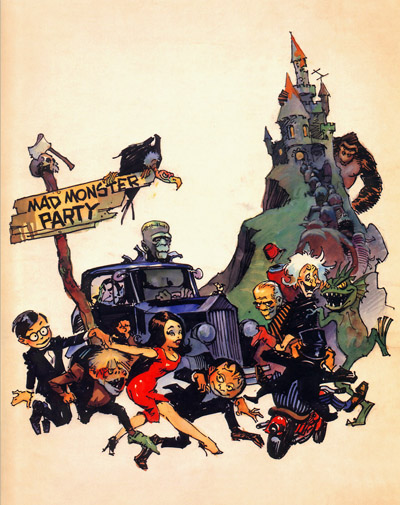
In the late 60s and eary 70s, the Rankin/Bass production company made a slew of endearingly hokey holiday-themed “Animagic” flicks that I’m just barely old enough to remember watching in early reruns. I couldn’t have been older than seven or eight when the popularity of such saccharine-injected TV specials as Rudolph the Red Nosed Reindeer and The Year Without A Santa Claus had begun to wane. While I’m too sentimental to harsh on any of that star-studded, sticky-sweet fare, only one of their films has really stuck with me all these years later. Tellingly, that movie is Rankin/Bass’s Halloween special, Mad Monster Party, and it’s all MAD Magazine‘s fault.
Classic Mad Monster Party illustration by Frank Frazetta.
Let’s talk for one sec about MAD. Who here read it growing up? Who still does? If you did/do, I bet it’s high on the What Made You Weird list. Founded in 1952 by editor Harvey Kurtzman and publisher William Gaines, this last gasp of the EC Comics line remained one of the most consistently clever, intelligent, and merciless satirical publications in print until at least the late 90s.* Nothing was sacred and no one was safe. Founded at a time when aggressive censorship and Cold War paranoia muted the voices of activists and humorists alike, the broadly grinning face of MAD’s mascot, Alfred E. Neuman, was a cheerfully innocuous “fuck you” to authority, and has remained so for generations. Honestly, I could rant and rave about the importance of MAD for hours, but it’s Halloweenie time, so I’ll shaddup for now, at least.
So! Mad Monster Party. Kurtzman and longtime MAD cartoonist Jack Davis were very hands on in writing and conceptualizing this island of classic horror movie monsters, and it shows. Appropriately, Boris Karloff loaned his voice to the character Baron Frankenstein (his final role). Phyllis Diller basically plays herself in it, which is even creepier than it sounds. One guy I know has claimed that the redheaded, husky-voiced fembot lab assistant, Francesca, gave him his first boner. Obviously, MMP influenced the hell out of Tim Burton. Studded with Forrest J. Ackerman-worthy puns and ridiculous musical numbers –including the song “Do the Mummy” performed by a skeletal Beatlesesque quartet called Little Tibia and the Fibias– MMP is campy, witty, and surprisingly risque for children’s fare… I’m pretty sure this is the only kiddie film that’s ever ended with a mushroom cloud!
Whether you’re revisiting it for the umpteenth time or watching it for the first, I hope you’ll enjoy Mad Monster Party with me on this most darque and spookylicious eve of Goth Christmas.
*I haven’t read the magazine since the late 90s, so I couldn’t honestly say if the rag’s still in top form. A lot of folks have said Mad’s gone downhill since becoming dependent on ad-revenue in 2001. The publication had been ad-free for decades until that time (beginning with issue #33 in April of 1957). It was, by a long shot, the most successful American magazine that ever published ad-free, and of course, by staying independent of ad revenue, Mad was free to tear American culture’s less savory, more materialistic aspects endless new arseholes without ever having to answer to financiers.
Hooray, Halloween is almost heeeere. What better way to greet the final stretch than to wake and stretch with this bonafide monster mash, courtesy of the great master of make believe, stop-motion model animator, Ray Harryhausen? (Added bonus: Tito Puente!)
More rousting clips of Harryhausen’s creations under the cut.