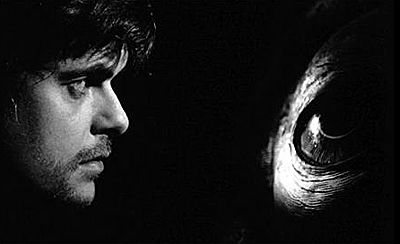
Thus opens visionary Béla Tarr’sWerckmeister Harmonies. The innocent hero Janos orchestrates a model of the solar system inside a bar. With this hypnotic scene the viewer is pulled into the frozen [though snowless] terrain of a poor Hungarian town. Based on The Melancholy of Resistance – László Krasznahorkai‘s 1989 novel, Werckmeister Harmonies is a journey through the bleak lives of some rather unhappy people among whom a romantic has the misfortune of existing. People whose sadness, suppressed anger and animal nature need but a trigger to explode into a hurricane of frenzied destruction.
When a circus claiming to have with it a whale carcass and a prince arrive in town square, suspicion and hysteria emerge. As if on queue, townspeople gather around like a pack of hungry dogs, no one daring to actually see the show, their collective agitation growing louder. Curious Janos is the first to enter the exhibit which turns out be no more than an enormous crate just big enough to hold the whale. He’s enthralled by the sight of the sea creature, enamored with its construction. We see his continued attempts to expose his cantankerous neighbors to the mystery and beauty of the world and be treated with patient condescension in return. Rumors about the prince spread, tension inflating until the unforgettable breaking point.
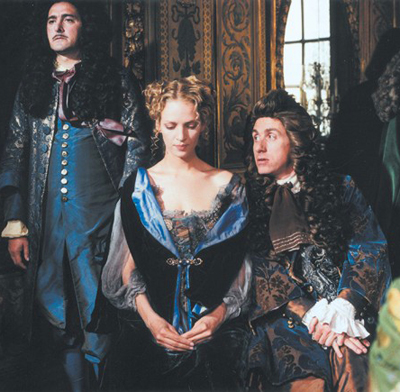
Nothing can top the excesses of royal 17th century France. The fashion, the banquets, the art – everything radiated king Louis XIV’s obsession with opulence. This grandiosity is captured in Vatel, Roland Joffré’s film starring Gerard Depardieu and Uma Thurman. Julian Sands plays Louis XIV with Tim Roth is his impeccably sleazy right hand man Marquis de Lauzun. Vatel tells the true story of a famed master chef ordered to feed, entertain and impress the capricious Sun King over a weekend at Chateau de Chantilly.
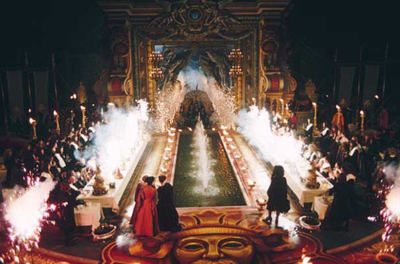
The costumes are, naturally, spectacular. To draw parallels between today’s rock stars and 17th century royalty, when choosing the materials for all the magnificent gowns and frocks Joffré took the costume designer to a Parisian shop specializing in dressing famous musicians. He also advised that the actors listen to rock music in their dressing rooms to get them in the proper mood. The cast is excellent as is the acting, there is intrigue, fireworks and brazen displays of food throughout. The set are appropriately pompous and droolworthy. For all these reasons I dub Vatel required viewing.
Though the film ultimately denounces the corruption and arrogance of the nobility, I find myself shamefully enchanted by the lavish design, best showcased in the clip below the jump [enigmatically in Spanish].
Spaniard Teruel Segundo de Chomón y Ruiz (1871-1929), a lesser known film pioneer with a particular fondness for hand-tinting his work, came to renown working for the Pathé brothers in the 1900s. While much of his work is directly informed by Méliès, Chomón’s distinctive aesthetic and deadpan humor set him apart and set a precedent for the surrealists Buñuel and Dalí. He also invented the film dolly.
The Golden Beetle (1907) is Chomón at his most delightfully innovative:
I learned of Chomón while watching the fantastic Landmarks of Early Film, Vol 1 collection, which also includes shorts by the Lumières, the aforementioned Méliès and some very early Kinetoscope movies. You can pick up a secondhand copy on Amazon for 20 bucks.
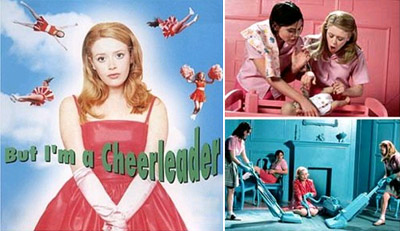
Brothers and sisters, I have a terrible confession; I was once A GAY. Lord have mercy! Lucikly, my parents had the good sense to ship me off to Love in Action, an ex-gay recovery camp for teens in Memphis, Tennesse. I learned many things at this camp; that homosexuality doesn’t exist, that men with bios like this and this make great mentors for kids, and that a 4-week course called WIVES’ TRACK can change your life forever. The reason I’m telling you all this is because I recently re-watched the 2000 film But I’m a Cheerleader and I was outraged. Outraged! How dare they ridicule something as holy as conversion therapy?
The entire cast is going straight to Hell: RuPaul (as camp counselor, completely out of drag), Clea Duvall (thou shall not tempt me!), Mink Stole, Natasha Lyone (damned since ’86 for appearing in Pee-Wee’s Playhouse), Bud Cort (Harold from Harold and Maude – here in a dad role, and I can’t believe how much he’s aged), and all the rest of them. Inspired by that filthy pervert John Waters, the film’s mockery of gender identity and the sacred institution of marriage is unforgivable.
The team that created this film has a new film out called Itty Bitty Titty Comittee. Lord Jesus, it hurt to even type that! As soon as I get the chance to see this one, expect an angry write-up. In the meantime, I urge you all to focus your anger at Singapore for frowning upon cosmetic products that promote Our Lord. For shame!
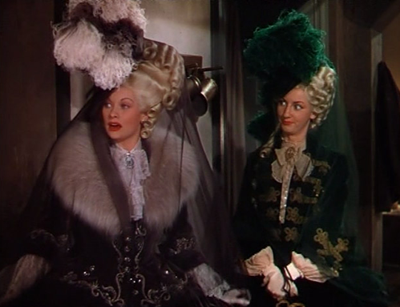
The late Sydney Guilaroff was Hollywood’s most beloved and trusted hairdresser. Credited with making the unforgetable Lucille Ball a redhead, he was friend and confidant to some of the biggest stars in history.
In Roy Del Ruth’s Du Barry was a Lady Gularoff is reunited with Ball, indulging in all that is glorious and flamboyant with sky-high powdered wigs. His talents coupled with Gile Steele‘s costuming prowess produce some enticing and hilarious hair concoctions, tricorn hats, ostrich feathers and all.
Say what you will about the bloodless electroclash/no wave resurgence. Lard knows I have. Watching its rise in popularity in post 9-11 New York City, I experienced what can only be described as an excruciating kind of soul death. It still makes me a bit nauseated to admit that in the wake of The Tower, my generation of NYC rock musicians had nothing better to offer up than this cocaine-spritzed, head-in-the-sand, garage schlocky, post post post punk photocopy of a bootleg of a cover rendition of a vibrant cultural scene populated by non-derivative bands 30 years ago. (The documentary Kill Your Idols offers an unflinching assessment of this phenomenon. Highly recommended.)
Still, there’s some truth to that whole “imitation is the sincerest form of flattery” spiel, and it was nice to go to downtown clubs where beautiful, artfully tweezed and ever-mysterious DJs with asymmetrical hair spun vintage wax nightly: ESG, DNA, Contortions, Foetus, Teenage Jesus & the Jerks, Swans, beloved Klaus, etc. Cool non-Manhattanites –oh, ‘scuse me, I meant to say Honorary Citizens of the Center of the Known Universe– like the Birthday Party, Lene Lovich, Nina Hagen, and Malaria! were in heavy rotation as well. Which brings us, in a roundabout way, to the point of this post. (Heh. Sorry.)
Founded in early ’81, Malaria! was led by Bettina Koester and Gudrun Gut, and filled out with Manon P. Dursma, Christine Hahan and Susanne Kuhnke. I’m a longtime fan of theirs, but I hadn’t seen this gorgeous homemade Super 8 video for their song off the 12inch New York Passage: Your Turn to Run until recently:
directed by Dieter Hormel, Brigitte Bühler, Gudrun Gut
Is it just me, or is this footage reminiscent of something non-narrative filmmakers like Brakhage, Anger or Morrison might shoot? You know… if they were young, fierce and scrumptiously German in 1982. Dang! Both Gut and Koester are still actively making music, and having watched “Your Turn to Run”, I’m actually grumblingly grateful to the Bedford Avenue acoyltes of electro for their role in bringing the band renewed recognition.
I’d love to be one of the greatest actors in the world. But acting often equates with fame. If you could be an actor, yet not be famous, that would be brilliant. – Jaye Davidson
I do believe I feel a painting coming on.
The reluctant star is a well-worn concept in the movie business. Half-shielding ones face while making an “unexpected” appearance in some hotspot, huge sunglasses and faining horror after accidentally flashing one’s bare crotch to paparazzi are de rigueur these days. I’d be hard-pressed to fall for such pretense delivered by anyone except perhaps Jaye Davidson, had he not disappeared entirely.
As our photo-evidence shows, Jaye is a deserving icon of sexual ambiguity. A striking unique appearance combined with natural acting talent landed this sometimes-destitute London fashion assistant three film roles and even an Oscar nomination, but more interesting is just how much Jaye genuinely hated his sudden fame.
Before The Crying Game even started filming in 1991 he attempted to break his contract, the only thing stopping him was advance money he’d already spent. After the Oscar nomination and media hullabaloo that followed he went off the radar, saying “The reason I haven’t got an agent is so that no one can contact me to offer me a film part”.
Hooo boy. I’ve been sitting on my hands for weeks, not knowing if/when I’d be allowed to say anything, but I just got the go-ahead from Nils. NOW IT CAN BE TOLD.
“Look out, you’re dead like us. Dead like candy.”
photo by Katherine Copenhaver
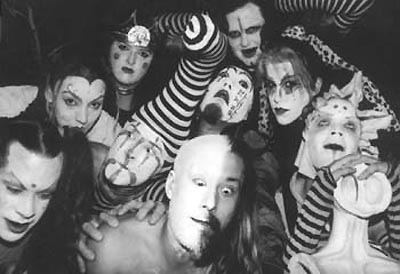
For really and truly. The four core members of one of the most unclassifiable, unbelievable underground bands of the 80s/90s met up in Oakland late last month to get reacquainted and talk shop. They’re currently in the studio recording the final tracks needed to complete an album left unfinished since 1998, and they have tentative plans to do some live reunion shows as well. A bit of background on the band from the Idiot Flesh wiki entry:
Known to tour the US in a converted city bus with [member] Rathbun as the driver/mechanic, with the windshield destination banner of “HELL.” Besides their “rock against rock” attitude, they were also known to defy classification with marching band routines, performing puppet shows, and playing household items as instruments (in tune).
“Idiot Song” video directed by Annmarie Piette
If you’re already a rabid cult follower, chances are you are doing an exuberant wiggle dance right now. If you’ve never heard of Idiot Flesh, try to place their sound, guerilla theater tactics and spookylicious attire in the context of the 80s and early 90s, before Tim Burton’s aesthetic became quite so zeitgeisty. While they often draw comparisons to Mr Bungle (and there’s merit in that, seeing as both groups formed in 1985, wore obfuscating costumes and displayed frenetic, mathrock/metal/funk shredder chops), Oingo Boingo, Crash Worship and other unhinged California weirdos from that time period, Idiot Flesh and their roving pack of Filthy Rotten Excuse Chickens inhabited a world all their own. Their influences range from the Residents and Zappa, to SWANS, the Art Bears and Henry Cow, to T.S. Eliot and John Kane. The band’s live act –which places emphasis on audience participation and non sequitur antics– is the stuff that Dadaist wet dreams are made of.
“Westinghouse and Edison were not friends at all. You can see why as the girls wind coils for the Alternating Current Westinghouse adopted from Tesla instead of Edison’s pet Direct Current.” – Goldenthrush on YouTube
I admit this post isn’t about a Voltron-style battle between Edison and Tesla, though I certainly wish it were. The Westinghouse Electric Corporation was an industrial giant founded in 1886. The company made itself known by being the proprietors of the first patent for Nikola Tesla‘s alternating-current transmission. In 1904, 21 short films were made by the company to showcase its various technological advancements – girls winding armatures, coil winding machines, steam hammers, assembling and testing turbines, etc. Parts of these films have been edited together into an exceptionally inspiring clip and set to music. The rhythm of industry at its finest – a superb way to begin the week!
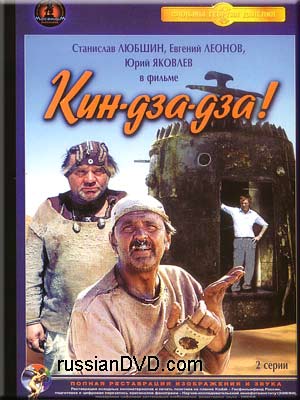
Ah, Soviet socio-political satire, ah Russian dystopia. Could anything be greater than a combination of both, in movie format? Unlikely, says Kin Dza-Dza! – a minimal and clever sci-fi masterpiece from the ’80s. Written and directed by revered director Georgi Daneliya, this film from my early years was only allowed to see the light of day thanks to its creator’s reputation. The plot revolves around the story of two oddballs who accidentally teleport to the mysterious planet Pluk in the Kin Dza-Dza galaxy. Fiddler and Uncle Vova unwittingly activate a device belonging to a hobo who claims to be an alien, and the fun begins.
Pluk’s inhabitants are a strange bunch; far advanced in technology, though scarcely evolved socially, with command of only a 2-word vocabulary. They look exactly like humans, have the power of telepathy, yet use a tool that divides all being into two groups – superior and inferior. Uncle Vova and Fiddler have many interesting encounters in store, and much to overcome if they’re ever to make it home.
Kin Dza-Dza! is rich with [not entirely subtle] critique of Communism and the poignant bitter humor I expect from Soviet Era films along with crunchy puns, rust, dust, and a Mad Maxy landscape throughout. Steampunk costumes and gadgets make appearances and are actually utilized in a way that makes sense! It’s a shame this Russian cult favorite isn’t better known – I deem it worthy of the pickiest sci-fi fans, provided they can get past the complete lack of any special effects.