’80s Explosion: Space Stallions

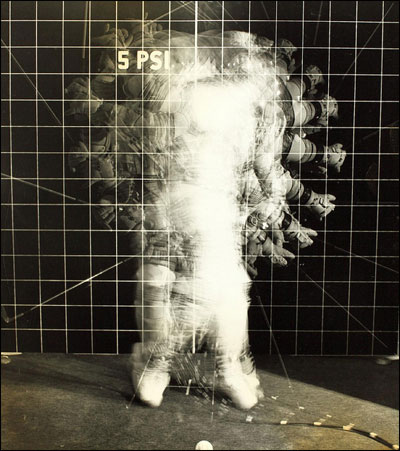
Space Stallions, a bachelor film project from the 2012 Animation Workshop, plays like every Saturday morning cartoon from my childhood boiled down into one four minute concept. Created by Thorvaldur S. Gunnarsson, Jonatan Brüsch, Ágúst Kristinsson, Arna Snæbjørnsdottir, Esben J. Jespersen, Touraj Khosravi and Polina Bokhan, it appears to have everything: spaceships, spandex-clad heroes, rainbows, unicorn-shaped hoverbikes, moustaches, and laser eggs. It’s like someone put peyote in your Lucky Charms.

A Time Lapse View of Earth From Space

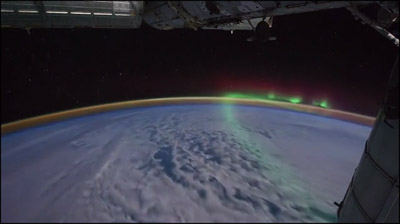
These incredible time lapse sequences are pieced together from thousands of photographs taken aboard the International Space Station by crew members and photographers of Expeditions 28 & 29 (August through October of 2011) at an altitude of approximately 217 miles above sea level.

German tech wizard Michael König took the time to gather together all of the photos from the Image Science & Analysis Laboratory,  NASA Johnson Space Center, and The Gateway to Astronaut Photography of Earth, put them in sequence, and then “refurbished, smoothed, retimed, denoised, deflickered, cut, etc.” all of the footage, taking care to avoid any kind of color adjustment or other visual manipulation, so as to let this beautiful, surreal footage speak entirely for itself.

Watching The Sounds Of Electromagnetic Storms

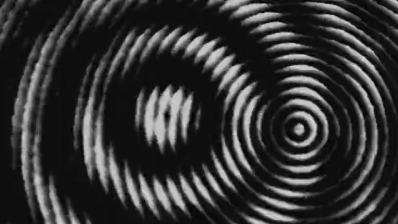
Created by art duo of Ruth Jarman and Joe Gerhardt, collectively known as Semiconductor, 20 Hz is a visualization of electromagnetic storms occurring in the Earth’s upper atmosphere as it is buffeted by solar winds. The data was gathered by the CARISMA radio array and interpreted as audio, making this an interpretation of an interpretation. The film itself is mesmerizing, the warbles and chirps causing intricate patterns to dance and echo across the screen — alien sounds come down from the cosmos and made visible.

Via The Fox Is Black

Céline Desrumaux’s “Countdown”

Céline Desrumaux‘s fantastic animated short “Countdown” details, as one might expect from the title, the launch of a rocket. The style here is a combination of flat colors and hard, almost architectural lines, as though it had leapt straight from the pages of Popular Mechanics circa 1958, along with some character animation by Florent Remize. Desrumaux (who is one half of Céline & Yann who produced the delightful series “The Giants”) cites Chris Ware as an influence and that is, indeed, the first person that comes to mind. “Countdown” has a heart-pounding, frenetic quality to it, combining almost abstract shots of dials, meters , and light; and shots of the rocket as it prepares to launch, cropped down into the square, vignetted look associated with, at least, the older exterior NASA footage. All of this is set to the harried pace of Apprat‘s “Granulard bastard”. It all makes for a gripping three and a half minutes.

Via Drawn

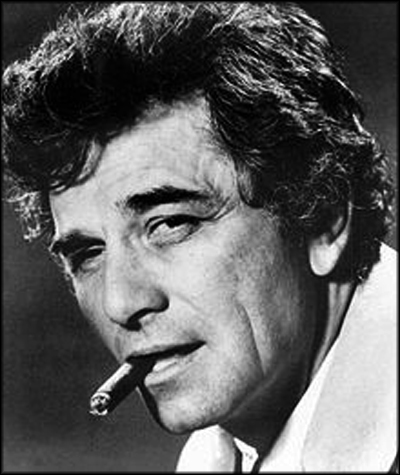
Farewell, Peter Falk

“Peter has a great range from comedy to drama. He could break your heart or he could make you laugh.” ~Director William Friedkin

To honor a handsomely disheveled, gruff-voiced and lovable actor who has passed away, here’s a beautiful scene from Wim Wender’s Wings of Desire:

Read more about how Falk came to play an ex-angel in the classic German romantic fantasy film here. (Via moonandserpent.)

Leonora Carrington – 6 April 1917 – 25 May 2011


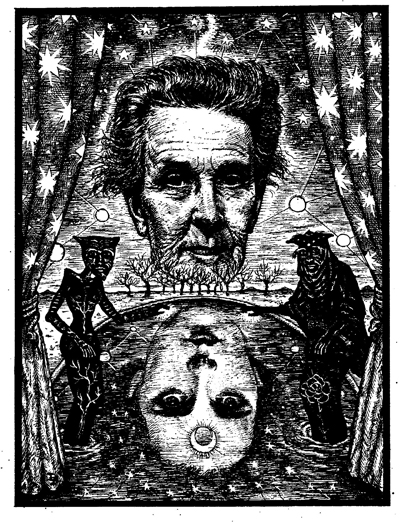
Fantastic pen and ink double portrait by Hilus Anendorf

Leonora Carrington lived a life as surreal and fantastical as the images she painted. The last of the first generation of Surrealists, she consorted with the full pantheon of greats, from Dali to Picasso, and was hailed as “Mexico’s greatest living artist” before her death 94. Despite her storied career as bohemian darling, wild muse and prolific creator of paintings, books, sculpture and theater, she remained always humble, and resolutely uninterested in labels, or all the laurels that have been flung her way over the years.

Her approach to art was completely intuitive, stemming from the deep well of her soul, her own psychic underworld realm that she populated with fantastic beasts and mysterious figures. She disdained the overintellectualization and analysis of her work, her beliefs, her inspirations – believing fervently that the visual world she created was unnecessarily hindered by those determined to understand what it was all about. She was a provocateur, delighting in stirring up trouble amongst the staid, society types whose ilk she rejected. André Breton wrote of her in his Anthologie de l’humoir noir:

“Those respectable people who, for a dozen years, had invited her to dine in a prestigious restaurant have still not recovered from the embarrassment when they noticed that, while continuing to take part in the conversation, she had taken off her shoes and meticulously covered her feet in mustard.”
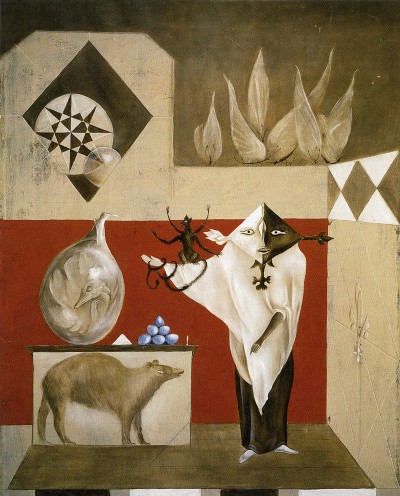

The Conjuror

All of her work is infused with this dark sense of humor and mischief, particularly her writing. In her only novel, The Hearing Trumpet, she envisions herself as a wizened crone – the 92 year old Marian Leatherby, a deaf and toothless “drooling sack of decomposing flesh” who is cast-off by callous relatives to a sanatorium for the elderly. It is here that her life truly begins, when she finds her kind: a coven of witch-sisters who help her discover and unleash her mediumistic talents.

Carrington once said, “I wanted to appear like an old lady so I could poke fun at sinister things.” As a young woman growing up in her stultifyingly proper Lancashire family estate, she railed against convention, and was booted out of multiple boarding schools. In her story “The Debutante”, she recounts her fantasy of dressing up a hyena in her coming-out dress, and sending the wild thing to her debutante’s ball in her stead. Allowed at last to attend art school, she horrified her family by running off with a married man twice her age, who happened to be Max Ernst. The romance was tragic, and ill-fated – doomed by the Nazi invasion of France and their subsequent incarceration of her lover. After a nervous breakdown, which caused her to be thrown into an asylum, she fled Europe for Mexico, where she settled and flourished until her death.
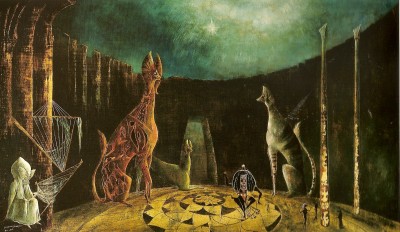

“We went down into the silent garden. Dawn is the time when nothing breathes, the hour of silence. Everything is transfixed, only the light moves.”
— Leonora Carrington


The Singing Ringing Tree (A Panopticons Sculpture)


Via DJ Dead Billy, thanks!

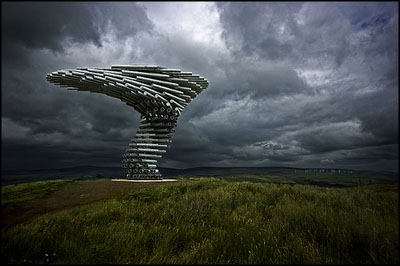
Designed and built by the architecture team of Tonkin Liu and completed in 2006, this award-winning sound sculpture called The Singing Ringing Tree stands atop a plateau in the Pennine mountain range overlooking Burnley in Lancashire, England. It’s one of a series from the Panopticons arts and regeneration project.

Galvanized steel pipes of various sizes are bound together in a nine-foot-tall, spiraling configuration. Depending on where and how the wind strikes it, The Singing Ringing Tree creates discordant choral sounds over a range of several octaves. Tonkin Liu tuned the pipes “according to their length by adding holes to the underside of each.” The eerie music created as a result is capable of ringing out across great distances.


Photo by Felix Spencer

See also:

Lucas Camargo

The draw of Lucas Camargo’s work, I think, is its density. Packed into each drawing is a cacophony of tiny details, jostling to make themselves known. They’re almost like those once ubiquitous Magic Eye images, at first they’re a mess of lines until, suddenly, their long-faced subjects unveil themselves.

Via supersonic electronic

In Remembrance: Kenneth Grant (1924-2011)

Editor’s note: Artist and researcher Scott Spencer has kindly written the following obituary in honor of Kenneth Grant. The more esoterically inclined readers of Coilhouse will immediately recognize that name. Those who are unfamiliar –but curious– may wish to click the many hyperlinks attached below and begin to explore Grant’s strange and beautiful work. Condolences to Grant’s widow, Steffi, their family, and friends.


Portrait of Kenneth Grant by Austin Osman Spare

“So life takes fire from death and runs. Whirling amidst the suns.”
~A. Crowley
Liber Pyramidos

It was announced today that occultist, author, artist, and gentleman Kenneth Grant passed away after an illness on January 15, 2011. He was 86 years old.

Grant, long a compelling figure in the world of occultism, has a legacy that extends back over half a century. He was the last man alive to have close ties to Aleister Crowley, having served as personal secretary to “The Beast”, and having been initiated into the Ordo Templi Orientis and Argentum Astrum by Crowley himself. After Crowley’s death, Grant and his wife Steffi were among the few attendees at Crowley’s funeral service. Subsequently, Grant became well known for helping to keep Crowley’s concepts and philosophies alive in the troubled decades following his death, and for the further continuation and expansion of Thelemic ideas over six decades.

Kenneth Grant’s occultism was not the fervent, dry adherence of the ideologue. Rather, he fashioned a deeply personal, fantastical, dynamic, and intricate system of magic woven together from syncretic elements of Tantra, Voudon, Gnosticism, Surrealism, fiction and a variety of other exotic threads. Building on the foundations of Crowley’s work, Grant expanded the current understanding of the meaning and implications of the “Law of Thelema”. Much like the mystic William Blake, Grant forged his own path beyond esoteric speculation, writing first-hand accounts of what he perceived to exist outside of the range of mundane experience.

Over the course of sixty years, Grant cataloged his evolving exploration of Crowley’s system of Magick and philosophy across a series of nine books that came to be known as the Typhonian Trilogies. Grant had stated that he wanted the act of reading these books to be an esoteric experience in and of itself. Certainly, the trilogies contain a maelstrom of esoteric ideas, dream imagery, and highly technical esotericism that, for the receptive reader, can border on a consciousness-altering experience. In addition to these seminal works, Grant wrote a variety of articles, fiction, and poetry, all of which are being made available via his official publisher, Starfire.


Portrait of Steffi and Kenneth Grant by Austin Osman Spare

Grant is also responsible for the enduring legend of the occultist and artist Austin Osman Spare, who had a profound influence on both his and Steffi’s art and world view. As Spare’s executor, Grant helped to catalog and publish Spare’s paintings, drawings, and writings, securing his friend’s art the long-term influence and respect it wields today. Were it not for the Grant’s loyal championing, the world would most likely lack knowledge of the rich, haunting body of work that Spare left behind.

Mr. Grant is survived by his aforementioned wife, the artist Steffi Grant –who has been an integral presence in Grant’s work since the beginning– and their family. His work continues via the Typhonian Order and individual explorers the world over. Through whatever strange spheres or iridescent geometric shapes he may choose as his vehicle among the scintillating transplutonian stars, may his journey continue!

The Music of Jupiter

An oldy but a goody, posted both for those who have never heard it, and those who have heard it a hundred times already. The serene and mysterious ambient music of Jupiter as captured by NASA Voyager:


These sounds are the result of “the complex interactions of charged electromagnetic particles from the solar wind, planetary magnetosphere, etc.” (Via Andy Ristaino, thank you.)

There’s something deeply comforting and astonishing about this, isn’t there? Our universe is so far from silent. A wide range of heavenly bodies are constantly emitting unique electromagnetic signals that we can pick up and process, provided we have the right instruments. The stars do sing.