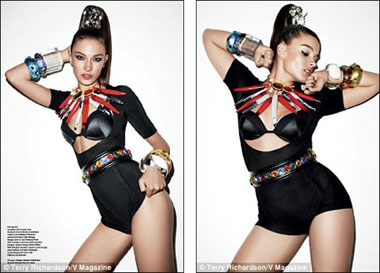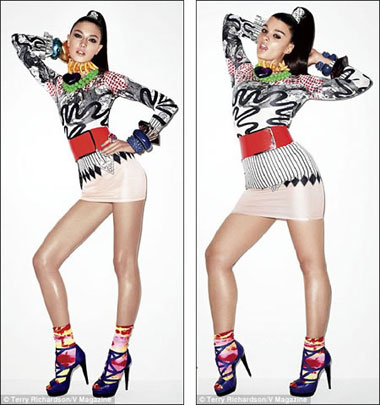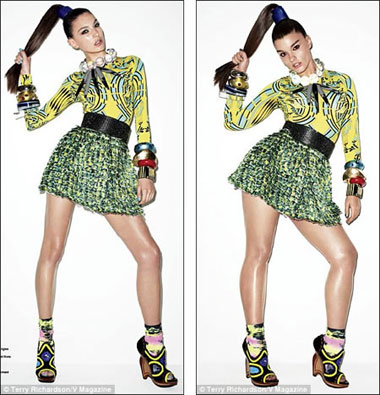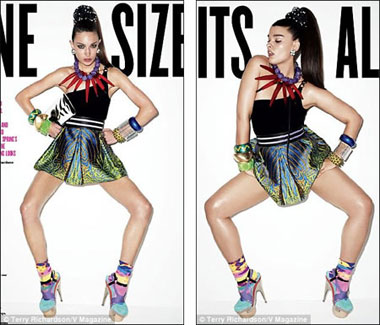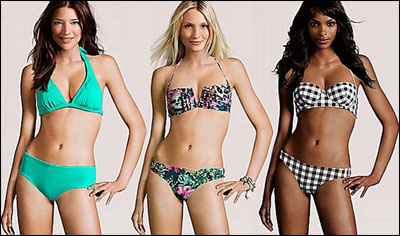
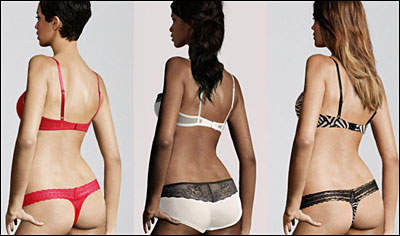
Fashion retailer H&M recently got called out for using computer-generated bodies in their online catalogue.
The company has admitted that the bodies are “completely virtual,” with faces of real models pasted in. “This is a technique that is not new, it is available within the industry today,” said an H&M spokesperson. “The virtual mannequins are used in the same way as we use mannequins in our stores for ladies wear and menswear.”
Bloggers have responded with appropriate criticism. Norwegian Broadcasting Corporation spokesman Helle Vaagland said, “this illustrates very well the sky-high aesthetic demands placed on the female body.” Blogger T.M. Gaouette writes, “I’m confused! If the intention is to just show the items of clothing, then why put real heads on fake bodies? Why not just put a fake head on the fake body? Is the real head needed so that we can relate to the models as human beings? But how is that possible when we are faced with a perfect body to which no one can relate?”
On Facebook, a couple of friends expressed concern that this trend will decrease the number of jobs available to working models. Another issue is the creepiness factor: “Man,” writes Jenna Sauer at Jezebel, “isn’t looking at the four identical bodies with different heads so uncanny?”
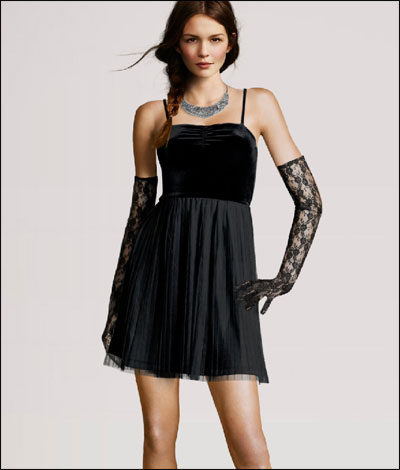
With that in mind, there are a few beautiful and amazing things going on here. First of all, there’s the unintentional modern art: this catalogue has brought us the haunting, Ringu-esque Model Without a Face. Also, this foray into the uncanny valley brings us one step closer to the age of the idoru. With teenage pop idol Aimi Eguchi, whose face is a composite of six different singers, and vocaloids (singing synthesizers) such as pigtailed holographic superstar Hatsune Miku, we’re almost there. And even though H&M’s online catalogue conforms to the same beauty standard as any other big fashion retailer, this technology actually has the potential to subvert the paradigm altogether.
Imagine an online shop where your preferred weight/height/measurements are used to generate 3D models of the bodies that you want to see. Imagine if there was an API for this that could be used across all online clothing stores you visit, so that no matter what site you were looking at, the models appeared the way that you wanted them to. Standardized beauty ideals would become less relevant, because people would have greater control over their exposure to them.
In the short term, it may seem like computer-generated models reinforce a homogenous beauty standard. In the long term, this technology may pave the way towards greater body diversity and inclusiveness.
EDIT: After some wonderful discussion in the comments, I’m appending my responses to the post:
Some of you have pointed out that advertisers aren’t known for championing body diversity. It’s true. Perfume companies hire leggy, angular supermodels to to sell you a lifestyle. Some female-targeted TV commercials begrudgingly include the token African-American women (especially, for some reason, when selling yogurt, cleaning products and tampons), but it’s rare to see them go beyond that. If you read Sociological Images, you know how often advertisers and companies create ads that are super-racist, sexist or classicist even in this day and age.
The reason why I think this has a chance of succeeding is that the advertising and retail branches (or outsourced teams) of a company have totally different goals. The goal of advertising is to make you aware of the brand, and to associate that brand with glamour, mystique, etc. That’s why fashion and editorial models are very tall and have exotic, alien features – Andrej Pejic, Alek Wek, etc. On the other hand, catalog models tend to look “wholesome” and just slightly more attractive than average. Your mileage may vary – the Victoria’s Secret catalog models will look more glamorous than the ones from Gap, and these H&M girls are on the more glamorous side – but generally, catalog models are supposed to be a very standard type of “pretty” that’s not supposed to make people insecure, because they want you to feel happy when you make the purchasing decision. Here are a few models from the Macy’s catalog… I think they’re pretty, but I don’t think that they’re “impossibly” pretty. They look like women I see every day:
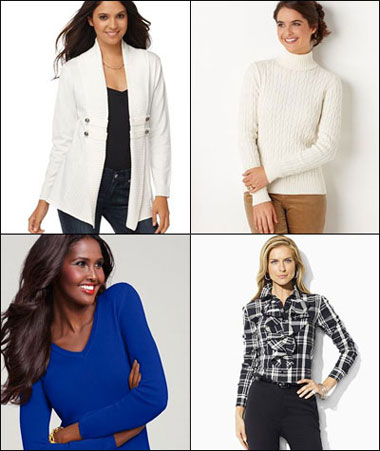
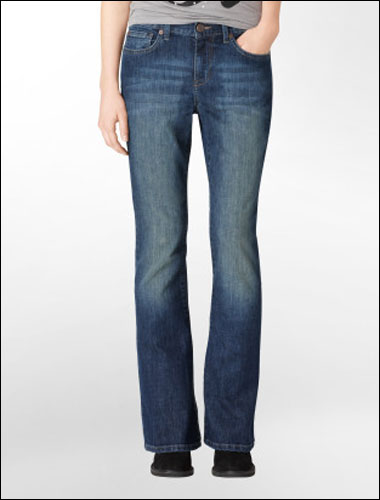
Advertising makes people feel insecure, like they’re lacking something, with the implicit message that buying this brand will make them somehow more attractive or fulfilled. But that’s not the goal of a product shot. The goal of the product shot is to make the average consumer feel like the item is right for them. Consider the difference between the Levi Jeans ad campaign and the completely neutral, non-threatening, disembodied product photo on their website:
Calvin Klein Ad:

Calvin Klein Product shot:
It’s true that almost all models presented in catalogs are still uniformly size small. That’s because they are often modeling samples, before the full line of clothing is produced. Samples are manufactured in size small because that’s always been the industry standard. Most of that is for practical reasons: size small clothing is faster and cheaper to produce, because it requires less fabric and time. But with advanced 3D modeling, that convention may go out the window as far as online catalog photos go. (I’m sure it’ll remain as a standard in the fashion world for a long time). There’s already a company called http://fits.me/ that’s working on this. It’s not as advanced as H&M’s one-size-fits-all fitting room interface, but hopefully it’ll evolve in that direction.
H&M doesn’t deserve TOO much praise because they didn’t really step outside the status quo with their use of digital models, but I don’t think they should be criticized, either. Their fake-bodied models were no skinnier than any real models that they would’ve used otherwise. I worry that if the blogosphere crucifies them, and so far that’s what has happened, then other fashion retailers will get discouraged from trying this type of technology in the future because they’ll think that people are just uncomfortable with it, and that it doesn’t test well. Ms. Magazine wrote in an op-ed about this, “Sign here to urge H&M to use real women to model its clothes.” If H&M does that, then it definitely won’t make any lasting change, because they’d just go back to using real Size 2 models. However with digital imaging, we can end up with a catalog that lets you change the size and shape of the clothing, looking something like this, only with more variations: