Good day, comrades. This mesmerizing WTFery has been on the YouToobz for a few years now, but DJ DeadBilly only alerted Coilhouse to its existence this morning. (2012 is off to an auspicious start!)
Who among our readers remembers The Rock-afire Explosion animatronic stage show from their pepperoni ‘n’ cheese-drenched childhood? It was the brainchild of one Mr. Aaron Fechter, who, in addition to creating and heading a company called Creative Engineering Incorporated, invented the Whac-a-Mole, and co-founded a venture called Showbiz Pizza Place in 1979, which eventually merged with –and became more commonly known as– Chuck E. Cheese (apparently under bitter circumstances).
In spite of a handful of painful business disappointments over the past thirty years, Fechter and his team have stayed the course, and C.E. Inc. remains “a leader in the Family Entertainment business”, designing and manufacturing “sophisticated animatronic stage shows for many amusement parks and entertainment centers around the world”.
Fechter’s company has additionally been involved in several somewhat less HappyHappyFuntimez™ projects of various sizes and technologies, ranging from development of robotic soldiers for the U.S. Army (“a great success, I might add”, says Fechter) to water removal systems for commericial roofing (“not one of my best”).
But through it all, Fechter’s heart has remained devoted to “developing high-tech equipment to entertain and amuse the public while developing the self-esteem of the participants”.
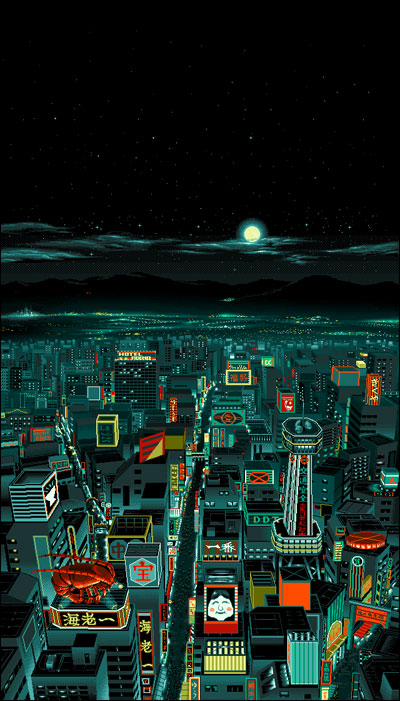
When I saw this striking image of Tokyo while riffling through my RSS feeds, my heart stopped. Supposedly, it’s a still from a forgotten video game made in 1995.
There’s something about this cityscape. I’ve been coming back to stare at the large version of it for two days now, marveling at all the details: that puffy-cheeked man and that lobster, the people on the streets, the density of the buildings, the beautiful pixel weave that makes up the clouds, and that ominous yellow moon. I want to know the story of this game world and its makers. If it’s a still from a mid-90s video game, very few people would have considered that art at the time. Now, in the world we live in, I could easily see this image selling at an art opening. If it turned out that this image was done by a contemporary pop artist, emulating/exaggerating the aesthetics of retro games, I would not be surprised. However, this image feels even more compelling to me precisely because it’s not that, but a forgotten relic, a lost gem, a genuine artifact.
Tumblr tells me (for once) that this striking image is from a video game called “Power Slave,” produced by Jellyfish Software in 1995. I’m not sure if I believe that; the only game titled Power Slave game I could find was this first-person shooter set in Egypt, released by Lobotomy Soft in 1997. Nothing in the game descriptions suggested the appearance of this scene. I checked out a couple of Power Slave playthroughs – not all 17 levels, but enough, including the intro and end, to be fairly sure that this scene was never among them. And the only Jellyfish Soft release that came up in my searches was Aerokid, an aviation game for kids, released in 1998. But then I read somewhere that on the Saturn conversion of PowerSlave included a hidden game. After some Googling, I found that name: Death Tank Zwei. With a name like that, I thought it sounded promising. But after looking through the entire game thanks to some guy’s research video for a Port-to-PC project on YouTube, I came to the conclusion that this game wasn’t the source of the image, either.
And that’s where the trail grew cold. Maybe I missed something. Maybe it’s just another beautiful Tumblr scrap I’ll never find the source of. Anyone have a clue?
Update: mystery solved, thanks to Coilhouse reader Fmtownsmarty. It’s Power Slave, a hentai first-person adventure/strategy game from Japan. “Tetsuya is a rather ordinary Japanese teenager, who prefers hanging out with his sweetheart Rika than going to school. His passion are 3D video games. The newest game machine which allows the player to completely submerge into the virtual world, modeled according to his desires, has captured his heart. But one thing is strange: lately, Tetsuya keeps seeing himself as a killer and rapist. Dreams begin to haunt him. Is this just a side-effect of the game, or does he have a dark side he knows nothing about?” Oh, Japan, don’t you ever change. <3
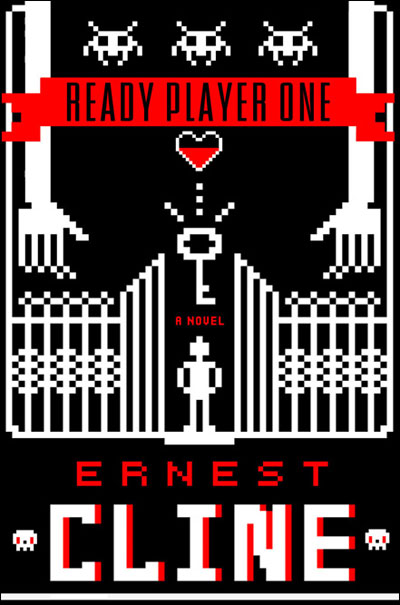
Earlier this year, Patton Oswalt wrote an essay for Wired entitled “Wake Up, Geek Culture. Time to Die.” In it, Oswalt warns that the world is on the brink of “Etewaf: Everything That Ever Was—Available Forever.” Ready Player One by Ernest Cline is a daring young-adult fiction book about what might happen in such a world.
The year is 2044, and the world is ravaged by economic collapse. The peak oil crisis has occurred, unemployment is at an all-time high (with a two-year wait for jobs in the fast food industry), global warming has destroyed the climate, and people live in abject poverty. Our protagonist, 18-year-old Wade Watts, lives with sixteen other people inside a trailer. The trailer is part of “the stacks” – a new type of ghetto on the outskirts of major cities in which trailers, RVs and shipping containers are stacked one on top of another, creating tall, precarious towers.
On the bright side, a nerd “über-deity”/computer genius named James Halliday has crafted the ultimate MMO: a haptic virtual world akin to the Stephenson’s metaverse, Gibson’s cyberspace, and World of Warcraft. The immersive environment, called OASIS, is accessed by everyone with a computer, and most people spend every waking second in it. In this world, education is free, space is nearly infinite, and every type of diversion exists to distract people away from their daily life.
One the day after James Halliday (born: 1979) dies, a recorded invitation gets sent to every player in OASIS. While Oingo Boingo’s “Dead Man’s Party” plays in the background, a recording of Halliday, digitally inserted into a scene of a John Hughes film, informs OASIS users that he has hidden an easter egg somewhere in the game. And that whoever finds it will inherit Halliday’s entire fortune of billions, his assets, his company, and rulership of OASIS.
The hunt is on. Teenagers race against an evil corporation to find the egg. In their search for clues, a new generation discovers the 80s culture that Halliday loved, the culture that inspired him to build his all-encompassing virtual world. From Blade Runner to Ultraman to the Commodore 64 to Dungeons and Dragons to Devo to Adventure and beyond, Halliday’s challenge produces an otaku culture the likes of which the world has never seen. But as the stakes get higher and people begin to die not only in OASIS but also in real life, it becomes clear that it’s not just a game, and that the future of civilization depends on the outcome.
It’s a wonderful book. Everyone should read it. Check out the excerpts on Ernest Cline’s site, where you can also purchase the book or e-book. The audiobook version is narrated by none other than “Portrait of the Artist as a Young Geek” author Wil Wheaton. A perfect match.
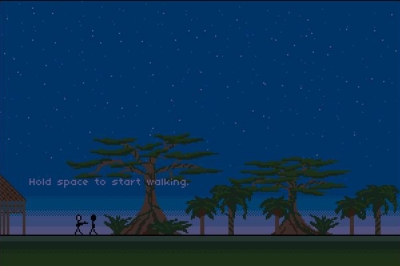
“The Killer” is, sickness as indicated, ambulance not a game. It was inspired by the brutal genocide perpetrated in Cambodia under the Khmer Rouge. In “The Killer” there are two figures, rx two stick figures, one whose ovoid head is white. This stick figure is the one you control, though, really, you control both, for this white-headed figure is in firm control of the figure in front of it, being as this white-headed figure is the one holding a gun.
At the beginning of “The Killer” these two figures are standing in front of a hut, silently, the only sounds are the sounds of the birds and the insects echoing through the trees and you are instructed to “Hold space to start walking.” When you finally do the white-headed figure pushes the figure before it and only then does the music begin and you, both of you, begin to march.
You march through jungles and you march over beaches. If you stop, you, both of you, are informed that you have not gone far enough, that you must reach the fields, that the fields are beyond the beach. So you push the space bar again and, once again, the whited-headed figure pushes the other with the barrel of its gun. And when you finally reach the fields, and you stop, you are told to aim you gun, and that clicking the left mouse button will fire. And there, in the field, you have a choice to make.
Via David Forbes, “A haunting (no, really) compilation of video game deaths” presented by our friends at Boing Boing Video:
Directed by Rob Beschizza. “Music is Rob’s MIDI homage to “Mad World” by Tears for Fears, and you can download the MP3 here and buy their original song here.”
The controller uses a computer graphics technique called “Structured Light” to build a depth map of the field of view. This allows the Xbox Kinect camera to discern shapes and ultimately build a skeletal model of the person standing in front of it. It does this by projecting a grid of tiny infrared dots across the room, and reading the position of those dots with another camera. Those infrared dots show up really well on an IR camera as they’re quite bright. Projected against a person, they create interesting contours and patterns.
A community of Bay Area artists, models and makers came together to pose for this series, working together in pitch darkness to craft these images. Penven describes the experience:
As a photographer I am most interested in the nature and quality of light: how light behaves in the physical world, and how it interacts with and affects the subjects that it illuminates. For this shoot my models and I were essentially working blind, with the results visible only after each image was captured. Together, we explored the unique physicality of structured light, finding our way in the darkness by touch and intuition. Dancing with invisible light.
Prior to releasing this shoot, Penven posted some early experiments combining the IR camera and the Kinect. The haunting early sketches have the air of sci-fi surveillance footage, and are just as fascinating as the final product.
More images after the jump, and many more in large format on Audrey’s Flickr page. The opening reception at Pictopia is on April 1st from 6-11pm, and will feature a musical performance by Doctor Popular and vegan cupcakes by Idle Hands Baking. See you there!
So, Someone on the Internet recently got upset about the gay romance in the new Dragon Age 2 game released by BioWare. So threatened was this person that he felt the need to post a long, butthurt rant on the BioWare forums titled “Bioware Neglected Their Main Demographic: The Straight Male Gamer.” The disgruntled fan writes, “in every previous BioWare game, I always felt that almost every companion in the game was designed for the male gamer in mind.” In Dragon Age 2, however, “it makes things very awkward when your male companions keep making passes at you. The fact that a “No Homosexuality” option, which could have been easily implemented, is omitted just proves my point.” He complains that the straight love interests are too “exotic,” and is disappointed that instead of having more heterosexual romances to choose from, the game instead has a gay romance. ” The best part is when he says, “it’s ridiculous that I even have to use a term like Straight Male Gamer, when in the past I would only have to say fans.” Boo fucking hoo.
The response from David Gaider, a Senior Writer at BioWare, was elegant, incisive, and generally spot-on:
I’ve said it before and I’ll say it again– perhaps a bit more eloquently, since it’s apparently of dire concern to some.
The romances in the game are not for “the straight male gamer”. They’re for everyone. We have a lot of fans, many of whom are neither straight nor male, and they deserve no less attention. We have good numbers, after all, on the number of people who actually used similar sorts of content in DAO and thus don’t need to resort to anecdotal evidence to support our idea that their numbers are not insignificant… and that’s ignoring the idea that they don’t have just as much right to play the kind of game they wish as anyone else. The “rights” of anyone with regards to a game are murky at best, but anyone who takes that stance must apply it equally to both the minority as well as the majority. The majority has no inherent “right” to get more options than anyone else.
More than that, I would question anyone deciding they speak for “the straight male gamer” just as much as someone claiming they speak for “all RPG fans”, “all female fans” or even “all gay fans”. You don’t. If you wish to express your personal desires, then do so. I have no doubt that any opinion expressed on these forums is shared by many others, but since none of them have elected a spokesperson you’re better off not trying to be one. If your attempt is to convince BioWare developers, I can tell you that you do in fact make your opinion less convincing by doing so.
And if there is any doubt why such an opinion might be met with hostility, it has to do with privilege. You can write it off as “political correctness” if you wish, but the truth is that privilege always lies with the majority. They’re so used to being catered to that they see the lack of catering as an imbalance. They don’t see anything wrong with having things set up to suit them, what’s everyone’s fuss all about? That’s the way it should be, any everyone else should be used to not getting what they want… The very best we can do is give everyone a little bit of choice, and that’s what we tried here. And the person who says that the only way to please them is to restrict options for others is, if you ask me, the one who deserves it least.
It goes on, but you get the gist. It’s rare that you see a big company so clearly defining privilege. Good on them. [via Slim]
In light of the charming Goodnight Dune children’s book that’s making the rounds online right now, today seems like a great time to share some treasures from my personal stash of weird, random, off-color, No-Seriously-WTF-Were-They-Thinking movie franchise ephemera.
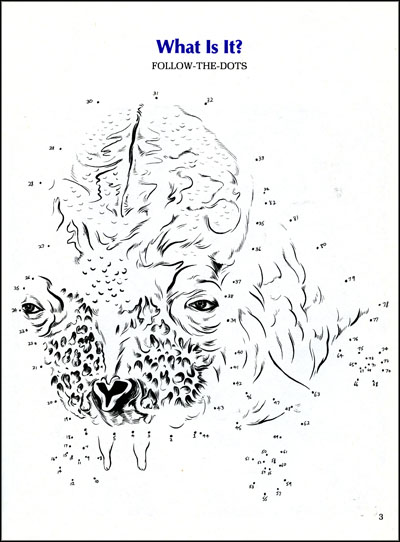
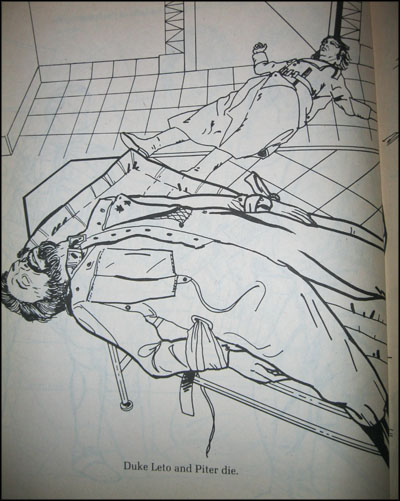
These, for your delectation, are scans and photos of various pages from the astoundingly age-inappropriate Dune activity book series, published in 1984 to promote David Lynch’s movie adaptation of the classic Frank Herbert novel, produced by Universal Studios.
You know, FOR KIDS:
Yes, that’s a coloring page of Dr. Yueh preparing to assassinate Duke Leto with a dartgun. And up at the top there, that’s a floppy, diseased sex organ-reminiscent Guild Navigator, presented a-la la la “Connect the Dots”.
And here’s another cheerful coloring page of the fresh corpses of Duke Leto and Piter:
Heeeeee! Who the frak was in charge of marketing? More to the point, what kind of Melange were they smokin’ during the merch meeting, when it was decided that producing this series of vengeful activity books for a K-through-8 demographic made good business sense?
Well, whoever they were, Coilhouse salutes them.
Explore the childlike wonderment murder, intrigue, suppurating boils, phallic symbolism and knifeplay after the jump.
Belgian avant-garde Game Developers Tale of Tales have made a name for themselves as an independent game development studio, creating genre defying art-games. Armed with ambitious vision and an unrelenting sense of artistic integrity, Tale of Tales co-founders Michaël Samyn and Auriea Harvey cater to an audience outside of mainstream gamers providing complex, meaningful gameplay experiences, and offering a “different kind of story” for “a different kind of people”.
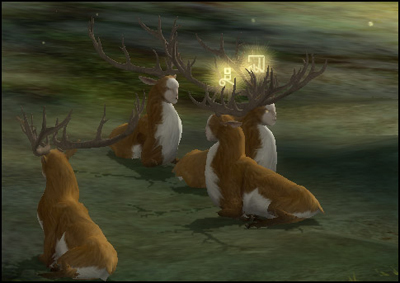
One of their first offerings, The Endless Forest, is a multi-player game set in a soothing, bucolic landscape; there are no goals to achieve, or rules to follow – “just run through the forest and see what happens.”
The Graveyard, launched in 2008, is a short tale which places the player in control of an old woman traversing a straight and narrow path across a gloomy graveyard. It is described as “an icon” of the studio’s work as a result of the game’s “apparent simplicity and vagueness”.
Tale of Tales next endeavor, The Path, is loosely categorized as “adventure-horror” and was inspired from the classic fairy tale of Little Red Riding Hood. There is one rule in the game, which needs to be broken. There is but one goal. And when you attain it, you die. It is “a game about playing, and failing, about embracing life, perhaps by accepting death.” The legendary SWANS member Jarboe, along with multitalented co-composer Kris Force, provide an dynamic, unsettling narrative and score.
Based on Oscar Wilde’s Salome, a play banished from the stages for over 50 years, Fatale is the studio’s latest gaming project. An interactive 3D vignette, it offers the same sort of “observational immersionist” approach that Tale of Tales has become known for. The player is encouraged to “explore a living tableau filled with references to the legendary tale and enjoy the moonlit serenity of a fatal night in the orient.”
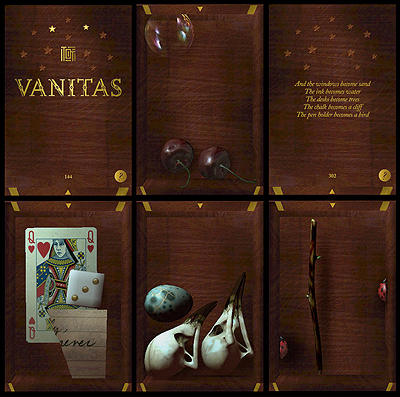
2010 saw the release by Tale of Tales of Vanitas, an app for iPhone and iPod touch. Referencing the still life paintings from the 16th and 17th century, Vanitas presents one with a 3D box filled with “intriguing objects…to create pleasant arrangements that inspire and enchant”, and is touted as a “a memento mori for your digital hands.” The app includes random quotations on the topic of life and vanity and music by avant cellist Zoë Keating.
Michael and Auriea graciously gave of their time to provide a thought-provoking look into the passionate philosophies behind Tale of Tale’s creative projects. See below the cut for the full interview.