
John John Jesse is a celebrated, controversial Catholic schoolboy-cum-punk rocker-cum-gonzo pop artist who came up in the dirty streets of NYC’s Lower East Side in the 80s and 90s. Luscious, filthy, fantastical, Jesse’s illustrative paintings are imbued with a lifelong appreciation for the fierce and rebellious girls he grew up with, and convey a deep understanding of the psychosexual underpinnings to work by a wide variety of fellow artists– from Gustav Klimt and Béla Iványi-Grünwald to Jamie Reid and Caravaggio. Most of the people featured in Jesse’s work are friends of his; many others are recognizable figures from sub/pop/countercultural spheres. A couple years back, Jesse moved from the big city into more pastoral climes, but his passionate love affair with the imagery and narrative of Punk Rawk New Yawk continues. Today on Coilhouse: a recent interview with JJJ conducted by Coilhouse contributor Sarah Hassan. ~Mer
L.I.E. ’88 by John John Jesse
As the quintessential ‘punk rock painter’ from the Lower East Side, a neighborhood now known more for it’s expensive rent and boutiques than heroin addicts and street gangs, how did your move from the city affect your work, if all? Is New York City still what inspires you, or is there something to be said for the quiet of small-town living?
I left New York City because it no longer is what it was. It has turned into an extremely over-crowded college dorm. I mean, now you actually have to wait in line to cross the street and some intersections. That’s fucked! But moving didn’t affect my work at all, it just removed the distractions. You can take the boy out of the city, but you can’t take the city out of the boy, as they say. My life story is what inspires me and most of that took place in New York City, so being here – the country – just gave me the clarity to get my point across in my works.
New York can be rather distracting for an artist, there is a simplicity to living outside it that seems to enhance ones creative output. Your work appears and is often credited to be extremely autobiographical; the music, the drugs, the girls, the heartache. As you’ve developed as an artist, have your inspirations changed in anyway, or do the same themes resonate with you even more than ever?
It’s a lot of the same; I am just discovering new ways to tell my story. After time, your craft always becomes more refined and that gets me pretty eager to keep painting. And as it – my work – is autobiographical, my life continues, so therefore my story does too.
The 3-Headed, Tattooed Waif by John John Jesse
The ever-evolving body of work; it’s inspiring. The exuberance and anxiety of youth is a major theme with your paintings, which music has always been successful in addressing. How has your experience as a musician affected your fine art?
I’m now retired from touring and playing in punk bands, I don’t have the time they need to commit. Better to give a one-hundred percent to one thing than spread myself thin and do both crappy. I had been on tour or recording most of my life, so it had a huge impact on my art. I mean, we weren’t the Jonas Brothers, but you can imagine what we were like on tour. It’s pretty much a free pass to do whatever the fuck you want.
Guys! “I Have Your Heart”, a tale of love and organ transplantation by Molly Crabapple, Kim Boekbinder and Jim Batt (previously on Coilhouse) is live, and it was totally worth the wait! Check out the interview with the creators on BoingBoing, and watch the animation here:
“Like living organisms; a breathing artificial skin garment with pulsing veins (air is pumping through the veins to simulate a pulse), the pulse increases when you approach and the neckpiece deflates on touch as sign of trust.”
Designer duo Local Androids consists of Cor and Leonie Baauw. Their work is a stunning techno-chthonian amalgam of 2D and 3D, traditional and digital imagery. With assistance from engineers Ralf Jacobs, Daniel Schatzmayr, and Berend-Jan van Dijkhey, Local Androids created this “interactive skinfashion” for the 2012 Technosensual Expo, which will be running until September 2 in Vienna.
The following embed of a notorious 1987 indie film called Superstar: The Karen Carpenter Story comes to us courtesy of New Zealand-based comic book writer and artist Dylan Horrocks, who says “I remember seeing it at the Auckland Film Festival and being disconcerted, impressed, and powerfully moved. [...] The audience laughed a lot at the beginning. But by the end, we watched in stunned silence. I’ve never forgotten it.”
Two years after graduating with an MFA from Bard College, Superstar director Todd Haynes (Velvet Goldmine,Far from Heaven,Safe) shocked and moved unprepared audiences with the now-infamous and nigh-impossible-to-track down 43 minute film. “Seizing upon the inspired gimmick of using Barbie and Ken dolls to sympathetically recount the story of the pop star’s death from anorexia, he spent months making miniature dishes, chairs, costumes, Kleenex and Ex-Lax boxes, and Carpenters’ records to create the film’s intricate, doll-size mise-en-scene. The result was both audacious and accomplished as the dolls seemingly ceased to be dolls leaving the audience weeping for the tragic singer.” (via)
Richard Carpenter, upon viewing the film, was apparently enraged at its depiction of his family– especially by Haynes’ insinuations that Richard was gay. In 1989, after confirming with A&M Records that Haynes had never obtained proper music licensing for numerous Carpenters songs used in the film, Richard Carpenter served Haynes with a cease-and-desist order and sued him for failing to obtain proper clearance. Haynes offered “to only show the film in clinics and schools, with all money going to the Karen Carpenter Memorial Fund for anorexia research”, but Carpenter was unrelenting, and eventually won his lawsuit against Haynes. All copies of Superstar were recalled and destroyed. (According to Wiki, the Museum of Modern Art retains a print of the film, but has consented to never screen or exhibit it at the Carpenter estate’s request.)
More than two full decades after it was made, copies of Superstar still remain very difficult to track down. Except, of course (somewhat dubiously), on YouTube.
A stunning series of anatomical cross sections by artist Lisa Nilsson, made using paper filigree, coiled strips of paper (in this case, Japanese mulberry paper). Using photographic references, Nilsson’s pieces are beautiful to look at, the rolled paper adding another level of detail to images already brimming with them. You can read about how she made them here and here.
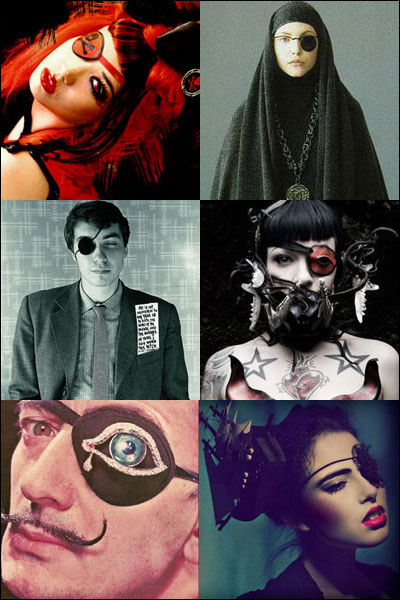
Eyepatches have long been a staple of alt fashion. From visual kei to burlesque, the eyepatch has been used to accentuate elements of romanticism, glamour, and mystique throughout the ages.
Advertising giant David Ogilvy knew this in 1951 when he created “the man in the Hathaway shirt,” a campaign that put a tiny company on the map by featuring a distinguished-looking man with a mysterious eyepatch in a series of ads that continued to run for over 25 years and inspired dozens of copycats.
Of course, stylish eyepatches aren’t just for show. For centuries, people with eye ailments have incorporated the patch into their personal style. The first chic eyepatch-wearer may have been Spanish princess Doña Ana de Mendoza y de la Cerda. Around 1545, young Ana lost her eye in an accident during a playfight with one of her guards. Donning an eyepatch only fueled her popularity at the court, and it is said that she had a bejeweled eyepatch for every dress she owned.
Film director Fritz Lang’s eye problems started in 1916, the same year he stumbled into film. While recuperating from war wounds that would eventually cost him his eye, he began to write scripts and took up acting. In his younger years, he wore a monocle over his injured eye; later in life, an eyepatch under dark glasses. Knowing the director’s struggle towards monocular vision, Maria’s lingering robot wink in Metropolis somehow feels much more significant. Other fabulous/functional eyepatch-wearers include Slick Rick, James Joyce and Momus.
I never thought I’d have to wear an eyepatch for any reason other than a fashion shoot or a fancy night out. But following some recent eye problems, I have to wear one for at least a portion of each day, for at least a little while. Thus began my trawl through Tumblr, Flickr, and fashion blogs in search for the perfect patch. The search uncovered dozens of beautiful images from Coilhouse friends and family. After the jump, an epic collection of over 60 eyepatches featuring Mother of London, Salvador Dali, PUREVILE!, James Dean, Amelia Arsenic, Chad Michael Ward, Shien Lee, Antiseptic, Jane Doe, Alyz Tale, Atsuko Kudo and many others. I suspect that many of you have eyepatch photos as well. If you’ve got one, post it in the comments!

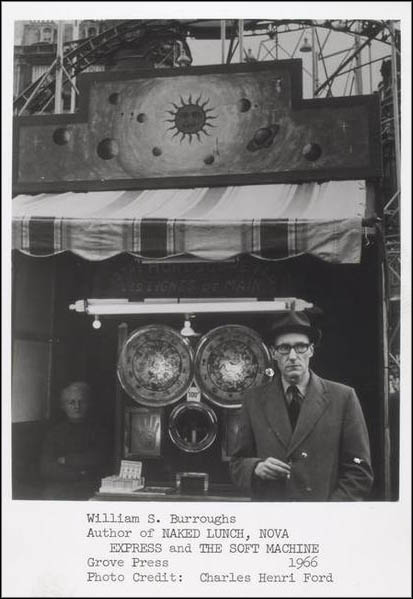
Yes. Hello. Feb 5th is the date of novelist William S. Burroughs’ birth. Coilhouse should really show the man some love. W.S.B. double feature, anyone?
First, The Cut-Ups, a mesmeric and disorienting experimental piece Burroughs put together with filmmaker Antony Balch (aided by multi-disciplinary art firebrand Brion Gysin and others) in 1966. Over the course of twenty minutes, it plays out in very much the same vein as Burroughs’ literary cut-ups, only with multiple sensory layers of headfuckery. (Read more about the film here / the generalized concept of cut-ups here.)
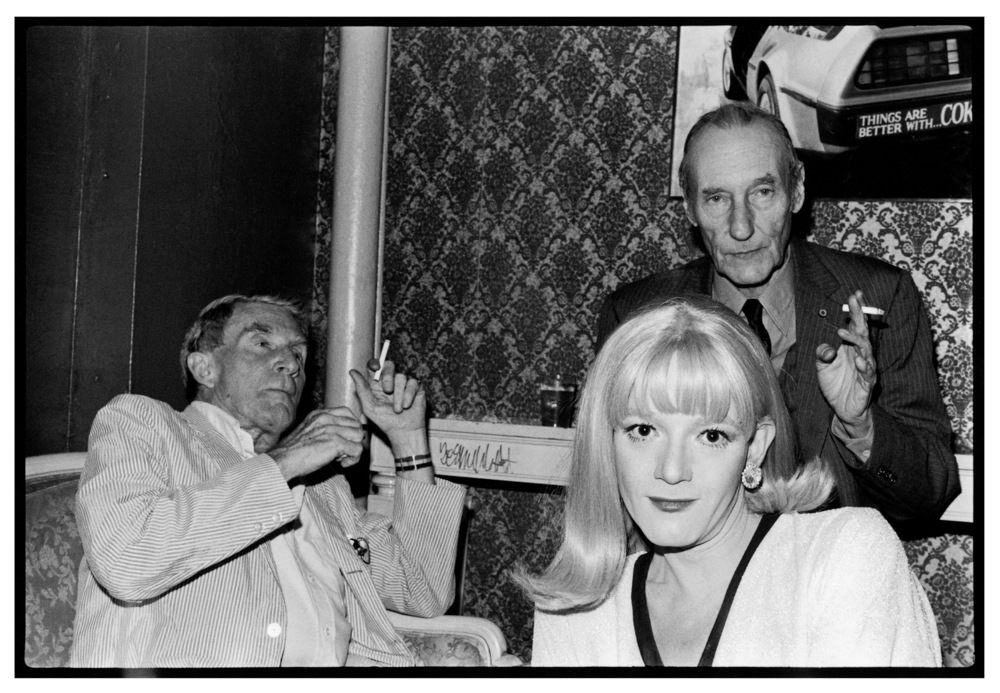
Second, a clip from the 1983 documentary Burroughs, wherein the birthday Billy reads aloud and acts out the horrifically funny Dr. Benway passage from Naked Lunch. Co-starring Jackie Curtis as the nurse! (And check out this amazing photo of Gysin, Curtis, and Burroughs together. Dawww.)
“Your mind will answer most questions if you learn to relax and wait for the answer.”
(W.S.B.)
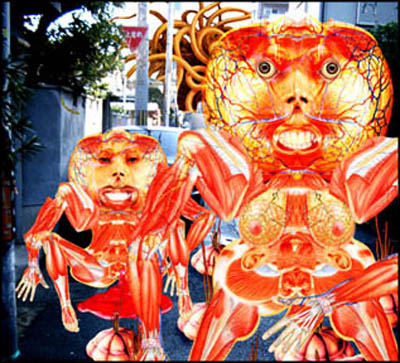
This perfect, gleaming sliver of transcendent “whaaaa thaaaa faaaaaa??!” comes to us care of a tweet from Keith Jenson of Brainwomb, who claims to be sharing it to polarize the effect of the “‘spirit bomb’ of Harajuku” video that Nadya just posted. (Athough it seems just as likely that he’s trying to insidiously destroy us with subliminal mind control.)
Laughing Squid says that Japanese artist Sekitani Norihiro –be sure to check out that website, but be warned, it is rife with CAN’T UNSEE imagery– made this succinctly fucked-up-beyond-all-reckoning-ness for the digital grindcore demigod Maruosa.
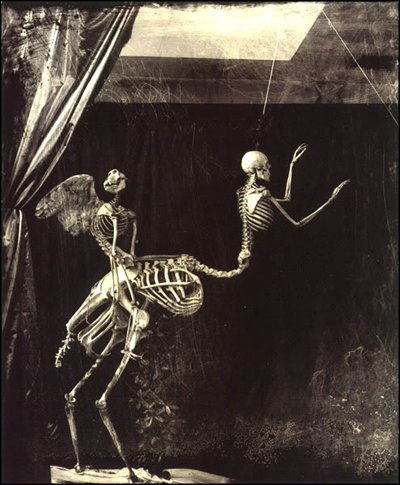
(un)Naturally, we can’t have Centaur Week without posting one of Joel-PeterWitkin‘s most famous works, riffing off the classical Greek “Kentauros & Eros” motif…
“Cupid and Centaur” by Joel-Peter Witkin (1992)
(Preaching to the choir, here, but) Is there another photographer living whose sublime darkroom necromancy conveys quite the same level of beauty, horror, ferocity, compassion, grace and grotesquerie as Witkin’s? Doubtful.