Alt Culture Antibodies


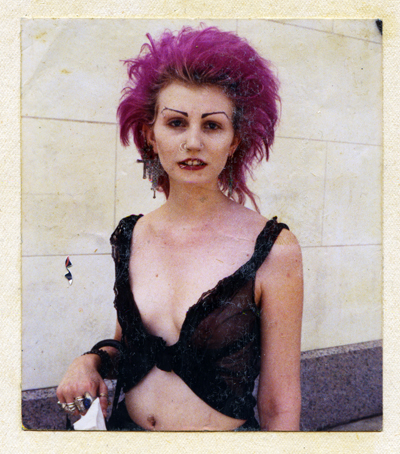
Photo by Hunter Freeman.

I’ll try to keep this short; it’s late and there’s not much time left. Please forgive me if you’ve heard parts of this story before.

For me, it started with an old box of science fiction. I tore through Samuel R. Delany, Joanna Russ, Gene Wolfe, and others, reliving stories old by the time I cracked the pages. I didn’t care.

To my mind, the New Wave had it: the future was something to play in. This status quo was the most transient of things, its passing viewed with a sense of infinite possibility. If there were other cultures out in space, forward in time, why not here? Why not now?


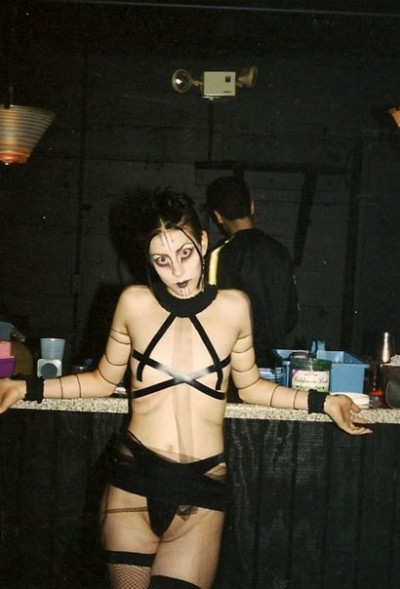
Photo by Mike Brodie.

I lived in one of those amazing, barely-clinging corners of the country too many ignore when they talk about culture of any variety. No metropoli there, just a scattering of people trying their desperate best. By the time I busted open the box full of old books, I had already faced a fair amount of poverty, hardship, and even death.


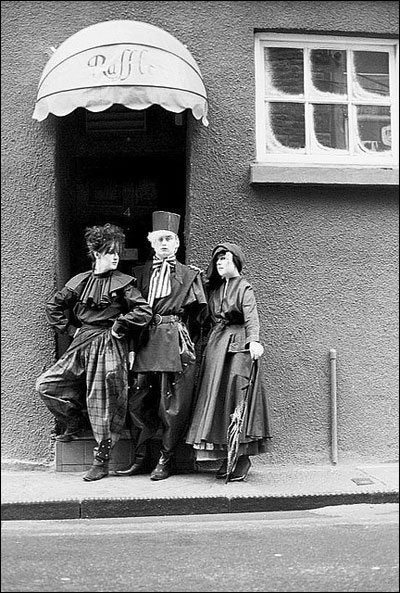
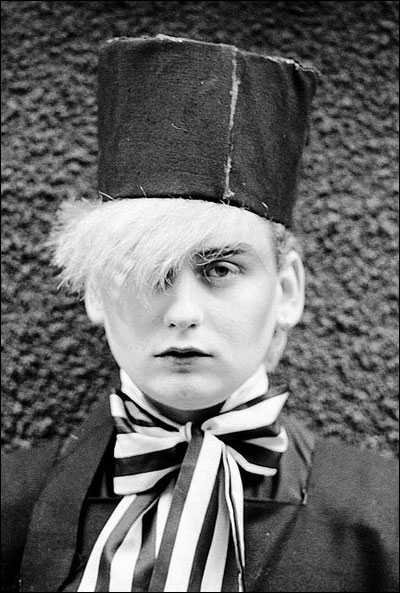
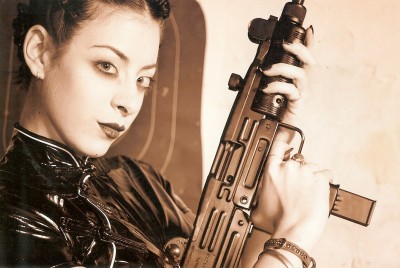
90s Cyberpunk portraiture by Steve Pyke.

But here, as the years wore on and I read my way through an uneasy adolescence, was something else: here was hope, in the most dangerous fashion. Somewhere out there, people changed their personalities, moved in unison, turned boundaries into blurs transitory as old blood on a highway.

By that point I did not care about ridicule, and laughed when someone threatened me, but this I was terrified of, sure that the half-described scenes — goths, ravers, activists, and more —  faced possibility with a courage I felt I’d never know.

Supersonic: Third Wave Feminism and the Importance of the “Hard Femme”-Cee (via Geekquality)

A final, fantastic Geekquality cross-posting written by Moxie Munroe. Thanks again to everyone over at our cherished sister blog for their thoughtful contributions and ongoing inspiration. We love you! Keep up the empowering, nourishing work. ~Mer

It’s a widely accepted idea that music, like fashion, social movements, and menstruation, runs in cycles. Sometimes this theory runs less true than others, but right now I think it’s pretty applicable. Because right now, in the year of our Lord 2012, three things are making a huge media comeback: feminism, babydoll dresses, and female [presenting] emcees. This is important on several different levels, one being that the rise of the female emcee in 2012, and the performance styles they’ve adopted, gives us the chance to have some real conversations about race, class, and presentation in the role of third wave feminism.

You might say, “But Moxie, this is a blog for geeks by geeks! What does this have to do with my geek culture?” And I might answer, “Well, you beautiful newborn baby, geek culture is fringe culture, just like this is fringe culture. Music geeks are geeks too, and music geeks encompass a wider berth than just Flaming Lips fans, so get over it – hip-hop geeks need some shine too, and the issues we’re dealing with here are the same issues we deal with when we talk about representation of women of color in media in general, including comics, so double get over it, zip your lips and listen up, sporty.” And you might say, “Moxie, that’s mean!” And I might say “I don’t care!” So let’s continue.

Third wave feminism, is Now feminism; it’s pop feminism; some people might identify it as “girl power” Spice Girls feminism. It’s important, because this particular wave allows us to focus on things like sexual progressiveness and agency as it exists within the feminist sphere. A lot of the criticisms surrounding third wave feminism (and feminism in general) focus on the perceived and actual exclusion of race, class, and gender presentation in discourse. Several of the up and coming femcees in 2012 serve to challenge many of the practical aspects of both the standard patriarchy and the perceived paradigm of the feminist ideal. I’d say a lot of this is because most femcees exist in a racial/sexual no-man’s land, where subversiveness is almost necessary to survival.


Azealia Banks in GQ Magazine.

The first wave of femcees seems to have come around sometime in the 80s and early 90s with folks like Queen Latifah, MC Lyte, Salt N Pepa, and TLC; with tracks like “Ladies First” and “None Of Your Business” lending a particularly feminist voice to the hip-hop game. As hot as these songs (and artists) were, none of them became banner anthems of the feminist movement, falling behind artists like Bikini Kill and other darlings of the Riot Grrl movement. Recently though, vintage fem-penned hip-hop has been getting more play in feminist circles, due in large part to this generation’s penchant for nostalgia, and also the rise of social media’s role in social movements, allowing more voices of color to come to the forefront of the conversation. Social media has aided in the diversity of the music scene as well, allowing more underground artists to be heard by a wide range of demographics.

But let’s get back to the future. Today’s crop of female emcees seems to be as influenced by the socially conscious hip-hop of the 80s and 90s as it is the more raw sexually charged female hip-hop of the early 00s, when artists like Lil’ Kim and Foxy Brown ruled the school. The explicit lyrics of that form of the genre tended to turn off a lot of feminists who dismissed it as both heteronormative and degrading.

The Evolution of Fashion as a Signifier

Coilhouse guest blogger Numidas Prasarn previously brought you an article on Fe Maidens, the all-girl high school robotics team from the Bronx. In her second guest post on Coilhouse, Numi talks about fashion as a signifier of status and identity, and how the emergence of the middle class, along with globalization, have changed the pace at which fashion trends are manufactured, adopted and discarded. Numi demonstrates this phenomenon by walking us through the evolution of the men’s three-piece suit. An academic #longread sure to delight fashion/history/socioeconomics geeks!  If you enjoyed “Starch Makes the Gentlemen” and “Teddy Boys,” this article provides some excellent context. - Nadya


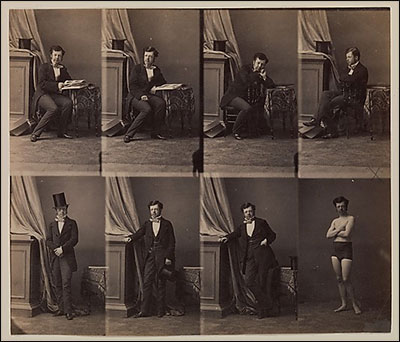
Prince Lobkowitz, 1858

Fashion as signifier is a concept familiar to many that identify as part of an alternative tribe or culture. How we express ourselves, how we identify with those around us, what style says about us and our culture – fashion is often examined through this scope. But how do we explain the origin of how trends in fashion move, how do we create these signifiers to begin with? There are many ways to approach this, one angle is the idea that fashion and socioeconomics are inseparable, that style and social politics are more intertwined than initially imagined and more specifically that globalization and the growth and reign of the middle class changed the game of fashion.

That is an awfully heavy statement to lay in one sentence.

Allow me to back up for a moment. There is a list of reasons designed to answer “Why do humans wear clothing.” They are Protection, Modesty, Identification, Adornment, and Status. Right now I am going to focus on Identification and Status, particularly in relation to using fashion as a means of establishing class division. German sociologist Georg Simmel puts it in terms of Imitation, Union and Exclusion. He writes that:

“Fashion is the imitation of a given example and satisfies the demand for social adaptation [...] At the same time it satisfies in no less degree the need of differentiation, the tendency towards dissimilarity, the desire for change and contrast, on the one hand by a constant change of contents, which gives to the fashion of to-day an individual stamp as opposed to that of yesterday and of tomorrow, on the other hand because fashions differ for different classes – the fashions of the upper stratum of society are never identical with those of the lower; in fact, they they are abandoned by the former as soon as the latter prepares to appropriate them.” [1]

Up until the 20th century, the largest shifts in style, silhouette and beauty have been directly linked with the changes of the ruling class. A trend established by the aristocracy and shared amongst themselves, it becomes a marker establishing what class the wearer belongs to. It is therefore a means of creating Status and allowing Identification, and on a deeper level creating an environment of Exclusion/Inclusion.

The game changes completely with the entrance of the middle class. After the Industrial Revolution but before WWI, you see an interesting shift start to happen where importance in the aristocracy turns instead to the working class. The idea of the self-made man and the nouveau riche become the new aristocracy and the middle class undergoes a growth spurt. Still young in its identity, it upholds a lot of the ideals it was taught to value and is a prime example of Simmel’s concept of Imitation. Post WWI, the notion of an aristocratic ruling class dies and so ideals change. From here on out, changes in trends happen faster and in a more cyclical manner. It isn’t that we ran out of ideas or new needs, we merely established that upward mobility was possible and therefore trends became more accessible. To use Simmel’s terms again, Imitation and Inclusion became possible on a wider scale which meant Exclusion had to happen at a faster rate.

Let’s demonstrate by examining the evolution of the male wardrobe, specifically the reign of the 3-piece suit.


“I am so goth, I was born black.”


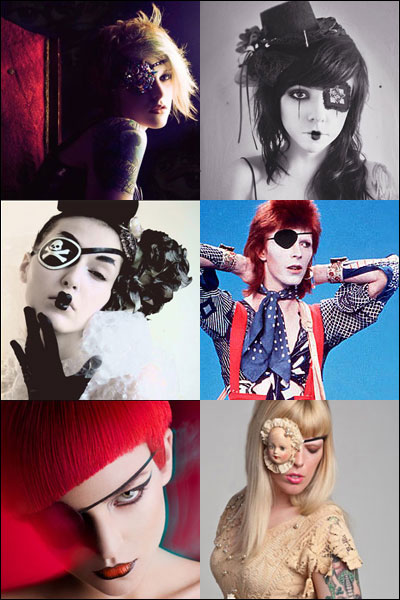
Clockwise: Ms. Sally Bonetta Forbes, Cathleen Naundorf, Untitled (check out the rest of the “gothic lolita” tag as well), Roni Zulu

While there’s still never been a black model on the cover of Gothic Beauty Magazine (in fact, having looked the past twelve years of covers up close, it’s clear that even models with brown eyes appear to be a rarity among the blue- and green-eyed cover ladies), and while most spooky fashion designers still prefer white models for their branding, a host of blogs dedicated to multicultural dark fashion are bringing greater visibility to the people that these venues ignore. Just on Tumblr, there’s Darque & Lovely, DarkSKIN (subtitled “I was so goth, I was born black), and Black Sheep Goths. On Facebook, groups such as Black/African American Goths foster lively discussion.

Of the Tumblr communities, Black Sheep focuses most specifically on people who are othered (providing a platform for “queer/fat/trans/non-binary/disabled/POC” goths), while DarkSKIN delves most deeply into different time periods (from Victorian photographs to seventies album covers to a friend’s most recently-uploaded snapshots), pop culture personalities taking a turn for the macabre (from Eartha Kitt singing “I want to be evil” to Aaliyah playing a sultry Anne Rice vampire) and media (from high-end fashion shoots to grainy self-portraits)

Many of the images come with empowering and, at times, defensive captions. It seems that even in 2012, some try to claim that the goth scene belongs to white people only. One caption on the Darque & Lovely blog, below an image of tattoo artist Roni Zulu, reads: “this is for the chicken-shit anon who said black people shouldn’t ‘do’ goth or punk. At certain points in history to be black in America was (still can be) a pretty gothic experience, to say the least.”


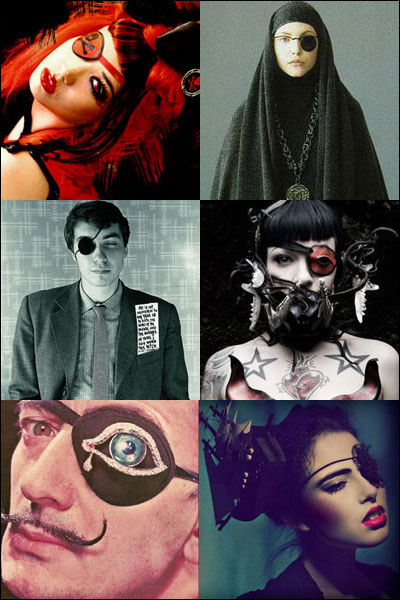
Clockwise: Asha Beta/Silentinfinite collaboration, Neon Leon, photo by Mert and Marcus, Actress Vonetta McGee as Princess Luva in Blacula, photo copyright Everett Collection / Rex Features

Is the goth scene unfriendly to people with dark skin? What do non-white goths think about the fetishization of paleness in the gothic subculture?

“The only time I experienced anything racial in the scene was at Death Guild [a San Francisco goth night],” says Shamika “Meeks” Baker, a San Francisco-based writer, artist and model. “A guy walked up to me, shouted ‘scuse me!’ and shoved me aside. Of couse, when I grabbed the back of his Fun Fur coat and yanked him back to demand an apology, he started screaming ‘get your black hands off of me!’ Happily, after I finished scaring him and turned around, I discovered several of my friends behind me and ready to back me up. [Other than that incident], I’ve found that the goth scene has been really welcoming and open.”

“For me, the fetishization of paleness in beauty in general is very much a class issue as opposed to straight race,” says New York-based artist/maker Numidas Prasarn. “The ‘ideal gothic beauty’ of being pale comes from this sense of otherness. When mainstream de mode is tanned beach babe, the pale contrast is taken up as the signifier of an Other that defensively puffs itself up. The problem is that it’s a microcosm that doesn’t necessary carry the sense of self-awareness to realize that it’s also othering people.”


Clockwise: Amanda Tea, Barron Claiborne, Leif Podhajsky, Unknown from Burning Man by Iñaki Vinaixa

Asha Beta, a sculptor, jewelry designer and musician currently living in Prescott, Arizona, comments on her invisibility within a community that borrows aesthetics from her cultural heritage:

The “traditional” ideal of the scene as the pale-faced, black-clad individual definitely never applied to me, but because of my instant and deep connection and attraction to the music and atmosphere of the scene I had to set that aside. I always felt that I was not perceived to be as attractive, as beautiful or even as “goth” as girls who were paler than me. I never attracted many suitors and I reconciled myself to never being able to approach the “gothic ideal of beauty” very early on, although I felt within myself that my personal way of being “goth” was very sincere and creative and very much true to what “goth” was all about. The one part of the scene that obviously made me uncomfortable was the military/Nazi/Aryan faction of it, although I understand that for many of those people it was a fetish or history obsession type of thing, and not necessarily based in racism.

Many of the aesthetics of goth culture are taken from my cultural heritage (Asian/East Indian/Middle Eastern, African/Egyptian/Voodoo/Haitian-Caribbean) so I still felt and feel strongly that my connection to it is natural and instinctive and powerful. It was achingly difficult to be a minority within the subculture I deeply loved because it’s within these that we find acceptance and understanding where the larger society rejects us. I was a loner within the scene just as I was in society. I found a personal solace and creative outlet, but I never found the community I was searching for. I am overjoyed to finally see our subcultures mirroring the multicultural quality of our world, and so glad to see the younger generations of subcultures finding and creating communities to connect with and support one another.

Meeks Baker agrees. “I love that more emerging blogs/sites focus on us dark-skinned gothy types. To be honest, I never really cared much for gothic beauty magazines because they didn’t really reflect my aesthetic, but I did still feel marginalized. To this day I am thrilled to see ethnic diversity represented in alternative culture.”

“My Way” Drummer Steals the Show

Regrets… we’ve all had a few.
Watching this video until the drummer kicks in? Probably not gonna be one of them.


(via M. S. le Despencer)

Print Artifacts on Skin: The Tattoo Art of Xoïl

French artist Xoïl (who also goes by Loïc) creates surreal, hyper-detailed tattoos that evoke collage, typography, and stencil art. Xoïl’s tattoos assemble the artifacts of print into tight, chaotic compositions that include torn paper textures, moire patterns, dot-matrix designs, chicken scratch, watercolor washes, dripping ink, bleeding markers and accidental-looking smudges of paint. These permanent “imperfections” are striking to behold.

File this under: “tattoo artists that make one want to buy plane tickets” (previously in this category: Guy le Tattooer)

[via glukkake]

June 16th is Bloomsday


Photo of James Joyce by Berenice Abbott

From Molly Bloom’s soliloquy, the final line of Ulysses by James Joyce:

“…I was a Flower of the mountain yes when I put the rose in my hair like the Andalusian girls used or shall I wear a red yes and how he kissed me under the Moorish wall and I thought well as well him as another and then I asked him with my eyes to ask again yes and then he asked me would I yes to say yes my mountain flower and first I put my arms around him yes and drew him down to me so he could feel my breasts all perfume yes and his heart was going like mad and yes I said yes I will Yes. “

Happy Bloomsday, everyone! Let us celebrate with a viewing of Pitch ‘n’ Putt with Joyce ‘n’ Beckett


via Colin Peters

The Enduring Power of the NYC Vogue Ball Scene and “Paris Is Burning”

A quick heads up: NPR just posted “The Music and Meaning of Paris Is Burning“, an article by Julianne Escobedo Shepherd that discusses Jennie Livingston‘s classic 1990 documentary Paris Is Burning and the legendary scene and songs that it celebrates.

In addition to providing an overview of both the documentary and vogue ball culture (both past and present) the NPR feature includes testimonies from Big Freedia, Light Asylum, Zebra Katz, Del Marquis, and many others. A quick, great read. It’s also exciting to discover that the documentary –which has been, for decades, fairly difficult to track down a decent copy of– is now readily available on iTunes and Netflix Streaming.

The realm of Paris Is Burning: resonant and radiant as it ever was.

Cornelius Boots Keeps On Rockin’ in the Weird World


Edmund Welles, 2010 press photo. Aaron Novik, Jeff Anderle, Jon Russell, and creative mastermind Cornelius Boots in the foreground.

Confession: I’ve been meaning to write a feverish and swooning rave-up of Oakland-based musician Cornelius Boots‘ absurdly beautiful and strange and intelligent and mischievous and sincere and meditative and heavy-as-fuck bass clarinet chamber music group, Edmund Welles*, for years now.

It certainly isn’t for lack of reverence for Boots or his compositions that I’ve lagged.  When suffering from blogger’s block, my editorial purview tends to be “when in doubt, crap it out.” But occasionally, there are those subjects that you can’t just casually hork up. You want so badly to do them every justice– to elevate and praise them to the highest and most lofty of misty, Middle Earth-worthy mountaintops. Boots’ ouvre definitely lives in that non-horkable category. Well, then! Having unburdened my guilty conscience…


Edmund Welles. 

Yes, Cornelius Boots and friends make music that I want throw a parade for. Or, alternately, throw my frilly undergarments at. While his group Edmund Welles definitely is not everyone’s cup of tea, it’s 100% my cuppa, and hopefully, it’ll resonate with Coilhouse readers who also love waaaay-off-the-beaten-path-no-srsly-bring-your-machete-cos-we-be-bushwhackin’ music.

Via their CD Baby page:

Edmund Welles [...] has the distinction of being the world’s only original, composing band of four bass clarinetists, they invent and perform heavy chamber music. The bass clarinet has a five octave range and a huge span of tonal, melodic, and rhythmic capabilities.

Drawing virtuosic precision from the classical realm; innovation and texture from jazz; and power, rhythm and overall perspective from rock and metal, the quartet’s sound is characterized by a thickness of tone, a density of texture, absolute rhythmic precision, and the extreme use of dynamic contrasts: a dense, pulsing sound capable of expressing and reflecting the full range of human emotions.

They ain’t foolin’. It’s a massive, meticulously structured bass reed sound like nothing else you’ve heard. (Parallels have been drawn between John Zorn’s more recent works and Edmund Welles, for sure, but Boots’ steez feels simultaneously more West Coast and Far East-steeped.) Weirdest Band in the World‘s assessment is pretty spot-on as well: “The bass clarinet is an inherently weird instrument. Put four of them together in one group, and it sounds like a chorus of demon cats in heat fighting over a chicken bone. A demon chorus whose eerie caterwaulings just happen to occasionally assemble themselves into passages from Pixies and Nirvana songs.”

In 2005, they put out Agrippa’s 3 Books, which offers up original compositions by Boots that reflect his abiding interest in the occult and his talent for interpreting uber heavy spine-crunching metal. (Hilariously, Boots calls this stuff an attempt to create “Muzak for conspiracy theorists.” ACHIEVEMENT UNLOCKED!) Additionally, there are Sepultura and Spinal Tap covers. Not to mention the most bewilderingly esoteric and brilliant liner notes you’ll find north of a Trey Spruance solo project. (Buy the goddamn CD. Seriously. No, seriously. Totally worth it.)

Edmund Welles’ second album is called Tooth & Claw, and it’s comprised predominantly of original composition that are as bizarre and heavy as anything Boots has ever written, but with more nuanced elements of avant jazz and modern classical woven into the dense sonority.

The Latest Awesome Sauce from Zoë Keating

It’s been a while since we mentioned Zoë Keating on the blog! Here’s a lovely six-minute feature about our very favorite avant cellist in the whole world, produced by Intel Visual Life:

Zoë’s been up to all kinds of cool stuff: traveling around the world along with her cellobaby and cellobabydaddy, making cellotastic “In-C” remixes, analyzing the Spotify hubbub from her unique vantage point as a highly successful unsigned musician… and her current live performance collaboration with the ODC dance ensemble, Breathing Underwater, is getting all kinds of rave-ups in the press! (NoCal folks can catch one of the final Yerba Buena shows in San Francisco tonight, the 23th, or the 25th.)

Then there’s this deeply moving video that high school student Gabriella Runnells recently made addressing the plight of girls in the developing world, using Zoë’s song “Optimist” as the score (which you can read more about on Zoë’s Tumblr):

Zoë’s also got a short tour in the works. US west coast beasties, this may be your last chance to see her live before 2013, after her new album (in the works now) comes out:

12 April - Cedar - Minneapolis MN

26 April - Largo - Los Angeles CA

27 April - UC Riverside - Riverside CA

03 May - Neptune Theater - Seattle WA

04 May - Aladdin Theater - Portland OR

05 May - Shedd Institute - Eugene OR


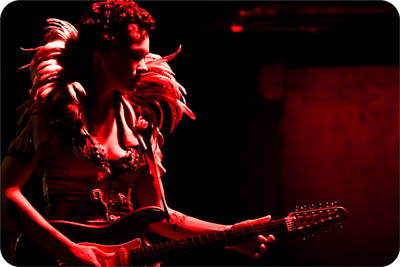
Zoë Keating, wearing Gibbous, photographed by Nadya Lev for Coilhouse Magazine

Yay, Zoë.