Alt Culture Antibodies


Photo by Hunter Freeman.

I’ll try to keep this short; it’s late and there’s not much time left. Please forgive me if you’ve heard parts of this story before.

For me, it started with an old box of science fiction. I tore through Samuel R. Delany, Joanna Russ, Gene Wolfe, and others, reliving stories old by the time I cracked the pages. I didn’t care.

To my mind, the New Wave had it: the future was something to play in. This status quo was the most transient of things, its passing viewed with a sense of infinite possibility. If there were other cultures out in space, forward in time, why not here? Why not now?


Photo by Mike Brodie.

I lived in one of those amazing, barely-clinging corners of the country too many ignore when they talk about culture of any variety. No metropoli there, just a scattering of people trying their desperate best. By the time I busted open the box full of old books, I had already faced a fair amount of poverty, hardship, and even death.


90s Cyberpunk portraiture by Steve Pyke.

But here, as the years wore on and I read my way through an uneasy adolescence, was something else: here was hope, in the most dangerous fashion. Somewhere out there, people changed their personalities, moved in unison, turned boundaries into blurs transitory as old blood on a highway.

By that point I did not care about ridicule, and laughed when someone threatened me, but this I was terrified of, sure that the half-described scenes — goths, ravers, activists, and more —  faced possibility with a courage I felt I’d never know.

Hollywood’s Dating Habits: A Quick Education On Geochronology

The brilliant and exuberantly tenacious Phil Broughton is a health physicist, radiation safety educator, and the proprietor/ranter-in-chief of Funranium Labs. It’s a joy to publish his edifying, hilarious essay concerning Hollywood expository narratives as they pertain to… TEH SCIENCE! Illustrated with LULZ from across the world wide interwubz, arbitrarily selected by yours truly. Haha! Sorry, Phil. (No I’m not.) But seriously, Phil is a tremendously gregarious and charming font of knowledge, so feel free to poke him about coffee, nuclear weapons, beer, history, urban exploring, science “or any of the myriad useless facts bubbling about” in his brainmeats at funranium@gmail.com. Yay, Phil! ~Mer

Hollywood, we need to talk about your dating habits. In particular, how important it is to have a reference to verify ages before you get in trouble. No, I’m not talking about the hypersexualization of 12 year old girls trying to pass for 18. Nor am I talking about the 60-somethings trying to pass for 18 as well. That is a totally separate headshaking situation.

I would like to blame the movie Prometheus for this rant, but it’s hardly the only guilty party, just the one that finally made me snap. Hollywood, you don’t understand how carbon dating works, that there are other dating methods that sometimes work better, and that the true (unattainable) goal is to find the perfect point of reference to scale them all against. But underlying all of that is a body of scientific work and assumptions that you’ve conveniently ignored in the interest of “character driven plot”. But I have news for you: your characters and your plot make less sense when you take these shortcuts. And when you do this, people become confused as to what science and state of the art technology actually are, to the point that we have to deprogram juries and judges of the CSI Effect in capital punishment trials because Reality. Doesn’t. Work. Like. That.

John John Jesse’s Punk Rock, New York Narrative

John John Jesse is a celebrated, controversial Catholic schoolboy-cum-punk rocker-cum-gonzo pop artist who came up in the dirty streets of NYC’s Lower East Side in the 80s and 90s. Luscious, filthy, fantastical, Jesse’s illustrative paintings are imbued with a lifelong appreciation for the fierce and rebellious girls he grew up with, and convey a deep understanding of the psychosexual underpinnings to work by a wide variety of fellow artists– from Gustav Klimt and Béla Iványi-Grünwald to Jamie Reid and Caravaggio. Most of the people featured in Jesse’s work are friends of his; many others are recognizable figures from sub/pop/countercultural spheres. A couple years back, Jesse moved from the big city into more pastoral climes, but his passionate love affair with the imagery and narrative of Punk Rawk New Yawk continues. Today on Coilhouse: a recent interview with JJJ conducted by Coilhouse contributor Sarah Hassan. ~Mer
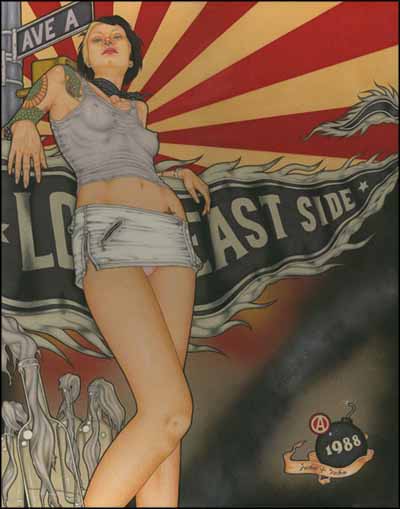

L.I.E. ’88 by John John Jesse

As the quintessential ‘punk rock painter’ from the Lower East Side, a neighborhood now known more for it’s expensive rent and boutiques than heroin addicts and street gangs, how did your move from the city affect your work, if all? Is New York City still what inspires you, or is there something to be said for the quiet of small-town living?
I left New York City because it no longer is what it was. It has turned into an extremely over-crowded college dorm. I mean, now you actually have to wait in line to cross the street and some intersections. That’s fucked! But moving didn’t affect my work at all, it just removed the distractions. You can take the boy out of the city, but you can’t take the city out of the boy, as they say. My life story is what inspires me and most of that took place in New York City, so being here – the country – just gave me the clarity to get my point across in my works.

New York can be rather distracting for an artist, there is a simplicity to living outside it that seems to enhance ones creative output. Your work appears and is often credited to be extremely autobiographical; the music, the drugs, the girls, the heartache. As you’ve developed as an artist, have your inspirations changed in anyway, or do the same themes resonate with you even more than ever?
It’s a lot of the same; I am just discovering new ways to tell my story. After time, your craft always becomes more refined and that gets me pretty eager to keep painting. And as it – my work – is autobiographical, my life continues, so therefore my story does too.
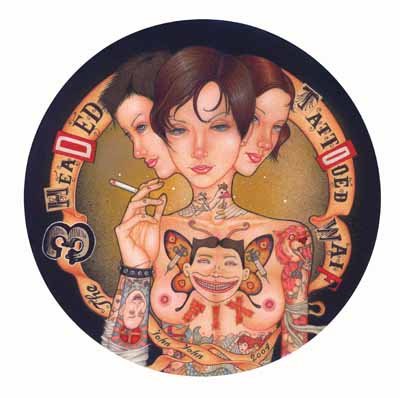

The 3-Headed, Tattooed Waif by John John Jesse

The ever-evolving body of work; it’s inspiring. The exuberance and anxiety of youth is a major theme with your paintings, which music has always been successful in addressing. How has your experience as a musician affected your fine art?
I’m now retired from touring and playing in punk bands, I don’t have the time they need to commit. Better to give a one-hundred percent to one thing than spread myself thin and do both crappy. I had been on tour or recording most of my life, so it had a huge impact on my art. I mean, we weren’t the Jonas Brothers, but you can imagine what we were like on tour. It’s pretty much a free pass to do whatever the fuck you want.


Joss Whedon: “The Zomneys will come for all of us.”

Joss Whedon, y’all.

“You know, like a lot of liberal Americans, I was excited when Barack Obama took office four years ago. But it’s a very different world now, and Mitt Romney is a very different candidate. One with the vision and determination to cut through ‘business as usual’ politics’ and finally put this country back on the path to the zombie apocalypse. Romney is ready to make the deep rollbacks in healthcare, education, social services, and reproductive rights that will guaranty poverty, unemployment, overpopulation, disease, rioting – all crucial elements in creating a nightmare zombie wasteland. But it’s his commitment to ungoverned corporate privilege that will nose-dive this economy into true insolvency and chaos. The kind of chaos you can’t buy back. Money is only so much paper to the undead. The 1% will no longer be the very rich, it’ll be the very fast. Anyone can run, fight, make explosives out of household objects or especially do parkour of any kind – you’ll want to stick with them, unless they read Ayn Rand.”

“Look, I don’t pretend to see the future. No one knows for sure if they’ll be the super-fast 28 Days Later zombies or the old-school shambling kind. But they’re out there, and they need brains. So, whether you’re a small business man just trying to keep his doors open, a single mom so concerned for her son’s welfare that she’ll run to embrace him when he’s clearly infected and going to bite her. Or a strung-out ex-military type, who’s been out there too long and is taking the kind of damn-fool chances that’ll get us all killed, you need to ask yourself, ‘Am I ready? Am I ready for the purity and courage of Mitt Romney’s apocalyptic vision?’ Mitt’s ready. He’s not afraid to face a ravening, rasping hoard of sub-humans, because that’s how he sees poor people already. Let’s all embrace the future, stop pretending we care about each other, and start hoarding canned goods. Because if Mitt takes office, sooner or later, the zombies will come for all of us.”

“Zomney – He Needs Brains”

“Paid for by the Committee to Learn Parkour, Like Really Soon, Like Maybe Take A Class Or Something.”

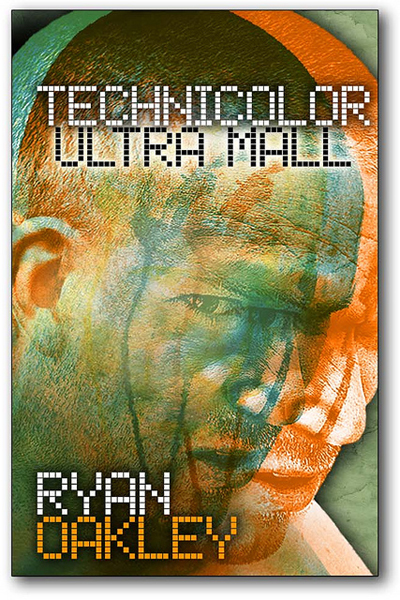
Ryan Oakley’s Technicolor Ultra Mall

(Big thanks to our longtime friend, the Posthuman Romantic/tech gonzo/all-around dashing gent M1K3Y, for this delightful rave review! Be sure to visit him over at Grinding.be. ~Mer)

AUTHOR’S PREFACE: It’s fitting that my review of this book appears here, because it’s via this wonderful blog that I first became acquainted with Mr Ryan Oakley. After which I stalked friended him, and in the way of the Golden Age of the Internet, quickly formed a band groupblog (The Worldwide Culture Gonzo Squad) that went kinda nowhere, but formed a lasting and important friendship.

SHOP. EAT. REPEAT.

Little is widely known about Canada’s speculative super soldier program. Much was rumoured, little actually validated. Ryan Oakley was whispered to be the bastard mind-child of Anthony Burgess and Philip K. Dick, but this was only confirmed with the release of his debut novel TECHNICOLOR ULTRA MALL into the wild. Torn pages clutched by catatonic mall rats left to rot in the back rows of electronic superstores. Curious graffiti in bathroom stalls announcing “The Coming Revelation of the Great Chosen One, Teevee”. Russian squats full of lively debate driven by dot-matrix printed excerpts, mistranslated from German. Ultraviolent science fiction makes its heroic return; travelling through time, back to kill the future.

TECHNICOLOR ULTRA MALL (#TCUM) is a busted neon literary warning sign. Where cyberpunk failed, this must succeed in alerting us to hyper-capitalism’s end state: the mega-mall as polis. Born to shop, in death do we become commerce itself (“you could usually get more for a dead person than you could pull from their pockets”). Hyper-mediated, people are alienated from their own body, unable to feel anything without the right chemical compound. Corporate colonisation of emotion and sensation.

This is what comes of the “old people afraid of the sky” future, as Bruce Sterling has described it, written before he even uttered the words. Outside may as well be the surface of the Moon (or better yet, Mars); there is only the Mall. The adult version of Nausicaä Valley of the Wind, but with gigantic, hermetically sealed machinery instead of mutant bugs. The malls feed on the garbage of the past, as the book itself mines the midden heaps of the collective refuse of the decadent 20th century (that still lingers on like a dying fire-breathing dragon stumbling into a village, unaware it’s killing us all.) This is Demolition Man mutated and buried underground by the Umbrella Corporation. This is Plato’s three-souled corporate Republic with its Red (bronze-souled favella), Green (silver-souled bourgeoisie) and Blue (golden-souled ruling class) levels, and twice as sickening.

“I am so goth, I was born black.”


Clockwise: Ms. Sally Bonetta Forbes, Cathleen Naundorf, Untitled (check out the rest of the “gothic lolita” tag as well), Roni Zulu

While there’s still never been a black model on the cover of Gothic Beauty Magazine (in fact, having looked the past twelve years of covers up close, it’s clear that even models with brown eyes appear to be a rarity among the blue- and green-eyed cover ladies), and while most spooky fashion designers still prefer white models for their branding, a host of blogs dedicated to multicultural dark fashion are bringing greater visibility to the people that these venues ignore. Just on Tumblr, there’s Darque & Lovely, DarkSKIN (subtitled “I was so goth, I was born black), and Black Sheep Goths. On Facebook, groups such as Black/African American Goths foster lively discussion.

Of the Tumblr communities, Black Sheep focuses most specifically on people who are othered (providing a platform for “queer/fat/trans/non-binary/disabled/POC” goths), while DarkSKIN delves most deeply into different time periods (from Victorian photographs to seventies album covers to a friend’s most recently-uploaded snapshots), pop culture personalities taking a turn for the macabre (from Eartha Kitt singing “I want to be evil” to Aaliyah playing a sultry Anne Rice vampire) and media (from high-end fashion shoots to grainy self-portraits)

Many of the images come with empowering and, at times, defensive captions. It seems that even in 2012, some try to claim that the goth scene belongs to white people only. One caption on the Darque & Lovely blog, below an image of tattoo artist Roni Zulu, reads: “this is for the chicken-shit anon who said black people shouldn’t ‘do’ goth or punk. At certain points in history to be black in America was (still can be) a pretty gothic experience, to say the least.”


Clockwise: Asha Beta/Silentinfinite collaboration, Neon Leon, photo by Mert and Marcus, Actress Vonetta McGee as Princess Luva in Blacula, photo copyright Everett Collection / Rex Features

Is the goth scene unfriendly to people with dark skin? What do non-white goths think about the fetishization of paleness in the gothic subculture?

“The only time I experienced anything racial in the scene was at Death Guild [a San Francisco goth night],” says Shamika “Meeks” Baker, a San Francisco-based writer, artist and model. “A guy walked up to me, shouted ‘scuse me!’ and shoved me aside. Of couse, when I grabbed the back of his Fun Fur coat and yanked him back to demand an apology, he started screaming ‘get your black hands off of me!’ Happily, after I finished scaring him and turned around, I discovered several of my friends behind me and ready to back me up. [Other than that incident], I’ve found that the goth scene has been really welcoming and open.”

“For me, the fetishization of paleness in beauty in general is very much a class issue as opposed to straight race,” says New York-based artist/maker Numidas Prasarn. “The ‘ideal gothic beauty’ of being pale comes from this sense of otherness. When mainstream de mode is tanned beach babe, the pale contrast is taken up as the signifier of an Other that defensively puffs itself up. The problem is that it’s a microcosm that doesn’t necessary carry the sense of self-awareness to realize that it’s also othering people.”


Clockwise: Amanda Tea, Barron Claiborne, Leif Podhajsky, Unknown from Burning Man by Iñaki Vinaixa

Asha Beta, a sculptor, jewelry designer and musician currently living in Prescott, Arizona, comments on her invisibility within a community that borrows aesthetics from her cultural heritage:

The “traditional” ideal of the scene as the pale-faced, black-clad individual definitely never applied to me, but because of my instant and deep connection and attraction to the music and atmosphere of the scene I had to set that aside. I always felt that I was not perceived to be as attractive, as beautiful or even as “goth” as girls who were paler than me. I never attracted many suitors and I reconciled myself to never being able to approach the “gothic ideal of beauty” very early on, although I felt within myself that my personal way of being “goth” was very sincere and creative and very much true to what “goth” was all about. The one part of the scene that obviously made me uncomfortable was the military/Nazi/Aryan faction of it, although I understand that for many of those people it was a fetish or history obsession type of thing, and not necessarily based in racism.

Many of the aesthetics of goth culture are taken from my cultural heritage (Asian/East Indian/Middle Eastern, African/Egyptian/Voodoo/Haitian-Caribbean) so I still felt and feel strongly that my connection to it is natural and instinctive and powerful. It was achingly difficult to be a minority within the subculture I deeply loved because it’s within these that we find acceptance and understanding where the larger society rejects us. I was a loner within the scene just as I was in society. I found a personal solace and creative outlet, but I never found the community I was searching for. I am overjoyed to finally see our subcultures mirroring the multicultural quality of our world, and so glad to see the younger generations of subcultures finding and creating communities to connect with and support one another.

Meeks Baker agrees. “I love that more emerging blogs/sites focus on us dark-skinned gothy types. To be honest, I never really cared much for gothic beauty magazines because they didn’t really reflect my aesthetic, but I did still feel marginalized. To this day I am thrilled to see ethnic diversity represented in alternative culture.”

Поющий кот Сальвадор / Salvador the Singing Cat (?)

I have no idea what you’re talking about, so here’s a vaguely phallic thumb-faced thingy singing a duet with a vaguely labia majora-lipped pussycat. In Russian. Honestly, I have no idea what they’re talking about, either. Wheeee!

Hey, Nadya! Welcome back from the playa! We can haz translation?

(Via E. Stephen Weirdo.)

A Tree Filled with Angels: The Visionary Worlds of Jim Woodring and William Blake

Please welcome the second guest post by artist and writer Eden Gallanter! Eden previously brought you an illustrated post on dancing, physics and Mannerstist painting titled The Tango, the Quark, and the Allegory of Love. In this post, Eden discusses the ways in which hallucinations have influenced the work of Jim Woodring and William Blake. Enjoy! – Nadya


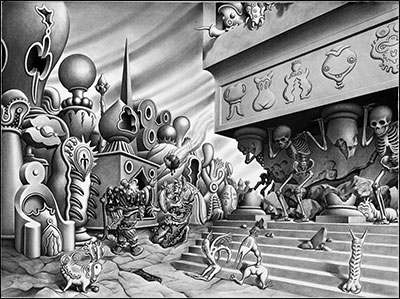
Jim Woodring, “Divornum – or Life After Man”

Although Jim Woodring is a contemporary American cartoonist, fine artist, and writer with a strong cult following, and William Blake was a 19th Century English poet and painter who lived most of his life in poverty and obscurity, these two men shared a common source of artistic inspiration: both experienced visual hallucinations for the majority of their lives.


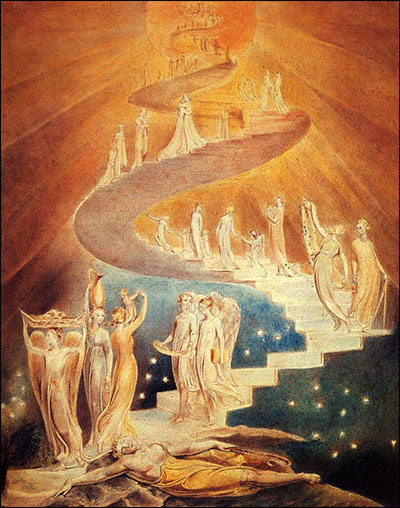
William Blake, Jacob’s Ladder

These visions (or apparitions) are clearly at the heart of both artists’ work, serving as gateways into another world that contains deep human truth and startling strangenesses. One account of Blake’s earliest visions, which remained full of the Christian iconography of 19th century England, describes the four-year-old Blake screaming for his parents upon seeing the face of God at the window.  A few years later, he saw a “tree filled with angels,” and was saved from a thrashing by his father for telling a lie by the sympathetic intervention of his mother.  Most of Blake’s hallucinations depicted the most beautiful and spiritual of the Christian themes.  He also could see and speak to deceased friends, and saw angelic figures and other celestial beings mingled among the everyday ladies and gentlemen of England.


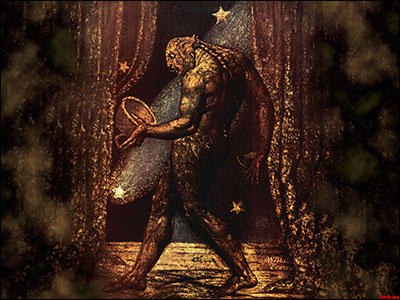
William Blake, Ghost of a Flea

Blake was considered to be a gentle madman by his contemporaries, and although some prominent writers regarded him with interest, his work was largely unrecognized during his lifetime.  Upon encouragement by his friends, he painted some of the apparitions he saw, most famously his Ghost of a Flea.  Blake’s lovely otherworldly visions, interpreted by him as divine inspiration, gave a confident shape to many socially deviant beliefs and practices.  Blake had many ideas about religion that were frankly considered heretical (most notably his The Marriage of Heaven and Hell, which described a unified vision of the cosmos, where both satanic and angelic realms were a vitally important part of a holy and just world).  Due to numerous references to the sanctity of romantic love and the necessity of its liberation from oppressive conventions such as duty and possession, Blake has been claimed as one of the forerunners of the Free Love movement in the 19th Century.  His poetry is full of rejections of the Christian virtue of chastity, and his writing advocated the removal of bans on homosexuality, prostitution, adultery, and birth control.  Blake is said to have lived a happy, quiet life: poor, obscure, and content simply in expressing his visions in his poetry and painting.

Blingtastic Sexbot Restaurant Opens in Japan

Robot Restaurant. Or, as jwz calls it, “Chuck E. Cheese: Judgement Day Version”.

The new restaurant (official site) is located in Shinjuku’s Kabukichō district, a neon-lit pleasure paradise also known as “Sleepless City” and renowned for its host/hostess bars, love hotels and nightclubs.

The restaurant is said to have cost 10 billion yen (or $130 million dollars). It features LED-encrusted tanks, cabaret girls, and gigantic fembots that can be steered with joysticks (one video also appears to show them being controlled via motion sensor.)

Admission to the restaurant costs 3000 yen (or $38). The fee covers seating, a simple meal, and an hour-long performance featuring Japanese taiko drums, a vinyl-clad marching band, a motorcycle performance, tanks and a B-52. More images can be found at Crunchyroll, Japan News 24, and Nippon News.

Now if we could get Freeform Delusion to go in there and circuit-bend a few things, this place would actually be perfect.

Meanwhile, We Are Experiencing Technical Difficulties. Please Stand By.

Not naming names, but someone‘s busted out of their pod again and gone on a psychedelics-and-Ebola-fueled rampage, flinging a truly mind-boggling amount of fecal matter and cold SpaghettiO’s directly onto the catacomb’s central alarm control panel, and then striking it repeatedly with some sort of… skull sceptre?

Not to worry, folks. Our backup system is kicking in now:

Regular broadcasting will resume shortly.