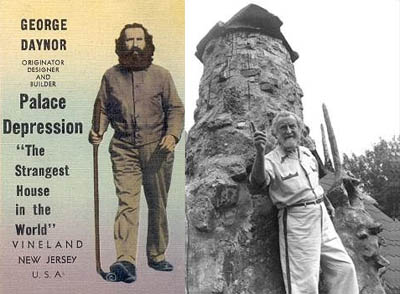
“The only real depression is a depression of individual ingenuity.” -George Daynor
The exploits of George Daynor read like the synopsis of a Coen Brothers flick. As the story goes, Daynor was a former gold prospector who’d lost his fortune in the Wall Street crash of 1929. Hitchhiking through Alaska, he was visited by an angel who told him to make his way to New Jersey without further delay. Divine providence had dictated that Daynor was to wait out the Great Depression there, building a castle with his bare hands.
Daynor had only four dollars in his pocket when he arrived in Vineland, NJ. He used the money to buy three swampy acres of land that had once been a car junkyard. For years he slept in an abandoned car on the mosquito-infested property, living off a steady diet of frogs, fish and squirrels while he built his elaborate eighteen-spired, pastel-hued Palace of Depression out of auto parts and mud. His primary objective? To encourage his downtrodden countrymen to hold onto their hope and stay resourceful, no matter what. Daynor opened his homemade castle to the public on Christmas Day, 1932, free of charge (he started charging an entrance fee after someone made fun of his beard), and proved an enthusiastic, albeit eccentric tour guide.
“The Palace Depression stands as a proof that education by thought can lift all the depressed peoples out of any depression, calamity or catastrophe; if mankind would use it. The proof stands before you my friends. Seeing is believing.”
Daynor held back his wild red hair with bobby pins, wore lipstick and rouge, and enjoyed dressing alternately as a prospector or a Victorian dandy. Legend has it he kept his common-law wife, Florence Daynor, locked up in one of the Palace’s subterranean chambers during visiting hours. He offered his “living brain” to the Smithsonian for experiments (they declined). His Palace of Depression, a.k.a The Strangest House In the World, quickly became a popular tourist destination for folks on their way to Atlantic City.
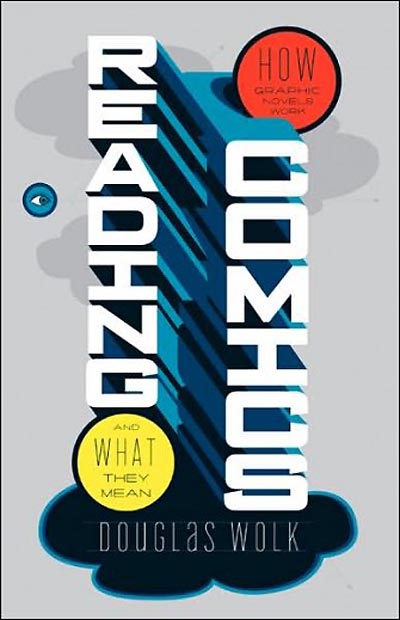
It would appear that the writer Douglas Wolk has only a single brain, of normal size, in his shaggy head. However, I remain unconvinced that he’s not storing another one (massive, turgid, jigglingly all-knowing) in some top secret subterranean storage facility which he accesses remotely. There’s just no other explanation for the bottomless depths of his knowledge on certain subjects, namely comics, pop music, fringe culture and vegetarian cuisine.
His latest book, Reading Comics, is a must-read for veterans and newbies alike, and there’s a fantastic interview with Wolk by Tom Spurgeon up over at the Comics Reporter right now. If you’re in the bay area, Wolk will be in town this coming Saturday, Feb. 23, for WonderCon, giving a talk called “The Senses-Shattering Return of the Novel of Ideas!” at the Comic Arts Conference. Not to be missed.
Spaniard Teruel Segundo de Chomón y Ruiz (1871-1929), a lesser known film pioneer with a particular fondness for hand-tinting his work, came to renown working for the Pathé brothers in the 1900s. While much of his work is directly informed by Méliès, Chomón’s distinctive aesthetic and deadpan humor set him apart and set a precedent for the surrealists Buñuel and Dalí. He also invented the film dolly.
The Golden Beetle (1907) is Chomón at his most delightfully innovative:
I learned of Chomón while watching the fantastic Landmarks of Early Film, Vol 1 collection, which also includes shorts by the Lumières, the aforementioned Méliès and some very early Kinetoscope movies. You can pick up a secondhand copy on Amazon for 20 bucks.
Blurry scan of the cover of an anti-VD mix CD I made back in 2003.
Happy Valentine’s Day to all. And to those who hate the day, I say this: Valentine’s Day is a Christian corruption of a pagan festival involving werewolves, blood and fucking. So wish people a happy Horny Werewolf Day and see what happens. –Warren Ellis
T-minus 45 minutes and counting to San Francisco’s third annual Valentine’s Day Pillow Fight! Play nice, kids. Attendees are highly encouraged to post links to their photos and bloggings of the event here.
Say what you will about the bloodless electroclash/no wave resurgence. Lard knows I have. Watching its rise in popularity in post 9-11 New York City, I experienced what can only be described as an excruciating kind of soul death. It still makes me a bit nauseated to admit that in the wake of The Tower, my generation of NYC rock musicians had nothing better to offer up than this cocaine-spritzed, head-in-the-sand, garage schlocky, post post post punk photocopy of a bootleg of a cover rendition of a vibrant cultural scene populated by non-derivative bands 30 years ago. (The documentary Kill Your Idols offers an unflinching assessment of this phenomenon. Highly recommended.)
Still, there’s some truth to that whole “imitation is the sincerest form of flattery” spiel, and it was nice to go to downtown clubs where beautiful, artfully tweezed and ever-mysterious DJs with asymmetrical hair spun vintage wax nightly: ESG, DNA, Contortions, Foetus, Teenage Jesus & the Jerks, Swans, beloved Klaus, etc. Cool non-Manhattanites –oh, ‘scuse me, I meant to say Honorary Citizens of the Center of the Known Universe– like the Birthday Party, Lene Lovich, Nina Hagen, and Malaria! were in heavy rotation as well. Which brings us, in a roundabout way, to the point of this post. (Heh. Sorry.)
Founded in early ’81, Malaria! was led by Bettina Koester and Gudrun Gut, and filled out with Manon P. Dursma, Christine Hahan and Susanne Kuhnke. I’m a longtime fan of theirs, but I hadn’t seen this gorgeous homemade Super 8 video for their song off the 12inch New York Passage: Your Turn to Run until recently:
directed by Dieter Hormel, Brigitte Bühler, Gudrun Gut
Is it just me, or is this footage reminiscent of something non-narrative filmmakers like Brakhage, Anger or Morrison might shoot? You know… if they were young, fierce and scrumptiously German in 1982. Dang! Both Gut and Koester are still actively making music, and having watched “Your Turn to Run”, I’m actually grumblingly grateful to the Bedford Avenue acoyltes of electro for their role in bringing the band renewed recognition.
Hooo boy. I’ve been sitting on my hands for weeks, not knowing if/when I’d be allowed to say anything, but I just got the go-ahead from Nils. NOW IT CAN BE TOLD.
“Look out, you’re dead like us. Dead like candy.”
photo by Katherine Copenhaver
For really and truly. The four core members of one of the most unclassifiable, unbelievable underground bands of the 80s/90s met up in Oakland late last month to get reacquainted and talk shop. They’re currently in the studio recording the final tracks needed to complete an album left unfinished since 1998, and they have tentative plans to do some live reunion shows as well. A bit of background on the band from the Idiot Flesh wiki entry:
Known to tour the US in a converted city bus with [member] Rathbun as the driver/mechanic, with the windshield destination banner of “HELL.” Besides their “rock against rock” attitude, they were also known to defy classification with marching band routines, performing puppet shows, and playing household items as instruments (in tune).
“Idiot Song” video directed by Annmarie Piette
If you’re already a rabid cult follower, chances are you are doing an exuberant wiggle dance right now. If you’ve never heard of Idiot Flesh, try to place their sound, guerilla theater tactics and spookylicious attire in the context of the 80s and early 90s, before Tim Burton’s aesthetic became quite so zeitgeisty. While they often draw comparisons to Mr Bungle (and there’s merit in that, seeing as both groups formed in 1985, wore obfuscating costumes and displayed frenetic, mathrock/metal/funk shredder chops), Oingo Boingo, Crash Worship and other unhinged California weirdos from that time period, Idiot Flesh and their roving pack of Filthy Rotten Excuse Chickens inhabited a world all their own. Their influences range from the Residents and Zappa, to SWANS, the Art Bears and Henry Cow, to T.S. Eliot and John Kane. The band’s live act –which places emphasis on audience participation and non sequitur antics– is the stuff that Dadaist wet dreams are made of.
In Paige’s kitchen, outmoded cutlery and vintage postcards abound.
Oh, I love trash!
Anything dirty or dingy or dusty!
Anything ragged or rotten or rusty!
Yes, I love TRASH!
–Oscar the Grouch
Artist, dancer, muse o’ Brooklyn, Paige Stevenson has lived in her sprawling Williamsburg loft for almost twenty years. Every last nook and cranny is filled with artfully displayed found objects. Nicknamed the Hip Joint (after Paige yoinked that specific prosthetic human body part from an abandoned asylum hospital) once upon a time [EDIT 05/11: and now called The House of Collection] the place is legendary; sort of an unofficial Town Hall for the last stubborn gasp of New York’s bohemian art collective. Paige has hosted hundreds of performances, benefits, discoteques, tea parties, rehearsals, photo sessions and film shoots there.
Even after seven years of fighting litigation to try and kick her out of the rent-controlled space, Paige’s enthusiasm for collecting and sharing this vast array of discarded treasures remains boundless. “I guess my relationship to trash is one of aesthetic appreciation on a daily basis, because one could define the decoration of my house as Trash Decoration. It’s something that I live with every day, and enjoy, and actually love.” In this recent interview for The Garbage Collection, Paige discusses site specific pieces she’s rescued from the rubbish heap:
“The collection has accrued over the years from scavenging unloved objects. It seemed very sad to me that these things, because they were no longer used, had become garbage, landfill, trash… It’s my way of holding on to a little bit of the past.”
It’s been an eventful day, hasn’t it? If you’re like me, you have trouble winding down after so much hullabaloo.
So here’s a wistful lullaby to sing you to sleep, courtesy of the brilliant innovators behind Creating Rem Lazar. You’ll be calling Child Protective Services drifting off to slumberland in no time. May you dream sweetly of infinity mullets and oddly bulging blue spandex.
I’m more than halfway through The Bad Popes by Eric Russell Chamberlin. Oh, it’s a knee-slapper, to say the least. Plenty of illicit sex, violence, greed, avarice, conspiracy, etc. Chamberlin denudes the nasty personal habits and dirty professional deeds of various popes throughout history. Short of The Name of the Rose and Memoirs of A Gnostic Dwarf*, it’s the most earthy and entertaining book I’ve read relating to the papacy.
Ever heard of The Cadaver Synod? Pope Stephen VI, consecrated in 896, ordered the rotting corpse of his predecessor, Pope Formosus, be exhumed and put on trial for various crimes against the church. Poor bastard was nine-months dead when they dug him up. Stephen dressed the ripe stiff in papal robes, propped it up in a chair, and proceeded to scream unintelligibly at it for several hours in front of a rapt audience. Afterwards, Formosus was declared guilty and his body was dragged through the streets of Rome, then thrown into the river Tiber. Not suprisingly, the morbid spectacle turned public opinion against Stephen. Rumors spread that the dead pontiff had washed up on the banks of the Tiber and was performing miracles. Stephen VI was eventually deposed and strangled to death in prison.
Left: Early tarot card depiction of Pope Joan. Right: La Papesse as Antichrist, wearing a jaunty tiara.
Chamberlin also addresses the origins of good old “Pope Joan“, that legendary, likely imaginary Papesse who supposedly reigned from 855 to 858 (Protestants used to loooove bringing her up as proof of their moral superiority to Catholics). As the story goes, she was an Englishwoman who fell in love with a Benedictine monk, disguised herself as a dude and joined his order. Eventually she moved to Rome where she impressed everyone with her vast knowledge, becoming a cardinal, and then pope. (In earlier, juicy versions of this fable, Joan was already knocked up at the time of her election, and actually squeezed one out during the procession to the Lateran!) Chamberlin hypothesizes that these tall tales stem from accounts of The Rule of Harlots: a period of the papacy where various popes were either the progeny of dastardly, influential aristocratic women, or boinking them. In doing so, he has introduced me to my favorite new word… Pornocracy.
Chamberlin eschews a bland professorial style in favor of fairly plainspoken writing, and his dry sense of humor about the subject matter reminds me of Alice K. Turner’s approach to The History of Hell, yet another well-researched, highly entertaining read that deals with some of the sillier and more political aspects of Christian dogma. Highly recommended.
*Incidentally, Memoirs of a Gnostic Dwarf gets my vote for Most Jaw-Droppingly Disgusting Opening Paragraph Ever Written. Even better than the ejaculatory beginning of The Dirt. Must read.
Waaaaugh! Why didn’t anyone tell me about Skywhales? This is incredible. Have you seen it? What about you there, in the back, wearing the Dragonriders of Pern tee shirt? Ever heard of Skywhales? Yeah?
DAMN it. I’d never even heard of Skywhales until just now. What a huge, unsightly gap in my nerducation.
My old friend Adam Lamas and I were just wasting many precious hours of life watching catshavepsychoticepisodes on Teh YooToobz when suddenly he asked “wait, time out, have you seen Skywhales?” Nope, never heard of it. He made with the clickies and I promptly spilled bongwater wine all over myself.
My manta ray is all right.
Completed in 1983, Skywhales is an animated short about a race of green-skinned humanoid aliens who live on a floating island in the upper layers of a gaseous planet’s atmosphere. To survive, they hunt enormous manta ray creatures in pedal-powered airships. As this fansite author puts it, Skywhales “is a window onto an alien way of life–language, culture, taboos… as complete a picture as a short film has ever painted, and its final revelations are nothing short of haunting.”
And how! The “boo bee boo boo bee” stuff is a bit grating at first, but hang in there. It’s epic, as Nadya would say. Uber, even. Circle of life. See it! Skywhales! (Sorry, I just really like saying that. “Skywhales!” While making jazz hands.) But seriously. It’s gorgeous and poignant and disturbing. Like your mom. With a mohawk.
Skywhales!
Skywhales! Directed by Derek Hayes and Phil Austin and produced for Channel 4.