Having been a bit overwhelmed lately by blanched, washed out, sepia-tinted, Dover-collagey everything, surreal footage that looks like animated Lomo imagery is delightful change of pace. Plus? Ponies!
I can’t have been any older than 8 or 9 when my brain was permanently warped byThe Adventures of Mark Twain. My folks though they were treating me to fluffy kid’s fare. They were quite wrong. A full length feature directed by claymation innovator Will Vinton, the film follows the existensial journey of Huck Finn, Tom Sawyer and Becky Thatcher as crew members aboard the funky, Verne-inspired flying machine of a very suicidal Mark Twain.
It’s been well documented that Twain –who was born and died with the arrival of Halley’s Comet– was a deeply depressed, reclusive misanthrope in his later years. In the film, disgusted with the human condition, Twain is determined to hunt down the comet and crash into it. “I will continue on doing my duty, but when I get to the other side, I will use my considerable influence to have the human race drowned again, this time drowned good. No omissions. No ark.”
Worried about their own fate, the kids plot to hijack the ship. With the aid of an inter-dimensional portal aboard, they meet several characters from Twain’s various short stories, including Captain Stormfield, the Jumping Frog of Calaveras County, and The Mysterious Stranger (this last sequence has got to be one of the impressive displays of clay animation around, not to mention the creepiest):
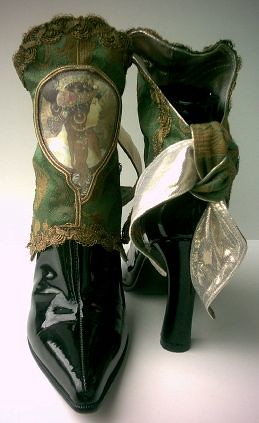
Bayern, Germany-based designerMaide has been creating her unique spats and gaiters for nearly a decade. “Nostalgia is one main theme of my work which I can not deny, obviously.” Inspired by Victorian and Edwardian textiles as well as the paintings of Mucha, Klimt, and Carl Larsson, her accessories integrate exquisite samples of early 20th century lace, trim, and appliqué. Each design is a meticulously handcrafted piece of wearable art. Brava, Maide!
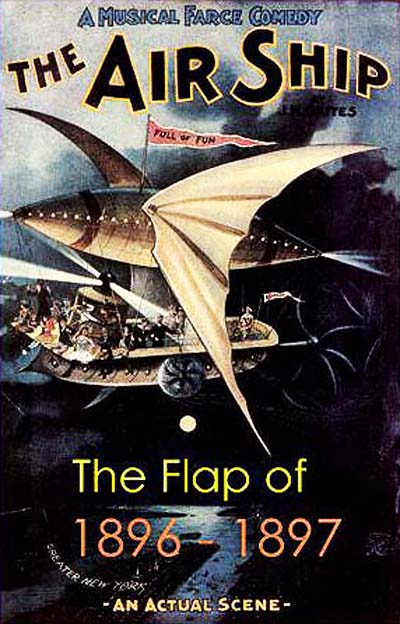
From late 1896 through early 1897, a full ten years before the flight of the first known powered dirigible, thousands of people across America claimed to see strange lights in the night sky, heard voices and music emanating from a mysterious airship. Some accounts described a cigar-shaped gasbag, others noted vast flapping canvas wings and large wheels like a paddle steamer’s. One early eye witness even insisted he’d glimpsed two men suspended in the ship’s undercarriage, furiously working bicycle pedals. From Sacramento to Chicago, folks from all walks of life strove to convince skeptical journalists that what they’d seen was not, in fact, an elaborate hoax.
The most carefully researched book written to date about the phenomenon is probably The Great Airship Mystery by Daniel Cohen. Cohen gives a well-rounded account of the circumstances and evidence before concluding –quite sensibly– that the airship probably never existed. (Bummer.)
Several other authors have offered up far more juicy theories. Michael Busby maintains in his own book Solving the 1879 Airship Mystery that a secret society of mad genius inventors joined forces to build a handful of highly advanced aircraft worthy of Jules Verne, each of which, after being viewed by countless drunken farmhands in the Midwest, inexplicably crashed and burned over the Atlantic ocean.
Noted ufologist/parapsychologist/journalist John Keel includes the sightings in the book UFOs: Operation Trojan Horse as compelling evidence for his long-standing hypothesis that certain “non-human or spiritual intelligence sources” have been staging elaborate events for centuries to manipulate and misinform the human pysche. (Other examples he cites include the fairy folklore of Middle Europe, vampire legends, black helicopter sightings, poltergeist phenomena and UFOs.)
Although the initial sightings in the US ended in 1897, several more sightings occurred in England, Europe and New Zealand from 1909 through 1913. In 1912, vaudeville superstars Elsie Baker and Billy Murray penned a little ditty about the airship fervor entitled “Mysterious Moon” and recorded it on wax cylinder.
A comprehensive list of newspaper clippings from 1897 newspapers can be found here. Wikipedia’s got a good entry on the subject as well.