Adagio is legendary animator Garri Bardin‘s 10-minute stop motion masterpiece in origami, set to Remo Giazotto’s Adagio in G minor. The events of this stark fable about ignorant intolerance among shadowy bird-creatures unfold [huhh huhh!] against a minimal backdrop in a variety of expert shots. The famous string score [used in the 1962 adaptation of Kafka‘s The Trial, and 1998 film Show Me Love just to name a couple] imparts a melancholy tension throughout.
The camera work is astounding, as is the vast range of expressions Bardin is able to assign these pieces of gray paper. He’s something of authority on bringing everyday objects to life, his famous earlier works being Conflict, where a war erupts among matches and Banquet, in which an entire dinner party plays out without people. Though most of Gari Bardin’s repertoire consists of embittered social commentary, Adagio stands apart in its sheer elegance. Enjoy, below.
Adagio is loosely based on one of my favorite short stories, Maxim Gorki’s legend of Danko and his burning heart. A part translation, part summary by E.J. Dillon, under the cut.
Part of what made me weird as a kid was the Hans Christian Andersen‘s Fairy Tales tome I kept bedside, right next to Roadside Picnic and The History of Metals [don’t ask]. My favorite was Rusalochka [The Little Mermaid] – a heartbreaking tale of impossible inter-species love between a human fish and a prince. Failure despite the best of efforts is the concept that makes The Little Mermaid the powerful, unforgettable piece that it is. While most children’s books pollute young brains with happy endings and ever afters, this is a love story made more beautiful by its futility.
Hans Christian Andersen’s Little Mermaid is a perfect tragedy – a concept mercilessly extinguished by the bubbly Disney animated film of the same name. Where is the star-crossed romance? Where are the spooky supernatural themes? Sure, here is Ursula the octo-witch, but the mysticism ends there. Instead of heartbreak and doom we get talking lobsters, horny priests and penis castles. Fortunately, there is also Rusalochka, the haunting 1968 Soyuzmultfilm animation. It follows Andersen’s story without too much sugar coating and puts melancholy back in its rightful place. The colors are muted, the characters are elegantly drawn and the music, composed by Aleksandr Lokshin, ranges between ethereal and somber. Watch all three parts below [with subtitles!].
When I first heard about Sita Sings the Blues, my initial reaction was one of near-disbelief. “No, wait, you’re telling me that someone made a feature-length animated version of the Ramayana focused on much-put-upon Sita and if that wasn’t enough, it’s filled with musical numbers set to Annette Hanshaw’s inimitable jazz vocals? With sarcastic shadow puppets?! You’re kidding, right?”
No, Nina Paley‘s Sita Sings the Blues is very, blessedly, real. My next reaction was that something this eclectic and experimental in concept was going to either crash and burn or succeed brilliantly.
The result? Well here’s a glimpse:
After attending a sold-out showing at the Asheville Film Festival a two weeks ago, I was blown away. It is, without a doubt, like nothing I have seen on screen. There are very few movies anymore where one can gleefully proclaim, mid-way through “Wow, I’ve got no fucking clue what’s going to happen next!”
Sita‘s magnificence is a testament to the tireless hard work and innovative vision of Paley, a longtime alternative cartoonist, who made the whole film on her home computer over five years. The ideas for the movie stem from a particularly harsh break-up (that story’s also told in the movie). Her struggle still isn’t over either: her creation still faces numerous hurdles, both from Hindu fundamentalists and corporate music juggernauts. This thankfully hasn’t stopped it from tearing up the festival circuit across several continents, getting much acclaim at big name fests like Berlin and Tribeca.
So how did something like this come about? Paley was kind enough to talk about the movie’s genesis, its challenges and why audiences these days are doing more than just buying tickets.
COILHOUSE: Why make a feature movie out of the Ramayana, of all things?
NINA PALEY: Well, I was moved by the story and it seemed to speak so much to my life at the time, my problems at the time. It was cathartic to retell the story.
The tagline you use in the movie is “the Greatest Breakup Story Ever Told” Which is a nod to the Bible movie, the Greatest Story Ever Told.
Yeah… in Russia we had none of that Sleepy, Sneezy, Dopey shit. Penned by Pushkin in 1833, the Russian version of the classic fairy tale, morbidly titled “The Tale of the DEAD PRINCESS and the Seven Knights,” had the princess living with seven “lusty” bogatyrs. I’m sure that many a girl who grew up with this fairy tale thought to herself, “yep, this is how life should be.”
Scanned for your viewing please are some illustrations from my childhood copy of this tale – a well-worn hand-me-down originally printed in 1970 and bought for 18 kopeks (that’s 10¢), with gorgeous illustrations done in 1954 by Tamara Ufa.
There are many similarities between the Russian version (full translation of the poem here) and version that most of us grew up with, including the poisoned apple and the glass coffin. One of the most interesting differences is there’s no kiss, a far cry from the one of the earliest versions of the tale, in which the princess is actually raped and abandoned by the prince, only to be awoken by newborn children. In the Russian version, the grief-stricken prince simply throws himself onto the coffin, and the shattering of the glass is what wakes the princess. Also, it’s interesting that the princess (or Tsarina, in Russian) doesn’t have a name. In fact, the only people in the story who have names are the Tsarina’s suitor, Prince Yelisei, and Smudge, the evil queen’s chambermaid.
There was also a 1951 cartoon by Ivan Ivanov-Vano, “patriarch of Soviet Animation”:
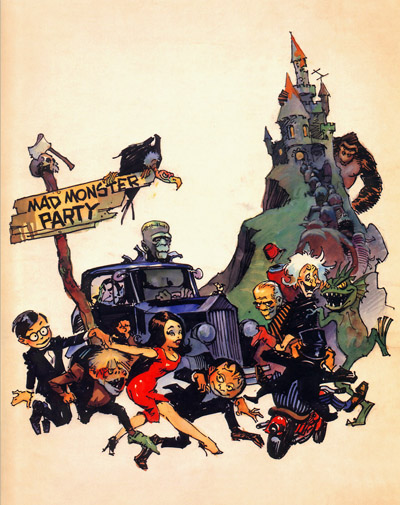
In the late 60s and eary 70s, the Rankin/Bass production company made a slew of endearingly hokey holiday-themed “Animagic” flicks that I’m just barely old enough to remember watching in early reruns. I couldn’t have been older than seven or eight when the popularity of such saccharine-injected TV specials as Rudolph the Red Nosed Reindeer and The Year Without A Santa Claus had begun to wane. While I’m too sentimental to harsh on any of that star-studded, sticky-sweet fare, only one of their films has really stuck with me all these years later. Tellingly, that movie is Rankin/Bass’s Halloween special, Mad Monster Party, and it’s all MAD Magazine‘s fault.
Classic Mad Monster Party illustration by Frank Frazetta.
Let’s talk for one sec about MAD. Who here read it growing up? Who still does? If you did/do, I bet it’s high on the What Made You Weird list. Founded in 1952 by editor Harvey Kurtzman and publisher William Gaines, this last gasp of the EC Comics line remained one of the most consistently clever, intelligent, and merciless satirical publications in print until at least the late 90s.* Nothing was sacred and no one was safe. Founded at a time when aggressive censorship and Cold War paranoia muted the voices of activists and humorists alike, the broadly grinning face of MAD’s mascot, Alfred E. Neuman, was a cheerfully innocuous “fuck you” to authority, and has remained so for generations. Honestly, I could rant and rave about the importance of MAD for hours, but it’s Halloweenie time, so I’ll shaddup for now, at least.
So! Mad Monster Party. Kurtzman and longtime MAD cartoonist Jack Davis were very hands on in writing and conceptualizing this island of classic horror movie monsters, and it shows. Appropriately, Boris Karloff loaned his voice to the character Baron Frankenstein (his final role). Phyllis Diller basically plays herself in it, which is even creepier than it sounds. One guy I know has claimed that the redheaded, husky-voiced fembot lab assistant, Francesca, gave him his first boner. Obviously, MMP influenced the hell out of Tim Burton. Studded with Forrest J. Ackerman-worthy puns and ridiculous musical numbers –including the song “Do the Mummy” performed by a skeletal Beatlesesque quartet called Little Tibia and the Fibias– MMP is campy, witty, and surprisingly risque for children’s fare… I’m pretty sure this is the only kiddie film that’s ever ended with a mushroom cloud!
Whether you’re revisiting it for the umpteenth time or watching it for the first, I hope you’ll enjoy Mad Monster Party with me on this most darque and spookylicious eve of Goth Christmas.
*I haven’t read the magazine since the late 90s, so I couldn’t honestly say if the rag’s still in top form. A lot of folks have said Mad’s gone downhill since becoming dependent on ad-revenue in 2001. The publication had been ad-free for decades until that time (beginning with issue #33 in April of 1957). It was, by a long shot, the most successful American magazine that ever published ad-free, and of course, by staying independent of ad revenue, Mad was free to tear American culture’s less savory, more materialistic aspects endless new arseholes without ever having to answer to financiers.
Hooray, Halloween is almost heeeere. What better way to greet the final stretch than to wake and stretch with this bonafide monster mash, courtesy of the great master of make believe, stop-motion model animator, Ray Harryhausen? (Added bonus: Tito Puente!)
More rousting clips of Harryhausen’s creations under the cut.
Ganked from the excellent Nightchillers site, thanks.
If you’ve never seen this campy Corman-produced adaptation of Lovecraft’s famous tale, you might want to Netflix it in time for your pumpkin-carving party.* Produced and shot in 1969 in the immediate wake of Manson Family shenanigans, it’s often pooh-poohed by Lovecraft purists for being too cornball. But in my opinion, Dunwich Horror is actually one of the better adaptations of old Howard P’s oeuvre** with its sumptuous matte paintings, capable-if-hokey performances from the cast, a beautiful score by Les Baxter, and a couple of genuinely creepy moments. Lovecraft stories lend themselves really well to the pyschedelic era.
Yes, he really did just say “horrendipity.”
Starring Dean “Uh Oh, Sam” Stockwell in his most brooding role short of Yueh in Dune, a rather weary-faced-but-supposedly-virginal Sandra Dee, and the even wearier-faced Ed Begley (his final role, R.I.P.), Dunwich Horror is worth renting for the gorgeous animated title sequence alone. Other highlights: the sight of young, yog-sothothelytizing Stockwell’s torso covered in pseudo-runic sharpie scribbles, Sam Jaffe’s “GET OFF MY LAWN” geezerdom, and Gidget clenching her butt in the throes of orgasm on the altar at Devil’s Hopyard.
*Or if you’re really cheap, you can watch the whole thing on YouTube.
**Not that that’s saying much, really. Other than ReAnimator, what’ve we got that’s not just crotch-punchingly horrid? Hmmm, let’s see… actually, I wouldn’t turn my nose up at any of these: The Resurrected, Die Monster Die, The Unnameable, that Night Gallery episode Pickman’s Model, and the amazingCall of Cthulhuindie movie that came out recently. Can you guys think of any others? A great suggestion from commenter Jack: Carpenter’s In the Mouth of Madness.
Another Soviet cartoon awaits below! A favorite in my childhood household, Very Blue Beard was released in 1979 and tells an alternate tale of the famed wife-killer and three of his objets d’amour. This particular version places all the blame directly on the wives and identifies the beard as symbol of male essence, constantly oppressed by scissor-happy women. Nonetheless, the Modigliani-meets-Peter Chung look of the figures and the background treatment are worth a peek. No subtitles, so I’ll summarize below each of the two parts.
Part 1
A modern day detective sets out to learn the truth about Blue Beard upon finding a piece of blue hair. He calls his wife to tell her of this discovery, only to be nagged half to death about the possibility of coming home late. The investigation must continue! Soon Bluebeard is found alive and well, just beyond the borders of alternate reality. [In Soviet Russia, alternate reality can be entered through the subway, by the way.] He admits his guilt but requests the detective’s ear for a chance to explain his reasons.
Blue Beard’s first wife is Marianna, an ultra-modern English fashionista who isn’t interested in Blue’s old-fashioned ways. She redecorates his palace to her own liking, then drives him mad with her weaves and pet dragon. As the rage wells up inside Blue Beard, his beard grows back, signaling that he’s had enough of this free-willed lady!
MTV was once amazing! Not to go there or anything, but what I miss most are the cartoons. Aeon Flux, The Maxx, Liquid Television (Nietzsche Pops!), and yes, even Beavis and Butthead had its moments (like when they watch the music video for Bull in the Heather and think that Kathleen Hanna is a 5-year-old who can’t dance). But the show that came back to haunt me this year? Daria. Smart as a whip and cynical as a roomful of reporters, Daria “misery chick” Morgendorfer was my age when the show first aired, and quickly became my hero. Recently, I decided to revisit the show now that 10 years have passed, and happily found that it’s as funny and true now as it was back then.
This time around, my favorite characters aren’t Daria and her artsy sidekick Jane, but the adults. Hands-down, my favorite character is Mr. DeMartino, the Chrisopher Walken-inspired history teacher with some anger-management issues and a serious gambling problem. A classic example of DeMartino’s temperament can be seen in early on in Fizz Ed, an episode in which the school runs out of budget and seeks sponsorship from a cola company. Then there’s Helen – Daria’s workaholic lawyer mom, whose parenting techniques backfire terribly but hit the mark when it matters.
Until the music liscencing issues get worked out, the show survives only in bootlegs. In the meantime, the legend lives on; if the obsessiveness/slash quotient of the fan art is any measure of a work’s impact, then Daria rivals Harry Potter. Actually, the show itself presented a myriad of character alter egos at the end of every episode during the credits. Every week, familiar denizens of the Daria-verse transformed into R. Crumb characters, historical figures, athletes, dinosaurs and canned vegetables. Amidst her turns as Mother Goose and Bella Abzug, Daria was sometimes shown in a more realistic context: a journalist, an author, a talk show host. Watching the credits roll, I always wondered: what will happen to Daria when she leaves high school? Is life really better after that? What will she be? What will I be? Now, I kinda know.
There Will Come Soft Rains is a Soviet era animation made by Uzbekfilm and based on the 1951 Ray Bradbury story of post-apocalyptic desolation.A fully-automated household is shown going through the motions of a daily routine in the year 2026. Service robots, with “faces” vaguely reminiscent of gas masks [or Storm Trooper helmets], prepare breakfast and declare wake up time as usual to the ashen remains of their masters.
One of those visceral experiences that has stayed with me until today, this beautiful vignette portrays the aftermath of senseless atomic destruction and human impermanence almost as well as the story it’s based on. Though the loneliness of the Ray Bradbury piece doesn’t quite come across as acutely, this animation never, ever failed to make me cry and substantially furthered that childhood Bradbury addiction. Edit: if by some chance you haven’t already, might we recommend reading the original story prior to watching the animation? You can do so by clicking here.