In a devastating turn of events Lady Jaye Breyer P-Orridge has died due to a “previously undiagnosed heart condition.” She died in the arms of her other half, legendary industrial music pioneer Genesis Breyer P-Orridge.
The sad news was broken yesterday but we didn’t find out until today and I’m honestly heartbroken. Thanks to my once-spooky brother I grew up with Psychic TV and later, of my own accord, Throbbing Gristle, so Genesis’ dealings have always been on my brain’s periphery. My interest was especially re-kindled in 2003 when he and his partner of over 10 years, Lady Jaye, embarked on their radical body modification mission known as Breaking Sex or the Breyer P-Orridge Project. I saw them perform here in Hollywood just a couple of short years ago and witnessed their physical progress first-hand. Redefining gender and becoming of the same & superior sex, a physical representation of their psychological bond as well as a potential new step in human evolution.
Few grander testaments of love have been made, in my humble opinion, ever.
We extend our sympathy and condolences to Genesis and offer you a few links to information about Breaking Sex.
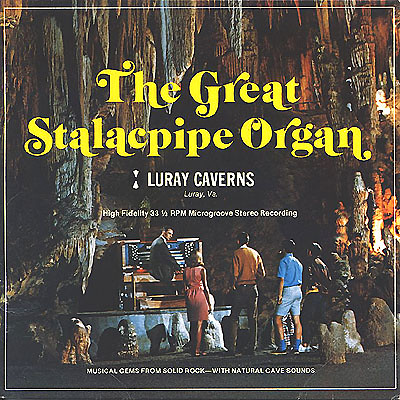
Hats off to Mr. Leland Sprinkle, inventor of the world’s largest musical instrument, the one-of-a-kind Stalacpipe Organ. Located deep in the bowels of Luray Caverns in Virginia’s Shenandoah Valley, its 3 1/2 acres of cavern stalactites produce resonant tones when electronically tapped by rubber-tipped mallets rigged to a large organ console in a centralized chamber.
Sprinkle, a mathematician and electronics whiz employed at the Pentagon, began his colossal project in 1954. For three years, he prowled the caverns with lamp and mallet, tapping thousands of stalactites in search of formations that would precisely match each of the 37 tones needed for a musical scale tuned to concert pitch. After this was accomplished, two master carpenters, Loyd Almarode and Richard Beaver, were brought in to build the beautiful inner and outer consoles of the organ itself.
I first heard the haunting, unpredictable music of Luray Caverns several years ago on a mix tape and had no idea what was producing it. Later on, the wonderful radio station WFMUdevoted a segment to the invention. Everyone I know who has experienced the Stalacpipe Organ in person says no recording –not even one using the most fancypants binaural mic in the world– could ever compare to the live experience. I gotta get out there someday SOON. Road trip, anyone?
Having been a bit overwhelmed lately by blanched, washed out, sepia-tinted, Dover-collagey everything, surreal footage that looks like animated Lomo imagery is delightful change of pace. Plus? Ponies!
“Honor to the Futurists who forbade the painting of female hams, the painting of portraits and guitars in the moonlight. They made a huge step forward: they abandoned meat and glorified the machine.”
– Kasimir Malevich, 1918
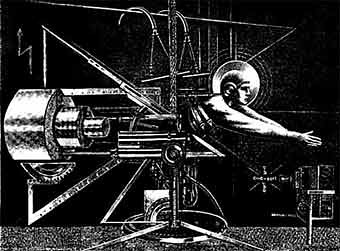
Image by Russian industrial musician Alexander Lebedev-Frontov.
In 1921, Russian physicist Lev Theremin, an inventor who insisted on building all his creations by hand, constructed the theremin, one of the 20 th century’s first successful electronic musical instruments and still the only music instrument whose haunting tones are elicited without touching the device. Unlike Theremin, neither famous theremin-users John Cage, Download, Brian Eno, Meat Beat Manifesto or Edgar Varese were ever arrested for its use. After a decade of teaching and performing, Theremin was suddenly seized and imprisoned in 1938 by the KGB on the grounds of “anti-Soviet Propaganda.” Theremin was sent to Siberia and later to a labor camp in Omsk, where, alongside other indentured scientists, he was forced to work on various military projects (Theremin was later given the Stalin Prize for perfecting the eavesdropping device known as “the bug”). Thus begins the history of industrial music in Russia…
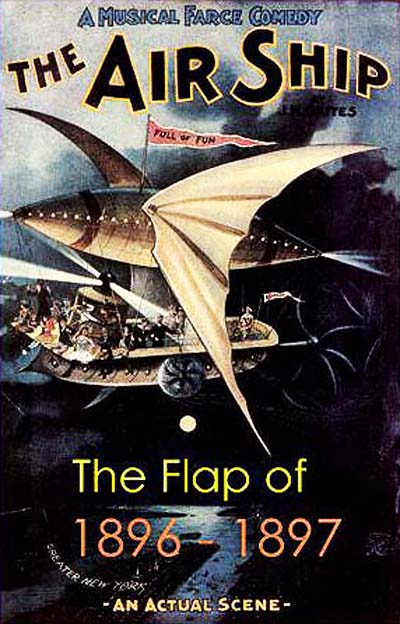
From late 1896 through early 1897, a full ten years before the flight of the first known powered dirigible, thousands of people across America claimed to see strange lights in the night sky, heard voices and music emanating from a mysterious airship. Some accounts described a cigar-shaped gasbag, others noted vast flapping canvas wings and large wheels like a paddle steamer’s. One early eye witness even insisted he’d glimpsed two men suspended in the ship’s undercarriage, furiously working bicycle pedals. From Sacramento to Chicago, folks from all walks of life strove to convince skeptical journalists that what they’d seen was not, in fact, an elaborate hoax.
The most carefully researched book written to date about the phenomenon is probably The Great Airship Mystery by Daniel Cohen. Cohen gives a well-rounded account of the circumstances and evidence before concluding –quite sensibly– that the airship probably never existed. (Bummer.)
Several other authors have offered up far more juicy theories. Michael Busby maintains in his own book Solving the 1879 Airship Mystery that a secret society of mad genius inventors joined forces to build a handful of highly advanced aircraft worthy of Jules Verne, each of which, after being viewed by countless drunken farmhands in the Midwest, inexplicably crashed and burned over the Atlantic ocean.
Noted ufologist/parapsychologist/journalist John Keel includes the sightings in the book UFOs: Operation Trojan Horse as compelling evidence for his long-standing hypothesis that certain “non-human or spiritual intelligence sources” have been staging elaborate events for centuries to manipulate and misinform the human pysche. (Other examples he cites include the fairy folklore of Middle Europe, vampire legends, black helicopter sightings, poltergeist phenomena and UFOs.)
Although the initial sightings in the US ended in 1897, several more sightings occurred in England, Europe and New Zealand from 1909 through 1913. In 1912, vaudeville superstars Elsie Baker and Billy Murray penned a little ditty about the airship fervor entitled “Mysterious Moon” and recorded it on wax cylinder.
A comprehensive list of newspaper clippings from 1897 newspapers can be found here. Wikipedia’s got a good entry on the subject as well.