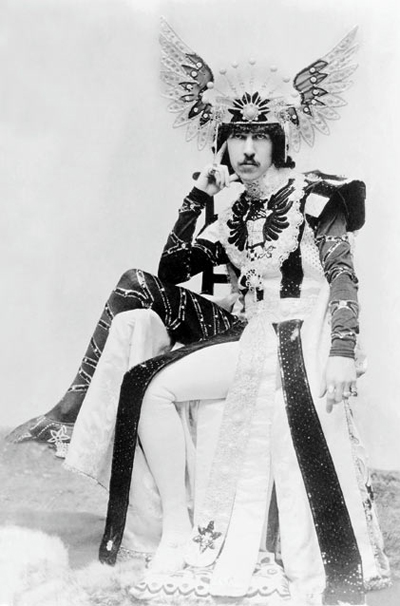
A sort of apparition – a tall, elegant and bejeweled creature, with wavering elegant gestures, reminding one rather of an Aubrey Beardsley illustration come to life – Clough Williams-Ellis about Henry Cyril Paget, 5th Marquis of Anglesey
The subject of the “Coilhouse patron saints” comes up in conversation quite often, and Henry Paget deserves a high rank on that list, perhaps between Genesis P-Orridge and Marchesa Luisa Casati. He was the most outrageous of the English aristocrats, often seen gallivanting around London bedecked in jewels and silk, with a poodle under his arm or driving a custom car spraying perfume from the exhaust pipes.
This was a boy raised entirely by women, first in a theater environment in Paris and later in the seclusion of a Gothic mansion in north Wales with little peer contact and sudden access to a seemingly endless supply of money. To call the grown up Henry Paget an eccentric would be a grave understatement, and his upbringing was blamed for his behavior and suspected homosexuality. The charismatic young man transformed himself into a work of art with each waking breath. Obsessed with being photographed, he spared no expense for his costumes, meticulously preparing his poses and taking on new personas for each shot. He even employed a team of dressers to help with frequent costume changes.
Briefly married to his cousin, he showered her with jewels, as well. He “liked to view his emeralds, his rubies, his diamonds displayed on her naked body. But he didn’t lay a finger on her. There was no sex… The marriage was annulled on the grounds of non-consummation.” says the Daily Mail. The Marquess may have shunned romantic involvement entirely, but surrounded himself with other beauty despite the raised eyebrow of aristocracy. His expenses included a number of modified cars, canes, “jewels, furs, boats, perfumes and potions, toys, medicines, dogs, horses and theatricals on a scale unimagined”.
But DAF do. Let this German electropunk duo’s clicky beeps entrance into a world [or at the very least a basement] of mechanized taxidermy, dusty porcelain, cracked papier-mâché and moth-bitten lace. Here, sterile minimalism and granny frills co-exist in harmony, somehow.
George Harrison’s “Set on You” got nothing on this billow-shirted, leather-trousered alchemy of pop. Perhaps he was somehow inspired by it?
It’s been an eventful day, hasn’t it? If you’re like me, you have trouble winding down after so much hullabaloo.
So here’s a wistful lullaby to sing you to sleep, courtesy of the brilliant innovators behind Creating Rem Lazar. You’ll be calling Child Protective Services drifting off to slumberland in no time. May you dream sweetly of infinity mullets and oddly bulging blue spandex.
I’m more than halfway through The Bad Popes by Eric Russell Chamberlin. Oh, it’s a knee-slapper, to say the least. Plenty of illicit sex, violence, greed, avarice, conspiracy, etc. Chamberlin denudes the nasty personal habits and dirty professional deeds of various popes throughout history. Short of The Name of the Rose and Memoirs of A Gnostic Dwarf*, it’s the most earthy and entertaining book I’ve read relating to the papacy.
Ever heard of The Cadaver Synod? Pope Stephen VI, consecrated in 896, ordered the rotting corpse of his predecessor, Pope Formosus, be exhumed and put on trial for various crimes against the church. Poor bastard was nine-months dead when they dug him up. Stephen dressed the ripe stiff in papal robes, propped it up in a chair, and proceeded to scream unintelligibly at it for several hours in front of a rapt audience. Afterwards, Formosus was declared guilty and his body was dragged through the streets of Rome, then thrown into the river Tiber. Not suprisingly, the morbid spectacle turned public opinion against Stephen. Rumors spread that the dead pontiff had washed up on the banks of the Tiber and was performing miracles. Stephen VI was eventually deposed and strangled to death in prison.
Left: Early tarot card depiction of Pope Joan. Right: La Papesse as Antichrist, wearing a jaunty tiara.
Chamberlin also addresses the origins of good old “Pope Joan“, that legendary, likely imaginary Papesse who supposedly reigned from 855 to 858 (Protestants used to loooove bringing her up as proof of their moral superiority to Catholics). As the story goes, she was an Englishwoman who fell in love with a Benedictine monk, disguised herself as a dude and joined his order. Eventually she moved to Rome where she impressed everyone with her vast knowledge, becoming a cardinal, and then pope. (In earlier, juicy versions of this fable, Joan was already knocked up at the time of her election, and actually squeezed one out during the procession to the Lateran!) Chamberlin hypothesizes that these tall tales stem from accounts of The Rule of Harlots: a period of the papacy where various popes were either the progeny of dastardly, influential aristocratic women, or boinking them. In doing so, he has introduced me to my favorite new word… Pornocracy.
Chamberlin eschews a bland professorial style in favor of fairly plainspoken writing, and his dry sense of humor about the subject matter reminds me of Alice K. Turner’s approach to The History of Hell, yet another well-researched, highly entertaining read that deals with some of the sillier and more political aspects of Christian dogma. Highly recommended.
*Incidentally, Memoirs of a Gnostic Dwarf gets my vote for Most Jaw-Droppingly Disgusting Opening Paragraph Ever Written. Even better than the ejaculatory beginning of The Dirt. Must read.
Hey, remember when Disney didn’t suck and blow simultaneously?
Deep down, most of us suspect that ol’ Uncle Walt was a sexist, racist, feeb-informing Machiavellian rat king. (Still, who doesn’t love Pinocchio?) And while there’s no doubt Disney’s recent corporate merge with Pixar and subsequent shakedown (leaving prodigies Lasseter, Catmull and Jobs steering the ship) will bring back much of the first company’s long lost artistry, the question bears repeating: have the past 20 years of Disney output blown epilepticpygmy goats,or what? Wtf happened?*
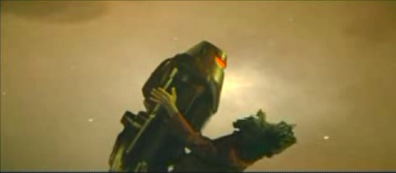
Never mind. Let’s focus on the semi-positive and take a look Disney’s chaotic neutral, pre-sucky years. I know I’m not the only one with fond recollections of the many offbeat live action flicks Disney produced in the late 70s and early 80s. Uncle Walt was in cryogenic deep freeze and the company’s heyday was fading, but gems like TRON, Something Wicked This Way Comes, and most poignantly their ridonkulous sci-fi space epic, The Black Hole all have a special place in this gal’s personal What Made Me Weird lexicon.
Yvette Mimieux gets some much-needed laser surgery.
Produced on the heels of Star Wars’ popularity, The Black Hole is one of Disney’s last gasps of cornball genius. Sure, it’s got problems. No originality, for starters. As one reviewer put it “[this is] nothing but a ‘creepy old house’ movie set in space.” Also, the screenwriters seem to have been unsure what demographic they were writing for, resulting in a plot that insults adult viewers’ intellects while still managing to scare the ever-loving crap out of children (and making The Black Hole the first PG-rated film in Disney history). Hokey dialog and unfortunate wardrobe choices abound. But if I’ve said it once, I’ve said it a hundred times; you can’t go wrong with Ernest Borgnine. If that’s not enough to entice you, there’s John Barry’s amazing score, the incredible scale models and sets, scene after scene featuring beautiful, richly colored matte paintings of deep space, and Anthony Perkins getting the Cuisinart treatment.
Best for last, the Maximilian <3 Reinhardt 4-Ebber (In Hell) ending:
I’m making a post on Christmas day, which if nothing else should indicate the degree of reverence I have for the holiday season.
Christmas, and the train-wreck of bad taste that ensues, is not entirely without its benefits, particularly the unquestionably awful effect it has on rock music. Artists struggling to maintain their hair-flicking, could-give-a-fuck bad-assery through a three-and-a-half minute ditty about magic always makes for priceless entertainment. So without further ado….To the YouTube!
Today we are going to play a game! It’s called “Gothic Outfit or Halloween Costume?” There are eight gothic ensembles in this post; some of them are actual outfits designed by alternative clothing labels to be worn out and about in the scene, others are Halloween costumes intended for adults who want to play-pretend to be goths one day out of the year. Can you guess which is which? Test yourself after the jump!
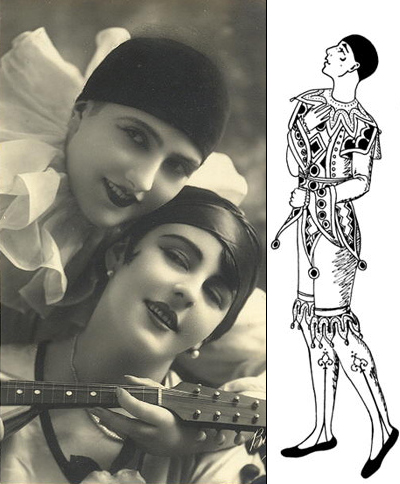
Pierrot was my first crush, and I mean the very first one, the one before real life boys, girls, etc. It all began with a life size doll [the size of a 6 year old anyhow] of a crying jester. More of a fusion of Pierrot and Harlequin, he had long noodly limbs, painted fingernails and a white made up moon-face with permanent blue teardrops slightly raised on the plastic surface. I assigned him a variety of appropriately tragic personalities in accordance with whatever game I was playing that day.
The name “Pierrot” didn’t hold any meaning until I read Buratino – Tolstoy’s version of Pinnochio. He was Buratino’s dismal friend, eternally pining for Malvina the blue-haired doll. I was smitten by his dapper costume in the 1975 film version of the book. The magnificent ruff and floor-length sleeves on the squeaky pallid boy left a permanent impression.
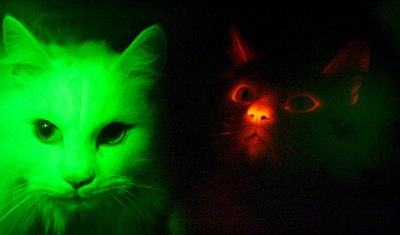
Korean scientists reached a new milestone by cloning several Turkish Angora cats that glow under UV light. Intended for genetic research, these felines had fluorescent genes added to their donor’s cells during the cloning process. Provided this doesn’t somehow result in a black market for glowcat fur stoles, it’s pretty great for both research and glow-stuff enthusiasts worldwide.
“They can say that I couldn’t sing, but they can never say that I didn’t sing!” – One of Florence Foster Jenkins’ releases
Ah, the glory days before computer software, when only the very talented, or wealthy eccentrics such as Florence Foster Jenkins could have access to recording facilities.
At sixty years of age, and a lifetime of fantasizing about becoming a singer, Miss Jenkins struck gold when her mother croaked and left her a free woman with a small fortune. In 1930 she set about making her mark in history, albeit inadvertently, as one of the worst recording artists in history.
She was almost an instant comedy sensation. Sporting a sensationally flamboyant wardrobe of her own design and accompanied by a hapless pianist who hilariously compensated for her tone-deaf-ness, her live performances were so coveted that scalpers would sometimes fetch ten times the price for a ticket. For what she absolutely lacked in pitch, rhythm, tone, or what is otherwise known in this dimension as ‘singing talent’, she made up for in stubborn confidence, insisting until the very end that she was a master. That end came a month after a sell-out show at Carnegie Hall in 1944, topping off a paradoxical career.
Behold, the genius of Florence Foster Jenkins in the form of Wolfgang Amadeus Mozart’s ‘Queen of the Night’ aria from The Magic Flute:
Florence Foster Jenkins, beyond being the subject of popular ridicule, actually leaves us with a unique legacy. She set out to do the very difficult, with very little ability, very late in life and wouldn’t take ‘no’ for an answer. There’s also a nod to be given to the concept of contentment, a state of zen rejected by most true artists, regardless of their achievements. Her bewildering success lies as much in primitive hilarity as it does her balls to look inevitable failure in the face and say ‘I don’t give a fuck, I’m having this’.