Florence and the Machine: “Dog Days Are Over”

First of all, just a quick announcement to say, we know we promised to post our 2010 Media Kit and some exciting news about Issue 05 here on the blog today, but, quelle surprise, it’s taking us a little bit longer than anticipated to tabulate the results of last week’s survey. Please do check back tomorrow for the stats and our big Issue 05 announcement. Also, warm, wet, sloppy thanks to everyone who took the time to fill out the survey. You’re wonderful. It’s been an honor to learn a little more about you. Especially your underwear habits. No, seriously. *filthy chortle*

And now back to our regularly scheduled programming. Damn, is Florence Welch one seriously glorious culture vulture in this video, or what?


Directed by Georgie Greville and Geremy Jasper. Edited by Paul Snyder.

From the production team’s official press statement: “Florence is the shamanic leader of a surreal orchestra where spiritual elation explodes into smokey psychedelic anarchy. Each musical element of the song is personified by a group of colorful characters that combine 60’s girl groups, Hinduism, gospel choirs, drum circles, paganism and pyrotechnics. Florence is a painted primal force of nature that whips a religious experience into a riot.” Yep. And those blue and gold Andorian Motown beehive girls definitely take it to the next level.

Major media outlets in the United Kingdom have been agressively touting Florence and the Machine‘s output for a couple of years now. More recently, Welch began capturing hearts around the world by touring internationally. Pairing her enormous voice with a rather intimidating bevy of musicians and couture wardrobe stylists, the art school dropout also exudes an earthy intelligence that’s both endearing and disarming. Currently, Welch et al are working on a second full-length album that she says is a lot heavier than their first record, Lungs.  “A bit more fuzzy, a bit harder. If the first album was animal and anatomical, I think this one is chemical and elemental.” She’s also touring the UK next month.

Just for contextual kicks, here are some more tidbits that the cultural grab bag style of “Dog Days” is either vaguely (or directly) reminiscent of:

The Friday Afternoon Movie: The Filth And The Fury

Today, in remembrance of the late Malcolm McClaren, who died this week at the age of 64, the FAM presents 2000’s, The Filth and the Fury. Directed by Julien Temple it is considered a response to Temple’s earlier film, The Great Rock ‘n’ Roll Swindle, filmed in 1978 and released in 1980. Swindle tells a fictionalized version of the rise and fall of the seminal punk band the Sex Pistols from the point of view of McClaren, who presents himself as an all powerful puppet master, using the band for his own ends. Filming began before the bands disintegration making the final product a disjointed — albeit entertaining — mess, with lead singer John Lydon and original bassist Glen Matlock only appearing in archive footage.

I’ll apologize then to those who have not seen it, as I could not find the film in its entirety to embed here. Instead, we have the film above which, as previously mentioned, represents a rebuttal to that 1980 release, specifically the band’s response. It’s a fascinating story but it also highlights the friction between the two parties, especially between McClaren and Lydon the two men at war over who harbored the creative spark that was responsible for this piece of music history.

The truth, no doubt, lies somewhere in the middle, and regardless of McClaren’s other achievements in fashion, film, and music, the Sex Pistols define his career in the minds of many. Whether he was a genius or a scoundrel depends on who you’re willing to believe.

Somarta: Machine-Made Fineries

We’ve been going through the Coilhouse Readership Survey responses. They’ve made us laugh, think, and feel incredibly grateful. We’ll be tabulating the results over the weekend, and posting our findings (and maybe even a few choice quotes) early next week.

Some of you made requests in the comments, ranging from “can we have a mailing list to notify us when a new issue has been released?” to “more porn.” Just so you know, we’re all reading every single comment. This particular post is dedicated to the lone responder who requested more fashion. It’s true, with a handful of blogs now doing an incredible job of covering dark/bizarre/futuristic fashion and indie designers (Twisted Lamb, Haute Macabre, Dirty Flaws being my Top 3 faves), we’ve eased up on the fashion coverage here quite a bit. Your comment made me realize that I miss uncovering new designers, so I present you with Japanese label Somarta, the brainchild of designer Tamae Hirokawa. Hirokawa is known for her use of machine-made lace, a common thread through many Somarta collections. “Making full use of advanced Japanese textile technology,” wrote the Japan Times of a recent collection, “Somarta presented designs of which some were made with the aid of specially created knitwear computer programs and devices. Squinting past the blinding crystals, it was possible to pick out exquisite ’20s-inspired black- and nude-lace dresses.”

Some of Somarta’s designs, such as the ones above, can be found in Somarta’s online shop or another store called nuan+. If you have Japanese friends who could help you out with site navigation/shipping, Somarta’s tights can be yours for about $179, and the top for about $200. Pricey, but beautiful. The look for less would definitely be these cute $12.50 “Aristocrat Lolita” tights on Ebay. More favorite images from Somarta, after the jump!

Please Take Our Coilhouse Readership Survey!


Photo by Gustavo Lopez Manas. Design by Courtney Riot

Much is afoot in da’ Haus. Next Monday, we’ll be putting out a call for ads for our upcoming Issue 05 as part of our Small Business Advertising Program. On that day, we’ll unveil our brand-new, 2010 Media Kit (the cover of which you can see above).

Meanwhile, have you got a few minutes to spare? To complete the media kit, we’d like to ask you, valued Coilhouse reader, a few questions about your stance as a consumer and your spending habits in a  35-question survey. It’s secure and anonymous, and all of the questions are optional. We hope you’ll help us, as well as the many indie businesses that support us, by answering the survey as truthfully and completely as you can. [Update: the survey is now closed. Thank you to all who participated!]

Monday’s post will also include some very exciting news about Issue 05. Stay tuned.

Nouadhibou Bay Through Jan Smith’s Lens

“Nouadhibou means ‘where the jackals get fat.’ It is also where ships go to die.” – Jan Smith

In 2008 photographer Jan Smith went to document the abandoned hulls of ships at Mauritania’s Nouadhibou Bay, the world’s largest ship graveyard. He would be turned away at the border, sleep in a minefield, and be accused of being a spy before he finally convinced them that his purposes were purely artistic. The government of Mauritania is, apparently, not too keen on allowing visitors in to see the collection of over 300 ships; the legacy of decades of corruption during which harbor officials were bribed into letting people simply abandon vessels, thereby allowing the owners to avoid the fees usually associated with discarding a ship.

Smith’s photos are hauntingly beautiful, stark black and white images that appear to be from another world entirely. Well worth sleeping in a minefield.

via Good Magazine

Rikki Simons Gurgles Slurs in The Bloaty Incident

Any Invader Zim fans here? If you fell into reluctant love with the tiny, spiteful Irken invader and his robotic companion Gir, you might have been keeping up with the recent blog posts of show creator Jhonen Vasquez. Over the past few weeks, Vasquez has been sharing daily bits of behind-the-scenes Invader Zim trivia, complete with grotesque digital illustrations, unforgivably long rants, and anecdotes that will probably get him killed very soon. Evidently, this stuff has been building up inside Jhonen and eating through his soul like some kind of psychic bile, until it exploded into a month-long pontification of, well, DOOM.

Above, Gir and Zim by Jhonen Vasquez, from Invader Zim Fact #25 – just one of the numerous drawings that accompany Invader Zim Facts. With his zip-up dog costume, built-in jets, and an unmistakable squeaky voice, adorable Gir gained a fan base as rabid and vast as Zim ‘s. However, Rikki Simonscomic book creatorcolorist on the show, and the man behind the squeaking, paid dearly for his involvement with Zim. Sometimes our work consumes us, and Rikki serves as an all-too-real reminder of what happens when we push ourselves too far. In a spectacular display of callous indifference to his once-colleague, Jhonen showcased a jarring, never-before-seen video interview with Simons in “Invader Zim Fact #31“. From the post:

A bit of info on the video:  It’s apparently a fragment from a documentary about voice actors by “Ani-Mazing” Magazine, one of the many publications I’ve never had the pleasure of taking with me to the bathroom.  The thing never got completed, and Rikki was actually the last person the filmmakers interviewed.  That’s just what the guy told me who gave me this thing.  If you ask me, AniMAZING Magazine should have stuck with magazines because the interview sucks as far as interviews go, and the sound and camera work is just awful.  The title of this last post comes from something the interview touches on, that Rikki, besides playing the lovable GIR, also played the lovable Bloaty the Pig.

Watch below, and be sure to stick around until the very end.

Cardiacs: “Tarred and Feathered”

Who here likes pronk* music? Who here even knows what pronk means? I didn’t, until Cardiacs blew my feeble mind.

Pronk = progressive + punk. Formed in 1977, the UK-based band (led by gibbering genius Tim Smith) is one of those “what the holy fucking shitballs is going on here” bands that 99.3% of humanity will have no idea what to do with, and the remaining .7% will want to kiss with tongue and worship and marry and make little psychedelic math rock babies with forever and ever, amen.


*To be fair, Smith dislikes his music being pigeonholed as Pronk, preferring a label of “Psychedelic” or “Pop”. Forgive me, good sir, Pronk’s just so fun to say! Pronkity, pronk, pronk, pronk.

Click on one of those grimacing visages above to watch the official “Tarred and Feathered” music video… if you dare. Read more about Cardiacs here.

Eugenio Recuenco’s String Diaspora

Issue 01 contributor Eugenio Recuenco recently updated his portfolio with a striking series of 12 images that span very different eras and cultures, all of which are united by one main character: the violin. The larger images can be seen on Recuenco’s site, and the full series can be seen here, after the cut.

In this series, the violin travels from the plains of Africa to an Indian bazaar, from an Elizabethan parlor to a pirate ship, from the hands of a white-clad nun to the laps of two conjoined Geisha twins. While it’s certainly a tribute to the universality of music, many of the images also seem to contain messages about culture, gender and inequality. In the image of Africa, the violins are represented as crops barely growing out of the parched soil. In the image depicting the Islamic world, one burqa-clad woman wearing black gloves points her violin bow accusingly at her fellow player, whose bare hands are exposed – a reference to the modesty police found in many countries in the Middle East, including Israel.  The American image seems to represent a two-party system orchestrating a rigid conformity. Interestingly, many of the images feature a visibly artificial background. In the Eskimo image, the sky is merely a cheap-looking painted sheet. The wallpaper in the Elizabethan image is stitched out of old rags. In fact, the images that appear to look the most “real” are the ones rooted in fantasy, such like the pirate, modern primitive, and fiddler on the factory roof.

The Black Keys – Tighten Up

Just a funky dinosaur puppet dance party on a lackadaisical Saturday afternoon. Frank’s got the moves:


Via Dr. Hypercube.

The Black Key’s new album, Brothers, drops May 18th.

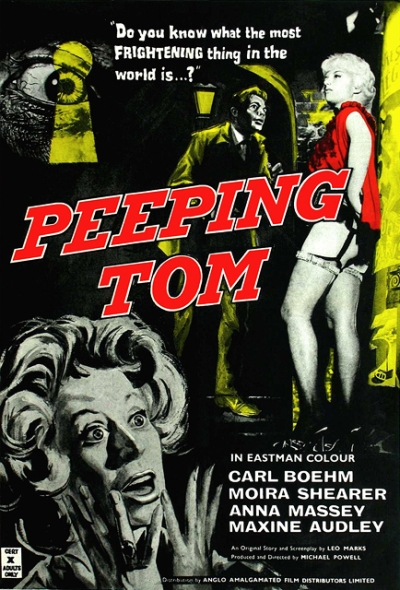
The Friday Afternoon Movie: Peeping Tom

(Update: The original playlist is gone, but you can still watch the whole thing here, courtesy of Lionsgate.)

It’s Good Friday today, the celebration of that penultimate event that preceded the most important of Christian miracles. In the spirit of this solemn occasion the Friday Afternoon Movie presents the story of a serial killer who impales his victims with a spike mounted to his video camera’s tripod. Happy Easter!

Released to intense controversy, Michael Powell’s brilliant Peeping Tom from 1960 is a film whose reputation has undergone a renaissance in the ensuing decades, starting in the 1970s. Martin Scorsese, in the book Scorsese on Scorsese, paired it with Fellini’s as a complete education in directing, saying:

I have always felt that Peeping Tom and 8½ say everything that can be said about film-making, about the process of dealing with film, the objectivity and subjectivity of it and the confusion between the two. 8½ captures the glamour and enjoyment of film-making, while Peeping Tom shows the aggression of it, how the camera violates… From studying them you can discover everything about people who make films, or at least people who express themselves through films.

Such effusive praise aside, Powell made a fantastic picture, one that manages to match the suspense of his contemporary, Alfred Hitchcock whose classic Psycho was released in June of that year, a mere three months after Peeping Tom.

The story of Peeping Tom is a simple one. Mark Lewis is a quiet man who works on a film crew, with aspirations of becoming a filmmaker. To supplement his income he also takes racy photos of women. He lives in a house willed to him by his father and rents out part of it while he poses as a tenant. He slowly becomes interested in Helen, who lives below him with her blind, alcoholic mother. Mark also likes to kill women with the aforementioned tripod, filming them as he is doing so. The explanation for this particular psychosis is that Mark’s father was a prominent psychologist who made his reputation by constantly harassing and terrifying his young son in order to better understand the psychology of fear, all the while filming his reactions, going so far as to wire all the rooms in the house.

To contemporary audiences this is all very old hat but again, at the time it was scandalous. The racier version of a scene with Pamela Green, in which one whole breast is exposed for two whole seconds, is credited with being the first nude scene in a major British feature, but even the cut version of this did nothing to silence the outcry. People were appalled of the idea of camera as weapon almost as much as they were by the fact that Powell cast himself as Mark’s psychologist father with his own son playing the role of Mark as a child, and the backlash effectively ended Powell’s career in the UK. A movie that can be read as an implication of its audience as voyeurs and the directors of horror films as psychotic killers, terrorizing the innocent for entertainment it was perhaps ahead of its time. The reevaluation of Peeping Tom is well deserved and Powell deserves all the recognition he can get.