Morning, late-risers! To kick things off this week, a simple post with two tags: “Cthulhu” & “Stroke Material.” What more could you ask for in life? This eye-popping drawing, titled Sashimi’s Revenge, was completed in Photoshop by illustrator Serge Birault. In addition to the above, not to be missed on Birault’s site is a charming homage to Lux Interior of the Cramps.
Do you know why the anvil — the metal plate near the front of your stapler — turns? It’s so you can temporarily join pieces of paper, or “pin” them together. With the legs of the staples pointed outwards instead of inwards it makes them easy to remove without causing too much damage to the paper. Isn’t that amazing? Did I just blow your mind?
Ye gods, it’s so slow today.
Thankfully, the FAM is here to rescue you from the doldrums leading up to Fuck-It-O’Clock. Today, the 23rd day of October in the year of our Lord two thousand and nine we present the 2001 HBO movie, Conspiracy, starring Stanley Tucci, Kenneth Branagh, and Colin Firth giving his best National Socialist Fitzwilliam Darcy performance. It details the proceedings of what would come to be known as the Wannsee Conference. Held on the 20th of January, 1942 at an Italian styled villa at 56–58 Am Grossen Wannsee — Wannsee being a suburb of Berlin — it was attended by 15 senior Nazi officials, presided over by SS-Obergruppenführer Reinhard Heydrich and organized by SS-Obersturmbannführer Adolf Eichmann. The purpose of this meeting was to come to discuss “the final solution to the Jewish question”.
Right around Issue 03, our lovely copy chief Joanne Starer sent all the editors of Coilhouse a condensed document of guidelines based on the Chicago Style Manual. It tells us to spell out whole numbers one through one hundred (unless they are percents), italicize titles of books, newspapers & magazines, omit spaces around our em/en dashes, and many other such useful things. That was all fine and good, until today: the day that FakeAPStylebook on Twitter shook the world of journalism to its very foundations. The feed has amassed over 8,000 new followers in just two days, and it’s no wonder why: all issues of grammar, capitalization & punctuation have finally been revealed. This incredible new resource finally provides clarity to crucial concepts that the heretofore-accepted AP Style Guide completely overlooked. For example:
Use the quintuple vowel to transcribe the utterances of small children, “Daaaaaddy, I waaaant a Pooooony!”
Since the 1986 edition, the plural of McDonald’s is officially McDonaldses.
“Batman” may be used informally (“let’s go, Batman!”) and “The Batman” formally (“Mr. President, this is the Batman”).
The word “boner” is not capitalized, regardless of size.
Use a possessive proper noun in front of a movie remake title to convey crushing disappointment. (e.g. Tim Burton’s Planet of the Apes)
In the news industry, an ’80s celebrity sex scandal is known as a “trifecta.”
Do not change weight of gorilla in phrase, “800-lb gorilla in the room.” Correct weight is 800 lbs. DO NOT CHANGE GORILLA’S WEIGHT!
“Your” and “you’re” may be used interchangeably if you are an idiot.
Avoid using the letter ‘G’ as it is unlucky.
The numbers one through ten should be spelled out while numbers greater than ten are products of the Illuminati and should be avoided.
Those who only casually listen to the lyrical stylings of hip-hop scribe Eminem may not be aware of the many intricacies found therein. However, any serious scholar of the man’s oeuvre will inform you that, should one truly wish to understand the depth and sheer breadth of his work, one must listen to it in the original Klingon. Only then will one truly grasp his mastery of the language, the way in which he subverts and molds the guttural utterances, fashioning witty puns and subtle adianoetae — which are, more often than not, lost in the translation to English — making him very much the Nabokov of rap. To that end, I present his classic treatise and social indictment, Without Me performed in his native tongue.
The above is a short but fascinating trailer for Dreamworlds 3, an hour-long documentary on the use and abuse of women’s bodies in modern-day pop music videos. You needn’t be a scholar of gender studies or media literacy to appreciate what you see here. If you’re a fan of thoughtful video editing, deadpan humor, or the ladiiiiies, this one’s for you.
Narrating over a relentless cascade titillating music-video imagery, Jhally finally explains the problem of sexual objectification in our culture in a way that does not, unlike many other texts that deal with this, make you feel like a real shit for objectifying others in your mind, or for wanting to be objectified. This point comes into clarity at the 29:30 mark:
There is nothing inherently wrong with [the techniques of objectification] in and of themselves. It is not that it is always negative to present women as ready to be watched, or wanting to be watched. We all – men and women – present ourselves to be watched, to be gazed at. We all – men and women – watch attractive strangers with sexual desire. To treat another as an object of our desires is part of what it means to be human. The problem in music video and in the culture in general is that women are presented as nothing else. If the story about femininity could be widened beyond sexual objectification to include many other qualities of individuals – [intellectual, emotional, spiritual, creative, etc] – then there would be no problem with a little objectification as a sexual aspect of femininity, to be balanced out and integrated with many other human qualities. The problem is that in our contemporary culture, the complexity gets crowded out by a one-dimensional femininity based on a single story of the body.
Click here for the full-length feature. It has a stupid watermark on it, but the documentary’s compelling enough that it really doesn’t matter. Even if you don’t have time to watch the whole thing, the 5-minute version included here stands as a fascinating vignette on the subject on its own.
Dreamworlds 3 is only one of several media literacy titles that Jhally’s produced or contributed to over the years. Here are a few other favorites:
Dreamworlds 2 – Same as the above, but retro! Made in 1995.
Advertising & the End of the World – A discussion of advertising’s promise to deliver happiness, society’s high-consumption lifestyle and the coming environmental crisis.
Reel Bad Arabs – On the vilification of Arab characters in the American cinema.
Wrestling with Manhood: Boys, Bullying & Battering – Focuses on “professional wrestling and the construction of contemporary masculinity, they show how so-called “entertainment” is related to homophobia, sexual assault and relationship violence.”
Yes, yes. You’ve already seen blurbs about Machinarium all over the friggin’ bloggitysphere. But when a game this scrappy and adorable and smart and just painfully lovely pops up, we can’t not archive it here.
Amanita Design is the Czech indie game studio who brought the ‘wub those delightful point-and-click adventures, Samorost and Samorost 2. Aesthetically, their latest creation follows somewhat in Samorost‘s footsteps, but delves far deeper. For all its gorgeous visuals, ambiance, clever puzzles, and creaking, rusty robot action, what sets Machinarium apart and above other point-and-click games is its surprising depth. Such tenderness and subtlety, humor and intelligence!
This is worldbuilding of the highest caliber, with a compelling narrative that slowly unfolds as you play through, bringing Wall-E, Perdido Street Station and The City of Lost Children to mind in equal measure. No spoilers. Just click here, try out the demo, and you’ll understand why it might just be the best 17 bucks you spend all month.
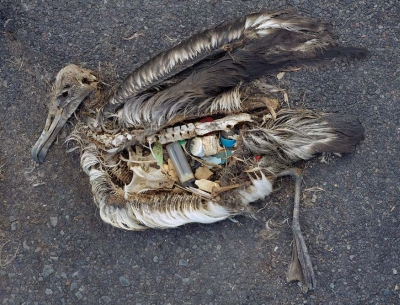
A powerful series of photographs by Chris Jordan detailing the deaths of albatross chicks on Midway Atoll. Here, albatrosses canvas the pacific ocean looking for food for their chicks, instead harvesting various bits of detritus which they then poison and asphyxiate their offspring with.
To document this phenomenon as faithfully as possible, not a single piece of plastic in any of these photographs was moved, placed, manipulated, arranged, or altered in any way. These images depict the actual stomach contents of baby birds in one of the world’s most remote marine sanctuaries, more than 2000 miles from the nearest continent
The photos here are both beautiful and terrible, the stomachs of the deceased birds neatly confining jumbles of colorful trash in dessicated frames. It is a stark reminder of just how much power we have over our environment and how little we take responsibility for it.
You know what, screw it. We’re taking off today. Yeah, that’s what we’re gonna do. I mean, how many times have we been told that if we don’t take those sick days we’re gonna lose ’em. Fine, if that’s the way they want to play it then maybe we’ll just take off every Friday from here on out. We’ll see how they handle the end of the quarter when the entire accounting department is home with “the swine flu”. Hope you’re mighty familiar with a calculator, ’cause we’re off to the movies, suckers!
In a fit of indecision, the FAM is super sized today, a John Carpenter Triple Feature comprised of 1982’s The Thing, 1987’s Prince of Darkness, and lastly 1994’s In the Mouth of Madness; what the director has referred to as his “Apocalypse Trilogy”. Certainly, the man has directed someshockinglyawfulfilms but his earlier work is pure gold and the first two of these rank as some of my favorite sci-fi/horror movies.
Finnish photographer Juha Arvid Helminen has created a black on black series that has me all aflutter. It’s the same mix of fear and attraction as the first time I read The Invisible Man or watched The Headless Horseman at the age of six. And a more recent instance–a shameful tickle in my pants upon discovering Pyramid Head in Silent Hill.
Besides the fetish appeal of complete coverage, tight-lacing, and uniforms, for me the mystery factor is the most potent reason for such a strong visceral response. Masking to create apprehension and giving the imagination freedom to explore its limits is such a common literary and artistic instrument that it’s almost surprising to feel just how effective it is. I’m sipping a cup of tea in the middle of afternoon–far from a spooky ambiance–yet every time I look at these images another infinite, matte black dimension of anxiety unfolds.