4SJ FTW 4EVER (We’ll Miss You, Uncle Forry)


Dearly departed Forrest J Ackerman. Photo by Mark Berry from a series of portraits taken for Bizarre Magazine’s wonderful feature on the Ackermonster.

Forrest J Ackerman: literary agent, magazine editor, writer, actor, producer, archivist, curator, and so much more, too much to pack into a brief obituary. He was a crackpot visionary to the max, to be sure, and deeply loved by millions of fellow freakazoids the world over. Tip o’ the iceberg: he discovered Ray Bradbury, represented Isaac Asimov, Ed Wood and L. Ron Hubbard, founded Famous Monsters of Filmland and is widely acknowledged as the man who coined the term “sci-fi.”

Ackerman cultivated one of the most enormous private collections of science-fiction movie and literary memorabilia in the world, cramming his hillside “Ackermansion” with 50,000 books, thousands more science-fiction magazines, and such priceless collectibles as Bela Lugosi’s cape, actual Star Trek tribbles, and original props from War of the Worlds.

He sold off quite a bit of his collection back in 2002 and moved to a smaller place, but schedule permitting, continued to open his home to strangers every Satuday afternoon to view his remaining treasures. He greatly enjoyed sharing his many colorful stories and anecdotes with fellow Hollyweird aficionados. Speaking to the AP during a lively tour of the Ackermansion on his 85th birthday, Ackerman said “My wife used to [ask] ‘How can you let strangers into our home?’ But what’s the point of having a collection like this if you can’t let people enjoy it?”

His health had been in a steady decline for months. He passed away at his home in LA yesterday, aged 92.

Skin Two: The Long Goodbye

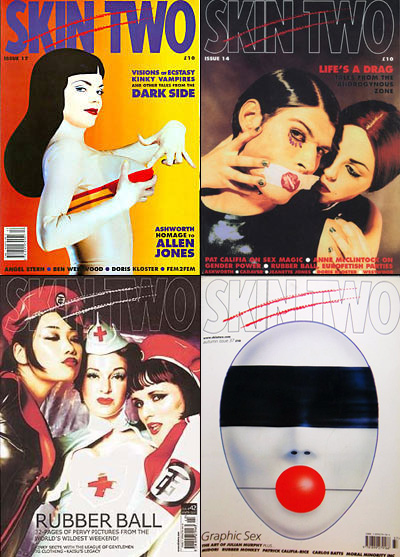
In addition to the many magazines we’ve already mentioned, one of the biggest influences on Coilhouse was Skin Two, the legendary UK fetish mag that’s been around since 1984. Skin Two and the print version of Coilhouse actually share quite a few contributors. David Hindley, who shot the “All Yesterday’s Parties” story in Issue 01, also shot the cover of SK2’s Issue 42 (see below, bottom left). And Nelly Recchia, who appeared in Issue 01’s “People as Pets,” is actually an artist I first discovered in SK2 Issue 51. Other SK2 alums found in Coilhouse Issue 01 include Scar, Atsuko Kudo and Mother of London. Issue 01’s inside cover, conceived by Mildred, was a direct nod to Skin Two’s influence.

And now, the undeniable truth is out: Skin Two is folding. Everyone who’s been following the mag saw this coming from a mile away. Since Skin Two hasn’t brought itself to make a formal announcement, here’s their former editor, Tony Mitchell, spilling the beans (perhaps with a bit of glee) on his blog:

Skin Two magazine is ceasing publication. Information posted on the skintwo.com website states that a new product, the Skin Two Yearbook, is taking over from the legendary fetish journal. Speculation about the impending demise of the magazine was sparked two weeks ago by an e-mail revealing that Liz Tray, its only full-time employee, was leaving the company. Something about the low-key style of this announcement suggested that a bigger story might be about to break. Then, at the end of October, it became evident that all references to advertising in Skin Two magazine had been removed from the Skin Two website. The ‘advertising’ link from the main navigation menu leads to a page that lists all the Skin Two products in which advertising can be bought — and Skin Two magazine is no longer on that list.

Will the current issue 59 be the last, or will the mag carry on to notch up a full 60 editions — or more — before closing? And when will the first Yearbook actually appear? In familiar Skin Two style, no publication date has been given, though blurb on the website refers to it as if it is already in print.

Skin Two was the first truly alt magazine I ever stumbled on, at age 13 (for the fashion, at first), and it inspired me in ways I can’t even count. I still get inspired for Coilhouse, looking at my stack of old Skin Two’s. Having eventually worked with Skin Two, I got to experience the best and worst of it. At its best, this magazine was beautiful, subversive, sexy and strange. At its worst, it was sleazy, tacky and boring. What killed Skin Two? Could anything have saved it? A completely arbitrary, incomplete, biased and NSFW history of Skin Two (with pictures of my favorite and not-so-favorite covers!), after the jump.

Weekly Ad Uncoiling: queer-travel.de

Mount Assmore! This is truly one of the funniest ads (click here for closer look) I’ve seen in my 20 years in this fucked-up business. It’s for German website queer-travel.de, who for over 12 years, have made “gay and lesbian travel dreams come true…” according to the highly reliable Google translate function. This week, the Epica Awards, “Europe’s Premier Creative Awards,” announced that this cheeky execution had a won a silver in the press and poster category. I’m sorry, but it totally smokes the gold winner. I usually poo-poo this hackneyed ad visual technique of manipulating well-known landmarks (Rushmore has been abused many times), but this one is just so wonderfully bizarre, and apropos! So, to the Presidential asses! Teddy (second from right) has the roundest rump, but Abraham’s (far right) is the tightest tushy. Poor George (left) has the flattest … I wonder what the open-minded, DOMA (Defense of Marriage Act)-supporting South Dakotans (and the equable Bill O’Reilly!) would think of this sullying of their state treasure?

Dolphin – Indie Rap of the Motherland

There is a restaurant we three like to go to here in LA that plays current music videos from Russia. It was there, on election night of all nights, where my eye was caught by an odd music video. It stood out from the glittery, overly polished, collagen-peroxide-silicone blur that is Russian music TV. A Google expedition later I’m downloading everything by Dolphin, relieved that Stella Solieil isn’t a regular part of the configuration.


Andrei Lisikov a.k.a. Dolphin on the cover of Russian magazine Afisha

Dolphin has been making noise for over 10 years, has won several high-ranking awards but has yet to hook an international audience. The sound is something like The Streets on the last leg of a bender. Singer and former breakdancer Andrei Lisikov combines rap, soft singing and screaming over organic and electronic music. It’s not at all my usual cup of tea but after a few days’ worth of listening I still like it. The song below is called “Without us” and has some of the most misanthropic lyrics ever. It’s not my favorite but the video is neat.

Maybe Dolphin will become a guilty pleasure, akin to my secret love of George Michael? Only time will tell. While I sort through my conflicting feelings, I want to hear your thoughts on this stuff! There are several more completely different videos from Dolphin, after the jump. Has anyone heard of them before, while I was living under a rock? Does anyone dig it besides me?

Playful Revolution: Caroline Woolard’s Subway Swing

After 9-11, that sick, sinking feeling many weary commuters experienced stepping onto a crowded NYC subway car was magnified by the MTA’s stentorian banner campaign, “If You See Something, Say Something.” Artist  Caroline Woolard has found a delightful way to strip away the defensive layers of suspicion and dread that can accompany a subterranean commute, replacing default anxiety with spontaneous joy by crafting a backpack that transforms easily into a swing! Using 1000 mesh “L-train grey” cordura, webbing, sliders, hooks, velcro, and snaps, Woolard’s “bag swing” is fitted with sturdy straps that hook easily around the handrail of the subway:


Says Woolard: “I hope that the innocent amusement of swinging on the subway eclipses the current atmosphere of insulation and suspicion.”

Much of Woolard’s creative output seems to revolve around the idea that we should all strive to come into the moment, moving actively through the world rather than shuffling absently through it. Her emphasis on exploring pedestrian space and “cultivating everyday magic” in an urban environment encourages viewers (and participants) to reexamine their relationships with the overwhelmingly massive, immovable urban architecture they live in.

What is the relationship between play and revolution? Creating fissures in reality opens up the possibility for change: change in the everyday/monotonous routine, change in assumptions about ‘facts’, change in the world in general. The act of “making strange” allows a new perspective for reassessment and critique. Nothing is fixed and anyone can make the environment around them better.


Adventurous New Yorkers will definitely want to get on her email list.

Recently, presumably to take her site specific explorations a step further and be even more fully in the present, Woolard has stopped updating her art blog. “My projects are lived and may eventually lose any connection to Art…” In other words, she’s just doing it without defining it. “Many things are happening, but you must discover them in real time.” Bravo, Caroline.

Via the lovable guerilla art wunderkind SF Slim, thanks.

We Need Barbie Pure (for the Virgin Sacrifice)

The future really is here! Not only do we have a black president, but Mattel has finally sanctioned a fishnet-wearing, corseted doll titled Goth Punk Barbie. Here she is. Goth. Punk. Barbie:

GPB (above, left) was released as a $70 collector’s item for Hard Rock Cafe, and makes quite a pair with Black Canary Barbie (right), a version of Barbie based on a comic character that drew fire from religious groups earlier this year for her BDSM appearance. But you know what? I like my Barbies in pink, frilly dresses. I like my Barbies to come with a miniature Easy-Bake Oven. I like my Barbies saying “Math is hard, let’s go shopping!” Because it makes it all the more satisfying to see shit like this:

However, my favorite products of a Barbie vivisection may be these classy adornments by artist Margaux Lange:

I love the idea of wearing little ears as earrings. So precious! Writes Lange, “Barbie has become the accessory instead of being accessorized. I take pleasure in the contrast and contradiction of something mass-produced being transformed and revealed as a unique, handmade, wearable piece of art.”

Hilarious Posts from Ayn Rand Dating Site

Anton LaVey, Scott Cunningham, Ayn Rand – oh, the follies of youth! I’d nearly forgotten my 14-year-old Objectivist phase until I stumbled on the hilarious “Free-Market Meat Market,” an article over at New York Magazine that features posts from an Ayn Rand Dating site, with precious gems such as this:

thustotyrants, Selden, New York
[I am] short, stark, and mansome.

You should contact me if you are a skinny woman. If your words are a meaningful progression of concepts rather than a series of vocalizations induced by your spinal cord for the purpose of complementing my tone of voice. If you’ve seen the meatbot, the walking automaton, the pod-people, the dense, glazy-eyed substrate through which living organisms such as myself must escape to reach air and sunlight. If you’ve realized that if speech is to be regarded as a cognitive function, technically they aren’t speaking, and you don’t have to listen.

Ladies… any takers?

Pink Things.


Yerim and Her Pink Things, 2005

The images above and below are just a few from JeongSee Yoon’s Pink And Blue Project, an ongoing set of images dealing with gender, consumerism, and globalization. Dozens of surreal, hyperdetailed images of mostly Asian boys and girls with their blue and pink things appear on Yoon’s page. The girls’ images are what strike me the most. “It looks like these little princesses vomited fairy-floss all over themselves,” observes Katie Olson at Lifelounge, then adds: “Fabulous.” Indeed!

It wasn’t always this way. The color pink, Yoon notes, was once considered the color of masculinity, a watered-down version of the virile color red. He quotes a 1914 American newspaper that advises parents to “use pink for the boy and blue for the girl, if you are a follower of convention.” The reversal of colors for boys and girls occurred only after World War II. Writes Yoon, “as modern society entered twentieth century political correctness, the concept of gender equality emerged and, as a result, reversed the perspective on the colors associated with each gender as well as the superficial connections that attached to them. Today, with the effects of advertising on consumer preferences, these color customs are a worldwide standard.” This is the first time I’ve ever heard the claim that the feminist movement is somehow even indirectly responsible for “pink for girls.” Some quick “say it ain’t so!” Internet research reveals that historians have been unable to pinpoint the reason for the post-WWII color reversal. Reasons for the reversal have been pinned on everything from the Nazis (who labeled the homosexuals in their camps with pink triangles) to a cultural desire on post-war America’s part to bury Rosie the Riveter and replace her with Susie Homemaker. A plausible theory – and I think I uncovered the missing link!

With stores like nANUFACTURE in Spain marketing to parents who wish to avoid the pink/blue dichotomy, it’s clear that color-coding your child’s life is increasingly being seen as unfashionable, even a bit creepy – though, as SocImages points out, this expensive store’s “Save the Babies” campaign may be “more about ‘saving’ kids from things these young, hip parents think are lame or uncool.” Even without the aid of hipster-kid clothing boutiques, parents have a myriad of choices for dressing their kids. As Yoon shows us, some skip out on the pink/blue thing altogether.

For parents of transgender children, on the other hand, the choices today are more complicated than ever. If your son insists, every day, for years, since the moment he can talk, that he’s a girl and not a boy, what kind of clothing do you buy? What kind of toys do you give them? A fascinating article in the current Atlantic examines this issue, focusing on the growing culture of parents who wish to honor their children’s wishes – and the difficulties that accompany such a decision. Delving into everything from children’s rights to Freudian therapy resembling scenes from But I’m a Cheerleader to the heartbreaking story of David Reimer (from the book As God Made Him), the article compassionately examines families on both sides of the fence, chronicling the paths of families who decide to go with their children’s wishes, and those who decide to fight against them.

Love on ya, Lev.


WOOOOOO!!! HAPPY BIRTHDAY!!! *hic* SHOW US YOUR KNICKERS!!!

Now, I know it’s quite early in the morning and some of us are still a bit hungover and as greasily stuffed as vat-fried Turduckens, but it’s time we all gathered ’round and sang happy birthday to our darling Nadya, the magical grrrlchild who brought this entire Coilhouse venture into being by sheer force of will, prescience, and love.

Yes, you already know that she’s an engaging writer who emits a quiet sagacity one would not necessarily expect from so young and doe-eyed a dear. You’re well aware that she’s a phenomenal photographer. But just in case we’ve not made it clear to you already? Nadya Lev is the reason Coilhouse exists. Were it not for our scrumptious mastermind, none of this would be here, and Nadya is the one who continues to hold it all together like a tiny, sexy tube of superglue. So take a moment to send her some whelping-day well-wishing, won’t you? I’m sure it’ll mean more to her than my questionable decision to pelt her with obscure indie spaz rock.

MMMMMMMWAH:

Digging Up Dirt on Thanksgiving Eve

Thanksgiving. The time to visit your family, to give thanks for what you have; your loved ones, your health, your path in life. An opportunity to return to your old room, to dig through your old stuff, to admit that you’re glad to be outta there. And then it’s late at night and the whole house is snoring, except for you. You find yourself wide awake, dusting off a copy of your junior high yearbook, lit only by the glow of the MySpace welcome screen. You type in the first name, hit “Search,” and it begins:

Your middle-school tormentors. Still living in that town you left behind. Wait, are they still living with their parents? Ha! Their top friends – your other tormentors from junior high. You think of all the people you’ve met in your life – on a train in London, at a gig in Rome, on the playa at Burning Man, on a photoshoot in Portland, in class, at a roller derby, on LJ, that time you volunteered – and you wonder, is this tiny slice of the world the only thing they know? Yes, you decide for them. It is. With great delight, you page through photos of their greasy significant others, and their babies, with their stained bibs, who look so heavy. A sense of poetic justice settles on the story you’ve been playing in your head, in which you’re the main character in the universe. Yes – the boy who put garbage on your desk grew up to be a garbage man. You won. They lost. And you all deserve everything that you got. It’s so simple, after all.

After a while, you find that the schadenfreude has an aftertaste, and it’s not something you expected. You begin to feel melancholy, and somehow very alone. Why are you clicking on their pictures, by yourself, in the dark? You try to tell yourself that you only wanted a laugh, but there’s something there. “Does what they did still hurt me, after all these years? Why else would I need to look up their crappy pictures?” What would happen if you suddenly found one of them in a wheelchair? Is it right to laugh when maybe they lacked something you had – say, a nutruring upbringing that made you succeed? And finally, what does this impulse to raise ghosts from the past say about you?

Readers, if you’ve ever engaged in this type of “research,” fess up. What did you find – and how did it make you feel?