Two Surreal Takes on Augmented Reality Glasses

In his fascinating article “The World Is Not Enough: Google and the Future of Augmented Reality,” Alexis Madrigal points out that the information displayed in the Google Glass demo that came out earlier this year is all rather banal: the weather, the time, an appointment, a text message, directions, interior directions (“within a bookstore? right.”), a location check on a friend, and a check-in.

Care for a darker, more dystopian view of what augmented reality glasses could bring? In addition to the numerous Google glass parodies (ADmented Reality being the best of these), and Episode Three of Black Mirror, titled “The Entire History of You,” here are two chilling examples.

The video above, Sight (via @sfslim), focuses on the creepiest aspects of dating with AR. The video below, made in 2010, shows AR as being eerily mundane. If you have a pair of 3D glasses lying around, there’s also this version!

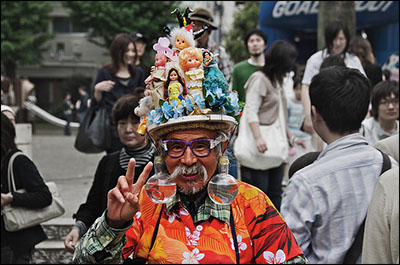
Eijiro Miyama, Japan’s Kawaii-est Older Gentleman


Photo by Geoffrey Gray

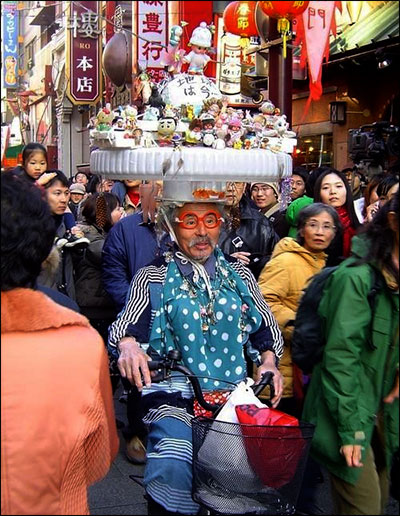
Eijiro Miyama, also known as Bōshi Ojisan (“Hat Man”) or Harajuku Ojisan, is an outsider artist living in Kanagawa Prefecture, Japan. He’s known for crafting strange hats adorned with dolls, live goldfish, candy wrappers and other adornments.

From l’Art Brut, Lausanne:

Eijiro Miyama was born in Mie Prefecture, Japan. A loner, he never married and has always led a wandering sort of existence. He has had various jobs, notably as a day labourer in the construction industry and as a lorry driver. When he was around fifty-five, he settled in one of the boarding houses for impoverished working men in Yokohama’s Kotobuki district, where the unemployed and the socially excluded, homeless, tend to congregate. Today, aged seventy-four, he divides his time between free karaoke and his parades in town : every Saturday and Sunday, Eijiro Miyama goes to the Chinese district in Yokohama, a very lively place. There he meanders through the crowd on his bike, decked out in his brightly coloured hats and clothing, with messages of peace and fraternity written on cardboard packaging attached to his back.

One day, about ten years ago, Eijiro Miyama walked around with a cup of instant noodles on his head. People turned to stare as he went by. This act, provocative and liberating, gave him a huge feeling of exaltation. He gradually created eccentric headgear that he adorned with toys and sundry objects found discarded at flea markets. But this creator also applies his ingenuity to the clothes bought at jumble sales that he dons for his weekly appearances, turning his body into a support for expression.

Here he is being photographed by the Gothic Lolitas of Japan. Awww! More images and information herehereherehere, here, here, and here.


Photographer unknown.

More images, after the cut!
Blingtastic Sexbot Restaurant Opens in Japan

Robot Restaurant. Or, as jwz calls it, “Chuck E. Cheese: Judgement Day Version”.

The new restaurant (official site) is located in Shinjuku’s Kabukichō district, a neon-lit pleasure paradise also known as “Sleepless City” and renowned for its host/hostess bars, love hotels and nightclubs.

The restaurant is said to have cost 10 billion yen (or $130 million dollars). It features LED-encrusted tanks, cabaret girls, and gigantic fembots that can be steered with joysticks (one video also appears to show them being controlled via motion sensor.)

Admission to the restaurant costs 3000 yen (or $38). The fee covers seating, a simple meal, and an hour-long performance featuring Japanese taiko drums, a vinyl-clad marching band, a motorcycle performance, tanks and a B-52. More images can be found at Crunchyroll, Japan News 24, and Nippon News.

Now if we could get Freeform Delusion to go in there and circuit-bend a few things, this place would actually be perfect.

More Than A Fashion Designer: Aoi Kotsuhiroi

Aoi Kotsuhiroi: creator of the The Official Shoes of Tumblr.  The France-based designer’s dark, textured art-fashion pieces have certainly made the rounds, but did you know that Kotsuhiroi is also the photographer, poet and model behind these creations?

Kotsuhiroi’s website feels like a fleeting vision. Page after page of large-scale images reveal a mysterious world full of fetish objects, in both senses of the word. In a series of fragile, dreamlike images reminiscent of Sarah Moon, Kotsuhiroi’s adornments appear to radiate profound magical power, while making your fetish platform boot look like a pair of flip-flops by comparison.

In addition to fashion and photography, Kotsuhiroi has the sensibility of a writer. Rather than releasing her work in collections, such as”AW12,” she releases them as chapters of a book on her site, which is rife with poetry. On Twitter, she describes herself as a novelist. Follow her to see what she does next!

Meanwhile, In Bavaria

Ross Rosenberg,

I see your clip of the gentleman covering Justin Bieber’s “Baby”, and raise you this YouTube video of Takeo Ischi yodeling the “Bibi Hendl” song… for ten full and glorious hours.

Sincerely,
M.E.R.
(Sub-level 66-6, Catacomb Battle Station 3F)

ps: Please do not attempt to dismantle either the screen or audio in Writer Pod 14B. Both systems are wired to detonate instantly if tampered with.

Robinson Deschamps’ Akiza

Akiza as Cheree Furiosa, the mascot of les Furieux

Who is Akiza?

Once upon a time in 2003, a graphic artist and calligrapher named Robinson Deschamps did a series of illustrations for an organization with a temperamental printer. The quirks of their machinery meant that Deschamps could not use colors or even grey levels; the illustrations had to be in black and white. He did the project, delighted with the challenge of the restraints, and in the process created several characters. Of those characters, it was the strange little Akiza-girl who caught Deschamps’ imagination.

Porn Art

The first Akiza is the girl with the iconic face, whose world consists of wires and signage and bits of architecture. She is diminutive, and playful, and fetishy, and asexual all at once.

Akiza has several siblings in the form of tributes that Deschamps crafts, dressing her in faces inspired by Amélie Nothomb or the works of Pierre Molinier.

Model on Bicycle, inspired by Molinier

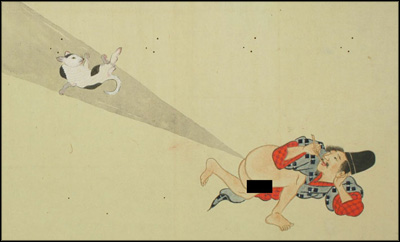
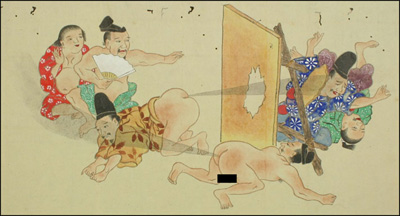
Japanese Fart Scroll from 1847

WOW. Wow…

Over at Tofugu, author Hashi states:

I was doing research for another post a while back, and found something a bit…unusual. It was an old Japanese scroll about farting. No, you didn’t misread that last sentence. The whole scroll, which is called He-Gassen (“The Fart Battle”) is just about people farting. Farting at other people, farting at cats, farting off of horses, farting into bags; just farting everywhere. [...] I kept expecting to find some deep cultural explanation as to why these guys made whole scrolls about farting. But I think it really just boils down to one universal truth: farts are funny. We can pretend that our senses of humor are more sophisticated than that, but let’s face it: when somebody lets one rip, you’re going to chuckle.

Couldn’t have put it better myself!

Click this link to read and see more. Click it now. Trust me. You may not know it yet, but you need more 19th Century Japanese fart scroll in your life. Delve deep into this dubious cleft of cryptohistory.

{Via Jessica Joslin, with fragrant thanks!)

WTFtastic Music Video for Maruosa’s “ACA” by Sekitani Norihiro

This perfect, gleaming sliver of transcendent “whaaaa thaaaa faaaaaa??!” comes to us care of a tweet from Keith Jenson of Brainwomb, who claims to be sharing it to polarize the effect of the “‘spirit bomb’ of Harajuku” video that Nadya just posted. (Athough it seems just as likely that he’s trying to insidiously destroy us with subliminal mind control.)

Laughing Squid says that Japanese artist Sekitani Norihiro –be sure to check out that website, but be warned, it is rife with CAN’T UNSEE imagery– made this succinctly fucked-up-beyond-all-reckoning-ness for the digital grindcore demigod Maruosa.

おはようございます!!!

Collage detail by Sekitani Norihiro.

The “Spirit Bomb” of Harajuku Culture

Featured previously on Coilhouse for her debut music video Pon Pon Pon, 19-year-old blogger-turned-singer Caroline Charonplop Kyary Pamyu Pamyu (also known is Kyary, or Carrie Pam) is back with a new music video for her single Tsukema Tsukeru.

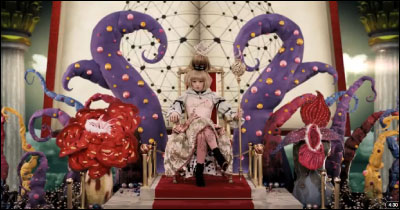
According to Super Happy Awesome, the song is all about the application, appreciation, and effects of false eyelashes. Kicking off the video with a sparkly-lashed wink to Kanye’s Power (which was also parodied to great effect by Freddie Wong), Kyary celebrates the art of eyelash extension through lyrics (“It’s the magic in a type of eyelash / My confidence changes, the way I see the world changes”), choreography (plenty of jazz hands emulating the batting of full lashes), set design (with some terrifying CGI depictions of the (lash-bedecked) Hamsa Hand floating in the background), and, perhaps most potently, costume design (featuring an extra head on top of her wig wearing lashes, a rather anatomical-looking corset decorated with an eye pendant, and two giant false eyelashes on her boobs).

The same team that created Pon Pon Pon was responsible for Tsukema Tsukeru. The song was produced by Yasutaka Nakata, one half of the electronic duo capsule. The video was art-directed by Sebastian Masuda, a pioneer of “kawaii culture” who also founded Harajuku fashion label %6DOKIDOKI. Masuda and Kyary also recently collaborated on an exhibition titled Table of Dreams.

In describing his first meeting and subsequent collaboration with Kyary, Nakata calls her “the ‘spirit bomb’ of Harajuku culture.” (The spirit bomb, the translator explains, “refers to an attack in the classic anime ‘Dragon Ball’, which channels the energy of surrounding life forms into a powerful sphere.”) Kyary’s success, writes Nakata, lies in her ability to infect people with enthusiasm for her projects. “I think it’s because everyone who gathers around Kyary feels like, ‘if I were with Kyary, I’d be able to express things that are new to me.’ That is, of course, how I feel too. So it’s different from a collaboration, and – to tell the truth – even saying that I produce her has a different meaning. The closest I can get is saying, ‘I’m doing it just for the fun of it.’ I feel like Kyary has this power in her to involve people that way.”

See also:

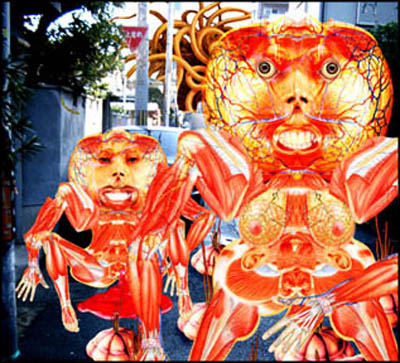
[via Nicole Aptekar]

R.I.P. Eiko Ishioka, July 1939 – January 21, 2012


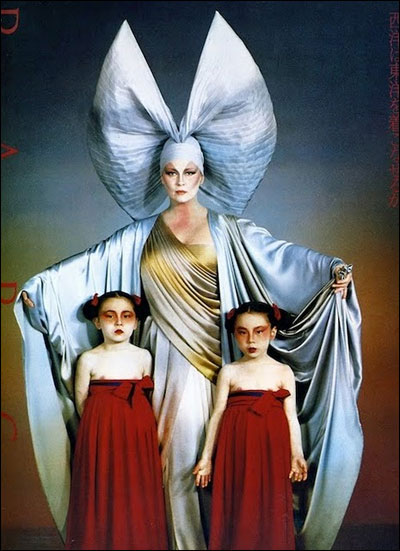
Eiko Ishioka, Motoko Narsue, Kyoko Inui, poster 1979. Photographed by Kazumi Kurigami.

One of the world’s greatest costume designers, Eiko Ishioka, died today at age 73. Ishioka’s work spanned genres and continents; she is best known for her costume design on Dracula, The Fall and The Cell, as well as her collaborations with Bjork, Grace Jones and Cirque du Soleil. From the New York Times:

Ms. Ishioka won an Academy Award for costume design in 1992 for “Bram Stoker’s ‘Dracula,’ ” directed by Francis Ford Coppola. Her outfits for the film included a suit of full body armor for the title character (played by Gary Oldman), whose glistening red color and all-over corrugation made it look like exposed musculature, and a voluminous wedding dress worn by the actress Sadie Frost, with a stiff, round, aggressive lace collar inspired by the ruffs of frill-necked lizards.

These typified Ms. Ishioka’s aesthetic. A deliberate marriage of East and West — she had lived in Manhattan for many years — it simultaneously embraced the gothic, the otherworldly, the dramatic and the unsettling and was suffused with a powerful, dark eroticism. Her work, whose outsize stylization dazzled some critics and discomforted others, was provocative in every possible sense of the word, and it was meant to be.

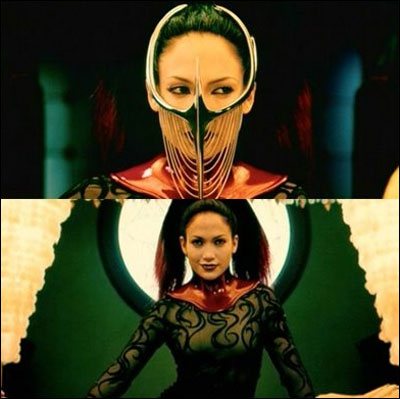
Ms. Ishioka was closely associated with the director Tarsem Singh, for whom she designed costumes for four films. In the first, “The Cell” (2000), she encased Jennifer Lopez, who plays a psychologist trapped by a serial killer, in a headpiece that resembled a cross between a rigid neck brace and a forbidding bird cage.

“Jennifer asked me if I could make it more comfortable,” Ms. Ishioka told The Ottawa Citizen in 2000, “but I said, ‘No, you’re supposed to be tortured.’ ”

Eiko Ishioka worked until the very end of her life. Her latest works can be seen in Tarsem Signh’s Immortals (2011) and Mirror Mirror (2012). After the cut, more images of Ishioka’s work throughout the ages, as well as recent video of her talking about her work on Immortals.


Costume design from The Fall


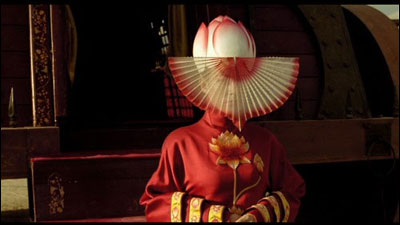
Costume design from The Cell