LONG LIVE RUBULAD. (Keep the Party Going!)

“I had some kind of epiphany about not chasing something in the above-ground world. Something happened in me that I no longer wanted to be in a band that wanted to be famous and go on tour. I just wanted to do something that was ours. I guess it was firmly planting myself in the underground, not after some kind of success that my parents would like.

…In the olden days of New York they had bands and dancing. Dancing and performers of every kind — spoken word, circus, whatever — in the same venue. Places like the Mud Club or Danceteria had a lot of different spaces and a lot of different installations and all kinds of different people went.

And then this weird thing happened when it suddenly became all giant discos and little rock bars. And those people never went to the same place anymore. It seemed like when we started doing Rubulad that people really wanted to be in the same space. They wanted to watch a band and go dance. And be happy.”

~Sari Rubinstein, co-founder of Rubulad, interviewed by Nonsense NYC


Photo via the Essentialist.

Oh, loves. We cover a lot of micropatronage drives on da ‘Haus, but the Rubulad Kickstarter project is especially near and dear. They have been an indescribably huge inspiration to many, many people involved with Coilhouse.

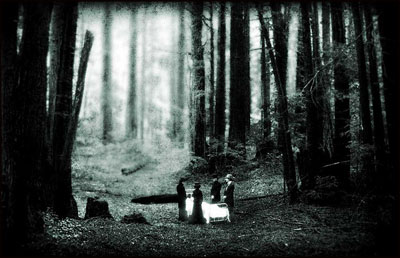
What is Rubulad? Back in 1993, two lovely souls named Sari Rubinstein and Chris Thomas took out a lease on a 5,000 square foot basement in south Williamsburg. Maybe a dozen other people got in on that initial deal, mostly artists and musicians in need of a cheap communal space where they could spread out and work. They all started building up and decorating the space communally. Soon, it became a fun, subterranean hang-out location that drew all sorts of kindred spirits together for dinners, readings, rehearsals, etc.

After a while, Sari, Chris, and their cohorts started throwing parties to cover each month’s rent. Over the course of the next few years, Rubulad (cleverly named with touch-tone letters that corresponded to the space’s phone number)’s space began to evolve, to literally bloom (with vibrant paper flowers, glittering murals, rope vines, colored glass, paper mache sculptures), and the parties developed into these elaborately themed bohemian blow-outs. They. Are. Fucking. AMAZING. For seventeen years now…

(Hang on, let’s take a moment. Seventeen. YEARS.

Yeah.)

…Rubulad has been instrumental in planning and throwing all kinds of events. They’ve already had to move their main warehouse space twice, but their warm, inviting DIY ethic has never faltered or changed; it’s only grown stronger.

Breathing New Life into Dead Men’s Patterns: An Interview with Artist Hormazd Narielwalla


From the “Fairy-God, Fashion Mother” series by Hormazd Narielwalla.

Born in India of Persian-Zoroastrian ancestry and now living London, artist Hormazd Narielwalla forages for patterns in historic tailoring archives to use in conjunction with his own photography, sketches and digital compositions, giving their forms new life as whimsical narrative works of art.

You can see some lovely examples of Homi’s unique work in our Issue Six feature devoted to Klaus Nomi. The puppet-like pattern collages are taken from Narielwalla (nickame Homi)’s series A little bit of Klaus…a little bit of Homi. Each Nomi figure contains elements extracted from the vintage bespoke pattern blocks of Savile Row tailors, made for customers now long-deceased. We could not have found a more deeply fitting serenade to the operatic, avant-garde style icon than Narielwalla’s work, with its deft mixture of affection, craft, and thoughtfulness. (Thank you again, Homi.)

In the following interview, Narielwalla tells Coilhouse a bit more about his work and his life. His current show, Fairy-God, Fashion-Mother, which features a series of paper collages inspired by cult curator Diane Pernet, will be viewable at The Modern Pantry in London until January 7th.


From Hormazd Narielwalla’s “A Little Bit of Klaus, a Little Bit of Homi” series.

How did you get started making art, and what eventually drew you to this very specific and personal form of creative expression?
I was pursuing a Masters degree at the University of Westminster, aiming to become a menswear designer specializing in alternate ways of communicating fashion. During one of many research meeting with William Skinner (the Managing Director of Savile Row tailors Dege & Skinner), I acquired a single set of bespoke patterns belonging to a customer, now-deceased.


From the “Dead Man’s Patterns” series by Hormazd Narielwalla.

The tailors no longer needed the patterns, as they were made for a shape that no longer exists. With the support of my mentors British designers Shelley Fox and Zowie Broach (from Boudicca), I followed my instinct to divorce the patterns from their original context, viewing them as abstract shapes of the human body instead. That is when and where my first publication, Dead Man’s Patterns, was conceived.

A Time Lapse View of Earth From Space

These incredible time lapse sequences are pieced together from thousands of photographs taken aboard the International Space Station by crew members and photographers of Expeditions 28 & 29 (August through October of 2011) at an altitude of approximately 217 miles above sea level.

German tech wizard Michael König took the time to gather together all of the photos from the Image Science & Analysis Laboratory,  NASA Johnson Space Center, and The Gateway to Astronaut Photography of Earth, put them in sequence, and then “refurbished, smoothed, retimed, denoised, deflickered, cut, etc.” all of the footage, taking care to avoid any kind of color adjustment or other visual manipulation, so as to let this beautiful, surreal footage speak entirely for itself.

Ukranian Folk-Rock/Accordion Rendition of “Du Hast”


Via Jhayne, thanks!

This talented folk-rock outfit, called Subito, hails from Lugansk, Ukraine. At this time, Coilhouse is unable to confirm whether or not these musicians are also coal miners (as has been claimed elsewhere on teh interwubz), or just hanging out drinking with ‘em. Either way, this has gotta be the best Rammstein cover since Polkaholix‘s rendition of “Pussy“.

Previous gems from Coilhouse’s time-honored “\m/” category:

“Can We All Come Together?”

This week (in addition to other far less culturally sensitive holidays), National Coming Out Day is observed.


“Rainbow umbrella , Gay Pride 2007, Paris, France” photo © Olivier

Do you have an acquaintance who will occasionally say things like “I don’t have a problem with homosexuality, I just wish Teh Gheys weren’t, ya know, so… in my face about it“, presumably because they have mistaken your distraught Oh-God-I-Feel-So-Trapped-and-Small-Right-Now silence for tacit approval? Frightened into denying your sexuality or your gender identity when a gaggle of high school kids pull you into the bathroom to interrogate you? Tired of turning the other cheek when your church-bake-sale-organizing grandma makes decidedly unChristian comments about Chaz Bono during your dutiful seasonal phone calls back home?  Stung when someone rolls their eyes or accuses you of being hypersensitive after you voice disapproval of casual slurs? Tormented that you can’t be more forthcoming about your personal life at the office without it resulting in being ostracized from the unofficial-but-highly-influential social club that you know being a part of will ensure your career a more, well, straight-and-narrow ascending trajectory during these scary economic times? Heartbroken that your relatives require you to call your domestic partner your “roommate”, or to answer to an incorrect pronoun, when you’re around their Rotary Club friends?

Friggin’ sucks, doesn’t it?

No one should ever feel unduly pressured, strong-armed or bullied into coming out when they’re not ready, don’t feel like they have a safe environment in which to do so, or simply don’t wish to. But here’s a cheerful idea for everyone who’s feeling a bit stifled (whether out, closeted, or somewhere in-between): maybe, just maybe, today’s as great a day as any to randomly unleash some loving Kevin Aviance style glossolalia on the more backasswards, empathy-challenged weeniepoopers in our lives…

SRSLY. Even those of us who are not in a safe enough space to run our LGBTQA banner all the way up a social flagpole can observe today with more subtle gestures of acceptance, and honesty. Let us each consider bringing some bright “Din Da Da” DaDaism into the world!

Can’t say “I’m gay”? Say “DUN DUN DUN DUN DUN DUN DUN BRAAAAP. DOOKUH BRRAAP.” Can’t say “I’m bi”? Cry “BOOM BOOM BOOM BOOM. BOW. BOW.” Trans and can’t say “c’est moi”? Just say “MMMWAH” and plant a big, warm, hella non-”heteronormative” smooch on those sourpusses, then walk away. Think about it: even if they have no idea what the heck just transpired, it’ll probably the most exciting thing to happen to them in ages! Maybe they’ll get the message. Maybe they’ll recalibrate a few things. Even if they don’t, chances are that a spontaneous “RRREEE BOBBA BREEEE BUUPPAH” tinged outburst of voguing will, at the very least, lighten the mood.

“Can we all come together?” Can we all come out, free of fear? Coilhouse hopes YES. Maybe today’s not that day for all of us. But someday. Let’s continue working toward it. In the meantime, we can keep visions of super-out, super strong, super-gorgeous Kevin Aviance dancing in our heads in that florescent pink top hat.

And may today be full of friggin’ rainbows, damn it.

Jeff Wengrofsky Talks Punk Rock, New York, and Jewish History…and Announces a Film Premiere


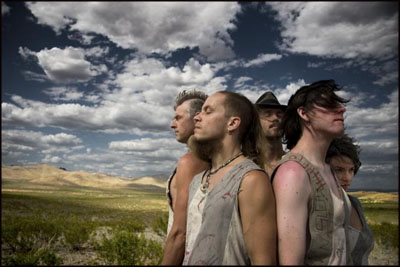
Press photo courtesy of The Syndicate of Human Image Traffickers.

Longtime Coilhouse friend and contributor, Jeff Wengrofsky, was recently interviewed for a prestigious podcast series– Long Story Short, presented by Tablet magazine (a recent winner of the National Magazine Award). Two other two guests in the series are eminent writers Vivian Gornkick and Morris Dickstein.

The conversation topic: how punk rock relates to Jewish history. Jeff has been a footnote to the NYC punk scene since 1982. In the podcast, he puzzles about how Jews have made significant contributions to punk, but the same could be said for their involvement in DaDa, feminism, socialism/communism/anarchism/unionism, The New Left, ecology, and the civil rights movement.

Jeff –who has one of the most astounding original issue vinyl collections of punk on the planet– invited podcast host Liel Leibovitz into his Art Deco lair on the Lower East Side for a fascinating conversation. From Tablet’s writeup:

“…in the 1970s, a very different sort of Jewish artist emerged. Joey Ramone, Handsome Dick Manitoba, Sylvain Sylvain and the other founding fathers of punk rock were as disdainful of the culture as their predecessors were eager to help define it. Wearing leather jackets, singing about sex and drugs, and cultivating their status as rejects, they made music that was loud and fast and much more true to the traditional status of Jews as eternal outsiders. touching on how many young, disenfranchised folks of Jewish descent “the other founding fathers of punk rock were as disdainful of the culture as their predecessors were eager to help define it. Wearing leather jackets, singing about sex and drugs, and cultivating their status as rejects, they made music that was loud and fast and much more true to the traditional status of Jews as eternal outsiders.”

Listen here.

As the Director of the Syndicate of Human Image Traffickers, Jeff has been making a series of films at the intersection of art and life. Several of them have appeared on the Coilhouse website.  The sixth film in the series, “The Party in Taylor Mead’s Kitchen,” is an Official Selection of DOC NYC 2011, the documentary film festival of the Independent Film Channel. After reading Jack Kerouac’s On the Road, Taylor Mead, the scion of Michigan’s Democratic Party political boss Harry Mead, left his
Grosse Point home and Merrill Lynch sinecure for a life hitchhiking around the US. Upon arriving in San Francisco, his ability to write and perform clever, bawdy, homoerotic poems made Taylor an instant hit with the Beatnik scene. He soon came to personify the “Beatnik” ethic in Ron Rice’s classic film, The Flower Thief, in 1960. After meeting Allen Ginsberg at a poetry function, Taylor moved to the Lower East Side of New York, then the Beatnik capital of the world. Taylor was soon a Warhol superstar and came to be featured, most famously, in Tarzan and Jane Revisited…Sort of, and most notoriously, as the star of Taylor Mead’s Ass in 1964. He has since acted in over a hundred films, has acted for the stage, and has published books of poetry.

Fifty-one years after trading in upper-crust luxury for bohemian art stardom, The Party in Taylor Mead’s Kitchen finds Taylor still living the life of poetry, painting, partying, acting, homo-eroticism, gossip, modest living, and indifference to bourgeois notions of hygiene. We visit the octogenarian in his Lower East Side grotto to find him still brilliant, boyishly cute, and ready to party at noon. The film depicts the romantic beauty and squalid dereliction of the bohemian life while dishing the dirt on Andy Warhol, Jack Kerouac, Ron Rice, Woody Allen, and Tallulah Bankhead. At 85, Taylor Mead is an ambassador of bohemianism from a world without the internet, cable television, surveillance cameras, cell phones, global positioning systems, credit cards or roach spray.


As this film is short, it has been paired with a longer film that also deals with New York City artists of a bygone era: Girl with the Black Balloons.
They will be shown as a double-feature at these times and dates and locations:

  • 7:30 PM, Sun. Nov. 6, 2011 – NYU’s Kimmel Ctr. 4th Floor (Eisner Auditorium) – Buy Tickets
  • 3:45 PM, Mon. Nov. 7, 2011 – IFC Center – Buy Tickets

The Mark of Princess Hijab

Editor’s note: today marks the birth date of one of our most tireless and incisive contributors, Mr. David Forbes. For his birthday, David gave us a present: an interview with elusive street artist Princess Hijab. Thanks, David – happy birthday!

A spectre is haunting Paris. For five years, Metro-goers have rounded corners to find heavy, black marker strokes obscuring the idealized arcadia depicted in subway advertisements, the airbrushed bodies of the inhabitants — men and women — disappeared behind a heavy veil. Princess Hijab has struck again.

When she started her “reign” in 2006, observers initially couldn’t decide if it was the work of a modernity-hating zealot or some sort of rabble-rousing commentary. The year before Paris had destructive rioting. France has its own serious racial and ethnic issues, and culture wars are never a place for nuance. The hijab is now, controversially, banned in public.

But from her work, there is no hiding, Parisians still pour out of trains to find the mark of Princess Hijab.

She hasn’t exactly hidden from the media, either. But strangely, in an era craving constant revelation, her identity remains a closely guarded secret. She claims to be around 22 years old, poor, from an immigrant background, and not a Muslim. Those who meet her aren’t even sure if she’s female.

Via e-mail, Princess Hijab, the alias chosen to represent “a mixture of precarity and aristocracy,” has chosen to draw back the veil, just a bit, and tell us about how — and why — she chose her domain.


“Why You’re Wearing Feathers Right Now” by Jenka Gurfinkel


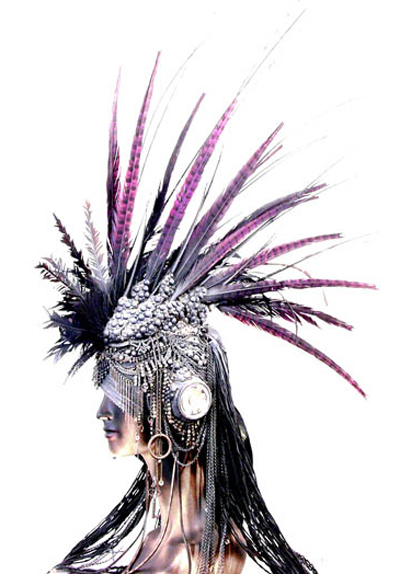
Jocelyn Marsh wearing a headdress by Tiffa Novoa. Photo by Brion Topolski. 2005.

Recently, Jenka Gurfinkel –a longtime mover/shaker in the California indie cirque scene– wrote “Why You’re Wearing Feathers Right Now”, a fantastic personal essay that happens to dovetail nicely (pun intended) with the extensive Tiffa Novoa love fest we ran in Coilhouse Magazine last year. Gurfinkel’s unique take on the current exploding trend of plumage in both indie and mainstream fashion is a deft mix of memoir and cultural nodal point-mapping:

“In the summer of 2011, feathers have become a staple of every sartorial and tonsorial aspect imaginable. The other day I was asked my opinion as to where this current ubiquity of feathers has come from. But as it turns out, I happen to have something better than an opinion: I have an explanation.”
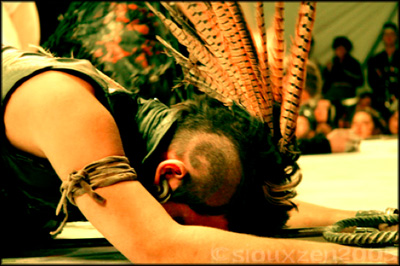

El Circo performer at Burning Man, 2005. Photo by Siouxzen Kang.

“Just two years out of college, I stumbled into the role of production manager for a newly-formed, L.A.-based vaudeville cirque troupe called, Lucent Dossier. Through that initial involvement with Lucent I would meet many other circus groups, including El Circo, who were by then based in San Francisco along with The Yard Dogs Road Show and Vau De Vire Society. There was also March Fourth Marching Band in Portland, Clan Destino in Santa Barbara, and Cirque Berzerk, and Mutaytor in L.A. As these acts grew, the I-5 Freeway became a central artery of culture, pumping a distinct combination of art, music, fashion, and performance up and down the west coast. A social scene evolved around these circus troupes the same way the punk subculture sprang up around the bands that defined it.”
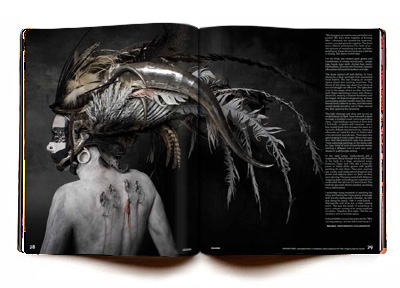

Full page Issue 05 Coilhouse spread of performer Joshua David wearing a Ernte feather headdress by Tiffa Novoa. Photo by Spencer Hansen.

“In the early to mid-aughts (when the photos above were taken) the feather was as de rigueur a cultural signifier within the circus scene as the safety pin was for punks in the late 1970s and early 80s. In fact, back before it was so commonplace as to lose meaning (or induce a national feather shortage), condescending terms for those sporting the look sprang up within the subculture: “Feather mafia,” was one I heard thrown around; ‘Trustafarian peacock‘ even made it into UrbanDictionary.com. And then, something else began to happen…”

View the full essay at Social Creature dot com.

As far as this ubiquitous trend of wearing feathers goes– if you adorn with birdie bits, please consider researching where they come from! Buying ethically and responsibly is beautiful. Here are some great resources:

Leonora Carrington – 6 April 1917 – 25 May 2011


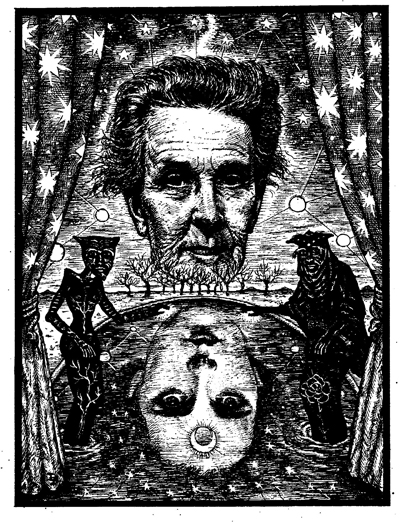
Fantastic pen and ink double portrait by Hilus Anendorf

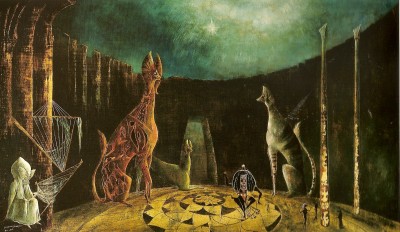
Leonora Carrington lived a life as surreal and fantastical as the images she painted. The last of the first generation of Surrealists, she consorted with the full pantheon of greats, from Dali to Picasso, and was hailed as “Mexico’s greatest living artist” before her death 94. Despite her storied career as bohemian darling, wild muse and prolific creator of paintings, books, sculpture and theater, she remained always humble, and resolutely uninterested in labels, or all the laurels that have been flung her way over the years.

Her approach to art was completely intuitive, stemming from the deep well of her soul, her own psychic underworld realm that she populated with fantastic beasts and mysterious figures. She disdained the overintellectualization and analysis of her work, her beliefs, her inspirations – believing fervently that the visual world she created was unnecessarily hindered by those determined to understand what it was all about. She was a provocateur, delighting in stirring up trouble amongst the staid, society types whose ilk she rejected. André Breton wrote of her in his Anthologie de l’humoir noir:

“Those respectable people who, for a dozen years, had invited her to dine in a prestigious restaurant have still not recovered from the embarrassment when they noticed that, while continuing to take part in the conversation, she had taken off her shoes and meticulously covered her feet in mustard.”


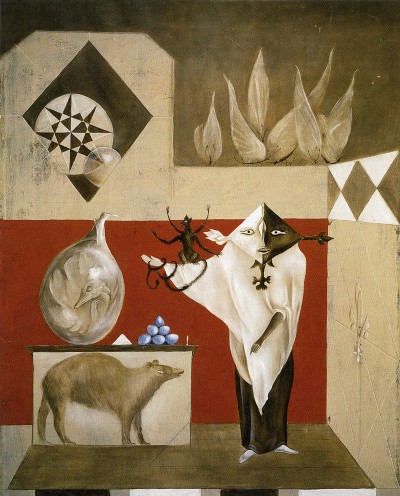
The Conjuror

All of her work is infused with this dark sense of humor and mischief, particularly her writing. In her only novel, The Hearing Trumpet, she envisions herself as a wizened crone – the 92 year old Marian Leatherby, a deaf and toothless “drooling sack of decomposing flesh” who is cast-off by callous relatives to a sanatorium for the elderly. It is here that her life truly begins, when she finds her kind: a coven of witch-sisters who help her discover and unleash her mediumistic talents.

Carrington once said, “I wanted to appear like an old lady so I could poke fun at sinister things.” As a young woman growing up in her stultifyingly proper Lancashire family estate, she railed against convention, and was booted out of multiple boarding schools. In her story “The Debutante”, she recounts her fantasy of dressing up a hyena in her coming-out dress, and sending the wild thing to her debutante’s ball in her stead. Allowed at last to attend art school, she horrified her family by running off with a married man twice her age, who happened to be Max Ernst. The romance was tragic, and ill-fated – doomed by the Nazi invasion of France and their subsequent incarceration of her lover. After a nervous breakdown, which caused her to be thrown into an asylum, she fled Europe for Mexico, where she settled and flourished until her death.


“We went down into the silent garden. Dawn is the time when nothing breathes, the hour of silence. Everything is transfixed, only the light moves.”
— Leonora Carrington

Diaghilev Gets His Due: The Golden Age of the Ballets Russes at the Victoria & Albert Museum

Coilhouse is delighted to welcome writer and dancer Sarah Hassan into the Coilhouse family. Her premiere piece for us is a 3000 word feature about Sergei Diaghilev and the Ballet Russes. This is definitely one of the most informative, inspiring, infectious posts you’ll read here this month, so settle in, and enjoy! ~Mer


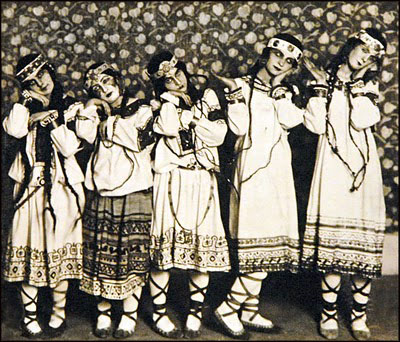
Dancers in the original Le sacre du printemps production.

The Théâtre des Champs-Élysées in Paris seems an unlikely venue for a riot. Yet almost one hundred years ago, on May 29th, 1913, fist-fights broke out in an audience made up of socialites, musicians, and artists. The institution in question was one that by today’s standards seems chaste and predictable: the ballet.

The premiere of Le sacre du printemps by Sergei Diaghilev’s Ballets Russes has become the stuff of legend. Against Nicholas Roerich’s backdrop of a primitive Russia, the radical score by Igor Stravinsky came alive to the choreography of Vaslav Nijinsky, the danseur noble darling – and object of Diaghilev’s affection – whose unsurpassed defiance of gravity on Europe’s great stages had been leaving balletomane’s breathless. Now, the dancer whose roles included a lovesick puppet, a sprightly rose, and a predatory golden slave presented a complicated tableau of sacred ritual. With balled-up fists and downward glances, his dancers jumped and stomped their pigeon-toed feet in time with the violins as if trying to conjure up the ghosts of pagan tribesmen. The heavy woolen dresses painted with folk patterns on the peasant girls were in place of the frothy tulle skirts of nighttime sylphs and bejeweled torsos of slinking odalisques expected from a program a’la Russes.


Nicholas Roerich’s Costumes for Le Sacre Du Printemps.

The production, presenting a ‘new type of savagery,’ caused a literal aesthetic outrage among the haute Parisian audience. Backstage, as the birth of modern dance unfolded, Nijinsky screamed the tempo counts in Russian to dancers who couldn’t hear over the booing, while Stravinsky held him by his coattails lest the crazed choreographer topple into the orchestra. Diaghilev attempted to placate the uproar by turning the house lights on and off. Yet despite its unsuccessful reception, Le sacre du printemps was performed six times, and Diaghilev declared the opening night scandal to be ‘exactly what he wanted.’ It was clear that the ballet was no longer safe.

Thirty-two years after Le sacre’s premiere, Nijinsky, having succumbed to insanity, leapt for a photographer’s camera in a Swiss asylum. The image captured the aging dancer smartly dressed in a suit suspended in the air, proof of his once otherworldly powers. Yet, one can only wonder if the height Nijinsky was attempting to recapture was not his own, but that of the sacrificial virgin he created, dying from her own mad dance in a flash of beastly glory.


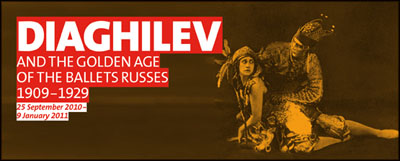
The banner at the Victoria & Albert Museum for Diaghilev and the Golden Age of the Ballets Russes.

All the hoopla generated by Darren Aronofsky’s psycho-sexual melodrama Black Swan made it easy to believe that ballet had been once again recovered from the ashes of its own antiquity. With Jennifer Homan’s attempt to condense 400 years of history with her book, Apollo’s Angels, the ballet’s ability to survive in an age where anything goes and everything changes came into question – the blood-stained tutu of Natalie Portman’s Nina Sawyer notwithstanding. Madness is, by Aronofsky’s account, the cost of greatness. This idea is artistic old-hat, retold through ballet by Moira Shearer’s exceptional Victoria Page in The Red Shoes – a movie loosely based on Diaghilev and his company – and all the gory details of Swan, from broken toes, bone-thin frames, and endless retching struck a resonant, less glamorous chord. The curtain was pulled back to reveal an art that demands perfection as you claw your way to the top while clawing yourself apart. Ballet, according to Black Swan, is more an arena for the cruel and calculated and less the foundation for beauty, innovation and fantasy.

Oh, how the days of Diaghilev would beg to differ.