Adventures in Spreepark: Photos by Matthew Borgatti


“Soon…” Photo by Matthew Borgatti.

A frozen rainbow carousel, headless dinosaurs and lonely swan-shaped boats: this can only be Spreepark, an abandoned amusement park in Southeast Berlin. Conceived as a Socialist project to celebrate 20 years of GDR, Spreepark opened its doors in 1969, and shut down in 2001.  If you saw the film Hanna, images of a girl assassin running through this decaying fairyland park may spring to mind. Recently, Matthew Borgatti (previously on Coilhouse here and here) grabbed his camera and went exploring: he’s just published a beautiful set of photos showing both Spreepark’s ruins and signs of life, in tandem with a witty, comprehensive guide to urban spelunking. Spreepark’s story, writes Matthew, is one of “broken dreams, drug smuggling, and illegal things done with kiddie park rides in the dead of night.” You can’t tell the story of Spreepark without mentioning the story of Norbert Witte, as told by journalist Julia Jüttner.

An affluent funfair operator known as the “King of Carousels” to his friends, Witte walked into trouble when he decided to invest in Spreepark after the reunification of Germany. The son of a carnival performer and grandson of Otto Witte, an acrobat/swindler who once managed to be crowned as the King of Albania, Norbert Witte built his own carnival empire from humble beginnings. Together with his young bride Pia, the daughter of a bumper-car operator, he purchased one roller coaster (“The Catapult”) and began to tour with it, amassing eight rides over the course of two decades.


Photo by Matthew Borgatti.

At first, Spreepark seemed like a lucrative investment for Witte. But after the government eliminated 3,000 parking spaces near the park, people stopped coming and the park went out of business. Witte relocated his family to Lima, Peru, with the hope of bringing over Spreepark’s rides and establishing a new park called Lunapark. However, Peruvian customs officials refused to release all the parts of the rides, and the family quickly slid into poverty. Ultimately, Witte was caught smuggling 76 pounds of cocaine (worth $14 million) back to Germany in the mast of the “Flying Carpet” carousel. Norbert Witte received a lenient 6-year sentence in Germany, but his 21-year-old son, stuck back in Peru, received a jail term of 20 years. In a heartbreaking interview with Spiegel Online, Pia Witte elaborates further.

Unlike the story of Spreepark’s ruin, Matthew’s photos aren’t all that tragic. In fact, unlike most typical, ruin porn-tastic shots of abandoned theme parks around the world, his photos reveal the park’s vibrant, frenetic second life. Vinyl stickers depicting the step-by-step construction of an origami swan adorn a swan boat’s plastic neck. One of the dinosaurs still standing dons glam-rock makeup crafted from neon adhesive tape. A layer of graffiti art slowly encroaches upon the abandoned rides, often giving them a strangely modern look. Perhaps it’s because the German authorities seem pretty lenient, occasionally allowing fashion shoots, filming, and festivities such as “concerts, art installations, performances and a burning man” to take place in the park.

As hinted in Matthew’s photos, the future is bright for Spreepark: this summer, a new project called Kulturpark will set up a three-week artist residency camp producing public art inside Spreepark’s walls. Artworks will include “ecological grafitti, sustainable bicycles, a ping pong competition, learning events, radio station, [and] storytelling projects.” The public opening will be June 28 – July 1st.


Photo by Matthew Borgatti.

America’s Dead Sea

Jim Lo Scalzo’s beautiful short documentary on the Salton Sea:

Deep in the desert of southern California sits one of the worst environmental sites in America—a former tourist destination that has turned into a toxic soup: the Salton Sea.

The sea was born by accident 100 years ago, when the Colorado River breached an irrigation canal; for the next two years the entire volume of the river flowed into the Salton Sink, one of the lowest places on Earth. The new lake became a major tourist attraction, with resort towns springing up along its shores. Yet with no outflow, and with agricultural runoff serving as its only inflow, the sea’s waters grew increasingly toxic. Farm chemicals and ever-increasing salinity caused massive fish and bird die-offs. Use of the sea for recreational activities plummeted, and by the 1980s its tourist towns were all but abandoned.

The skeletons of these structures are still there; ghost towns encrusted in salt. California officials acknowledge that if billions of dollars are not spent to save it, the sea could shrink another 60 percent in the next 20 years, exposing soil contaminated with arsenic and other cancerous chemicals to strong winds. Should that dust become airborne, it would blow across much of southern California, creating an environmental calamity.

Much of the footage is filmed in and around The Salton Riviera, a former resort built by entrepreneur M. Penn Phillips, old footage of which Scalzo expertly contrasts with images of the now dilapidated buildings and piles of dead fish. His eye for composition is the real star here, though, and he captures some stunningly haunting images of this increasingly barren wasteland.

Via The Fox Is Black

“LastBreathe” by Robert Wun

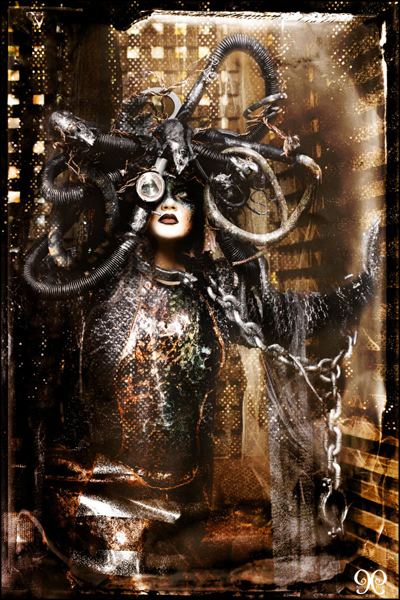
The ghostly garment resembles magically symmetrical wisps of smoke curling around the model. Below, zip ties are used to create a striking crown of thorns.

These images are from a series called “LastBreathe” by fashion designer Robert Wun. A recent graduate of the University of the Arts in London, Wun creates textured, airy garments such as the ones pictured here. This series was photographed by Bobby Sham, and the model is Lauren H.

[via JUST_MONK3Y]

Astronauts & Amazons: Lado Alexi’s Fashion Photography

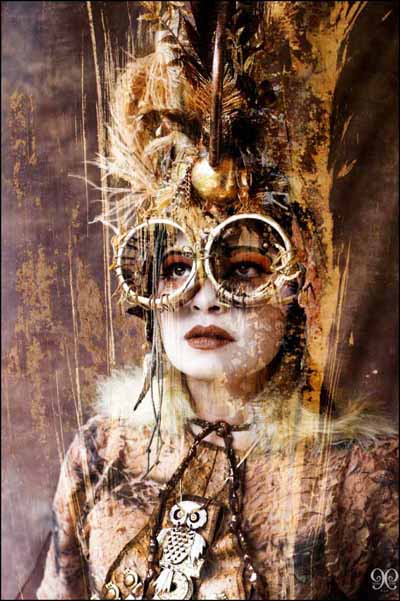
While most of Lado Alexi’s photography falls squarely in the realm of traditional, commercial fashion photography, a few of his photos are too magical not to share here. The character in the image above looks like an spellbound Russian princess, while the fetish gladiatrix below resembles a rendering or a sculpture more than a real person.

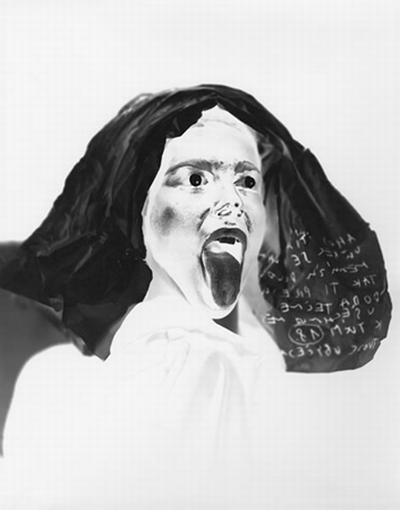
After the jump, a couple more of Alexi’s stranger photos from the series Fin de Siecle, Amazones, and Astronaut, including a priestess wearing a decrepit doll head, a blue-faced woman wearing Saran wrap, a colorful circus girl, and an astronaut resting in a mysterious room with red lanterns. Overall, the photos might be more compelling if the agency models didn’t all employ the same thousand-yard stare (and, in fact, if some of them weren’t agency models), but the colors are beautiful, the fashion is astonishing, and the makeup is very inspired.

[via Wicked Halo]

To the Center Within: Photographs by The Silent Infinite + Asha Beta

Last summer, photographer Abigail Amalton, who publishes moody, meditative images under the name The Silent Infinite, met artist Asha Beta (previously on Coilhouse) at the Coilhouse Black and White And Red All Over Ball in Brooklyn. The result was a series of photos titled “Immanence” and “To the Center Within“: a collaboration that explores personal mythology and self-transformation. With piercing assistance from Venus Pain, Asha and Abigail created a three-part sequence taking place outdoors, and a second shoot in the studio.

“We can use art for deep change – when we undertake the journey of individuation, we can move beyond survival needs and encounter truly beautiful territory,” writes Abigail in a description of this series. “These images remind me that I can always hold myself to my greatest possibilities, that I no longer need to pretend that the conventional is something I want in any form at all … what I want is real, deep, never-ending change. A feeling of the power of choice in creating reality. The second we free ourselves of the half-truth that we are bound to the organizational templates of society and culture is the precious moment we start to self-define and steer our own ship … Who knows where we will arrive?”

More images after the jump, and even more on Flickr and on Abigail’s site.

“That Heartbreaking Invisible Place”

“She makes visible that heartbreaking invisible place between the appearance and the disappearance of things,” wrote Richard Avedon about photographer Lillian Bassman, who died at 94 in her home at Manhattan last week.

Like her contemporary Irving Penn, who passed away last year at age 92, Bassman worked on her art until the very end of her life. The photo above, titled “It’s a Cinch,” was taken for Harper’s Bazaar in 1951. At that time, model Stella Tennant, who appears in the shot below (part of this shoot for Vogue Germany), wasn’t even born yet – and wouldn’t be born for another 19 years.

Bassman lived an extraordinary life. The daughter of bohemian Russian-Jewish immigrants living in Brooklyn, she moved in with her husband, fellow artist Paul Himmel, when she 15. Together they survived through the Great Depression: Bassman worked as an artists’ model, while Himmel taught art. They were involved in political strikes of the era, and Bassman once picketed in the nude to protest arts financing cuts. Soon, she got a job co-art-directing Junior Bazaar, one of the most creative and experimental teen girl magazines that ever existed. Junior Bazaar failed because it was too out-there, but it launched Bassman’s fashion photography career, landing her gigs for Harper’s Bazaar.

Over the years, Bassman’s painterly, impressionistic style fell out of fashion.  Harper’s Bazaar editor Carmel Snow  famously said to her during a shoot, “I didn’t bring you to Paris to make art; I brought you here to do the buttons and bows.” Fed up with fashion photography, Bassman famously destroyed most of her negatives in the 60s. It wasn’t until the early 90s that a fashion historian urged her to revisit the few negatives she had left. Bassman began experimenting anew, and re-emerged as a force in fashion photography. She embraced new technologies, discovering Photoshop when she was 87.

After the jump, a collection of Bassman’s work, past and present.

Auberon Shull’s “Desert Dance”, and an Interview with Director Sequoia Emmanuelle

LA-based imagemaker/mover/shaker Sequoia Emmanuelle has just premiered this video of dancer Auberon Shull (definitely watch it full screen):

Filmed, edited and directed by Sequoia Emmanuelle
Dance by Auberon Shull
Hair and makeup by Ashley Joy Beck
Costumes by Tiffa Novoa and Auberon Shull
Music by Distance and Adventure Club

Auberon is a powerhouse. Sequoia, too, is a force of nature who has shot countless portrait series and fashion editorials with all manner of West Coast lovelies: SkingraftEskmo, Zoe Jakes and Rachel Brice (for Tawapa/Wild Card/Five and Diamond), Galareh, Kucoon, Beats AntiqueLucent Dossier Vaudeville Circus, El Circo… the list’s about a mile long. In addition to her photography portfolio and video work, Sequoia’s also got a well-established background in fashion design (check out her S&G Clothing line), wardrobe styling, painting, and graphic design.

Recently, she took the time to answer a few questions about her collaboration with Auberon, and to let us know what’s coming next. (Thank you, Sequoia! Always a pleasure.)

Much of the Coilhouse readership is already familiar with your photography, but this may be the first time many of us have (knowingly) watched a video by you. Can you tell us a bit about the differences and parallels between your creative process shooting/editing film and your photography methods?
Sequoia Emmanuelle: I grew up watching music videos, [they're] a huge inspiration to me, and I have always planned on getting more involved with film/video as well as photography. In the last year I have been working on several videos for fashion, music and dance. It feels very natural to the way I see things for photography, but of course it is very different, too. For one thing, everything you shoot needs to be horizontal, so it changes the composition of how you set things up. Your lenses change, and lighting changes. You can’t use strobe lights for video, so you have to set things up quite differently. When it comes to editing, it’s quite involved, because you have to pay attention to all the moving details and make your cuts flow in an interesting and creative way, not to mention syncing up the music. Right now I am focusing on simple ways of creating artistic videos… using less is more for the time being, and I’ll surely get more experimental as I keep working at it.

Astronaut Ghosts


“Space Suits”

The San Diego Air & Space Museum Archives Flickr Photostream has a lot of beautiful vintage photographs related to flight. You’ll fighter jets, airships, factories, control centers, aviation posters, lushly-illustrated training manuals, and lots of neat historical tidbits.


ST-124 Inertial Guidance Platform

Of particular interest is the set titled Space Related Images. After the jump, a selection of photos from this set. Space food, astronaut training and retro machinery galore.

Related:

[via Surrogate Self]

Eyepatch Party!

Eyepatches have long been a staple of alt fashion. From visual kei to burlesque, the eyepatch has been used to accentuate elements of romanticism, glamour, and mystique throughout the ages.

Advertising giant David Ogilvy knew this in 1951 when he created “the man in the Hathaway shirt,” a campaign that put a tiny company on the map by featuring a distinguished-looking man with a mysterious eyepatch in a series of ads that continued to run for over 25 years and inspired dozens of copycats.

David “Wear the Eyepatch“ Bowie knew this in 1972 when he popularized the patch during his Ziggy Stardust era, influencing everyone from Peter Burns to Rihanna. And of course, film directors know that an eyepatch can create the character, from Quentin Tarantino’s Elle Driver to John Carpenter’s Snake Plissen. It can be said that the most (come to think of it, the only) memorable thing from Sky Captain and The World of Tomorrow was the sight of Angie with an eyepatch.

Of course, stylish eyepatches aren’t just for show. For centuries, people with eye ailments have incorporated the patch into their personal style. The first chic eyepatch-wearer may have been Spanish princess Doña Ana de Mendoza y de la Cerda. Around 1545, young Ana lost her eye in an accident during a playfight with one of her guards. Donning an eyepatch only fueled her popularity at the court, and it is said that she had a bejeweled eyepatch for every dress she owned.

Film director Fritz Lang’s eye problems started in 1916, the same year he stumbled into film. While recuperating from war wounds that would eventually cost him his eye, he began to write scripts and took up acting. In his younger years, he wore a monocle over his injured eye; later in life, an eyepatch under dark glasses. Knowing the director’s struggle towards monocular vision, Maria’s lingering robot wink in Metropolis somehow feels much more significant. Other fabulous/functional eyepatch-wearers include Slick Rick, James Joyce and Momus.

I never thought I’d have to wear an eyepatch for any reason other than a fashion shoot or a fancy night out. But following some recent eye problems, I have to wear one for at least a portion of each day, for at least a little while. Thus began my trawl through Tumblr, Flickr, and fashion blogs in search for the perfect patch. The search uncovered dozens of beautiful images from Coilhouse friends and family. After the jump, an epic collection of over 60 eyepatches featuring Mother of London, Salvador Dali, PUREVILE!, James Dean, Amelia Arsenic, Chad Michael Ward, Shien Lee, Antiseptic, Jane Doe, Alyz Tale, Atsuko Kudo and many others. I suspect that many of you have eyepatch photos as well. If you’ve got one, post it in the comments!

Bristol Punks, 1977

They look like a macabre traveling circus troupe out of a Neil Gaiman novel. These images are from the Bristol Archive Records’ photostream, and were taken by John Spink. More from this set here.

See also:

[via fuckyeahurbantribes]