“Accoutrements Horse Head Mask” Customer Gallery on Amazon


Horse head customer photo, uploaded by Amazon user Mike.

From the same site that brought you disgruntled reviews of A Million Random Digits comes this bizarre collection of photos. “This mask imbues the wearer with super-human abilities … the power to make everyone around you feel akward and uncomfortable being first among them,” writes one reviewer of this mask on Amazon.

The “Accoutrements Horse Head Mask” customer gallery shows horse-headed people going about their daily lives: reading books to children, playing Scrabble, passing out from too much booze, camping, spelunking, and more. [via raindrift]


“It’s a shame that you can still find this kind of discrimination in America.” Uploaded by Amazon user Michael Genovese.

True Adventures in Better Homes

This collage series by Nadine Boughton combines men’s adventure magazines from the 50s and early 60s with the pristine rooms of Better Homes and Gardens. Bedrooms, living rooms and bathrooms are attacked by squids and rabid baboons, overrun by bats,  submerged underwater, and besieged by helicopters.

“The collages are set against the backdrop of the McCarthy era, advertising, sexual repression, WWII and the Korean War. The cool, insular world of mid-century modern living glossed over all danger and darkness, which the heroic male fought off in every corner,” writes Boughton.

Previously on Coilhouse:

[via jwz]

Adventures in Spreepark: Photos by Matthew Borgatti


“Soon…” Photo by Matthew Borgatti.

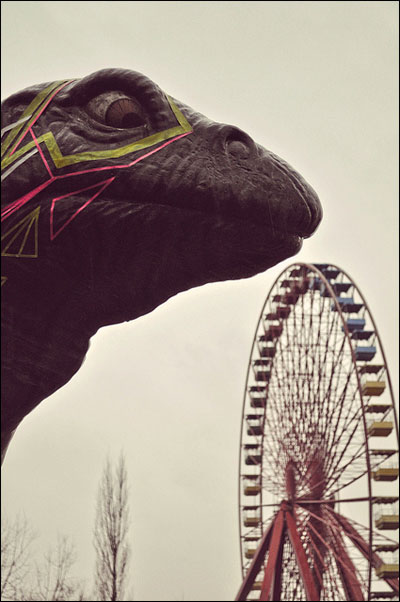
A frozen rainbow carousel, headless dinosaurs and lonely swan-shaped boats: this can only be Spreepark, an abandoned amusement park in Southeast Berlin. Conceived as a Socialist project to celebrate 20 years of GDR, Spreepark opened its doors in 1969, and shut down in 2001.  If you saw the film Hanna, images of a girl assassin running through this decaying fairyland park may spring to mind. Recently, Matthew Borgatti (previously on Coilhouse here and here) grabbed his camera and went exploring: he’s just published a beautiful set of photos showing both Spreepark’s ruins and signs of life, in tandem with a witty, comprehensive guide to urban spelunking. Spreepark’s story, writes Matthew, is one of “broken dreams, drug smuggling, and illegal things done with kiddie park rides in the dead of night.” You can’t tell the story of Spreepark without mentioning the story of Norbert Witte, as told by journalist Julia Jüttner.

An affluent funfair operator known as the “King of Carousels” to his friends, Witte walked into trouble when he decided to invest in Spreepark after the reunification of Germany. The son of a carnival performer and grandson of Otto Witte, an acrobat/swindler who once managed to be crowned as the King of Albania, Norbert Witte built his own carnival empire from humble beginnings. Together with his young bride Pia, the daughter of a bumper-car operator, he purchased one roller coaster (“The Catapult”) and began to tour with it, amassing eight rides over the course of two decades.


Photo by Matthew Borgatti.

At first, Spreepark seemed like a lucrative investment for Witte. But after the government eliminated 3,000 parking spaces near the park, people stopped coming and the park went out of business. Witte relocated his family to Lima, Peru, with the hope of bringing over Spreepark’s rides and establishing a new park called Lunapark. However, Peruvian customs officials refused to release all the parts of the rides, and the family quickly slid into poverty. Ultimately, Witte was caught smuggling 76 pounds of cocaine (worth $14 million) back to Germany in the mast of the “Flying Carpet” carousel. Norbert Witte received a lenient 6-year sentence in Germany, but his 21-year-old son, stuck back in Peru, received a jail term of 20 years. In a heartbreaking interview with Spiegel Online, Pia Witte elaborates further.

Unlike the story of Spreepark’s ruin, Matthew’s photos aren’t all that tragic. In fact, unlike most typical, ruin porn-tastic shots of abandoned theme parks around the world, his photos reveal the park’s vibrant, frenetic second life. Vinyl stickers depicting the step-by-step construction of an origami swan adorn a swan boat’s plastic neck. One of the dinosaurs still standing dons glam-rock makeup crafted from neon adhesive tape. A layer of graffiti art slowly encroaches upon the abandoned rides, often giving them a strangely modern look. Perhaps it’s because the German authorities seem pretty lenient, occasionally allowing fashion shoots, filming, and festivities such as “concerts, art installations, performances and a burning man” to take place in the park.

As hinted in Matthew’s photos, the future is bright for Spreepark: this summer, a new project called Kulturpark will set up a three-week artist residency camp producing public art inside Spreepark’s walls. Artworks will include “ecological grafitti, sustainable bicycles, a ping pong competition, learning events, radio station, [and] storytelling projects.” The public opening will be June 28 – July 1st.


Photo by Matthew Borgatti.

“Crazy Clown Time” By David Lynch

Above you’ll find the official video, directed by David Lynch, for the title track of his new album Crazy Clown Time. It is officially a thing that exists. In it, Lynch narrates a series of Lynchian events at a Lynchian backyard barbecue as they transpire on screen in a manner sort of like singing but not really. It’s as if a film student set to work to reconstruct a David Lynch movie as related to them by someone who had had a few too many drinks. It may be the best David Lynch parody ever made.

(NSFW, unsurprisingly.)

Via poetv

America’s Dead Sea

Jim Lo Scalzo’s beautiful short documentary on the Salton Sea:

Deep in the desert of southern California sits one of the worst environmental sites in America—a former tourist destination that has turned into a toxic soup: the Salton Sea.

The sea was born by accident 100 years ago, when the Colorado River breached an irrigation canal; for the next two years the entire volume of the river flowed into the Salton Sink, one of the lowest places on Earth. The new lake became a major tourist attraction, with resort towns springing up along its shores. Yet with no outflow, and with agricultural runoff serving as its only inflow, the sea’s waters grew increasingly toxic. Farm chemicals and ever-increasing salinity caused massive fish and bird die-offs. Use of the sea for recreational activities plummeted, and by the 1980s its tourist towns were all but abandoned.

The skeletons of these structures are still there; ghost towns encrusted in salt. California officials acknowledge that if billions of dollars are not spent to save it, the sea could shrink another 60 percent in the next 20 years, exposing soil contaminated with arsenic and other cancerous chemicals to strong winds. Should that dust become airborne, it would blow across much of southern California, creating an environmental calamity.

Much of the footage is filmed in and around The Salton Riviera, a former resort built by entrepreneur M. Penn Phillips, old footage of which Scalzo expertly contrasts with images of the now dilapidated buildings and piles of dead fish. His eye for composition is the real star here, though, and he captures some stunningly haunting images of this increasingly barren wasteland.

Via The Fox Is Black

Obscure 1970s Electronic Music Spotted in The Hunger Games

Someone working on The Hunger Games really knew what they were doing! As Wired blogger Geeta Dayal points out, hidden in the middle of the film, there’s a rare, beautiful, raw experimental track titled “Sediment”.

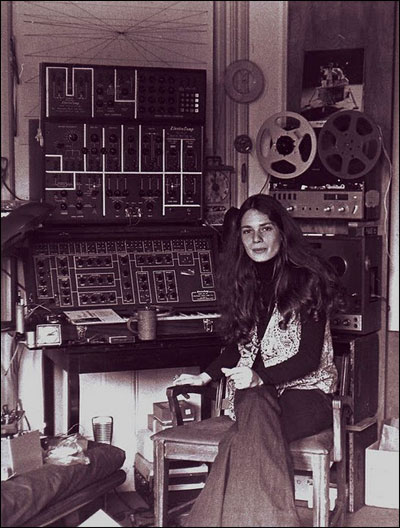
The track was recorded by electronic music pioneer and computer scientist Laurie Spiegel in 1972. Appearing during the film’s cornucopia scene, “Sediment” is a 9-minute soundscape created using an ElectroComp 200 analog synthesizer, two tape decks, graphing paper and a ruler. It’s the perfect music for the tense, terrifying moment when the competition truly begins.

“The only way to mix was to play something live, where one deck was playing audio while the other deck was recording the other machine,” Spiegel told Wired in a phone interview. “You piled the tape hiss and noise for every generation you added.” Spiegel recorded the piece in a five-room apartment running on a 15-amp fuse, leading to technical difficulties when her appliances interfered with the recording. “When the refrigerator went on, half the oscillators dropped by a quarter tone…. I had to turn the refrigerator off, or it would ruin the take.”


Laurie Spiegel surrounded by her equipment in the 1970s. Photo by Stan Bratman

[more on Wired, via Geeta Dayal]

Rick Santorum Releases Dystopian Horror Film

Man, do 2012′s Republican presidential hopefuls ever have a penchant for apocalyptic fiction! While Rick Perry fantasizes about Obama’s war on religion, (“the openly gay military hereby sentences you to re-education at Camp Kwanzaa!”) and Newt Gingrich speaks of colonizing the moon and pens alternate-history fiction in which Nazi Germany thrives (see also: “terrible sex scenes written by politicians”), Rick Santorum has just upped the ante.

This week, the Santorum camp released a chilling (read: hilarious) trailer for an eight-part series titled Obamaville. Rife with a combination of Silent Hill-like visuals, random stock imagery (meat grinders and babies!), and Obama/Ahmadinejad speech footage mashups, the 1-minute video closes with an ominous shot of the open road, with promises of more “coming soon.” YES PLEASE. It’s the perfect film to pair up with newly-released Iron Sky.

Matt Novak of Paleofuture has helpfully screen-captured and captioned the most striking images from the video. At time of writing, the video has 852 likes and 11,011 dislikes on YouTube. ”Santorumville” porn parody coming in 3… 2…

[via Matt Novak via William Gibson]

Kate Bush’s “Wuthering Heights”: The 36-Minute Masterpiece

OH SHI-

It’s Kate Bush’s “Wuthering Heights” slowed down to a crawl by Looking at Blue from the Kate BushNews and Information forum.

This technique never fails! Whether it’s Justin Bieber’s “U Smile” or a dial-up modem, the result is transcendent.

If this isn’t quite your speed (hurr), try the metal version of Wuthering Heights, performed by Angra.

[via Geeta Dayal / Dangerous Minds]

Industrial Culture Handbook: The Movie!

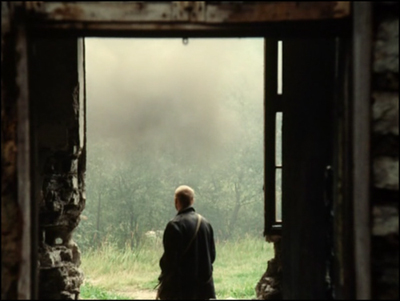
That might as well be the title of Decoder, a German film that came out in 1984. Unreleased in the United States and forgotten until the Internet recovered it in recent years, Decoder is a fascinating relic of the early industrial ethos.

Written by Klaus Maeck, directed by Jürgen Muschalek, and based on The Electronic Revolution by William S. Burroughs, the film focuses on a lone audiophile who discovers that multinational corporations are controlling populations through muzak. By playing the mind-controlling, sedative non-music in elevators, fast food joints, lobbies and stores all over the country, corporations such as the evil H-Burger are able to produce a docile population of consumers. To combat this, our protagonist turns to industrial noise, and inspires a legion of “cassette terrorists” to covertly swap muzak tapes for sounds that are much more subliminally sinister, inciting riots all over Germany.

The film’s score was a collaboration between F.M. Einheit (Einsturzende Neubauten) and Dave Ball (Soft Cell), with contributions from Genesis P. Orridge and Alexander Hacke. In addition to scoring, F.M. Einheit, a.k.a Mufti, also plays the film’s protagonist. Other characters include cult film actor, scholar and artist Bill Rice, playing a sad-faced security official on a mission to foil the cassette terrorists’ plot, and inadvertent heroin-chic style icon/musician Christiane Felscherinow, playing an amateur herpetologist/go-go dancer who looks eerily similar to Rooney Mara’s Liz Salander. Cameo appearances include Genesis P. Orridge and William S. Burroughs. The film is sprinkled with many other references to items you might find in a 1980s-era RE/Search publication, such as the appearance of a Brion Gysin Dreamachine inside a secret nightclub belonging to an industrial cult, as well as a giant Survival Research Laboratories logo on the wall of the protagonist’s  studio.

One of the film’s most stunning features is the color palette. “Lensed by Johanna Heer,” writes Samantha Anne Scott,  ”the film’s blunted, monochromatic color schemes — primarily red, green, and CRT blue — demarcate character, mood, and motivation … while doused with art house affectation, Decoder delineates a relatively cohesive narrative of corporatism, control, and the power of noise.” The full film is posted above.

[via wobbly]

An Experimental Film with Early Electronic Music Starring Anaïs Nin

Today, we celebrate what would have been Anaïs Nin’s 109th birthday by posting Bells of Atlantis, an experimental film from 1952.

The film stars Nin as the mythical queen of Atlantis and conveys, as Wonders in the Dark puts it, ”the experience of trying to remember and re-experience a dream.” Over cascading experimental footage, Nin reads aloud from her novella House of Incest. We catch glimpses of her nude form swinging in a hammock, and we see her shadow undulating over sheer fabric blowing in the wind, but for the most part, the imagery, captured by Nin’s husband Ian Hugo, remains very abstract, creating a “sense of swimming through a hallucination, trying to get closer to a world clouded not only by its own hazy nature, but the veils of memory and reality cast over it – given form by the watery ambiance that washes over the images.”


Bebe Barron, an early pioneer of electronic music.

The soundscape was crafted by Louis and Bebe Barron, two pioneers of electronic music who are best known for composing the world’s first entirely electronic music score for The Forbidden Planet, which the Barrons filled with ”bleeps, blurps, whirs, whines, throbs, hums, and screeches.” They built their own circuits, which they viewed as “cybernetic organisms,” and spliced together the sounds they made into collages. Louis did the work of creating the circuits, while Bebe did most of the composing. Their sound, wrote Nin, was akin to “a molecule that has stubbed its toes.” Bebe Barron was one of the first women in the field of electronic music, and in her last interview, she fondly recalls memories of her friend Anaïs.

[via wobbly]