Remember when people in the New York goth scene dressed like this? No? Okay, me neither. I missed out on the glory days of the New York Scene as well, and I have these paintings by Steven Assael to rub it in. I don’t know if it was truly as magical and mysterious as his paintings make it seem, but I do know that the people in them are real; here’s a picture of goth club legend Johanna Constantine, looking every inch as amazing in real life as in the painting above.The painting above is part of a sculpture called At Mother (Mother was an actual club in New York), which has the people above standing like guardians at a set of double doors. The doors of the sculpture (which can be seen after the jump) open to reveal the painting below:
Posted by Nadya Lev on October 13th, 2007
Filed under Art, Fashion, Goth | Comments Off on Steven Assael: Classic Portraits of a Scene
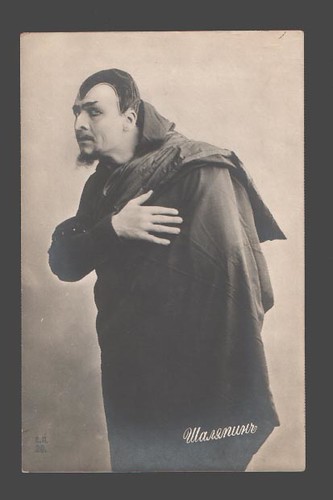
Famed Russian singer Fyodor Chaliapin as Mephistopheles. Chalyapin was known for his deep baritone and powerful on-stage presence, but in this image is something incredibly comical, he’s almost apologetic.
Honestly, I hadn’t been missing NYC at all since I moved out west last May. Then the autumn equinox hit. Ever since, I’ve been aching to take a long bike ride through the fiery foliage of Prospect Park.
Gordon and Morrison previously worked together on Morrison’s full length movie Decasia. Both pieces build around a very simple premise; film is a fragile medium. Nearly all of that old nitrate-based film stock is too grimy and scratched, rotting and stinking of vinegar to be of much use to film preservationists. Morrison salvaged 70 minutes of archival footage from someone’s rubbish bin, stitched it together and re-shot film that showed decay or was actively decaying, frame-by-frame, using an optical printer.
The cumulative effect is breathtaking, and for reasons that are difficult to articulate, will always remind me of New York in the fall.
In a devastating turn of events Lady Jaye Breyer P-Orridge has died due to a “previously undiagnosed heart condition.” She died in the arms of her other half, legendary industrial music pioneer Genesis Breyer P-Orridge.
The sad news was broken yesterday but we didn’t find out until today and I’m honestly heartbroken. Thanks to my once-spooky brother I grew up with Psychic TV and later, of my own accord, Throbbing Gristle, so Genesis’ dealings have always been on my brain’s periphery. My interest was especially re-kindled in 2003 when he and his partner of over 10 years, Lady Jaye, embarked on their radical body modification mission known as Breaking Sex or the Breyer P-Orridge Project. I saw them perform here in Hollywood just a couple of short years ago and witnessed their physical progress first-hand. Redefining gender and becoming of the same & superior sex, a physical representation of their psychological bond as well as a potential new step in human evolution.
Few grander testaments of love have been made, in my humble opinion, ever.
We extend our sympathy and condolences to Genesis and offer you a few links to information about Breaking Sex.
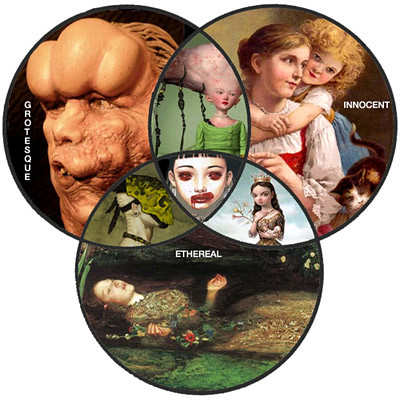
I’m a huge fan of the Babyart Livejournal Community, where people post pictures of tentacled, glass-eyed, pigtailed nymphettes that resemble broken dolls and frequently have their arm in a sling. The term “babyart” was originally just the title of Trevor Brown’s art website (don’t click it, mom!), but has since broadened to refer to the type of themes found in the art of Mark Ryden, Ray Caesar, David Stoupakis, Lori Earley and a number of other people who probably hate the idea that I’m mentioning them all in the same sentence together.
Once in a while, some misguided soul wanders onto the Babyart LJ thinking it’s a community about “Art, But With Babies In It” and posts something like this. Some people may like these pictures, but personally, it’s not why I joined the community. No, for me, this is what it’s all about! And this, and this, and this. One day a few months ago I got so fed up with the off-topic posts that I created this handy Venn Diagram to help establish some guidelines, a kind of subjective pocket guide:
My Babyart Venn Diagram was a hit. Still, I’ve still yet to figure out why “Babyart” has become such a huge phenomenon in the past few years, why this generation has embraced its themes like never before. Was there some show we all watched as kids that warped us into lovers of disturbing-cuteness? Is it some sort of cultural awareness of a loss of innocence? Any theories?
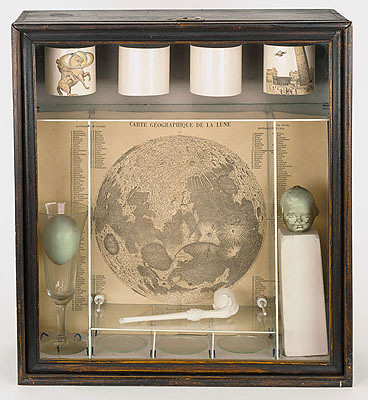
Soap Bubble Box, originally uploaded by Coilhouse.
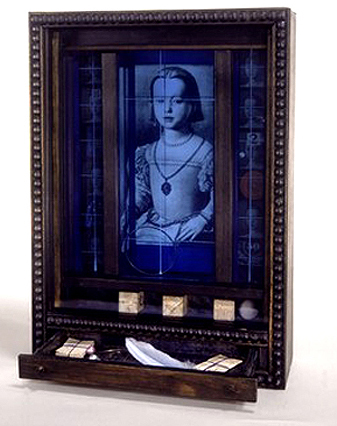
The magical curio cabinets and collages of Joseph Cornell make me pine for a Manhattan I never knew, for all things mildewed, dusty and indigo-hued, for faded starlets and forgotten prima ballerinas, and for constellations I have never seen.
Born towards the end of the Victorian era in upstate NY, reclusive Cornell never ventured any further than New England, but his body of work reveals an inner world of incalcuable depth. Inspired in equal parts by the penny arcades of his youth and the grandiose vision of the Dada/Surrealists, Cornell spent a lonely lifetime trawling L.E.S. flea markets and secondhand bookstores for nostalgic scraps of yesteryear. Whatever the medium (diorama, film collage, decoupage), each piece reflects the inexorable drive of a compulsive scavenger/architect to coax meaning and narrative –however mysterious– from discarded scraps of the past.
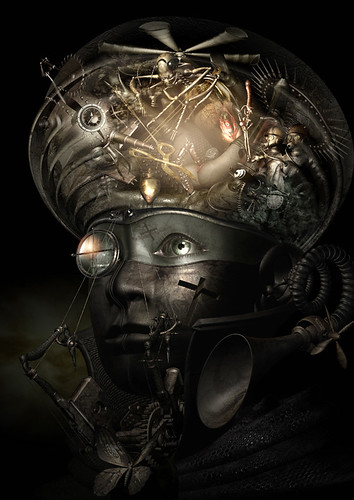
In vein with the hologram photos earlier, another odd, though more common medium. Usually I am, admittedly, prejudiced against 3D modeling, but something about Japanese artist Almacan’s work appeals to me. Maybe it’s that the medium suits the subject matter. His part Escher part Giger constructions are, undeniably, very 90s, but tonight I don’t particularly mind. Too busy being delighted by all the propellers and wishing I were watching Videodrome, or Tetsuo, for that matter.
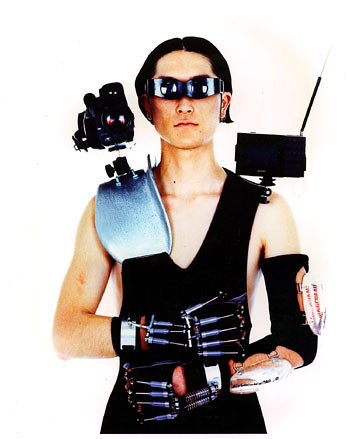
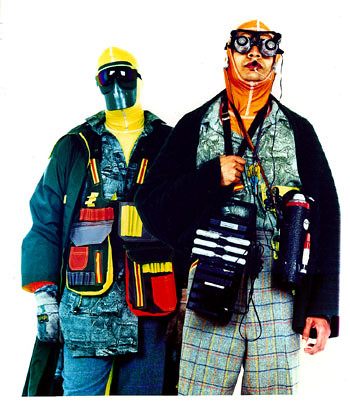
Steve Pyke is an English photographer who covered the early cyberpunk scene. Pyke writes, “Cyberpunks, a small subculture, influenced by the work of the author William Gibson and particularly the film Bladerunner, existed in London in the early 1990s. I became interested and photographed a series of about fifty portraits in my studio over a short period.” Here’s a link to his image gallery, which features 16 portraits. I love his clean, streamlined, almost anthropological portraits of this small sub-genre. There’s something really charming about this original incarnation of the cyber aesthetic.
One thing I found really interesting about this series that almost half the people in the pictures have some sort of lenses concealing their eyes. This makes sense, because mirrorshades were one of the strongest symbols of cyberpunk writing from the late 80s and early 90s, starting with Molly in Neuromancer. This is why everyone in The Matrix also wears mirrored shades as an homage.
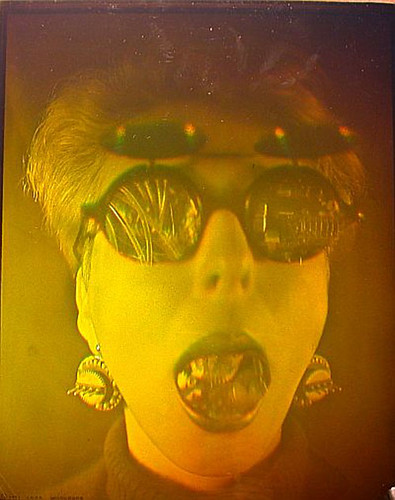
First saw this image in DrTenge’s livejournal and had to have MORE. It’s so classically cyberpunk from the actual image to the medium.
What i found through some quick googlemancery is a fairly large private collection of holographic photographs belonging to one Guillermito, apparently an admirer of technology in art and vice-versa. In a touching testimony he says “I think they are a perfect balance between esthetics and technology, between science and art…Buying fine art holograms is throwing money out of the window, financially speaking. You really have to love them. Because, basically, nobody cares.“.
A delightful page dedicated to Unidentified European Instrumentsfound during a search for old gypsy photos. Click on, dear readers, for wonderful vintage pictures of musicians wielding strange guitars.
typical nu-gypsy dance extravaganza photos. I’ve actually been to a performance like this as a kid in Moscow.
Not a single actual vintage Russian gypsy photo was to be found, however. I’ll resume this later, in the meantime there is a launch celebration to attempt.