Eugenio Recuenco’s String Diaspora

Issue 01 contributor Eugenio Recuenco recently updated his portfolio with a striking series of 12 images that span very different eras and cultures, all of which are united by one main character: the violin. The larger images can be seen on Recuenco’s site, and the full series can be seen here, after the cut.

In this series, the violin travels from the plains of Africa to an Indian bazaar, from an Elizabethan parlor to a pirate ship, from the hands of a white-clad nun to the laps of two conjoined Geisha twins. While it’s certainly a tribute to the universality of music, many of the images also seem to contain messages about culture, gender and inequality. In the image of Africa, the violins are represented as crops barely growing out of the parched soil. In the image depicting the Islamic world, one burqa-clad woman wearing black gloves points her violin bow accusingly at her fellow player, whose bare hands are exposed – a reference to the modesty police found in many countries in the Middle East, including Israel.  The American image seems to represent a two-party system orchestrating a rigid conformity. Interestingly, many of the images feature a visibly artificial background. In the Eskimo image, the sky is merely a cheap-looking painted sheet. The wallpaper in the Elizabethan image is stitched out of old rags. In fact, the images that appear to look the most “real” are the ones rooted in fantasy, such like the pirate, modern primitive, and fiddler on the factory roof.

The Black Keys – Tighten Up

Just a funky dinosaur puppet dance party on a lackadaisical Saturday afternoon. Frank’s got the moves:


Via Dr. Hypercube.

The Black Key’s new album, Brothers, drops May 18th.

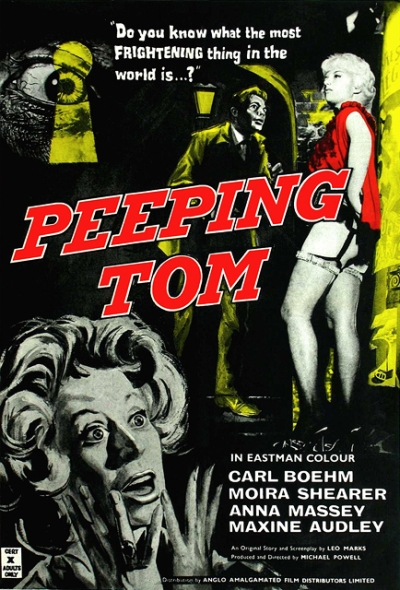
The Friday Afternoon Movie: Peeping Tom

(Update: The original playlist is gone, but you can still watch the whole thing here, courtesy of Lionsgate.)

It’s Good Friday today, the celebration of that penultimate event that preceded the most important of Christian miracles. In the spirit of this solemn occasion the Friday Afternoon Movie presents the story of a serial killer who impales his victims with a spike mounted to his video camera’s tripod. Happy Easter!

Released to intense controversy, Michael Powell’s brilliant Peeping Tom from 1960 is a film whose reputation has undergone a renaissance in the ensuing decades, starting in the 1970s. Martin Scorsese, in the book Scorsese on Scorsese, paired it with Fellini’s as a complete education in directing, saying:

I have always felt that Peeping Tom and 8½ say everything that can be said about film-making, about the process of dealing with film, the objectivity and subjectivity of it and the confusion between the two. 8½ captures the glamour and enjoyment of film-making, while Peeping Tom shows the aggression of it, how the camera violates… From studying them you can discover everything about people who make films, or at least people who express themselves through films.

Such effusive praise aside, Powell made a fantastic picture, one that manages to match the suspense of his contemporary, Alfred Hitchcock whose classic Psycho was released in June of that year, a mere three months after Peeping Tom.

The story of Peeping Tom is a simple one. Mark Lewis is a quiet man who works on a film crew, with aspirations of becoming a filmmaker. To supplement his income he also takes racy photos of women. He lives in a house willed to him by his father and rents out part of it while he poses as a tenant. He slowly becomes interested in Helen, who lives below him with her blind, alcoholic mother. Mark also likes to kill women with the aforementioned tripod, filming them as he is doing so. The explanation for this particular psychosis is that Mark’s father was a prominent psychologist who made his reputation by constantly harassing and terrifying his young son in order to better understand the psychology of fear, all the while filming his reactions, going so far as to wire all the rooms in the house.

To contemporary audiences this is all very old hat but again, at the time it was scandalous. The racier version of a scene with Pamela Green, in which one whole breast is exposed for two whole seconds, is credited with being the first nude scene in a major British feature, but even the cut version of this did nothing to silence the outcry. People were appalled of the idea of camera as weapon almost as much as they were by the fact that Powell cast himself as Mark’s psychologist father with his own son playing the role of Mark as a child, and the backlash effectively ended Powell’s career in the UK. A movie that can be read as an implication of its audience as voyeurs and the directors of horror films as psychotic killers, terrorizing the innocent for entertainment it was perhaps ahead of its time. The reevaluation of Peeping Tom is well deserved and Powell deserves all the recognition he can get.

“Animals Doing People Things” by Teagan White

Meet Teagan White, a 20-year-old Minneapois-based college sophomore originally from Chicago. Her work is the visual equivalent of warm milk and madeleines before bed. It has the same calming effect on me as Amy Ross, Finn Family Moomintroll, and Gnomes by Will Huygen/Rien Poortvliet.

Pictured here are some of Teagan’s illustrations on the topic of “animals doing people things,” inspired by J.J. Grandville’s animal art. After the cut, a motley assortment of favorites, taken from Teagan’s site and her blog. In addition to illustration and fine art, Teagan is also a typographer, sculptor and graphic designer. So young, so talented! One to watch. In fact, watch closely, because Miss Teagan will be collaborating with Coilhouse on something unique in the very near future. You heard it here first! Stay tuned.

Art Of The Mundane: Shining Shoes

If the internet has taught me anything it’s that, from the right perspective, anything can become fascinating. It’s a particular sort of alchemy comprised of varying parts talent, ingenuity, and obsession. Blogs are full of such inanities turned art projects; thousands of words devoted to even the most banal activities. Sites like YouTube are littered with such exercises in elevating the everyday, such as the one shown here in which gentleman goes about shining a shoe. Never uttering a word, the viewer is instead treated to a series of precise movements set to a soundtrack of clinking, tapping, rattling, and scratching. It is almost disturbingly riveting.

via Dark Roasted Blend

BIRDEMIC and the Dichotomy of Ironic Hipster Fan Luv

Lucky, lucky Los Anglicans. Your cup runneth over: Tarkovsky festivals, the approaching Hollywood Forever film season, Kenneth Anger screenings… and soon, an encore presentation of Birdemic: Shock and Terror:


Only last month, Cinefamily housed the drunkenly enthusiastic world premiere of this cinematic Tour de Farce. The screening was hosted by Tim and Eric in cahoots with Severin Films, who turned the entire West Hollywood theater into “a temporary aviary with epic displays of Birdemic special effects, props and costumes that… put the Smithsonian to shame.”

Some background on the film from Severin’s official press release:

Birdemic, described by [writer/producer/director] James Nguyen as a romantic thriller, is a horror/action/special-effects-driven love story about a young couple trapped in a small Northern California town under siege by homicidal birds. Birdemic also tackles topical issues of global warming, avian flu, world peace, organic living, sexual promiscuity and lavatory access.

Nguyen, a 42-year-old Vietnamese refugee, wrote, cast and shot the film over the course of four years using salary from his day job as a mid-level software salesman in Silicon Valley. The film pays homage to Hitchcock’s The Birds via location shooting in Mission Bay, California, as well as an appearance by star of Tippi Hedren. When rejected for an official screening slot at Sundance, Nguyen spent eight days driving up and down the festivals nearby streets in a van covered with fake birds, frozen blood and Birdemic posters, while loudspeakers blared the sounds of eagle attacks and human screams.

Severin’s executive producers took one look at Nguyen’s labor of love and bought the rights to Birdemic for the next 20 years.

After the premiere screening last month, Nguyen and Birdemic co-stars Alan Bagh and Whitney Moore stayed on hand for a lively Q&A session with their soused and roaring public. They laughed, they cried, it was better than Cats. Now, thanks to popular demand, Birdemic is hitting the open road. Screenings are scheduled in thirteen cities across the continental US, starting April 2nd. Not since The Room or Troll 2 has a film been so poised for Ironic Hipster Fan Luv.

Hey… can we talk about Ironic Hipster Fan Luv for a sec?

Or not. In fact, I’m going to put the rest of this post under a cut, because I honestly don’t know if its ouroboric tone will be interesting, or merely irritating, to the majority of our readers. If you’re not already rolling your eyes with your arms folded across your chest, I invite you to read on!

Andrew Chase’s Metal Mammals

I’m really not sure what I have to say to properly convey the danger of robots to you people. Really, at this point I feel that the risks should be self-evident; but almost on a daily basis I am proven wrong. You just do not seem to understand where this road leads to and my words appear impotent, unable to realize the dark future I see should mankind continue down this path towards sentient mechanical beings.

And yet, I find myself unable to just give up. Someone has to be the voice of reason, if only to be able to point out that they told you so; and that person might as well be me if only because I like being right and I am an accomplished pointer, if I do say so myself. With that in mind follow my index finger and gaze in horror and wonder at the sculptures of Andrew Chase. Chase, unlike most who crusade for our demise by automatons, has his sights set squarely on the animal kingdom, making him, perhaps, even more despicable — for what kind of man would set such a plague upon the beasts of the Earth, innocent and pure as they are? Chase has no such qualms, creating giant, lumbering steel pachyderms and lithe, gear-driven, and indefatigable cheetahs. The savannas of the future will be occupied by metal giraffes, wading through the corpses of extinct fauna to hunt down the last of humanity with laser eyes under a smog-choked and blackened sky, mark my words.

And you’ll have only yourselves — and Andrew Chase — to blame.

Mister Graves’ Nuclear Landscapes, Life-worn Faces

Mister David Graves does many things, but this post is about his gorgeous photography, and about his charity walk across Oregon in support of the Oregon Food Bank. More on that in a moment. In fact, this post is just about two aspects of his photo-repertoire, while there are several. For instance, Graves has taken plenty of photos of beautiful women and forgotten cemeteries, but today I’d rather show off his nuclear landscapes and life-worn faces.

The shot below is titled “They Make Milk Here”.
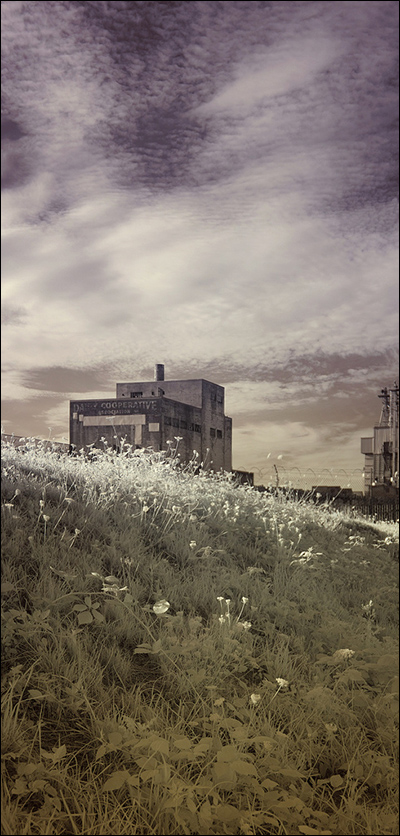
Arresting, yes? This is one of a series of vertical panoramas, another one of which is below the jump. Uncle Tarkovsky would approve.

Much of Graves’ work explores nature – sometimes coexisting in contrast with civilization, other times wild and exceeding all, with objects of human development becoming lifeless artifacts, left behind by an environmental revolution.
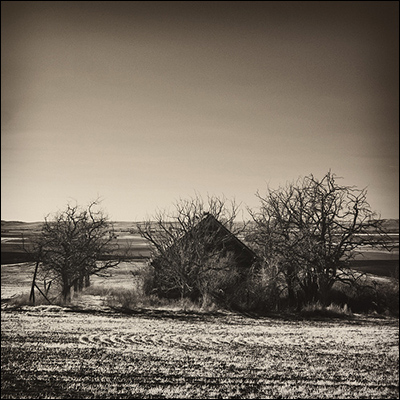

Dead House

Another dimension of Mister Graves’ work takes on cities, society, and its casualties. His photos of the homeless are, to me, among his best. On Flickr, these portraits are often accompanied by short blurbs of how the shot came about. This is Sally, captioned, “She asked for change, I asked for a picture in trade. She showed me her tattoo.”

Graves is far from a spectator with a camera. After years of working for various non-profits and going through a number of skin-thickening experiences like hitchhiking across parts of America, he’s decided to spend ninety days walking for charity. He leaves next week. On his website, WalkingOregon.com, David Graves states:

I believe that access to real food is a basic human right. This philosophy is in line with the work the Oregon Food Bank does, and therefore I have chosen them as my charity for this event. All donations, minus personal expense, will be given to the Oregon Food Bank to support their efforts throughout the state. It is my hope that through the kindness of individual donors, and aided by numerous radio interviews/newspaper articles, I can raise $40,000 for the Oregon Food Bank.

My walk will begin and end at the State Capitol building in Salem. The event is planned to last anywhere from 80 to 100 days, with a scheduled start date of April 5th. My planned rate of walking is 15 miles per day, but I am leaving room for various setbacks, such as sickness, closed roads, and theft/robbery. My walk will begin heading east from Salem until I reach John Day. From John Day, I will walk north to Umatilla, and back west to Portland. From Portland I will walk to the coast and continue south to Coos Bay. The final leg of my walk will take me from Coos Bay to Springfield and back north to Salem. Many of my nights on the road I will be camping, in an attempt to keep my personal expense as low as possible. Any couches/hotel rooms that can be offered along the way will be of great help.

David is taking his cameras along for this journey, and he’ll be documenting his adventure online, which I’m really looking forward to. You can follow his progress on the Walking Oregon Facebook page.

Click the jump for some of my favorite shots by Mister Graves.
A Tribe of Dark and Poetic Creatures


Les gardiennes du temple : “La tordue “

Like a menagerie of majestic, menacing mythological creatures from savage campfire fables, or ancestral memories translated through the fantastical filter of dreams, Svene’s dark sculptures possess a primitive grace, a fierce  splendor, and a shadowy awareness of faith, and fear and love,   inextricably linked.

As a dance teacher, art director and choreographer for a collective, the enigmatic Svene’s  artistic path seemed to be mapped out;  during those years she had explored music, choreography and scenography….but felt that a part of her “remained asleep”

Better Than Coffee: Dom Yunogo Technika

Ah, the legendary 14th episode of Nu Pogodi (“You Just Wait!”), a ’70s/’80s children’s cartoon outlining the tormented, love-hate, co-dependent relationship of Zayatz and Volk (bunny and wolf), the Wile E. Coyote & Road Runner of the USSR.  Their relationship spanned 16 “classic” episodes (from 1969 to 1986) and included plenty of substance abuse, violence, “bad touches,” and one very awkward romantic dinner.

The 14th episode – with its murderous rabbit simulacrum, metrosexual hair-cutting/pants-pressing robots, junky schteeempunk Volkswagon (YOU SEE WHAT I DID THERE?!), and zero-G flight simulators that play Space Race-inspired Soviet pop music. Episode 14 – my first exposure to electronic music of any sort. The techno kicks in at 2:57, when the main Space/Technology portion of the episode begins. In this episode, the wolf chases the rabbit around the “Dom Yunogo Technika,” which translates roughly to “House/Society of Young Tech-heads.” (That’s my best 5 AM translation, at least).  Before 2:57, there’s a short mini-episode in which Rabbit & Wolf share a dinner together – the aforementioned date, which ended in hilarious tragedy and made the show go down in Russian gay animation/film history, as both Rabbit & Wolf are male.

As with all episodes of Nu Pogodi, which can be found on YouTube, the wide-ranging music is one of the best parts. This episode is one of the best examples of that. The tracklist of Episode 14, which includes some appearances by Western artists, is this:

1. Alla Pugachova – Million Alyh Roz
2. Digital Emotion — Get Up, Action
3. Digital Emotion — Go Go Yellow Screen
4. Bonnie and Clyde – Leroy Holmes
5. Methusalem (Empire) – Black Hole (Bavarian Affair)
6. Digital Emotion — The Beauty & The Beast
7. Zemlyane – Trava u Doma
8. VIA Leisya Pesnya – Kachaetsya Vagon