FAM Double Feature: Invasion Of The Neptune Men

While it must be said that all actors start somewhere it must also be said that some start lower than others. Sonny Chiba, before starring in the martial arts films that would bring him international success, was no different taking roles in scores of what can only be described as truly terrible films. This is not to say that his output since then has been of stellar quality and one could say that he never quite graduated from the B-movies of his youth but then one might risk Sonny Chiba punching one in the face so hard that one’s eyeballs exit explosively from one’s colon.

Today, the FAM takes a look at one of those early films, Invasion of the Neptune Men from 1961; a title that simply screams B-movie. The then 22-year-old Chiba plays one Shinichi Tachibana, a mild-mannered astronomer, who in actuality is the superhero Iron-Sharp, or Space Chief as he is called in the English dub. When mysterious metal aliens arrive to invade Earth, it’s up to Iron-Sharp/Space Chief to stop them.

It’s standard, ’60s era sci-fi/superhero fare with the distinct advantage as being a pretty awful example of the genre. With a kitsch factor this high it was no surprise that it was featured on the cult television series Mystery Science Theater 3000 in 1997. Indeed the movie was so bad that it almost succeeded in fulfilling the plans of Dr. Clayton Forrester to drive Mike Nelson, Tom Servo, and Crow insane. They are only saved by a surprise visit from characters from the 1958 Japanese television series Planet Prince. The movie received fairly harsh treatment from the three, including one off-color moment in which they refer to Chiba’s character as “Space Dink”. The MST3K version also omits footage of the destruction of Tokyo which was actual World War II bombing footage — the writers’s feelings being that it had no place in a kids’s movie.

Regardless of such questions of taste, Invasion of the Neptune Men remains a prime example of ’60s era, Japanese cinema awfulness; a must watch for anyone looking to expand their knowledge beyond the likes of Godzilla.

Inner Space

I realize that this demo reel from Hybrid Medical Animation may only appeal to me. As a child if I was sick I would often visualize the goings on within my body as some sort of protracted war; a campaign waged around and within the machinery responsible for the operation of the various divisions of my physical person. Even now, ask as what some would call an adult and what others would call a drooling man-child, buy cialis I still fall back upon these simplistic representations when feeling feverish. Hybrid, pills of course, represents the internal mechanisms of the human body as close to their reality but still, when viewed from a macroscopic perspective, they swiftly recall those childhood visions.

Children by the Millions Wait for Alex Chilton

In honor of Alex Chilton’s passing, we’d like to publish this article written by Joshua Ellis. This article appeared in Coilhouse Issue 04. You can also view a PDF of this article, by a strange twist of fate, over at the official Pixies website. It’s not an article about him, or The Pixies, per se. However, we’ve been wanting to publish this article on our blog for a while now, and this feels like the right moment to do so. This article speaks to the heart of why we’re all here together. What’s that song? / I’m in love / With that song…

I have this memory, and I’m not sure if it’s even real–or if it’s real, if it’s cobbled together from a half-dozen memories, fragments of things that happened over the course of a year or two that began the summer before I started high school, in 1991.

In this memory, I’m sitting in the basement of a girl named Sara, who pronounced her name “Saah-rah” and had purple hair and smoked clove cigarettes. I didn’t know Sara very well, but she was part of a small collective of freaks and weirdos that I had congregated to when I moved that summer from my ancestral home of north Texas to the small mountain town of Hamilton, Montana.

I’m sitting in Sara’s basement with my friends: Jeremy, the pretty guy who wears big black woolen overcoats and Jamaican tam o’ shanters in bright yellow and red and green, and seems to have unlimited access to the panties of every single girl in the Bitterroot Valley; Wade, who perpetually sports Birkenstock loafers that look like inflated bladders and drives a white Volkswagen Beetle covered in Grateful Dead stickers; Nate, who is one of the best guitarists I’ve ever met and is a huge aficionado of what will later come to be known as “extreme” sports, like bouncing down jagged rock faces on a beat-up skateboard deck; Sarah and her sister, Jenny, who are both fond of dropping random giggly non sequiturs into the conversation when stoned.

They’re all here, or some of them, or none of them. We’re sitting in the dark, talking bohemian bullshit, maybe smoking pot. It’s the kind of night that gets put on endless repeat when you’re young and strange and condemned to spend your adolescence in some far-flung desolate shithole like Hamilton, Montana, where you can’t lose yourself in the noise or happily become part of it, the way you can in New York or Seattle or Los Angeles or Chicago.

I’m not as cool as they are. I don’t know about cool shit. I’m just this uptight kid from J. R. Ewing Land who talks too much, still wears Bugle Boy button-downs and M. C. Hammer pants, and has only the dimmest idea that there’s some entire world out there of cool shit that I know nothing about. I own a Jane’s Addiction album and I’ve vaguely heard of the Sex Pistols.

And in this memory, Sara gets up and puts a cassette tape into her boom box. It’s a time traveler from 1984, beaten and scuffed, with the inevitable broken-off cassette door, so you just slap the tape in and hope that the tape head keeps it from falling out, which will cause the relentless motors to chew the tape and unspool it like the entrails of a slaughtered pig. Sara slaps the tape in and hits play.

This song comes out–a slow beat, big and echoing, then a bass playing eighth notes, and then a guitar, dreamy and vibrating. It sounds like what I imagine sunrise on a beach would be like, like what I imagine doing heroin would be like, like what I imagine sex in a dark room with that awesome girl you lie awake and dream of meeting would be like. I haven’t experienced any of these things–yet.

And then a voice, a high husky man’s voice, gentle over the music.

Cease to resist, given my good-byes
Drive my car into the o-o-sha-hah-hahn

You think I’m dead, but I sail away
On a wave of mutilation, wave of mutilation
Wave of mutilation

Way-hey-hey-hey-have

“What is this?” I ask. Sara shrugs.

“It’s the Pixies,” she says in this memory that may not even be real, or maybe didn’t happen this way at all. “The song’s called ‘Wave of Mutilation.’ This is the U.K. Surf Mix. The real version is faster and louder.”

“I’ve never heard of them,” I said. “I’ve never heard this.”

“They’re pretty cool,” Sara says. “I think they’re from, like, Boston.”

I nod. Pretty cool.
A Depressed Whale

FilmCow, buy creators of such classics as “Charlie the Unicorn” present the story of a depressed whale and the fish who tries to help him. What ensues is a vicious cycle of victimization and one-upmanship; a harrowing look at the nature of survival in the briny depths of our oceans.

via The Daily What

Youareareyouwhoareyou… Jonna Lee?

In the past two months, seven clips have appeared on YouTube under a mysterious account titled iamamiwhoami. Two days ago, the first full-length music video appeared – and many are claiming that, based on a few clues in the video, the identity of the author (widely rumored to be Goldfrapp, Trent Reznor, Lykke Li, Lady Gaga, The Knife and, seriously, Christina Aguilera) has finally been uncovered. But first, a bit of background by Leila Brillson to underscore the sheer amount of gematrical/Fortean weirdness packed into this haunting viral endeavor:

In December, a 55-second clip of a hyper-saturated, eerie (Scandinavian?) forest appeared on YouTube. No information was given, just the title “Prelude 699130082.451322-5.4.21.3.1.20.9.15.14.1.12.” The set of numbers following the dash, when matched to their alphabetical correspondents, spell “Educational.”

A few weeks later, a second video emerged, with a dirt-covered blonde girl seductively licking trees to a slow, driving electronic beat – the message this time, “Its Me.” Each video ended with the outline of an animal: a goat and an owl, respectively. The next video, accompanied by a funkier and more cheerful song, featured the painted girl again, up-close, with freakishly large eyes… this time, it spelled “Mandragora.”

The next video (“Officinarum”) increased the count to five (the featured animals, at that point, comprised of a goat, owl, whale, bee and llama). Then, on Friday, [James Montgomery, a music editor] received a package from a messenger service. “It was a thin, brown envelope with my name and floor typed on the front, and no return address.” Inside was a strand of hair from the blonde wig, some bits of wood, and what Montgomery calls a codex.

The project is not without a sense of humor. Each of the videos has a hyperlink in its description to another random but zoologically relevant YouTube clip –  Spit On by a Lllama, Screaming Monkeys, Bumble Bee on a Sunflower, to name a few. The new music video, which you can see below, links to this terrifying monstrosity.

So, yes! Now that the new music video has been posted, people have been started putting together the pieces. The most compelling evidence is here – while it does take a bit of magic out of the whole thing, it’s an impressive piece of internet sleuthing.

Yep, she’s a weird one. Please, please let it be her, and not some overproduced pop star. I mean, look at what she did to Nitzer Ebb. Jonna, if this is you, you have arrived!

Harry Crosby’s Black Sun


Harry Crosby and unidentified woman, Four Arts Ball, Paris

“Yet it was precisely in his character … to invest all his loyalty and energy in magic: at first the approved magic of established religion; later the witchwork of poetry and sun worship; finally the black mass of violence” -Geoffrey Wolf, Author of Black Sun: The Brief Transit and Violent Eclipse of Harry Crosby

Harry Crosby – self indulgent socialite, tortured poet, wealthy mystic …. a playboy who lived his life with reckless abandon – was a man both adored and reviled. He has been described by some as “a representative figure of the so-called Lost Generation”, the bohemian 1920s.

A godson of J.P. Morgan Jr., Harry was a Harvard graduate and a decorated war veteran, who had left school to become an ambulance driver in France with his upper-crust chums during World War I. He ended up with the Croix de Guerre for valor and, after a few frustrating years back in Boston, fled to Paris for the rest of his short life. Married in 1922 to Mary Phelps Jacob, known as “Caresse”, they lived the “ultimate Bohemian lives as poets, artists, and patrons in Paris in the 1920’s. To every adventure their answer was always ‘yes’.” Harry once sent a telegram from Paris to his father, the quintessential sober, patriarch, which read, “Please sell $10,000 worth in stock. We intend to live a mad and extravagant life.”

While living and writing in Paris Harry Crosby founded The Black Sun Press, one of the “finest small presses of the twentieth century”.   In 1924, the Crosbys went public with their first book. The following year, they each published their first collections of verse. Harry commissioned Alastair – a “spectacularly camp” German creator of beautifully decadent and Gothic fantasies – to illustrate his second collection, Red Skeletons.  Soon they were issuing works by other writers, including Poe, James, Wilde, Joyce and D. H. Lawrence.

Color plate from Red Skeletons, by artist Alastair

On December 10, 1929, Harry was found in bed with a .25 caliber bullet hole in his right temple next to his mistress, the newly married Josephine Bigelow who had a matching hole in her left temple, in an apparent suicide pact. Harry’s toenails were painted red and strange symbols were tattooed between his shoulder blades and on the soles of his feet. A lover of dark mysteries to the last, he left no suicide note. London’s Daily Mirror speculated on psychological motives, while New York’s Daily News blamed poetry and passion: “Death itself had been the motive, others speculated, just as aspiring poet Harry’s life had been his greatest artwork.”

Coilhouse recently caught up with Erik Rodgers, founder of String and a Can Productions, and director of The Black Sun: The Life and Death of Harry Crosby, who provides his own insight into Harry Crosby’s strange, short life and speaks to what makes the man such a fascinating study.

Coilhouse: How did you come to decide Harry Crosby might make good material for a play – what it was about him or his life that inspired you, or what aspect of him you were hoping to shed more light on? How did you come across him to begin with?

Erik Rodgers: I actually came upon Caresse first, while developing a project on Salvador Dalí.  [My business partner] was intrigued by the idea of such an accomplished and independent female from that era, and started researching her life.   Of course as soon as she began reading about Caresse, she discovered Harry as well.  Their story captured her imagination, and she began relating to me some of the details as she read them. We both felt there was something vital and overlooked in their story, something that had been obscured by all the scandal and negative criticism.

Coilhouse Kindred Spirt: Yaso Magazine

Some more Serious Journalism from my time in Japan (see also: cat cafes). I previously mentioned Yaso Magazine in a post about Neon O’Clockworks – as promised in that post, here are some snapshots of Yaso for you to see! It’s a beautiful, hefty magazine with themed issues, published and distributed almost exclusively in Japan. I took some photos of three issues with the following themes: Vampire: Painful Eternity / Heartrendingness, Victorian: Influences & Metamorphoses of Victorian Culture in Today’s Japanese Sub-Cultures, and Sense of Beauty: Japanese Aesthetic. Other themed issues I didn’t get my hands on: Svankmajer (yes, an entire Svankmajer-themed issue), Gothic, Monster & Freaks [sic]. I also had a fourth issue called Doll, but gave it away to Ross because he is a doll fancier before I got a chance to snap some photos.

It’s a stunning magazine. Paging through it feels like like falling into a paper-fetish world that’s at once completely alien and intimately familiar.

The small pictures don’t do it justice, so click on through to the Coilhouse Flickr Set to see the full, annotated collection of images. This magazine cost around $15 in Japan, but I’m only finding it priced at $35 for those of us living in the US or in Europe. I’ve even seen copies appear and disappear for about $45 on Ebay. The magazine is almost entirely in Japanese, as is their site.

We are so inspired to see others publishing the kinds of things that we love, all over the word. We don’t know the people who do Yaso, but we are so, so grateful for them.

Fantastical Morphology: The Art of Richard A. Kirk


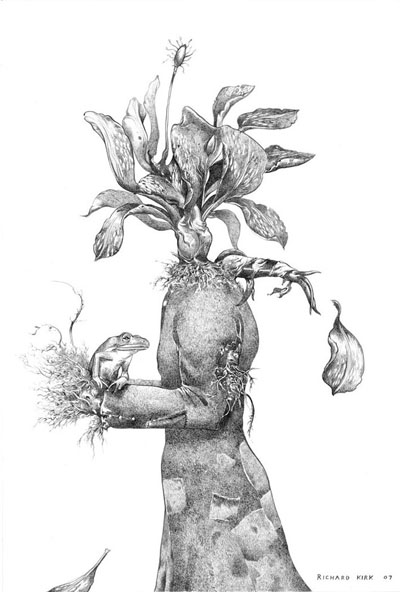
Botanica” by Richard A. Kirk.

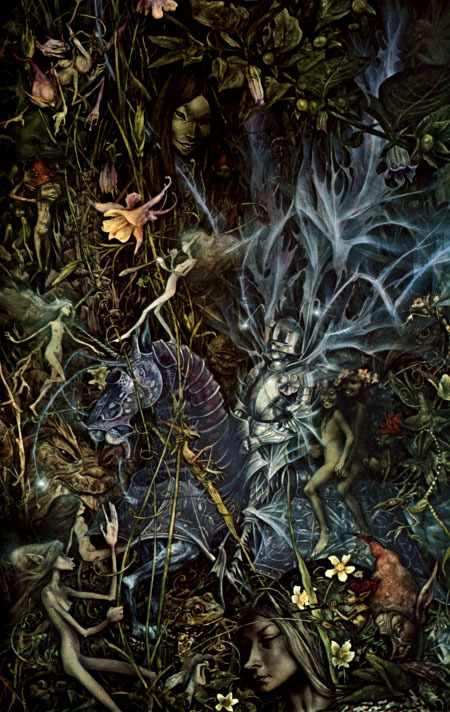
The artwork of Richard A. Kirk is delicate, dense, mysterious, formidable. Rendered in ink, graphite and silverpoint, his most successful pieces conjure echoes of everyone from Rackham and Froud to Yerka and Barlow and Beksinski; everything from the The Garden of Earthly Delights to The Fairy Feller’s Master Stroke to Haeckel’s monographs; yet the overall aesthetic is very much its own thing, and still evolving.


Chimera” by Richard A. Kirk.

Kirk’s done illustration work for China Mieville and Clive Barker, and shares Strychnin representation with Coilhouse faves like Madeline von Foerster, Chet Zar and Natalie Shau. In other words, he is a badass. Keep an eye on him.

A few more pieces after the jump. Click their titles to see higher res versions. Also see previous Coilhouse coverage of:

Friday Afternoon Movie: 4 Oscar Nominated Shorts

It’s one of those Fridays. Nothing going on; nothing doing. Sitting at your desk, playing FreeCell, only stopping to see how far the hands on the clock have progressed. Then to see if the clock is slower than your computer. Then to check your watch, just to be sure. Maybe they’re all wrong; better check your phone. Damn.

Well, as a personal service to you, please allow the FAM to distract you for a number of minutes. Don’t worry, you can always go back to FreeCell. In the meantime let us present to you three of the animated shorts nominated for Academy Awards this year. Yes, I realize that the Academy Awards have already been handed out, thereby robbing these of a modicum of suspense, but I’m sure you’ll survive.

First up is Fabrice O. Joubert’s French Roast, the story of a less than agreeable gentleman who seems to have left his wallet in his other trousers. And just what is the deal with that nun?

Next is Granny O’Grimm’s Sleeping Beauty, directed by Nicky Phelan. It is perhaps best to not let a bitter, elderly woman read fairy tales. She may very well color the story with her own, distinct outlook.

Thirdly: Javier Recio Gracia’s The Lady and the Reaper, the story of a young doctor’s battle with Death over the fate of an elderly woman whose only wish is to be reunited with her departed husband. It’s a fate that she alone will decide.

And lastly we have Logorama directed by François Alaux, Herve de Crecy, and Ludovic Houplain. Police drama! In Los Angeles! A Los Angeles comprised of corporate logos! Will the Michelin Men be able to apprehend Ronald McDonald or will an earthquake kill them all!? Watch and see!

And so today’s FAM draws to a close. For those of you wondering, the fifth and final nominee was Wallace and Gromit: A Matter of Loaf or Death from Nick Park which is not on YouTube because the BBC have just a few more lawyers than these other guys. The award this year went to Logorama.

Now, what time is it…

Getting Out of Bed with Richard Foreman


Film courtesy of Syndicate of Human Image Traffickers

Storytelling is, among other things, the art of regulating the flow of information shared with an audience. Playwright Richard Foreman is a foremost master of this art, withholding much that makes our world familiar and meaningful.  In his plays, we are thrust into a room – perhaps suggestive of the human psyche – where information circulates without context, and language often appears to lose its capacity to bear information or even conjure words.  Characters inhabit situations and events transpire, but usually without the problem resolution endemic to most fiction.  Ultimately, we never know whether what we have witnessed is satirical, psychological, resolutely absurdist, or somehow all three concurrently.  Enduring such a bewildering circumstance, the audience is challenged to find or impose order and meaning – never knowing which they are doing.  As you may well imagine, this is not easy art.  It may leave the theatergoer uneasy – even queasy – amid buzzers, flashing lights, warped music, and the voice of un-reason.  One may even wonder whether it’s akin to what Jeremy Bentham said of natural rights: “nonsense upon stilts.”  If, however, the official tastemakers are to be believed, this is theatre operating at a high degree of abstraction, offering sly humor and curious insight into our social and inner worlds.

Richard Foreman’s Ontological-Hysteric Theater made its debut in 1968 – a year redolent with meaning for alternative culture – and his plays have been a mainstay of the weird and wonderful (and wise?) ever since.  He has written, directed, and designed more than fifty plays, received five “OBIE” (Off-Broadway) Awards for Best Play of the Year, the Literature Award from the American Academy and Institute of Arts and Letters, a Lifetime Achievement in the Theatre Award from the National Endowment for the Arts, the PEN Club Master American Dramatist Award, a MacArthur “Genius” Fellowship, was elected officer of the Order of Arts and Letters of France, and his direction of the 50th anniversary production of The Threepenny Opera was nominated for both T.O.N.Y. and Grammy Awards.


Foreman directs at Tanglewood, 1968.

For nearly 20 years Foreman has launched his plays from a little theater on the grounds of the historic St. Mark’s Church-in-the-Bowery in New York City’s East Village.  For those of us for whom an annual trek to Foreman’s demented dimension provides regular respite from worlds we are otherwise doomed to inhabit, I bear bad news: this year’s play is slated to be his last.  And for those new to Foreman, or without the ability to see one of his plays in New York or when they tour Paris or Los Angeles or Berlin, there is good news: he will now be turning his prodigious talents exclusively to film making.

A blinkered guest in Foreman’s book, art, and technology engorged SOHO loft – one of the original lofts designed by George Maciunas – I feebly tossed feeble questions before the “Genius” himself.  Despite his telling me that he “didn’t like people,” Foreman was a good sport, ruminating on whether alternative- and counter-cultures have futures, the keys to a vital art scene and to becoming an artist, the meta-politics of theatre, and his mystical yearnings.  Alas, I still don’t understand why existentialists get out of bed in the morning.  The Syndicate of Human Image Traffickers maintained surveillance (see above) and the remainder was captured by my electro-ear (see below).

COILHOUSE: What first brought you to lower Manhattan?
RICHARD FOREMAN: I moved to lower Manhattan because, in the middle 1960s, I got friendly with Jonas Mekas, who was head of the underground film movement, and a close friend of his was George Maciunas, who was the head of Fluxus.  At a certain point, George made his art setting up artists’ coops.  It was totally illegal.  I was coming down all the time to look at underground films.  At one point, I told George that I was ready to take the risk and move downtown, and he got ten people to buy a building together.  Starving artists did all the work of converting the manufacturing lofts into living lofts.  I was going to films Jonas was showing all the time and, at one point, I dared to tell him that I was writing plays. I showed him a play. He allowed me to show it at his theater when the fire department closed it after they said that he didn’t have a proper license to show films, since it was a play.


Photo via Real Time Arts.