Unlike many, I have no particular quibbles with Scientology. In terms of belief their particular brand of lunacy is no more abhorrent than omnipotent bearded men, elephant-headed deities, or reincarnation. There is something intrinsically modern about Scientology’s aliens and space-faring DC-3s. It is a a belief system with a mythology that could only have been invented by an author of science fiction. No other person would have that complete a vision or be willing to go so far beyond the pale. In that regard it is no surprise that the likes of Anonymous have pursued the organization as it has. They are, after all, infringing on prime geek territory.
In keeping with that same tone, Scientology has started a new advertising campaign comprised of a trio of commercials aimed at enticing the public. The one above is most interesting. If one didn’t know better one might speculate that it was aimed squarely at the aforementioned 4chaners, as it appears to be a none to subtle nod at a similar speech from Fight Club which, among other things, inspired the boards’s rules. Perhaps it is merely a byproduct of the organization’s many ties with elite Hollywood actors. Either way, the ads are undeniably slick and handily fit in with Scientology’s sci-fi roots. These are ads you would expect to find on the television in a Philip K. Dick novel; plastered on the billboards of some dystopian, near-future Los Angeles.
Mostly, though, they bring me back to my childhood, staying home sick from school and watching daytime television. Family Feud cuts to commercial break and a series of insightful questions flash on screen, appended by page numbers. How can a person suddenly lose confidence? Can your mind limit your success? Paper or plastic? Then, CRASH, a volcano explodes on the screen, churning up a hellish cauldron of white-hot magma, an ominous voice intoning the words “Read Dianetics, by L. Ron Hubbard. It’s the owner’s manual, for the human mind.” It had a profound effect on me as a child. At least, until The Feud came back on.
Like any other job, there are downsides to being employed at the Catacombs. The company health insurance does not cover dental, for example. Also, parking is sparse. There are also more idiosyncratic deficiencies and policies, like the recent memo I received from Zoe which informed the staff that olives would no longer be allowed on the premises. Still, for every omission or strange and drug-addled edict, there is a perk. Our co-pay is almost criminally low and the break room is always fully stocked. The company also works with other local businesses to get discounts for employees, like 10% off electrolysis (Thanks, Dave!).
Certainly the best perks though, are the company vehicles. Not only are they immaculate and well-kept, they are also available for employee use. It’s comforting to know that should the grind of panning through the silt of the web for that tell-tale sparkle become too much, one can call down to M.E.R. to have their office unlocked and sign out the company balloon for an hour. After being escorted to the roof there it will be, the cranium full and bobbing gently over the basket. Then, it’s just a matter of dropping some of the eyes and you’re on your way. Just you, your armed guard, and the endless gray vista.
There are some days on which I have absolutely no intention of blogging. My mind dessicated, dry and wrung out like an old, disintegrating sponge, the words are simply no longer there. They have abandoned the empty husk which once housed them and have relocated elsewhere, out of my reach and away from the harsh, disapproving gaze of the blinking cursor on my monitor.
This was to be one such day and, indeed, it was until I came across this piece, entitled Fluid, by Clair Morgan. Something about it stuck with me and I kept coming back to it; staring at it. I thought about it on my way home. It’s hard for me to pinpoint just exactly what draws me to it. I suppose it’s the precision of the entire affair. The way the strawberries are hung in neat rows except for those that perfectly follow the trajectory of the fallen crow. The arrangement of the crow itself caught at the point of impact; and the carefully squashed strawberries that accompany its terminus. All these, working in concert create a startling sense of movement; of a moment frozen perfectly in time.
There is, I find, a fascination with outdated methods of medicine. It stems, I think, from a combination of what strikes us now as the humorous ignorance on the part of the medical practitioners of bygone eras and abject terror at the products of said ignorance. Certainly, a quick glance around the web finds a myriad of lists focusing on extremely painful procedures and heinous looking surgical objects meant to cure ailments ranging from appendicitis to hiccups.
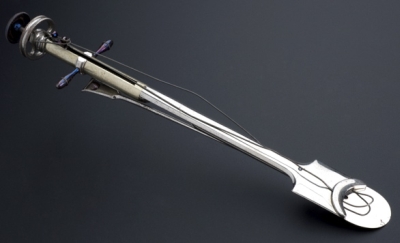
This particular list of “20 Scary Old School Surgical Tools” is no exception and, indeed, it does manage quite handily to fulfill the purpose set forth by its title containing, as it does, a score of surgical instruments of dubious nature and malevolent air. It is rife with miniature scimitars, saws, and horrid contraptions meant only to mutilate and scar as well as less insidious forms of early quackery like the tobacco enema kit pictured above.
The hook here, so to speak, is the sheer brutality these instruments represent. There is no subtlety or delicacy involved; they are meant to create a serviceable opening as quickly as possible so that the doctor could insert their hands inside whatever cavity was their focus. In that regard, it strikes me that, perhaps, the gynecologist’s arsenal remains little changed, a collection of devices used to stretch and pry open their victims as if opening a tin can. Of course, it is also entirely possible that this may merely represent a distinct and grievous misunderstanding of the gynecological craft on my part.
If one were to attend law school one could do a lot worse than New York University. The prestigious institution has a long and storied history. It also has an excellent program which invites well educated law professors from around the world to teach at NYU for a semester. This fall, Thio Li-ann will be teaching a class on human rights. Dr. Li-ann has an impressive résumé with degrees from Cambridge, Harvard, and Oxford. She has served on various law and advisory boards and taught at universities in New Zealand, Australia, and Taiwan. She has written papers on international law and human rights. She has also served in parliament in her home of Singapore where she worked tirelessly to protect the public from sodomy by supporting the continuation of legislation that criminalizes homosexual acts.
That last point seems to have angered some gay and lesbian students, many of whom are members of NYU OUTLaw. The group sent out an email to fellow students drawing attention to statements made by Dr. Li-ann in a speech she gave to Singapore’s Parliament on October 22, 2007 (transcript here; video above) concerning the fate of 377A of Singapore’s penal code which states the following:
Any male person who, in public or private, commits, or abets the commission of, or procures or attempts to procure the commission by any male person of, any act of gross indecency with another male person, shall be punished with imprisonment for a term which may extend to 2 years.
Over the course of her argument Li-ann provides a laundry list of reasons for why this statute must stand and just how its repeal would cause society to collapse into a sweaty pile of diseased, unmarried, sex-crazed perverts who would, presumably, roam the streets raping children and feasting on the flesh of heterosexuals. The scope of her speech is, at times, breathtaking. She argues that homosexuality is a choice and homosexuals can change. She supposes that terms like “sexual orientation” can not only apply to homosexuality but to incest, bestiality, and pedophilia. She is also concerned about health, arguing that sodomy breeds disease with this, astonishing simile: “Anal-penetrative sex is inherently damaging to the body and a misuse of organs, like shoving a straw up your nose to drink.”
She then goes on to provide a handy list of five key steps that supporters of the gay agenda subscribe to in order to push their views and undermine society, one of which looks to lower the age of consent and another which looks to prohibit discrimination based and sexual orientation. These quickly bring her back to, you guessed it, pedophilia; going as far as to quote the “motto” of NAMBLA. She wraps up this particular section with a warning for the ladies:
To slouch back to Sodom is to return to the Bad Old Days in ancient Greece or even China where sex was utterly wild and unrestrained, and homosexuality was considered superior to man-women relations. Women’s groups should note that where homosexuality was celebrated, women were relegated to low social roles; when homosexuality was idealized in Greece, women were objects not partners, who ran homes and bore babies. Back then, whether a man had sex with another man, woman or child was a matter of indifference, like one’s eating preferences. The only relevant category was penetrator and penetrated; sex was not seen as interactive intimacy, but a doing of something to someone. How degrading.
She then goes on to blame the invention of marriage on the Torah, which I find not only ridiculous but highly offensive. One would like to think we’ve progressed far enough to where such antisemitism from an elected official would not be tolerated. It seems that people are still more than willing to blame the world’s ills on the Jews.
NYU has, thus far, not elected to rescind Dr. Li-ann’s invitation to teach, but there are questions that must be asked; the first and foremost of those being whether or not she is qualified to teach a class on human rights, something Cary Nelson, national president of the American Association of University Professors — which has advised NYU on this matter — has doubts: “Academic freedom protects you from retaliation for your extramural remarks, but it does not protect you from being prohibited from teaching in an area where you are not professionally competent […]”
In the depths of West Virginia a wild man lived amongst the hills and trailers and tar-paper shacks. Fueled by alcohol and possessing a madness born of that place, he made music. He made music about violence and hot dogs; aliens and chickens. And in 2005, not long after being run over by a teenager on an ATV, he died. His name was Hasil Adkins. Some called him Haze.
Julien Nitzberg’s 1993 documentary The Wild World Of Hasil “Haze” Adkins: One Man Band and Inventor of the Hunch is decidedly short, considering the subject matter, and yet it is fitting for a man who took claim for nine thousand songs, many of which are merely seconds long, consisting solely of bestial whoops and screams. He is, perhaps, the epitome of a “cult” musician, little known outside of certain, rigidly defined circles bound in bright lipstick and leopard print, and even then mostly known for having his name dropped by bands like The Cramps. The portrayal here is one of an amiable lunatic, a portrayal which I am unqualified to argue with, knowing as little as I do about the man. Regardless, it is impossible to ignore the dark undertones of his work, perfectly reflected in his surroundings, especially the impromptu brawl between bar patrons at one of his performances. Little doubt is left as to what had inspired him. The man wrote what he knew.
Miniatures have always fascinated me. When I was younger I would save up my weekly allowance in order to purchase detailed plastic models of airplanes and cars which I would wantonly assemble and paint into twisted caricatures of the images featured on the boxes; my desire far outreaching my ability. I remained diligent, however, and eventually I got to the point where I got a job and discovered other things to occupy my time, like crack cocaine and back alley craps games.
My love of miniatures has endured, and I still salivate over the minute details of a well executed model. It is a love that is shared, it seems, considering the rise in popularity of tilt-shift photography, which allows one to turn the entirety of reality into a lilliputian version of itself; and while they are sometimes beautiful, they never quite grab me the same way the real thing does. I think that’s why I like these photos by Slinkachu so much, featuring as they do vignettes comprised of diminutive figures; tiny stories transpiring in a land of giants.
A quick jaunt through the internet’s collection of blogs reveals a sometimes startling trend toward the spartan life; any number of sites dedicated to ridding one’s self of extraneous detritus like so many folds of fat. While I’m not entirely sure that it is singular to the generation of web connected, chic geek types it does seem to have embedded itself deeply in the collective conscious.
One is inundated with a myriad of ways to de-clutter one’s workspace, thereby improving productivity. How-Tos on creating furniture within furniture can be found in innumerable permutations; helping you create Russian nesting doll contraptions that can transform and unfold from bed to sofa to kitchen sink. Thousands of words are dedicated to hollowing out everything you own to mask, disguise, and camouflage the embarrassing traces of your unsightly possessions. Pages and pages and pages dedicated to those wishing to live in vacuous, tidy, Ikea showrooms; their work-spaces lone laptops seated upon vast expanses of desk.
No doubt this is an admirable pursuit, and I have gleaned very helpful information from such laser-like studies of militant organization. Yet, I am much closer to the other end of the spectrum. That is to say that I am more of a hoarder. I collect; I accumulate. Like Pigpen, my very existence draws stuff to it. My dream domicile is almost the antithesis of the sterile, productive space; lined from wall to wall with items and objects. A familial trait, passed down through a successive line of hoarders on both sides, it is firmly entrenched; oblivious to any and all attempts at change.
In that regard I can watch this short film by Martin Hampton and see some of myself in it. These people, surrounded by their things whose meaning and importance is only known and understood by them, is at once comforting and heart wrenching. The most startling realization may be that these individuals know that something is not quite right. They are aware that this is not “normal” and they are trapped by it. It is the idea of the things you own owning you made real.
Fair warning to any and all: This one will not be for everybody. In his film Immersion: Porn, shot for Wallpaper*, artist Robbie Cooper interviewed “active porn aficionados” and then recorded their faces as they masturbated to pornography. The end result is a number of straight and gay men and women describing how they discovered porn, their feelings about porn, why they watch porn interspersed with shots of their “O” faces. Wallpaper is quick to point out that “the film does throw up any number of questions about voyeurism and exhibitionism and makes clear the incredible nakedness of the solo sex act.”
I’ll most certainly agree with the latter half of that statement. There’s something unsettling about watching these people, completely removed from contact with another person as their faces twist and contort, seemingly comprised of half a dozen different facial expressions ranging from pain to fear, that we associate with pleasure. As for questions, I’m not so sure. It always strikes me with projects like this that the artist’s intent is so overbearing that I wind up searching for the specific question that I was meant to ask; and more often than not I cannot find it.
It seems to me that porn in and of itself raises plenty of questions without the help of any outside agents. America, as a country founded by people who banned Christmas, has plenty of incongruous and negative emotions tied up in its cultural attitudes toward sexuality. Those feelings of shame and guilt crashing up against the wall of animal impulse and desire is what makes pornography such a contentious subject. In that regard I suppose that makes the interviews like Kristin’s the most interesting in that she seems to reconcile her views of porn with actually viewing porn. Even if that means not really reconciling the two at all.
You see that title? Do you? Have a good look at. Study it. Let it roll around in your mind. That right there is but a small glimpse into my process. This is how I got to where I am today, folks; making up words that make me chortle. One day, with enough practice, maybe you to can be paid to make up silly words. Until then, leave it to the professionals. Moving on!
Surely we are all familiar with the congruences between The Wizard of Oz and Pink Floyd’s Dark Side of the Moon. A favorite pastime of the connoisseur of illicit substances, it is guaranteed in such circles to blow one’s mind. Having experienced the monumental coincidence that is this pairing I must admit that it can be fairly impressive. Still, even devotees must admit that the act has become a bit stale. Certainly, in this wondrous, fast-paced digital age our culture must have produced another strange, random fusing of disparate works in different media? Rest assured that such a vacuum has been filled by the unholy coupling of a dance number from 80s roller-skate sensation Xanadu and “Teamwork” by poet laureate Ludacris.