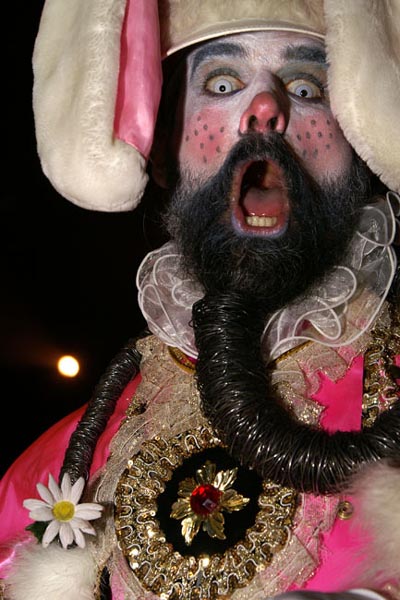
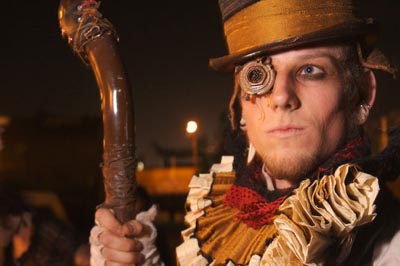
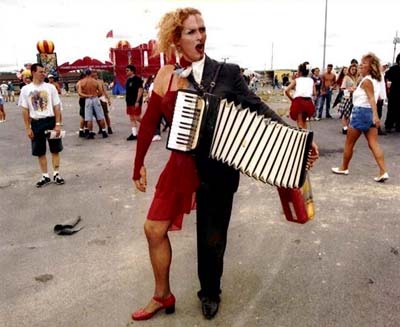
With Crash Worship warehouse roots in San Diego, an enclave of trendsetting troupes in LA, and benefiting from its colorful Bay Area yippie heritage, just about anything goes in this subterranean Cali carny set. Constantly touring, seat-of-the-pants caravans push themselves to the limits of physical and financial endurance, venturing into the fiery realms of SRL, the Crucible, Black Rock City and beyond. Warwoundsabound. This ain’t no Circe du Soleil. There is no safety net.
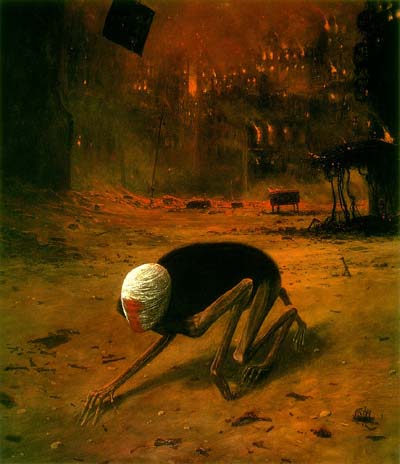
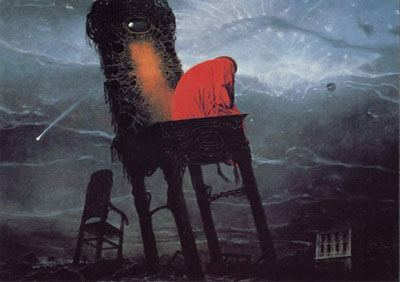
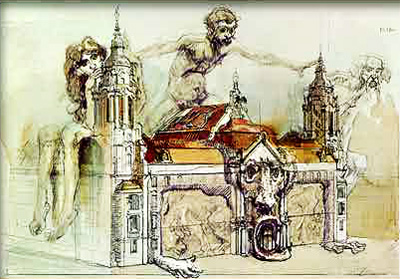
Artist Zdzislaw Beksiński is best known for his immense, obsessively detailed paintings of catastrophic landscapes, surreal humanoid figures and afflicted nudes. Born in 1929, he grew up in southern Poland, then traveled to Krakow to study architecture where he subsequently spent several miserable years working as a construction site supervisor. His work from that era is primarily photography and sculpture.
In his mid thirties, Beksiński shifted his focus to painting large, purely abstract pieces on wooden boards (he preferred wood to canvas). Eventually, their form and structure became more straightforward and he entered a self-proclaimed “fantastic period” reminiscent of Bruegel, Ernst or Bosch, and drawing comparisons to his Swiss contemporary, H.R. Giger.
Beksiński’s post-apocalyptic vision, much like Giger’s, is uniquely disturbing owing in part to a highly developed architectural eye. His manipulation of scale and manic overworking of texture is ingenious. Overwhelmingly huge structures rise up from dust or empty desert. Sinewy figures cavort under ominous skies.
Dee is an unknown superstar, casting songs like blessings… She is one of the most remarkable and unclassifiable artists I have ever encountered. Muse, manic, maniac, possessed by such beauty and pain, so intensely real and yet so mythical. Songster, trickster, breaker of hearts, with songs so cruel and kind that it leaves me spinning.
–David Tibet of Current 93
A gusty spring evening in Manhattan in the late 90s. It’s sort of dead in the East Village, not a lot of people out. I’m sitting at some sidewalk cafe nursing a hangover when I hear the distant wheeze of an accordion and this implacable, warbling voice. At first I figure it’s music on the cafe stereo so I don’t look up, but I’m thinking… who on earth does that vocalist remind me of? Mel Torme? Biff Rose? My great auntie? Such an oddly comforting sound. Gradually it dawns on me that the music is actually coming from up the street and getting louder. I finally look up from my cappuccino to see this wild-haired, cat-faced lady gliding up to the curb, perched 12 feet in the air on a custom-built tricycle with an enormous gilded harp lashed to the back.
She parks her trike next to a Harley Davidson, carefully dismounts with her accordion and croons a sad, sweetly funny song about a sailor… or a girl… a small crowd gathers, beaming her beatific smile back at her. At the end of her ditty she graciously curtsies, accepting coins and small bills from all of us, then gets back on her tricycle and pedals away, cackling insanely. She is an irresistible creature. The cheers and applause continue long after her waving form has disappeared around the corner.
Fast forward a couple of years. A band called Antony and the Johnsons is taking the city by storm, and I recognize the harpist by her contagious cackle. Her name is Baby Dee, and apparently she’s made it her life’s calling to charm the pantaloons off everyone she meets, including Will Oldham, Michael Gira, Marc Almond and David Tibet, the last of whom started releasing Dee’s solo albums on his record label Durtro a few years ago.
Guten Morgen. Or should I say, unhealthy Hallogallo…
No visual conveys the wide-eyed, wondering delight of NEU! quite as joyfully as this video.
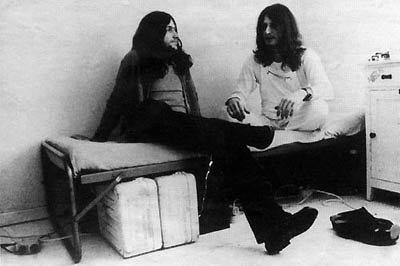
The music of this seminal Krautrock duo lives up to the name. How these songs have retained their aura of newness over the years is a mystery. For the briefest window in time, elements of glimmering psychedelic prog, robotic disco and thumping space rock coalesced and one of the most understated yet influential sounds in 20th century music was born.
NEU! formed in Düsseldorf, Germany, in 1971 after wunderkinds Michael Rother and Klaus Dinger split from a more well-known outfit called Kraftwerk. Their self-titled debut was recorded in four days (with Can producer Conrad Plank). An eye-blink later, NEU! had disbanded. Yet their influence on music spans multiple decades and genres. Everyone from Julian Cope to David Bowie to Sonic Youth to Negativland to Stereolab has cited the duo as an inspiration. As the above video attests, the love fest will undoubtedly continue well into this century.
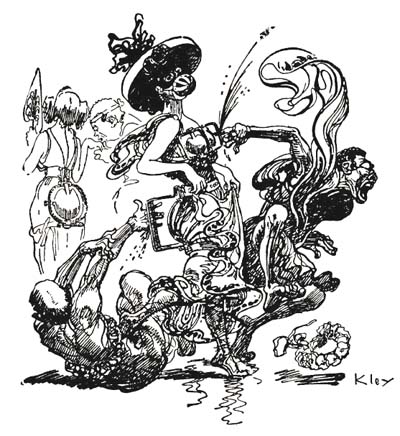
The greater the draftsman, the more the artist can suggest with the least number of pen strokes. He knows beforehand where each line will touch the paper and why. Each line and dot will convey large areas of figure or scene, and the true artist/draftsman can relate his imagination to the viewer. Add to this one other quality the rare attribute of satirical humor and you have one of the greatest draftsman of this century: Heinrich Kley. -Donald Weeks
It’s amusing that Heinrich Kley earned his college degree studying the “practical arts” when one considers the decidedly impractial nature of the artist’s most famous work. Although Kley’s technical prowess always set him apart, his early paintings of landscapes and still life subjects are nothing to write home about. It wasn’t until the turn of the 20th century –while Germany scrambled to catch up to the rest of the swiftly industrializing world– that Kley’s own work took some fascinating turns.
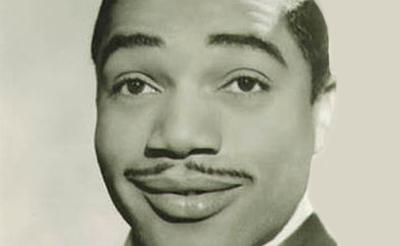
Proto-emcee Slim Gaillard, the great grandaddy of flow.
In 1941, a musical comedy farce called Hellzapoppin’ made the jump from stage to screen. It’s a very silly film (about a film within a play about a film), rather sanitized in comparison to the original anarchic revue (which featured little people, clowns, trained pigeons, and Hitler speaking in a Yiddish accent). There isn’t much of a plot and many of the jokes are corny even by 40s standards. The premise wasn’t nearly as successful on celluloid as it was on Broadway. Still, Hellzapoppin’ has two invaluable things going for it: an appearance by sainted Slim Gaillard, and the most impossibly freakin’ insanely amazing Lindy Hop dance sequence ever filmed, courtesy of a fearless troupe called Whitey’s Lindy Hoppers. Behold o’rootey:
“This is a new secret science, to master the emptiness and turn it into something that is filled with sound and visual images.”
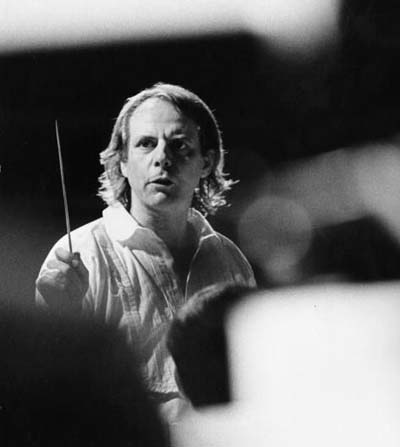
– Karlheinz Stockhausen Stockhausen has died, aged 79. Depending on who you talk to, he was either one of the most revered or reviled composers of the 20th century. A student of Olivier Messiaen with little interest in conventional “classical” modes of composition, Stockhausen’s sonic innovations range from the sublimely understated (Mantra, 1970) to the grandiose (Spiral, 1968) to the bombastic and beautifully absurd (Helikopter-Streichquartett, 1993).
Throughout his life, Stockhausen was obsessed with the concept of flight. As early as the 1950s, he was already discussing his desire to “liberate musicians from the constraints of gravity.” He even consulted with recording technicians to see if there was a way to harness performers in specially rigged chairs that could be swung through the studio on ropes. The aforementioned Helikopter Streichquartett was in many ways a culmination of his lifelong dream to see music truly take flight. Many people have said, will undoubtedly continue to say “I don’t get it.” Indeed, not long ago the entire world shouted in disbelief at the aging iconoclast when he dared to refer to the attacks on the World Trade Center as “the greatest work of art imaginable.”
Regardless, even Stockhausen’s harshest detractors can never argue that he was not a swashbuckling pioneer of sound and vision. A relentless seeker, he never allowed the circumscriptions of others to stand in his way. Somewhere in the expansive aleatory of the cosmos, an echo of Stockhausen’s voice speaks with more conviction than ever: “I no longer limit myself.”
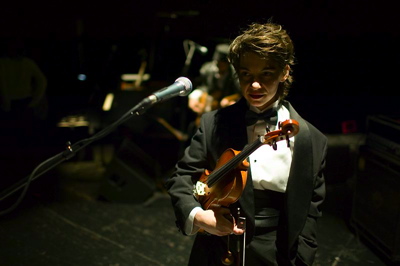
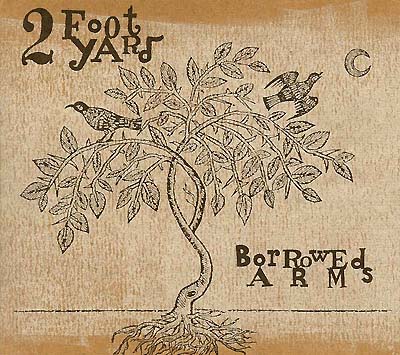
Musician Carla Kihlstedt never fails to astound me. She’s always got her nimble fingers stuck in multiple pies, all invariably delicious. Right now a Kihlstedt taste sensation I can’t get enough is 2 Foot Yard, her independently produced trio with cellist/vocalist Marika Hughes and multi-instrumentalist Shahzad Ismaily. Their new album is entitled Borrowed Arms and the title track is as scrumptious a slice of swingin’ dream pop as you’ll hear this year. Click over to 2 Foot Yard’s MySpace page and give it a listen. From their latest press release:
Borrowed Arms is scheduled to be released in the US on March 4th. Help us finish the CD by pre-ordering now and in return you will receive a signed copy in your hands before everyone else. Pre-ordered copies are available for a limited time.
In the spirit of community and paying it forward, we’ll be donating $.50 from every copy of Borrowed Arms sold in the US both to Food Change in Harlem, NYC and to the Canyon School organic gardening project in Canyon, CA to help promote community-based education and awareness of sustainable agriculture and nutrition as well as daily free meals to those in need.
These are people of the highest integrity. I love them dearly. Go say hello.
Speaking of the Rolling Stones, here’s a blast from the past that I haven’t been able to chase out of my head for days now, the version of “Satisfaction” cited as one of Mick Jagger’s favorite Stones covers:
It’s hard to believe Devo’s frenetic, herky jerky movements here aren’t a camera trick, but watch live footage from the same era and you realize yes, they really were that tightly wound.
Bless these guys for helping legions of spud children to survive pubescence with some shred of self esteem intact. While I wouldn’t put them in the “What Made Me Weird” category, they certainly helped me feel less awful for being weird. I still have an old Trapper Keeper lying around somewhere with the lyrics of “Through Being Cool” scrawled on it.
Devo’s alliance with the Church of the Subgenius made them cooler in my eyes than any football-throwing Homecoming King could ever hope to be. Their Men Who Make the Music collection of home videos amused the hell out of me back then, but today, some of those skits seem downright prescient, voicing concerns about the sinister manipulations of genetics, food and culture.
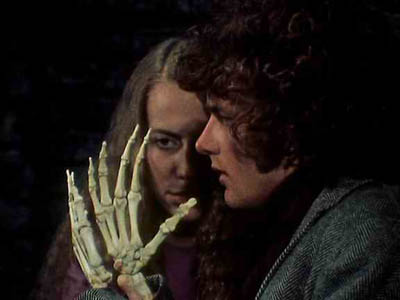
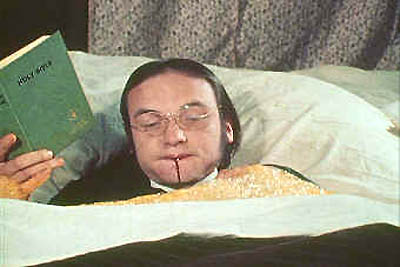
I’m not sure how to explain what makes Death Bed: The Bed That Eats so special, or if I should even try. I certainly didn’t know anything about the film when it was first recommended to me (by some hairy-palmed weirdo lurking near the Jess Rollin section of Kim’s in NYC a few years back). Completed in 1977, this “forgotten horror classic” was never officially released. Legend has it that director George Barry had no idea anyone had even seen the picture until he Googled himself and found a bunch of websites raving about it. After 25 years, Cult Epics finally put it out on DVD.
Death Bed is definitely rave-worthy, but again, I’m at a loss to explain why without taking away some of the mystique. Here’s the overview from Cult Epics:
“At the edge of a grand estate, near a crumbling old mansion lies a strange stone building with just a single room. In the room, a four-poster bed waits to absorb the flesh, blood and life essence of unwary travelers…”