Musician/filmmaker Joshua Zucker is one of very few folks whose tastes I trust implicitly. Episode 13 of his thematic Roadside Picnic podcast just went up. As always, it’s an astonishing mix of sounds and genres, lovingly and seamlessly compiled. Put on your best pair of headphones, and drift.
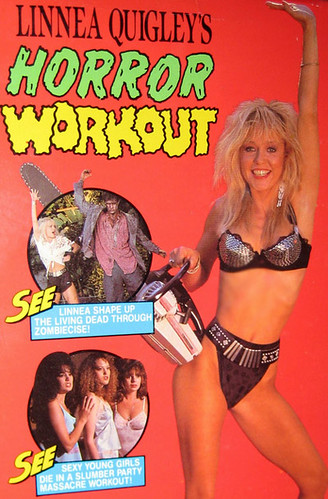
At this very moment, in my hot little hands, I hold a copy of 80s scream queen Linnea Quigley‘s ineffably rad “Horror Workout” video.
Much to the disappointment of B-movie fans everywhere, this pinnacle of home fitness instruction has yet to be made available on DVD. The VHS cassette sells for anywhere between 50 and 100 clams online.
Here’s a taste of what you’re missing…
EDIT 05/29/2009: Good news, boys and ghouls! You can now buy an autographed DVD-R of Linnea Quigley’s Horror Workout on the scream queen’s website, www.linneaquigley.net.
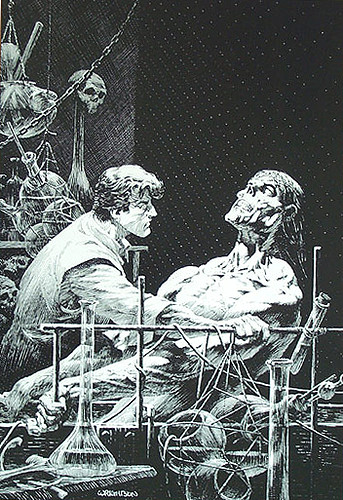
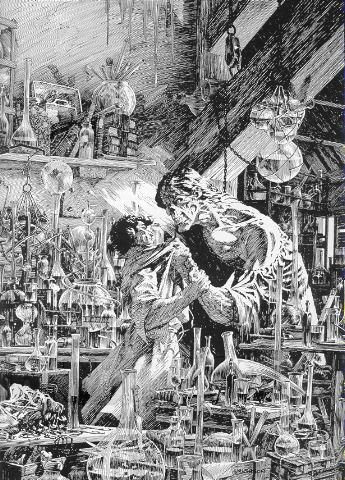
I met one of my heroes at the October Shadows gallery opening in Glendale last weekend: artist Bernie Wrightson. My boyfriend (who has a fantastic piece of his own the show) had to literally drag me over, I was so nervous. Thankfully, Wrightson and his wife Liz are kind-hearted folks, so they humored me.
The brilliant songwriter was fond of slathering himself in various forms of goop and leaping into his audiences, as well as “playing instruments with his head”, but apparently the world just wasn’t ready for that sort of thing back in 1982. Despite being a huge influence on later luminaries of the gothic/industrial movement, Fad Gadget remains relatively obscure.
Photo via Ben Heaney over at http://www.digitalviolin.com.
This was originally a guest-blog written several years ago at the request of my dear friend Warren Ellis, for Die Puny Humans (may it rest in peace). Now with visual aids!
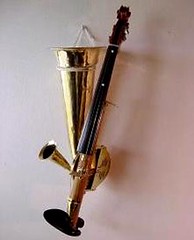
I have a new beau. Well, not so new. He’s probably quite a bit older than I am, actually. A big, brass Stroh violin, aka a phono-fiddle:
Photo via Ben Heaney over at http://www.digitalviolin.com.
The phono-fiddle is much louder than a conventional violin, but its timbre is thinner, with eerie phonographic overtones. Vibrations from the strings are conducted to the center of an aluminum disc that acts as a diaphragm (like a very old-fashioned amp), propelling the sound back out through the large horn and smaller ear trumpet.
Sometimes, the Stroh sounds like a human voice playing through a hand-cranked Victrola. Other times it sounds like a tenor saxophone gargling a cat…
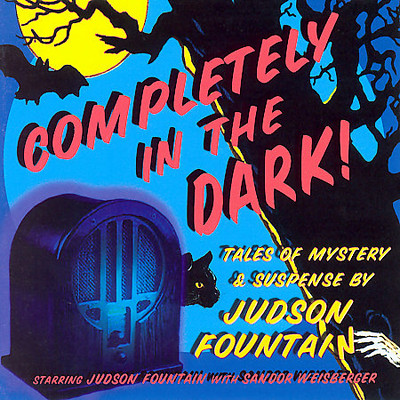
Much like cult legends Shooby Taylor, Lucia Pamela and Gary Wilson, Fountain’s warped genius would not have survived these long decades were it not for the feverish worship of bootleggers. By the time his priceless “radio drammers” were officially released on CD in 2004, Fountain had long-since gained icon status among lovers of outsider music, cartoonists, and (somewhat redundantly) WFMU DJs and listeners.
Judson Fountain (b. 1952) grew up after the heyday of classic radio theater, but as a child heard vestiges of programs that had enthralled his parents. He developed an obsession with suspense-filled shows like The Shadow, Inner Sanctum, and Lights Out! While most Americans were evolving into couch potatoes, Judson embraced radio as the superior theatrical medium, and felt compelled to single-handedly revive the art. That he lacked training, technology, skilled staff and a budget did not deter him. Ed Wood, Jr. made movies; Judson produced radio dramas.
Judson was between 17 and 22 when he produced these extremely primitive affairs. His simple, derivative plotlines employ Halloween kitsch — spooks, witches, haunted houses — as vehicles in morality plays about redemption for the honorable and damnation for evil-doers. The original recordings were pressed on LPs (reportedly about 200 copies of each). The jackets were hand-made, with grainy xeroxes pasted on otherwise blank cardboard sleeves.
Their limited edition CD (produced by foremost outsider musicologist Irwin Chusid and Barbara Economon) is itself growing difficult to score. But you can still grab the tracks off emusic, bless ’em.
Honestly, I hadn’t been missing NYC at all since I moved out west last May. Then the autumn equinox hit. Ever since, I’ve been aching to take a long bike ride through the fiery foliage of Prospect Park.
Gordon and Morrison previously worked together on Morrison’s full length movie Decasia. Both pieces build around a very simple premise; film is a fragile medium. Nearly all of that old nitrate-based film stock is too grimy and scratched, rotting and stinking of vinegar to be of much use to film preservationists. Morrison salvaged 70 minutes of archival footage from someone’s rubbish bin, stitched it together and re-shot film that showed decay or was actively decaying, frame-by-frame, using an optical printer.
The cumulative effect is breathtaking, and for reasons that are difficult to articulate, will always remind me of New York in the fall.
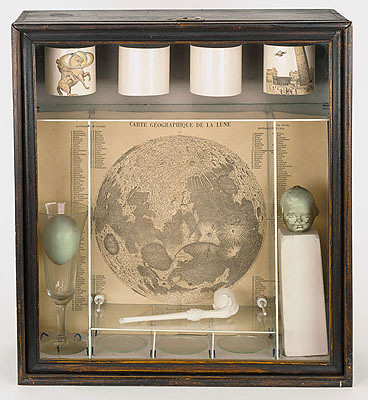
Soap Bubble Box, originally uploaded by Coilhouse.
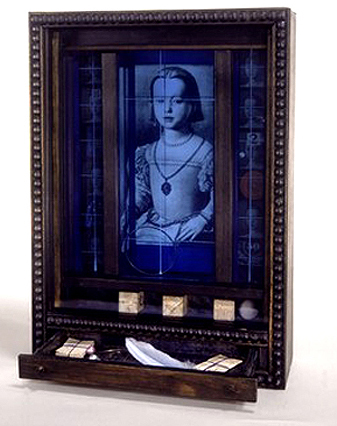
The magical curio cabinets and collages of Joseph Cornell make me pine for a Manhattan I never knew, for all things mildewed, dusty and indigo-hued, for faded starlets and forgotten prima ballerinas, and for constellations I have never seen.
Born towards the end of the Victorian era in upstate NY, reclusive Cornell never ventured any further than New England, but his body of work reveals an inner world of incalcuable depth. Inspired in equal parts by the penny arcades of his youth and the grandiose vision of the Dada/Surrealists, Cornell spent a lonely lifetime trawling L.E.S. flea markets and secondhand bookstores for nostalgic scraps of yesteryear. Whatever the medium (diorama, film collage, decoupage), each piece reflects the inexorable drive of a compulsive scavenger/architect to coax meaning and narrative –however mysterious– from discarded scraps of the past.
And now it’s time for a joyous yodel (erm, sorry) shout out to a dear sister in Lucerne, Mlle Susanne G., a young lady who has officially been keeping it weird on the web since 2003. Unofficially? Much longer than that. In fact, we first found one another on deadjournal (of all the godforsaken places!) maaaany, many moons ago. Like, a moon in the nineties. *gasp*
Her blog compendium, Wurzeltod, is one of my absolute favorite nooks on the net, “a drawer full of all things weird, grotesque, bitter-sweet, embalmed and fortean. Brought to you by Suzanne – the eternal art history student.” You’ll laugh, you’ll cry… occasionally you’ll gag. It’s bliss.
So go for the gas masks, stay for the marzipan, and tell her Coilhouse sent ye.
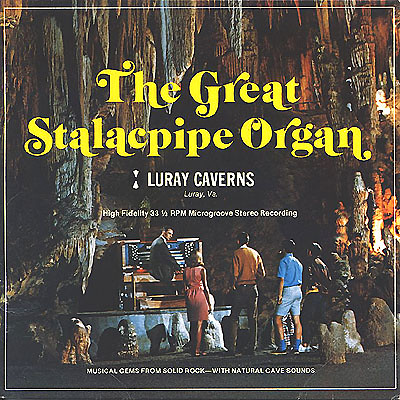
Hats off to Mr. Leland Sprinkle, inventor of the world’s largest musical instrument, the one-of-a-kind Stalacpipe Organ. Located deep in the bowels of Luray Caverns in Virginia’s Shenandoah Valley, its 3 1/2 acres of cavern stalactites produce resonant tones when electronically tapped by rubber-tipped mallets rigged to a large organ console in a centralized chamber.
Sprinkle, a mathematician and electronics whiz employed at the Pentagon, began his colossal project in 1954. For three years, he prowled the caverns with lamp and mallet, tapping thousands of stalactites in search of formations that would precisely match each of the 37 tones needed for a musical scale tuned to concert pitch. After this was accomplished, two master carpenters, Loyd Almarode and Richard Beaver, were brought in to build the beautiful inner and outer consoles of the organ itself.
I first heard the haunting, unpredictable music of Luray Caverns several years ago on a mix tape and had no idea what was producing it. Later on, the wonderful radio station WFMUdevoted a segment to the invention. Everyone I know who has experienced the Stalacpipe Organ in person says no recording –not even one using the most fancypants binaural mic in the world– could ever compare to the live experience. I gotta get out there someday SOON. Road trip, anyone?